A report published this week shows that AI lobbyists have had an huge and unequal access to government over the last two years compared to any others. 84% of ministerial stakeholder meetings on data centres were with business or private-sector trade associations whereas ministers met with no environmental NGOs and not a single community group prior to designation of an AI Growth Zone.
The report comes as questions remain about the protections for water, energy and climate impacts contained in Chancellor John Healey’s announcement of a data centre covenant which was broadly welcomed by the AI industry in a context of escalating opposition to data centres across the UK.
Rachel MiIlward, deputy leader of the Green Party of England and Wales. CC image.
Rachel Millward, Green Party Deputy Leader said:
“Labour is diving headfirst into AI without a roadmap, charmed by corporate lobbyists while community and green voices are shut out. We need to slam the brakes on new data centres before they drain our water supplies and wreck the UK’s carbon budget.
“When policy is written by corporations, decisions benefit shareholder profits rather than the public good. It’s a dangerous lack of oversight, proven by a recent FOI showing the government doesn’t even know what current data centres are being used for.”
Report authors Spotlight on Corruption also highlight that not a single environmental group sits on the government’s AI Energy Council even though the group has a mandate “to support the use of sustainable energy to power AI” and that the group met only once in the 17 months from its establishment in January 2025 to July 2026.
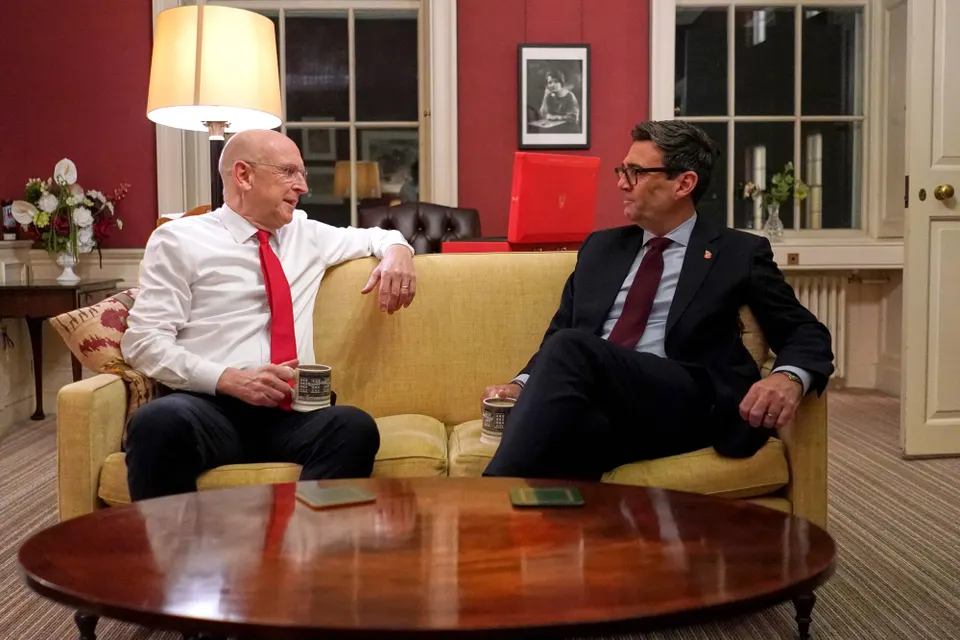
PM Andy Burnham and chancellor John Healey meet at 11 Downing Street ahead of the budget. Alberto Pezzali – WPA Pool / Getty Images
Mild bank levies and one-off handouts won’t undo decades of damage to places like Makerfield
Having spent 30 years as a Labour MP, I have long argued that tinkering around the edges with the UK’s badly skewed economy simply will not do. Andy Burnham seemed to agree when campaigning in the Makerfield by-election in June.
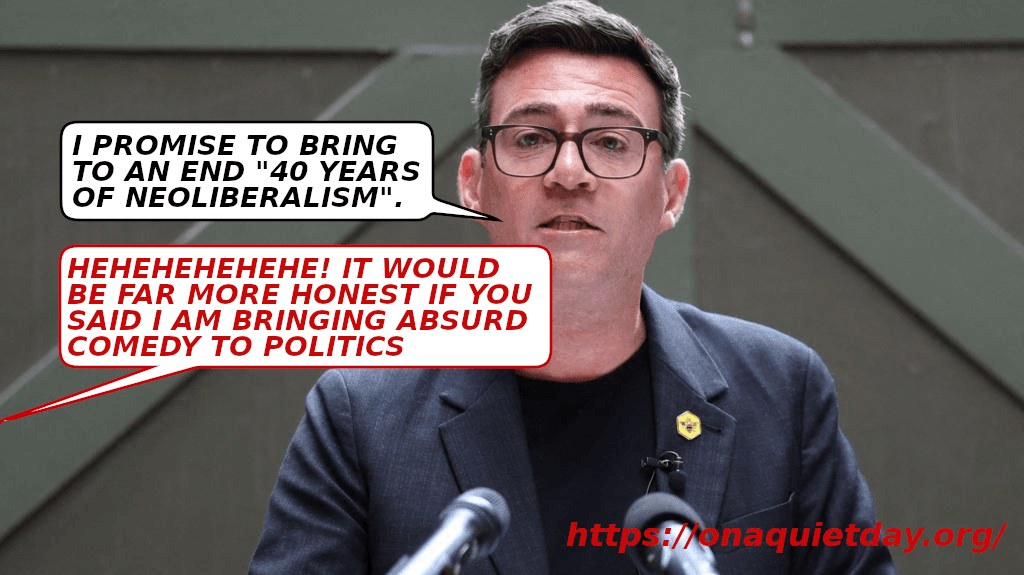
Back then, Burnham promised a new direction, a break with neoliberalism and the hope of a better future. He seemed to understand that the country needed a rupture with the status quo in order to address the underlying economic, political and social malaise.
Within weeks of winning his seat, he became Labour leader and entered Number 10 without a contest, meaning there was no real space to interrogate his political programme. The Labour Party and the country took him at his word, because we had to.
The Budget, then, is the first time Burnham’s vision has been properly tested. We should judge it by a ‘Makerfield test’: if the policies unveiled do not work for his constituency, or constituencies like it, they do not work at all. And by that measure, the Budget has failed.
Chancellor John Healey said he would secure growth in every postcode. A £100 one-off energy payment is very welcome, but the energy sector has been ripping consumers off for a generation, while retail giants take advantage of their market power by driving up the cost of groceries. If we really want to help people in every area of the country, why not take on the privatised monopolies directly, not with a few more rules, but with proper public ownership?
Finding additional money for defence is an inevitable choice for a chancellor who helped precipitate Keir Starmer’s downfall by resigning as defence secretary. But the defence industries are concentrated in a small number of regions and will do little in terms of growth for the large part of the country.
Healey has delivered a Budget within the same fiscal constraints as his predecessors, one that simply does not shake off the cloying grip of neoliberal ideology, Treasury orthodoxy, and the usual vested interests lobbying the government. If the chancellor cannot deliver radical change at a macro-economic level, the only option is to tinker around the edges with micro-economic policy. But that strategy simply doesn’t transform the country in the way Burnham promised Makerfield, and Britain, he would.
What is clear is that over-reliance on official institutions, which Burnham has spoken strongly against, has produced a Budget that is at best mildly progressive.
Of course, there are good things in the Budget. Healey’s pledge that every penny of the Miners’ Pension Fund will go to miners was welcome, but it should never have been in doubt – and questions still remain over when and how that will happen.
It is also welcome that the chancellor has recognised the need for “breathing room” from the cost of living crisis, especially with a 6% levy on banks’ profits above £100m. But the truth is that this levy is less than it ought to be, and will apply for only 15 months. It does not go far enough at a time when banks make billions in super profits as many struggle.
NHS founder Nye Bevan once said socialism is a language of priorities, a mantra that any Labour chancellor should heed in a Budget. That’s why it is disappointing that the chancellor is pushing ahead with plans to abandon the pensions triple lock, a move projected to save £15bn a year, while ignoring policies such as equalising capital gains tax, which could raise over £19bn a year by 2030. Britain doesn’t have to choose between offering a decent pension and decent care. We can, and should, provide both.
The country needs to fundamentally rupture with the neoliberal status quo. In recent decades, the government has ceded control of the main economic levers to the Treasury, the Bank of England and the Office for Budget Responsibility, making it difficult for any government to intervene adequately in the economy.
Indeed, the UK’s institutions have been colonised by neoliberalism. We have witnessed a long history of catastrophic forecasting failures due to Whitehall orthodoxy: from Denis Healey’s misjudged swingeing cuts in the 1976 IMF crisis to joining the European Exchange Rate Mechanism in 1990 and exiting two years later on Black Wednesday, the promotion of austerity over much of the past two decades, the blind eye turned to deindustrialisation, and most recently, the miscalculations of the Truss Budget.
Burnham previously criticised our central institutions, arguing that top-down neoliberal economics doesn’t work. Why, then, expect the country to continue to accept the Treasury’s orthodoxy?
His government has spoken a lot about a “radical rewiring” of the state to restore democratic control. But the Budget was always touted as a ‘safety first’ fiscal event, with the promise that a 10-year plan is on its way to address the underlying crises in our economy. My concern is that putting off big decisions until next year’s Spending Review, as the chancellor has said he is doing, suggests potential cuts down the line.
The truth is, the UK’s economy is still constrained by tight fiscal rules, which will not deliver the urgent changes needed, especially for communities such as those in Makerfield. Indeed, I would advise that the chancellor needs to be careful to avoid the accusation that he is starting to look a lot like his much-criticised predecessor, Rachel Reeves.
This work by Middle East Monitor is licensed under a Creative Commons Attribution-NonCommercial-ShareAlike 4.0 International License.
Gadi Eisenkot, leader of the Yashar Party and former IDF Chief of General Staff, delivers a speech at the party headquarters in Tel Aviv, Israel, on October 28, 2026. [Nir Keidar – Anadolu Agency]
Israeli opposition leader Gadi Eisenkot on Thursday [accused] Prime Minister Benjamin Netanyahu of seeking to delay the announcement of election results and undermine the legitimacy of the incoming Knesset, as complaints of foreign interference in the vote triggered a political dispute, Anadolu reports.
In a statement, Eisenkot accused Netanyahu and his allies of carrying out an “improper influence operation” aimed at delaying the results beyond their scheduled announcement and creating pretexts to delegate the work of the incoming Knesset.
He also called for a “comprehensive, immediate and impartial investigation” into suspected “foreign interference.”
The dispute followed a letter sent Thursday by Judge Noam Sohlberg, the chair of Israel’s election committee, to Shin Bet security agency chief David Zini asking him to investigate “serious suspicions” of “hostile” foreign influence on the election in favor of Arab parties, Haaretz daily reported.
Netanyahu’s Likud party seized on the request, saying no Zionist party should cooperate with the United Arab List or the Joint List, the two Arab parties.
“Following the exposure of attempts by foreign entities to take over the Knesset, no Zionist party may cooperate with the United Arab List or the Joint List,” the party said in a statement.
Likud also said Knesset Speaker Amir Ohana, a member of the party, should not be replaced by votes “bought with money,” and that no government posing a danger to Israel should be formed.
Eisenkot said foreign interference was “unacceptable and extremely serious,” particularly when it involves a country that “funds and supports Hamas,” echoing complaints concerning Qatar.
Doha has repeatedly said its aid is directed to Palestinians in the Gaza Strip and is provided with the knowledge of Israel and the UN.
Eisenkot also accused Netanyahu of responding to political developments with “lies, manipulation of public opinion, and the spread of chaos.”
With all regular ballots counted, Netanyahu’s bloc had secured 53 seats, compared to 48 for the opposition bloc led by Eisenkot, while Arab parties won a combined 19 seats.
Neither main bloc reached the 61 seats needed for a majority in the 120-member Knesset, leaving Arab judges potentially pivotal in efforts to form a government.
The new Knesset is expected to be sworn in on Nov. 10, while the official election results are due to be announced next Wednesday.
Donald Trump calls for help from NATO allies in securing the Strait of Hormuz despite saying on 7 March 2026 that they don’t need people to join wars after they’ve already won. He’s challenged with the claim that he lies as much as the IDF.
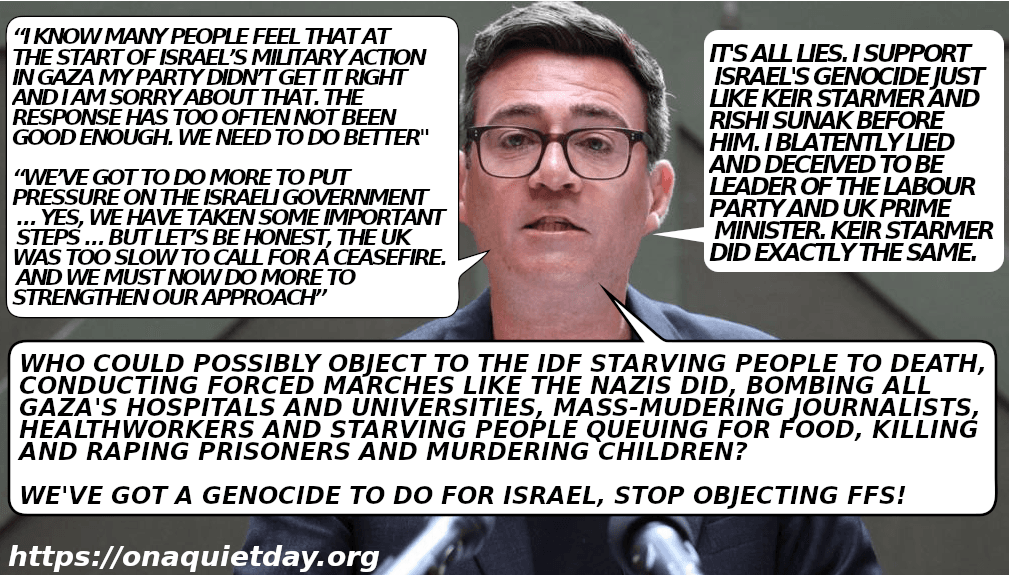
UK Prime Minister Andy Burnham admits to blatently lying and engaging in deception to become leader of the UK Labour Party and Prime Minister. He asks who could possibly object to the IDF starving people to death, conducting forced marches like the Nazis did, bombing all Gaza’s hospitals and universities, mass-murdering journalists, healthworkers and starving people queuing for food, killing and raping prisoners and murdering children. He says they’ve got a genocide to do for Israel and to stop objectingEd Miliband says that he and the Labour Party are full of shit criminalising people holding signs as terrorists despite anything he says.
This work by Middle East Monitor is licensed under a Creative Commons Attribution-NonCommercial-ShareAlike 4.0 International License.
President of Iran Masoud Pezeshkian at the plenary session of the 8th Summit of the Gas Exporting Countries Forum in Moscow, Russia on October 27, 2026. [Kirill Zykov / 8th GECF summit – Anadolu Agency]
Countries in the region are capable of ensuring their own security through cooperation without US involvement, said Iran’s president on Thursday, Anadolu reports.
Speaking at an event marking a local holiday, Masoud Pezeshkian addressed regional issues and called for closer cooperation among neighboring countries, according to a statement from the Iranian presidency.
“We are brothers with all the countries around us, and we are all Muslims. Therefore, we can help one another and ensure the security of our region,” he said.
“Regional countries do not need the US to come from the other side of the world under the pretext of providing security,” Pezeshkian said.
He also criticized Washington’s military spending and accused the US of committing violations while presenting its presence as necessary for regional security.
The remarks come amid continued tensions between Tehran and Washington following the start of the current conflict on Feb. 28, when the US and Israel launched attacks on Iran and Tehran responded by targeting Israel and what it said were US positions in Arab countries.
Washington and Tehran on June 18 signed a framework agreement and subsequently began negotiations, but the talks later collapsed over differences concerning freedom and security of navigation in the Strait of Hormuz, a key route for global energy and goods shipments.
Donald Trump calls for help from NATO allies in securing the Strait of Hormuz despite saying on 7 March 2026 that they don’t need people to join wars after they’ve already won. He’s challenged with the claim that he lies as much as the IDF.
UK Prime Minister Andy Burnham admits to blatently lying and engaging in deception to become leader of the UK Labour Party and Prime Minister. He asks who could possibly object to the IDF starving people to death, conducting forced marches like the Nazis did, bombing all Gaza’s hospitals and universities, mass-murdering journalists, healthworkers and starving people queuing for food, killing and raping prisoners and murdering children. He says they’ve got a genocide to do for Israel and to stop objectingEd Miliband says that he and the Labour Party are full of shit criminalising people holding signs as terrorists despite anything he says.
Former Chief of General Staff and leader of the Yashar party, Gadi Eisenkot holds an election rally ahead of Israeli parliamentary (Knesset) elections in Tel Aviv, Israel, on October 25, 2026. [Saeed Qaq – Anadolu Agency]
In the past, many Palestinians and Arabs followed Israeli elections closely. They did so not because they entertained illusions that a Zionist leader would deliver peace and justice, dismantle the occupation or remove illegal settlements. Rather, they feared that some Israeli leaders were worse than others. They hoped to avert the worst-case scenario.
Over time, however, that distinction gave way to the belief that all Israeli leaders were essentially the same. This is not pessimism. It is experience.
Consider, for example, the expansion of illegal Jewish settlements during the Oslo peace process under Israeli Prime Minister Yitzhak Rabin.
Between 1992 and 1995, the number of Israeli settlers in the West Bank, excluding East Jerusalem, increased from 111,673 to 140,235 – a rise of more than 25 per cent, according to the Palestinian Central Bureau of Statistics (PCBS), drawing on Israeli statistical records.
The same pattern continued under the Labour government of Prime Minister Ehud Barak.
Within his first six months, Barak’s government issued tenders for 3,196 settlement housing units, exceeding the annual average under his right-wing predecessor, Benjamin Netanyahu.
When Naftali Bennett formed a coalition government in June 2021 that included the Arab party Ra’am, settlement expansion continued unabated.
According to the Israeli settlement watchdog Peace Now, the Bennett–Lapid government advanced plans for 7,292 settlement housing units during its first year, a 26 per cent increase over the annual average recorded under previous Netanyahu governments.
The settlements are themselves a driving force behind the occupation. They require land, and therefore land confiscation; protection, and therefore an expanded military presence; water, roads and infrastructure, and therefore the appropriation of Palestinian resources. Together, these elements deepen dispossession and generate further Israeli violence.
According to the PCBS, the West Bank contained 645 Israeli settlement sites, outposts and other occupation installations by the end of 2025, including 350 settlement outposts.
The Palestinian Colonization and Wall Resistance Commission, a Palestinian Authority body, reported that Israeli authorities targeted approximately 29,335 dunums of Palestinian land through declarations of so-called “state land” between October 2023 and August 2026 – one of the largest waves of such land appropriation since Oslo.
By September 2026, the Commission had also documented the advancement or consideration of plans for more than 18,000 additional settlement housing units across the West Bank and occupied East Jerusalem.
By the end of 2023, the West Bank had experienced its deadliest year for Palestinians since the UN began systematically recording casualties in 2005.
The Colonization and Wall Resistance Commission documented 23,827 attacks by Israeli forces and settlers against Palestinians and their property during 2025 alone. In the first seven months of 2026, settler attacks increased by 63 per cent compared with the corresponding period of the previous year.
Typically, this violence, carried out by the Israeli occupation army and armed illegal settlers, is contextualised within the ongoing genocide in Gaza. But violence in the West Bank also serves another purpose beyond collective punishment: the confiscation of Palestinian orchards, the annexation of land, the expansion of settlements and the crushing of Palestinian resistance, including non-violent opposition to this colonial enterprise.
Any Israeli candidate in the 27 October elections who supports settlement expansion does so with full knowledge of its consequences: further dispossession, military occupation, annexation and violence.
The difference between Prime Minister Benjamin Netanyahu, Finance Minister Bezalel Smotrich and National Security Minister Itamar Ben-Gvir, and politicians presented as less extreme, is often one of language, strategy and timing.
Former Israeli military chief and Yashar party leader Gadi Eisenkot, for example, openly supports the expansion of Israeli settlements in the occupied West Bank, despite his reputation as a more “moderate” alternative to Netanyahu.
Who among Israel’s leading political figures is promising to end the genocide, lift the siege, ensure unrestricted humanitarian aid, restrain the army or investigate violations of international law? None.
Israeli media have spent the past three years reporting on major disagreements between the government, military establishment, intelligence agencies and political opposition over what should happen in Gaza.
Yet Eisenkot has pledged to end Hamas’s rule in Gaza within 18 months of taking office, whether through US President Donald Trump’s framework or through continued war.
For his part, Yesh Atid leader and former Prime Minister Yair Lapid has proposed placing Gaza under Egyptian administration for up to 15 years, effectively shifting responsibility for Israel’s actions onto Arab states.
Former Prime Minister Naftali Bennett, meanwhile, supports continued Israeli military control until Palestinian groups are disarmed.
The disagreement, therefore, is often over how Israel should achieve its objectives, rather than whether those objectives should change.
Other major disagreements primarily concern Israeli society: the conscription of ultra-Orthodox Jews, judicial reform and accountability for the failures of 7 October.
But these disputes should not be confused with the questions that matter most to Palestinians.
If Netanyahu succeeds in forming another right-wing coalition, the policies of occupation, settlement expansion and military confrontation will continue, potentially with renewed momentum.
If Israel produces a broader coalition, its members may reach compromises over judicial reform, conscription and other domestic disputes. The occupation, however, is unlikely to become the central point of disagreement.
More troubling still, even a government leaning towards the centre-left might succeed in presenting Israel to the international community as a country ready to move beyond the image it acquired during three years of genocide, without fundamentally changing its conduct on the ground.
The international community must therefore remain vigilant. It cannot allow a future Israeli government to present itself as a peacemaker, or sell the illusion of a newly reformed Israel, while continuing to invest in settlements, occupation, war and genocide.
The views expressed in this article belong to the author and do not necessarily reflect the editorial policy of Middle East Monitor.
This work by Middle East Monitor is licensed under a Creative Commons Attribution-NonCommercial-ShareAlike 4.0 International License.
Donald Trump calls for help from NATO allies in securing the Strait of Hormuz despite saying on 7 March 2026 that they don’t need people to join wars after they’ve already won. He’s challenged with the claim that he lies as much as the IDF.
UK Prime Minister Andy Burnham admits to blatently lying and engaging in deception to become leader of the UK Labour Party and Prime Minister. He asks who could possibly object to the IDF starving people to death, conducting forced marches like the Nazis did, bombing all Gaza’s hospitals and universities, mass-murdering journalists, healthworkers and starving people queuing for food, killing and raping prisoners and murdering children. He says they’ve got a genocide to do for Israel and to stop objectingEd Miliband says that he and the Labour Party are full of shit criminalising people holding signs as terrorists despite anything he says.