Category: new authoritarianism

  • For US Commentators on Iran, Mass Murder Is Magic

    Spread the love

    Article by Gregory Shupak republished from FAIR under http://creativecommons.org/licenses/by-nc-nd/3.0/

    In the wake of the temporary US/Iran ceasefire, hawkish commentary in leading American newspapers advanced the premise that the US can dictate terms to Iran in negotiations, with a faith in the power of Washington’s military might that was hard to justify by the previous course of the war.

    A Washington Post editorial (4/8/26) contended:

    Despite the massive damage inflicted upon the country by the US in recent weeks, the regime acts like it holds the cards. Its leaders are demanding the US pull all troops out of the Middle East and accept Iran’s right to pursue nuclear weapons. The question is why Trump would bend over backward to keep obviously unserious talks on track.

    Whether the Post likes it or not, Iran has a decent hand to play. For instance, Iranian drones cost just $20,000 to produce, and the US uses missiles that cost $4 million each to try and destroy them (Bloomberg, 3/2/26). Less than three weeks into the war, the US was already estimated to have spent more than $18 billion attacking Iran (Guardian, 3/19/26). The longer Iran can hold out, the more it financially bleeds the US.

    The majority of Americans already consistently oppose the war (NBC News, 4/1/26) and, as costs spiral, domestic opposition to the US’s assault is likely to grow. In this context, the paper may need to revise its definition of seriousness to include accepting that Iran has the power to resist US bullying and bluster.

    ‘More work to degrade’
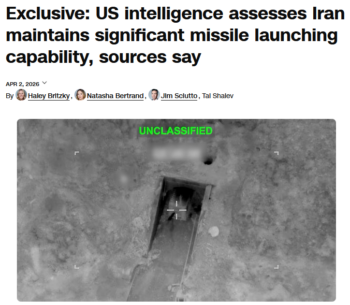
    CNN: US intelligence assesses Iran maintains significant missile launching capability, sources say

    An intelligence source tells CNN (4/2/26) that Iran is “still very much poised to wreak absolute havoc throughout the entire region.”

    The Washington Post editorial also said that there “is still more work to be done to degrade Iran’s offensive capabilities and its capacity to rebuild them.” “Offensive” here is a propaganda term, as Iran has not launched an aggressive war in nearly two centuries—unlike the United States and Israel, which have attacked Iran twice in the last year.

    By reversing victim and offender, the Post was transparently calling for the US to resume bombing Iran; after all, it’s through war that one country “degrades” another’s military capacity. But it’s not that the US and Israel didn’t try to destroy Iranian capabilities; rather, they tried and have not succeeded.

    Less than a week before the ceasefire, a CNN report (4/2/26) said US intelligence had assessed that

    roughly half of Iran’s missile launchers are still intact and thousands of one-way attack drones remain in Iran’s arsenal, despite the daily pounding by US and Israeli strikes against military targets over the past five weeks….

    The intelligence, compiled in recent days, also showed a large percentage of Iran’s coastal defense cruise missiles were intact, the sources said, consistent with the US not focusing its air campaign on coastal military assets, though they have been hitting ships. Those missiles serve as a key capability allowing Iran to threaten shipping traffic in the Strait of Hormuz.

    Iran retained that capacity despite the US hitting more than 12,300 targets in Iran, according to US Central Command. Israel, for its part, said it had dropped 15,000 bombs on Iran since February 28 (Jerusalem Post, 3/25/26).

    The Post offered no insight into why it believes the US/Israeli assault will suddenly become more effective.

    ‘Finish the job’

    WSJ: Trump Declares Premature Victory in Iran

    “If the [Iranian] regime behaves as it always has, it will claim to want to reach a deal but never will,” the Wall Street Journal (4/8/26) writes—stuffing the 2015 Iran nuclear agreement down the memory hole.A Wall StreetJournal editorial (4/8/26) echoed the Post, writing that “the Iranian regime remains a threat in the Strait of Hormuz and the job is far from finished.” The Journal insisted that the US should restart the war if it doesn’t get its way:

    The next test for Mr. Trump will be whether he takes his two-week ceasefire deadline seriously. If he does, and Iran plays its usual games, then he really will have to “finish the job.”

    Such calls overlook the limits to US war-making capacity. Analysts at Colorado’s Payne Institute for Public Policy, cited by the Australian Broadcasting Corporation (4/1/26), “assessed that the US had lost nearly 46% of its Army Tactical Missile Systems (ATACMS),” one of the US’s main tactical ballistic weapons. Likewise, they estimated that

    supplies of Terminal High Altitude Area Defense (THAAD) missile systems, used by the US and its partners in the region to defend against Iranian missiles, were also dropping significantly. Projections showed the THAAD interceptors could run out by mid-April.

    The US also burned through 850 Tomahawk cruise missiles in the war’s first four weeks, “a rate that has alarmed some Pentagon officials” (Washington Post, 3/27/26). Meanwhile, the Arrow 2 and Arrow 3 interceptors that Israel used against Iran’s longer-range missiles “were also projected to be exhausted by the end of March” (Australian Broadcasting Corporation, 4/1/26). Unlike the Journal’s lust for violence, the US/Israeli arsenal is finite.

    ‘Circle of death’
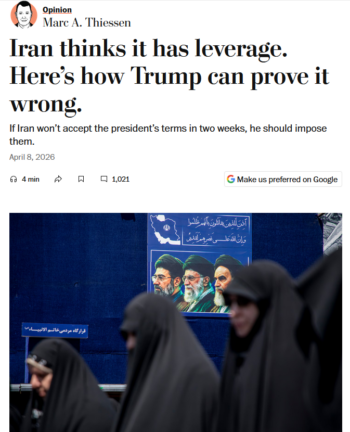
    WaPo: Iran thinks it has leverage. Here’s how Trump can prove it wrong.

    Marc Thiessen (Washington Post, 4/8/26) asserts that Trump can “bring the war to a final and decisive conclusion…in a matter of weeks”—disregarding the fact that nearly six weeks of all-out war were far from decisive.

    Nor did these constraints prevent the Washington Post‘s Marc A. Thiessen (4/8/26) from calling on Trump to create a “circle of death” around any former nuclear sites in Iran, and enforce it by “killing any Iranian who enters that circle.” He also suggested another round of assassinations, “eliminating the Iranian officials who had been spared for the purpose of negotiations,” so that the country’s leaders understand that if they fail to reach “a negotiated settlement to Trump’s liking…they will be killed.”

    Murderous fantasies about the US imposing total domination over Iran are perhaps a symptom of the US being unable to do so in reality. As Thiessen’s own paper (4/3/26) reported, despite the US/Israeli assassinations of high-ranking Iranian officials,

    Iran has continued to launch retaliatory attacks, often hitting high-value targets, demonstrating sustained command and control beyond the conflict’s initial days when units largely operated on autopilot under Iran’s “mosaic” defense strategy, which emphasizes decentralized autonomy. In recent weeks, Iranian attacks have struck critical energy infrastructure in the Persian Gulf, industrial and energy sites in Israel, and key US military installations, including a direct strike on an advanced US spy plane.

    In other words, decapitating the Iranian government hasn’t caused it to capitulate or prevented it from responding to US/Israeli attacks, but Thiessen—for reasons he did not explain—thinks that doing the same thing again will produce a different result.

    Thiessen also said that the US should

    develop and implement a covert action plan to support the Iranian opposition…. Such a plan could involve supplying the Iranian opposition with weapons, much as the US once provided arms to anti-Communist “freedom fighters” across the world.

    The overriding goal should be to help the Iranian people, over time, bring down this murderous regime.

    Set aside that this plan would violate the UN Charter’s principle of nonintervention and that the US has zero right to shape who governs Iran. In reality, multiple US intelligence reports conclude that Iran’s government “is not in danger” of falling (Reuters, 3/11/26). Israeli officials also think that Iran’s government “isn’t likely to fall soon” (Wall Street Journal, 3/12/26).

    While there’s little reason to believe that Thiessen’s proposal would produce regime change in Iran, we can be fairly confident that flooding Iran with weapons will have the same outcome that flooding countries with arms generally has—namely, a devastating bloodbath for its inhabitants (Electronic Intifada, 3/16/17; Jacobin, 9/11/21).

    ‘The easiest method’

    NYT: How Trump Can Wrap Up the War

    Bret Stephens (New York Times, 4/14/26) advises Trump to “keep turning the screws on the regime’s leaders”—a torture metaphor from an advocate of actual torture.

    Bret Stephens of the New York Times (4/14/26) likewise wrote from an alternate reality where the war showed that the US can impose its will on Iran. Stephens opened by quoting his own piece (4/7/26) from the previous week :

    “The easiest method for the United States to reopen Hormuz,” I wrote last Tuesday, “is to start seizing tankers carrying Iranian crude once they reach the Arabian Sea.”

    It’s not clear why Stephens thought seizing Iranian ships would cause Iran to back down. After all, assassinating many of the country’s leaders, attacking Iranian health facilities (Al Jazeera, 4/3/26) and vital civilian infrastructure (BBC, 3/19/26), and mass-murdering Iranian school girls (Guardian, 3/3/26) did not compel the country to stop defending itself.

    Stephens went on to contend:

    Trump should put Iran’s regime to a fundamental choice: It can have an economy. Or the regime can attempt to have a nuclear program while trying to control the Strait of Hormuz. But it can’t have both.

    This quote suggests Stephens was unwilling to seriously grapple with Iran’s retaliatory power. For example, Iran has consistently responded to US aggression by attacking the empire’s regional nodes, killing Israelis (BBC, 3/1/26; Reuters, 4/6/26) and badly damaging Israeli infrastructure (Al Jazeera, 3/21/26).

    Iranian countermeasures have likewise hit energy infrastructure in the US’s client states in the Gulf, leading—for example—to fires at Kuwaiti oil and petrochemical facilities, at a petrochemical plant in the UAE and at a storage tank in Bahrain (AFP, 4/5/26). In other words, Iran has illustrated that it has a multitude of options for raising the costs of US violence, indicating it would likely continue exercising these in the scenario Stephens advocates.

    ‘Broke the petrodollar’
    Bloomberg: The Iran War Just Broke the Petrodollar

    Aaron Brown (Bloomberg, 4/6/26) notes that while investment generally flows into the US Treasury in times of crisis, “the calculus changes when the US itself is the belligerent.”

    None of these commentators acknowledge what is likely the strongest blow that Iran has landed against the US. The Islamic Republic has undermined what’s called the petrodollar regime, a system in which the US promises to militarily protect the Gulf monarchies in exchange for these states putting money they earn from oil sales into US assets—most notably Treasury bonds. The arrangement, which has been in place since 1974, subsidizes US borrowing costs and keeps the US dollar as the de facto global reserve currency.

    Bloomberg (4/6/26) reports that the war on Iran “broke the petrodollar,” because the conflict is “categorically different” from other political, military and economic crises of the post-1974 period:

    Gulf producers can’t get their oil out. The Strait of Hormuz closure has stranded their barrels along with everyone else’s.

    Gulf states including Kuwait, Iraq, Saudi Arabia and the UAE collectively cut production by at least 10 million barrels per day in March. Saudi Arabia and the UAE can export reduced volumes through alternative pipelines. But those routes handle only about a quarter of normal Strait throughput at full capacity, and they are under active Iranian drone and missile threat. Qatar declared force majeure on exports of liquified natural gas after strikes on its Ras Laffan facility.

    Thus, Iran has shown that it can hinder, and possibly destroy, a central plank in the architecture of the US empire. Stephens, Thiessen and the editorial boards of the Journal and the Post appear to be deluding themselves about the gravity of this development. Iran has successfully resisted subjugation, largely by jeopardizing a key instrument of US global hegemony, but these authors have gone on writing as if Washington were in a position to force Iran to surrender to its diktats.

    These observers traffic in illusions about a virtually omnipotent US that can indefinitely control the world through force of arms, consequence-free. Op-ed writing is supposed to be persuasive. In that regard, these authors have failed spectacularly.

    FAIR’s work is sustained by our generous contributors, who allow us to remain independent. Donate today to be a part of this important mission.

    Article by Gregory Shupak republished from FAIR under http://creativecommons.org/licenses/by-nc-nd/3.0/

    Donald Trump sings and dances, says that it's fun to kill everyone ...
    Donald Trump sings and dances, says that it’s fun to kill everyone …
    Keir Starmer explains that UK is actively supporting Israel's genocidal expansion and repeats his previous quotation that he supports Zionism "without qualification". Keir Starmer said “I said it loud and clear – and meant it – that I support Zionism without qualification.” here: https://www.jewishnews.co.uk/keir-starmer-interview-i-will-work-to-eradicate-antisemitism-from-day-one/
    Keir Starmer explains that UK is actively supporting Israel’s genocidal expansion and repeats his previous quotation that he supports Zionism “without qualification”. Keir Starmer said “I said it loud and clear – and meant it – that I support Zionism without qualification.” here: https://www.jewishnews.co.uk/keir-starmer-interview-i-will-work-to-eradicate-antisemitism-from-day-one/

  • ‘More Destruction of Science’: Trump Fires Every Member of US National Science Board

    Spread the love

    Article by Jake Johnson republished from Common Dreams under Creative Commons (CC BY-NC-ND 3.0). 

    University of Minnesota researchers, scientists, and others protested President Donald Trump’s proposed scientific research funding cuts on March 7, 2025. (Photo by Michael Siluk/UCG/Universal Images Group via Getty Images)

    “This is the latest stupid move made by a president who continues to harm science and American innovation.”

    US President Donald Trump on Friday quietly fired every member of the independent board that governs the National Science Foundation, a move seen as an escalation of the administration’s destructive war on science.

    Members of the National Science Board (NSB) were notified in a brief email “on behalf of President Donald J. Trump” that their “position as a member of the National Science Board is terminated, effective immediately.” One fired board member, chemist Willie May, told The New York Times that he was “disappointed” but not “entirely surprised,” adding, “I have watched the systematic dismantling of the scientific advisory infrastructure of this government with growing alarm, and the National Science Board is simply the latest casualty.”

    RECOMMENDED…

    Gas Prices Rocket as US and Israel Attacks Iran

    As Trump Pushes ‘Polluters First Agenda,’ 2027 Budget Blasted as ‘Bloody New Deal’

    Trump Works To Revive US Coal Industry With Pentagon Contracts And Less Regulation

    Peer-Reviewed Health Study Warns of Trump’s ‘Silent But Deadly Assault’ on Health of Americans

    The NSB sets the policies of the US National Science Foundation (NSF), approves major funding decisions for NSF, and advises Congress and the president on “policy matters related to science and engineering.”

    Rep. Zoe Lofgren (D-Calif.), the ranking member of the House Committee on Science, Space, and Technology, said in a statement Saturday that “this is the latest stupid move made by a president who continues to harm science and American innovation.”

    “The NSB is apolitical,” said Lofgren. “It advises the president on the future of NSF. It unfortunately is no surprise a president who has attacked NSF from day one would seek to destroy the board that helps guide the foundation. Will the president fill the NSB with MAGA loyalists who won’t stand up to him as he hands over our leadership in science to our adversaries? A real bozo the clown move.”

    Alondra Nelson, an academic who resigned from the NSB last May over concerns of political interference, wrote on social media that “history will not look kindly on this administration for many reasons, but the systematic silencing of independent expertise is particularly troubling.”

    Since the start of his second term, Trump and his deputies have assailed science across the federal government, including by eliminating the Environmental Protection Agency’s scientific research arm and firing experts en masse.

    In the coming fiscal year, Trump has proposed cutting NSF’s budget by nearly 55%. Additionally, the president’s budget would “eliminate funding for the National Oceanic and Atmospheric Administration’s Office of Oceanic and Atmospheric Research,” Scientific American reported. The White House plan, if approved by Congress, would also slash NASA’s budget by nearly 25%.

    “This is how the US loses its scientific leadership—with a reckless budget line,” Leigh Stearns, a glaciologist at the University of Pennsylvania, told Scientific American.

    Article by Jake Johnson republished from Common Dreams under Creative Commons (CC BY-NC-ND 3.0). 

  • ‘Genocide Has No Place in This World’: Activists Sabotage Israeli-Owned Elbit Weapons Factory in UK

    Spread the love

    Article by Jon Queally republished from Common Dreams under Creative Commons (CC BY-NC-ND 3.0).

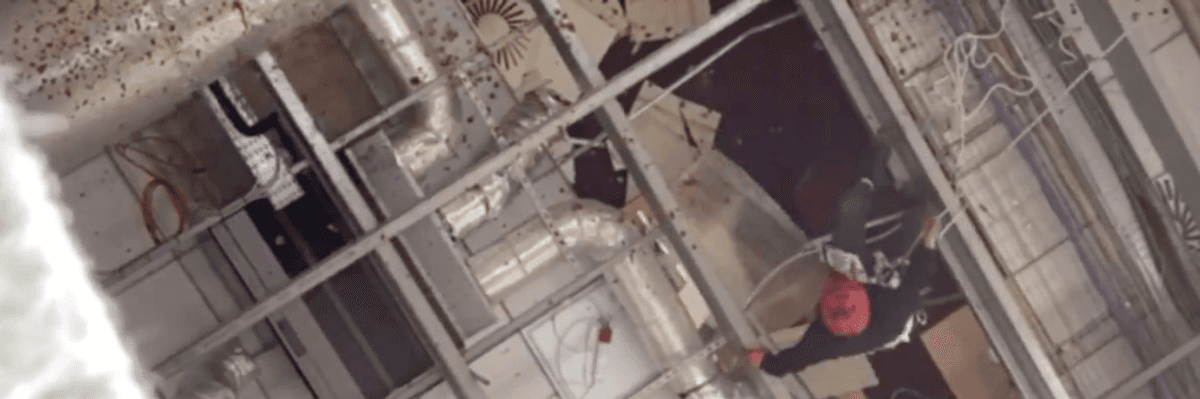
    An activist with People Against Genocide kicks down a ceiling inside the UAV Tactical Systems, owned by Elbit, in the city of Leicester, England on Friday April 24, 2026.(Photo: via social media / screengrab)

    “We are fucking sick and tired of our government’s collaboration in this genocide,” said one activist who participated in the direct action.

    In the early hours of Friday morning, members of the anti-war group People Against Genocide in the United Kingdom gained access to the roof of a drone manufacturing facility in the city of Leicester and began sabotaging a so-called “clean room” to hamper the building of weapons used in the ongoing Israeli military assault on Gaza that experts from around the world characterize as genocide and a crime against humanity.

    The UAV Tactical Systems facility, owned by the Israeli weapons company Elbit Systems Ltd., has been the target of protest in recent years for its role in providing the Israeli Defense Forces (IDF) with unmanned aerial drones, combat vehicles, surveillance equipment, and other military hardware.

    RECOMMENDED…

    Palestinian girl killed in Israeli ceasefire violating attack in Gaza

    ‘It Seems Nothing Is Moving the World to Stop Israel’s Terrorism’: Palestinian Poet Shares Photos of 9-Year-Old Girl Killed

    US Sen. Bernie Sanders

    With Congress Back in DC, Sanders Plans Another Vote on Blocking US Weapons to Israel Over Genocide

    “We are fucking sick and tired of our government’s collaboration in this genocide that Israel is committing against the Palestinian people,” said one unnamed activist, sitting on the facility’s roof early Friday. “We are tired of waiting for them to uphold international law.”

    Footage posted online by The Aftershock, a media outlet focused on the pro-Palestinian movement, showed members of the People Against Genocide on the roof of the facility in Leicester and then making their way down toward the manufacturing rooms inside.

    “They’re breaking the ceiling of the clean room used to make key parts for Israeli military drones,” the outlet noted. “Contaminating the clean room can knock it out of use for several months.”

    According to The Canary, a UK-based news outlet:

    At approximately 10am, an action taker from the group occupying the roof abseiled into the factory through a hole made with power tools. Whilst abseiling into the weapons factory, the action taker proceeded to damage the ceiling and air supply to the clean room.

    The clean room is used to make essential components for Israeli military drones and, once contaminated, it could be out of use for several months.

    The action involved four people from direct action group People Against Genocide. They successfully evaded recently-increased security patrols at the plant, and used 10m extension ladders to ascend over razor-wire fencing, gaining access to the factory roof. The team next began to use high-grade power tools to cut their way through the roof, to damage weaponry inside.

    “We cannot stand idly by while Elbit continues to manufacture death and destruction here in Leicester,” a spokesperson for People Against Genocide said in a statement.

    “Petitions, protests and lobbying decision makers who are actively involved in the Gaza genocide, has unsurprisingly, failed to create necessary change,” the spokesperson explained. “Therefore, rather than appeal to politicians or the government, we’re bypassing the complicit decision makers and are taking direct action to shut Elbit down and disrupt the murderous Israeli war machine ourselves.”

    “Genocide,” said the unnamed activist on the roof of the facility, “has no place in this world. That’s why we’re here today—to shut Elbit down.”

    Article by Jon Queally republished from Common Dreams under Creative Commons (CC BY-NC-ND 3.0).

    Keir Starmer objects to criticism of the IDF. He asks how could anyone object to them starving people to death, forced marches like the Nazis did, bombing Gaza's hospitals and universities, mass-murdering journalists, healthworkers and starving people queuing for food, killing and raping prisoners and murdering children. He calls for people to stop obstructing his genocide for Israel.
    Keir Starmer objects to criticism of the IDF. He asks how could anyone object to them starving people to death, forced marches like the Nazis did, bombing Gaza’s hospitals and universities, mass-murdering journalists, healthworkers and starving people queuing for food, killing and raping prisoners and murdering children. He calls for people to stop obstructing his genocide for Israel.
    Keir Starmer explains that UK is actively supporting Israel's genocidal expansion and repeats his previous quotation that he supports Zionism "without qualification". Keir Starmer said “I said it loud and clear – and meant it – that I support Zionism without qualification.” here: https://www.jewishnews.co.uk/keir-starmer-interview-i-will-work-to-eradicate-antisemitism-from-day-one/
    Keir Starmer explains that UK is actively supporting Israel’s genocidal expansion and repeats his previous quotation that he supports Zionism “without qualification”. Keir Starmer said “I said it loud and clear – and meant it – that I support Zionism without qualification.” here: https://www.jewishnews.co.uk/keir-starmer-interview-i-will-work-to-eradicate-antisemitism-from-day-one/

  • Groups Issue World Cup Travel Advisory Over ‘Deeply Troubling Human Rights Landscape’ in US

    Spread the love

    Article by Brett Wilkins republished from Common Dreams under Creative Commons (CC BY-NC-ND 3.0).

    US President Donald Trump receives the inaugural FIFA Peace Prize from FIFA President Gianni Infantino on December 5, 2025 in Washington, DC.(Photo by Brendan Smialowski/AFP via Getty Images)

    The coalition cited the Trump administration’s “racist immigration policies, mass detention and deportation, and attacks on freedom of expression and peaceful protest.”

    A coalition of more than 120 US-based civil society groups on Thursday issued a travel advisory ahead of the upcoming FIFA Men’s World Cup over what the ACLU called the “deteriorating human rights situation” in the United States amid the Trump administration’s deadly anti-immigrant crackdown, suppression of free speech, and more.

    Citing the “absence of meaningful action and concrete guarantees from FIFA”—world soccer’s governing body—“host cities, or the US government,” the coalition published a warning urging “fans, players, journalists, and other visitors traveling to and within the United States” for the tournament to “have an emergency contingency plan.”

    RECOMMENDED…

    Wayuu fishermen continue coastal work amid rising regional tensions in Venezuela

    Rights Groups Warn Countries to End Complicity in Trump’s High Seas Murder Spree

    Philippines protest against Netanyahu and Trump

    Amnesty Calls for Resistance to ‘Predatory World Order’ Pushed by Trump, Netanyahu in Annual Rights Report

    The US, Canada, and Mexico are jointly hosting the tournament, which is set to kick off with group stage matches in Mexico City and Guadalajara on June 11 and Los Angeles and Toronto the following day.

    “World Cup games will be played in 11 different cities across the United States, which, like many localities, have already been the target of the Trump administration’s violent and abusive immigration crackdown,” the coalition wrote.

    BREAKING: We're joining over 120 organizations issuing a travel advisory to warn anyone visiting the U.S. for the 2026 FIFA World Cup of possible civil and human rights violations.FIFA must pressure the Trump administration to protect the people traveling to and working at the games.

    — ACLU (@aclu.org) 2026-04-23T14:12:08.610Z

    “While the Trump administration’s rising authoritarianism and increasing violence pose serious risks to all,” the advisory continues, “those from immigrant communities, racial and ethnic minority groups, and LGBTQ+ individuals have been and continue to be disproportionately targeted and affected by the administration’s policies and, as such, are most vulnerable to serious harm.”

    According to the groups, those harms potentially include:

    • Arbitrary denial of entry and risk of arrest, detention, and/or deportation of non-US nationals—even those with prior authorization from the US government;
    • Expanded restrictions and limitations on travel and entry into the United States, given the Trump administration’s ban or severe restriction on entry of people from 19 Global South nations;
    • Invasive social media screening and searches of electronic devices as part of admission to the United States;
    • Violent and unconstitutional immigration enforcement, including racial profiling and other discrimination by law enforcement;
    • Suppression of speech and protest and increased surveillance; and
    • Serious risk of cruel, inhuman, or degrading treatment, and in some cases, death, while in immigration detention facilities or custody.

    The coalition—which includes groups like the ACLU, Amnesty International USA, Center for Constitutional Rights, Committee to Protect Journalists, Haitian Bridge Alliance, Human Rights First, Legal Defense Fund, Mijente Support Committee, NAACP, National Lawyers Guild, and Southern Poverty Law Center—is urging prospective World Cup attendees to take steps to protect themselves. These include knowing their rights, securing their electronic devices, and informing trusted people about travel plans.

    Visitors are also advised to download Human Rights First’s ReadyNow! mobile app “to notify trusted contacts in case of possible detention.”

    Journalists covering the tournament are urged to “consult resources from the Committee to Protect Journalists or Reporters Without Borders for information on how to keep themselves safe while entering the US and while reporting inside the country.”

    Daniel Noroña, Americas advocacy director at Amnesty International USA, said in a statement Thursday that “fans, journalists, and others traveling to the United States for the 2026 FIFA World Cup risk encountering a deeply troubling human rights landscape, shaped by the Trump administration’s racist immigration policies, mass detention and deportation, and attacks on freedom of expression and peaceful protest.”

    ACLU human rights program director Jamil Dakwar said that “FIFA has been paying lip service to human rights while cozying up with the Trump administration, putting millions of people at risk of being harmed and their basic rights violated.”

    “The Trump administration’s abusive actions continue to threaten our communities, tourists, and fans alike—and it’s past time that FIFA use its leverage to push for meaningful policy changes and binding assurances that will make people feel safe to travel and enjoy the games,” Dakwar added.

    FIFA faced worldwide ridicule for awarding President Donald Trump its first-ever Peace Prize last December amid his administration’s illegal high-seas boat-bombing spree, and just ahead of his bombing of Nigeria, kidnapping of Venezuelan President Nicolás Maduro, launch of the US-Israeli war of choice against Iran, and threats to attack several other countries.

    Despite US bombing that’s killed thousands of its people—including hundreds of children—and FIFA’s refusal to relocate its matches outside the United States, Iran, which easily qualified, is planning to take part in the tournament.

    On Thursday, Iran’s embassy in Italy decried what it called a “morally bankrupt” effort by US Special Envoy for Global Partnerships Paolo Zampolli to ban it from the tournament and replace its bracket slot with Italy, which is reeling from missing its third consecutive World Cup final.

    Article by Brett Wilkins republished from Common Dreams under Creative Commons (CC BY-NC-ND 3.0).

    Climate science denier Donald Trump confirms that he knows nothing about democracy and that more liquid gold is being secured according to his policy of global privateering.
    Climate science denier Donald Trump confirms that he knows nothing about democracy and that more liquid gold is being secured according to his policy of global privateering.
    Donald Trump sings and dances, says that it's fun to kill everyone ...
    Donald Trump sings and dances, says that it’s fun to kill everyone …

  • Palantir and the NHS – 10 things you need to know

    Spread the love
    Who has access? DC Studio/Shutterstock.com

    Eerke Boiten, De Montfort University

    Palantir, a US data analytics company backed in its early years by In-Q-Tel, now plays a central role in the NHS’s £330 million Federated Data Platform. Supporters say it could improve planning and efficiency, while critics have raised questions about governance, transparency and trust. Here’s what you need to know.

    1. What is Palantir and what does it do?

    Palantir is a large American technology company, specialising in storing large data collections and providing tools to manage the data, in particular artificial intelligence (AI) to ask questions of it. It provides decision-making platforms, such as Foundry, which government organisations and businesses use to uncover patterns, manage operations, and support planning and decision-making.

    The company’s chairman, Peter Thiel, is known for his controversial views. At the Oxford Union in 2023, he said that the NHS makes people ill and should be privatised.

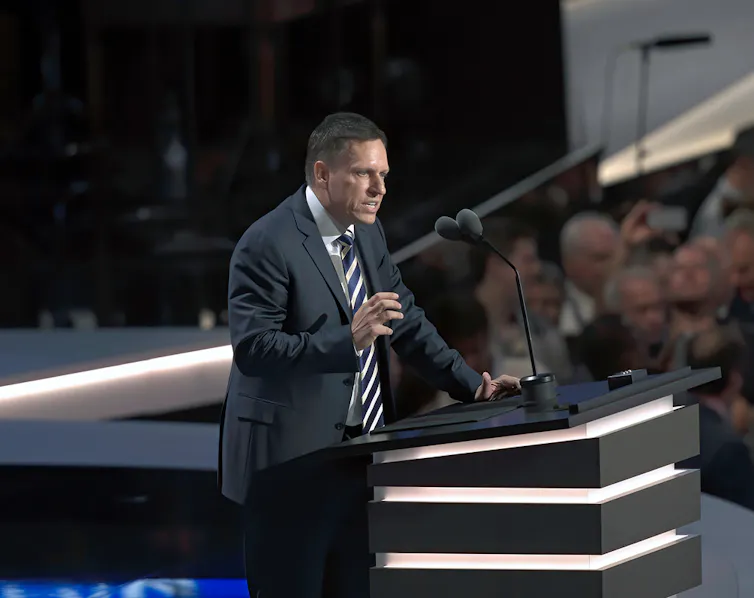
    Peter Thiel, chairman of Palantir, giving a talk.
    Peter Thiel thinks the NHS should be privatised. Mark Reinstein/Shutterstock.com

    2. Why is a private American company involved in managing NHS medical records?

    That’s not how Palantir views it. It sees itself as providing a platform on which the NHS can store and analyse NHS medical records. And that wouldn’t be exceptional. A large amount of data from across society is stored on cloud platforms provided by American companies.

    Some of the discussion is about whether Palantir is really less trustworthy than, say, Microsoft, Google or Amazon.

    3. Who gave Palantir this contract, and was it put out to open tender?

    The governments of Boris Johnson (2020) and Rishi Sunak (2023) awarded Palantir the contracts.

    Palantir had been lobbying to get access to NHS data for a while when it offered to build a COVID data store for £1 in early 2020; there was no open competition under emergency COVID procurement rules. The data store combined patient-level data from many sources, as well as operational data from hospitals and other sources.

    The initial three-month contract was only made public under legal pressure, and the deal was then renewed for £23 million, again without evidence of competition.

    The latest version of this deal, the Federated Data Platform, was awarded competitively in December 2023 to a Palantir-led consortium. Having had the deal previously will have been a big advantage for Palantir – a phenomenon known as “vendor lock-in”.

    4. Can Palantir use my data for its own commercial purposes or share it with the US government?

    Palantir’s role is as a “data processor”, which means it is not legally allowed to make its own decisions about what to do with the data – only the “data controllers” (NHS organisations) can.

    There is some grey area on what Palantir is allowed to do with the data that is “necessary to provide products or services … under the Agreement”. It has been claimed that this includes using NHS data for AI models, but the original contract does not really suggest this. Unhelpfully, in the publicly available version of the latest contract, nearly all the data protection text (three pages) is redacted.

    So it is not legally allowed to use NHS data for their own purposes. And although UK regulators, such as the Information Commissioner’s Office, have oversight powers, some critics question how effectively large multinational technology providers can be audited in practice.

    Trust plays an important role, particularly at a time when we have seen US government appropriating databases relating, for example, to health, mobile phone location and car number plates, for immigration enforcement. Under the US Cloud Act, American authorities can, under certain legal conditions, request data from US-based companies, which has raised concerns among privacy advocates about potential cross-border access.

    5. What is the Federated Data Platform, and what is it supposed to do for the NHS?

    There has long been an NHS England ambition to have a central place to store “all” NHS data. The core of this was effectively realised quickly during COVID, under special legislation, in two forms with slightly different targets.

    The first was the NHS COVID-19 Data Store, which has grown into the Federated Data Platform, and is targeted more towards planning. The second is OpenSafely, which provides research access to unified NHS datasets using strong privacy protections.

    6. Has the system improved NHS care, and is the taxpayer getting value for money?

    The UK government has already made claims of significant improvements due to Palantir. But researchers have raised doubts both about the research methods used to quantify such successes and about the personal connections of the people involved in these.

    7. What is Palantir’s track record — who else does it work for, and should that concern me?

    Palantir was initially funded by In-Q-Tel, the non-profit venture capital arm of the CIA, and has been working with US Immigration and Customs Enforcement (ICE), which has been criticised by civil liberties groups.

    It works with several other UK government organisations, including the army. The Israeli army reportedly used Palantir for AI-based targeting in the war in Gaza, which is a main reason Amnesty International campaigned against Palantir within the NHS.

    8. Can I opt my data out? If so, how?

    You can opt out of your GP practice sharing your health data, or separately out of NHS England and others sharing it for research and planning.

    Unfortunately, this would affect beneficial uses of your health data too, including by making the overall dataset less comprehensive and representative. This is part of why the medical community worries about the Palantir effect.

    9. Why are so many doctors, nurses and campaigners opposed to this — and should I be worried too?

    There is a wide range of concerns. Palantir’s political positioning, including opposing the NHS in its current form, as well as the more controversial political views expressed by some of its leaders, means many people don’t trust it with their health data.

    There is a technological concern over concentrating NHS data processing with a single supplier, possibly replacing working solutions with inferior ones. For some people, Palantir’s activity with ICE and allegedly in Gaza makes them morally unacceptable.

    10. Could the government cancel the contract, and what would happen to the data Palantir already holds if it did?

    There is a break clause in the current contract coming up, so yes, it can. The contract says Palantir needs to lose all access to the data when the contract ends.

    Responding to Conservative MP Wendy Morton’s call for more scrutiny of Palantir’s ability to protect data, Louis Mosley, Palantir UK’s executive vice-chair, told the BBC that he welcomed scrutiny and was confident the firm was delivering value for money for NHS patients.

    Mosley went on to say that Palantir has no interest in patient data in the UK. “It’s not our business model,” he said. “It’s not the legal basis on which we operate, in the same way that Microsoft Excel or Microsoft Word or email is used in the NHS and again that is NHS data, Microsoft doesn’t have access to it, nor do we to NHS data.”

    Eerke Boiten, Professor of Cybersecurity, Head of School of Computer Science and Informatics, De Montfort University

    This article is republished from The Conversation under a Creative Commons license. Read the original article.

    Keir Starmer confirms that he doesn't know anything about democracy.
    Keir Starmer confirms that he doesn’t know anything about democracy.

    Being Assassinated in Your Home by a Killer Robot Sent by a Fascist State Is No Longer Science Fiction