Trump’s ICE Jacks Up Weapons Spending by 700%—Including ‘Guided Missile Warheads’

Spread the love

Original article by Julia Conley republished from Common Dreams under Creative Commons (CC BY-NC-ND 3.0).
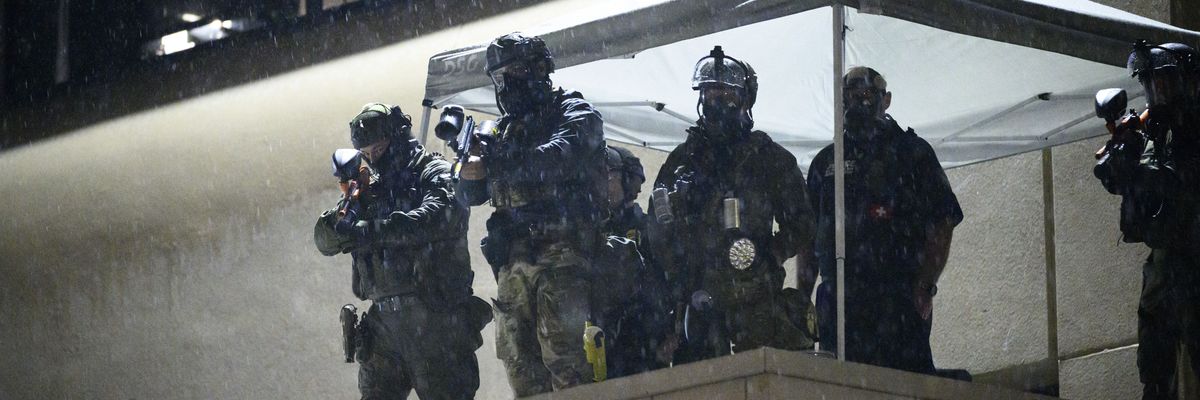
Federal agents target protesters with “less lethal” weapons at the US Immigration and Customs Enforcement building on October 18, 2025 in Portland, Oregon. 
(Photo by Mathieu Lewis-Rolland/Getty Images)

“ICE was always going to be Trump’s private military to deploy domestically against Americans,” said one critic.

The $170 billion in new funding for immigration enforcement operations that the Republican Party included in the One Big Beautiful Bill Act earlier this year led some to warn that the Trump administration was ramping up spending at anti-immigration agencies not just to fund its attacks on migrants, but to deploy federal forces against anyone it wanted to across US communities.

New reporting on Monday detailed just how much US Immigration and Customs Enforcement has spent on weaponry since President Donald Trump took office—weapons that have been purchased as the administration has turned federal agents on US cities such as Chicago and Portland, illustrating how the president is treating increasingly armed ICE officers as his “private military,” as one progressive critic said.

As images spread online of immigration agents deploying pepper spray and tear gas at nonviolent protesters, Judd Legum at Popular Information recently delved into government contracting records from the Federal Procurement Data System and found that ICE has increased its spending on “small arms, ordnance, and ordnance accessories manufacturing” by 700% this year compared to 2024 numbers.

The agency spent $71,515,762 on small arms from January 20—the day Trump began his second term—through October 18.

The number dwarfs ICE’s spending during the first Trump term, during which the agency spent about $8.4 million annually on small arms, and during President Joe Biden’s administration.

The type of weaponry purchased by ICE also raised alarm Monday, with Legum reporting that while most of the agency’s spending was on guns and armor, “there have also been significant purchases of chemical weapons and ‘guided missile warheads and explosive components.’”

“If the immigration enforcement apparatus of the United States were its own national military, it would be the 13th most heavily funded in the world. This puts it higher than the national militaries of PolandItalyAustralia, Canada, Turkey, and Spain—and just below Israel.”

The reporting comes as ICE and other immigration agencies continue to deploy armed, masked agents in major Democratic-leaning US cities, where officers have been filmed and photographed pointing a weapon at a protester; firing a pepper ball at a pastor, and pointing a firearm at bystanders who saw one agent arresting a man.

CBS reporter in Chicago also accused an ICE officer of firing a pepper ball at her vehicle, causing the chemical to “engulf the inside of her truck.”

Sally Duval, a Texas state House candidate in last year’s election, said she was “curious to know why ICE needs ‘guided missile warheads.’”

The report came days after the Trump administration used the US military for what Democratic California Gov. Gavin Newsom called “a profoundly absurd show of force that could put Californians directly in harm’s way,” when the Marines fired 155-millimeter artillery shells over a section of the busy Interstate 5 freeway to celebrate the military branch’s 250th anniversary.

Newsom accused Trump of “using our military to intimidate people [he disagrees] with” and called the exercise “reckless.”

Melanie D’Arrigo, executive director of the Campaign for New York Health, said Legum’s reporting on Monday showed that “ICE was always going to be Trump’s private military to deploy domestically against Americans.”

Legum’s analysis—which likely understated total spending on weapons by Trump’s deportation forces, as it did not include spending by other anti-immigration agencies—followed a report on ICE’s recent funding increase by In These Times.

With the $170 billion included in the OBBBA, reported the outlet, “if the immigration enforcement apparatus of the United States were its own national military, it would be the 13th most heavily funded in the world. This puts it higher than the national militaries of Poland, Italy, Australia, Canada, Turkey, and Spain—and just below Israel.”

The budget, Brandon Lee of the Illinois Coalition for Immigrant and Refugee Rights told In These Times, “shows the misplaced priorities of this administration, where they are cutting healthcare and cutting vital programs for people across the country, and putting all of this money into a domestic terrible force.”

“And it shows the cruelty,” said Lee, “that the Trump administration intends to enact on all people in the United States.”

Original article by Julia Conley republished from Common Dreams under Creative Commons (CC BY-NC-ND 3.0).

Orcas discuss how Trump was re-elected and him being an obviously insane, xenophobic Fascist.
Donald Fuhrump says that Amerikkka doesn't bother with crimes or charges anymore, not being 100% Amerikkkan and opposing his real estate intentions is enough.
Donald Fuhrump says that Amerikkka doesn’t bother with crimes or charges anymore, not being 100% Amerikkkan and opposing his real estate intentions is enough.

Continue ReadingTrump’s ICE Jacks Up Weapons Spending by 700%—Including ‘Guided Missile Warheads’

Trump-Appointed Judges Give Him Green Light to Send Troops Into Portland

Spread the love

Original article by Brad Reed republished from Common Dreams under Creative Commons (CC BY-NC-ND 3.0).

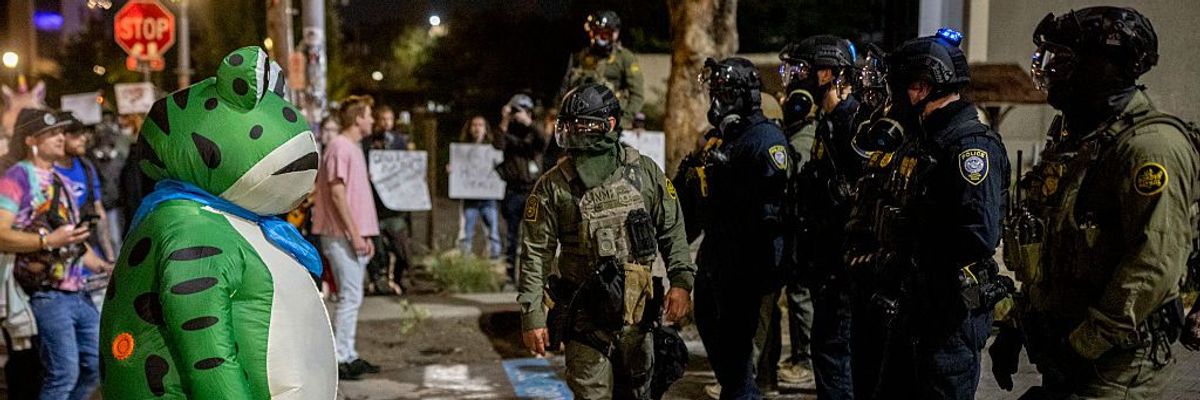
A protester in a frog costume stands in front of a line of federal law enforcement officers outside a United States Immigration and Customs Enforcement (ICE) facility in Portland, Oregon, on October 6, 2025. (Photo by Stephen Lam/San Francisco Chronicle via Getty Images)

In a dissent, Judge Susan Graber accused her 9th Circuit colleagues of eroding “core constitutional principles.”

Two federal judges are giving President Donald Trump the green light to send National Guard troops into Portland, Oregon on Monday.

The US Court of Appeals for the 9th Circuit granted the US Department of Justice’s (DOJ) request to put a hold on US District Judge Karin Immergut’s earlier order blocking deployment of the National Guard to Oregon’s largest city.

The two judges who ruled in the DOJ’s favor were appointed by Trump, while the lone dissenter in the case, Judge Susan Graber, was appointed by former President Bill Clinton.

The court’s majority ruled that the protests outside the Portland Immigration and Customs Enforcement (ICE) facility were sufficiently disruptive to justify deploying the National Guard, despite the fact that demonstrations outside the facility in recent weeks had not disrupted operations.

Judge Ryan Nelson, one of the Trump appointees, went so far as to issue a concurring opinion stating that the president’s right to deploy the National Guard, even over the objections of state and local officials, cannot be reviewed by the judiciary.

In a scathing dissent, Graber noted that “the record contains no evidence whatsoever that, on September 27… ICE was unable either to protect its Portland facility or to execute the immigration laws it is charged with enforcing.” This is relevant, she said, because the law states that the president may only deploy the National Guard “to repel a foreign invasion, quell a rebellion, or overcome an inability to execute the laws.”

Graber then accused her colleagues of eroding “core constitutional principles, including sovereign states’ control over their states’ militias and the people’s First Amendment rights to assemble and to object to the government’s policies and actions.”

Graber’s argument echoed a ruling made earlier this month by Immergut, who was also appointed to the bench by Trump and who said his declarations that violent protests at the Portland ICE facility prevented the enforcement of the law were “untethered to facts.”

Sandy Chung, executive director of the ACLU of Oregon, said in a statement responding to the ruling that “we are very disappointed that the majority on this 9th Circuit panel were unable to see through President Trump’s political theater, divisive rhetoric, and extreme abuse of power and misuse of our military.”

“The fact remains that Portland is peaceful,” Chung added. “Portland protesters have shown a remarkable level of humor, creativity, and community care in the face of this administration’s persistent and violent abuses of power. Inflatable frog and unicorn costumes, bike rides, and musical events are hardly a threat or reason to take the extremely dangerous and anti-democratic action of sending American troops into our communities.”

In addition to Portland, Trump is also seeking to send National Guard troops to Chicago over the objections of both Mayor Brandon Johnson and Illinois Gov. JB Pritzker. The administration has appealed that case to the US Supreme Court.

This article has been updated with comment from the ACLU.

Original article by Brad Reed republished from Common Dreams under Creative Commons (CC BY-NC-ND 3.0).

Orcas discuss how Trump was re-elected and him being an obviously insane, xenophobic Fascist.
Donald Fuhrump says that Amerikkka doesn't bother with crimes or charges anymore, not being 100% Amerikkkan and opposing his real estate intentions is enough.
Donald Fuhrump says that Amerikkka doesn’t bother with crimes or charges anymore, not being 100% Amerikkkan and opposing his real estate intentions is enough.

Continue ReadingTrump-Appointed Judges Give Him Green Light to Send Troops Into Portland

Trump’s Portland Lies Euphemized as ‘Dueling Versions of Reality’

Spread the love

Original article by Saurav Sarkar republished from FAIR under a Creative Commons Attribution-NonCommercial-NoDerivs 3.0 Unported License.

As more and more US cities face the prospect of federal police and military patrolling their streets, the New York Times (10/10/25) began a recent article on the fight over sending National Guard troops to Portland, Oregon, with the following passage:

Democratic leaders in the city and state have pleaded with President Trump and the courts to trust law enforcement records, both local and federal, that describe the demonstrations as small and comparatively calm.

But in the bifurcated media world of 2025, one side’s comparative calm is the other’s “hellscape.”

By “both-sidesing” its description of the protests in Portland, the Times fails to inform its readers that one of these descriptions is true and the other is simply fabricated. Instead, it tells readers the situation reflects “dueling versions of reality.”

Compare this to Michael Tomasky’s reporting in the New Republic (10/13/25), which aptly notes in the kicker that “the disturbances in Portland are basically limited to a single block about two miles from the city center.”

Or the snarky factcheck website Is Portland Burning? which shows images of the serene city and video of a calm, small protest.

Elsewhere, the Times (10/11/25) has written about the funny animal costumes worn by protesters in Portland, reporting that could have been used to debunk MAGA claims that the city is a “hellscape.”

‘Both officials disagree’

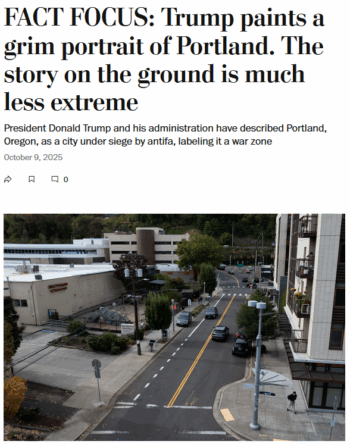
WaPo: FACT FOCUS: Trump paints a grim portrait of Portland. The story on the ground is much less extreme

Taking a “closer look” at Trump’s claim that “in Portland, Oregon, antifa thugs have repeatedly attacked our offices and laid siege to federal property in an attempt to violently stop the execution of federal law,” AP (via Washington Post10/9/25) began its response, “There have been nightly protests outside the US Immigration and Customs Enforcement building in Portland for months, peaking in June when police declared one demonstration a riot.”

In an Associated Press factchecking piece (reprinted in the Washington Post10/9/25), promising to take “a closer look at the facts” about Portland, only one of Trump’s claims (that in Portland, “you don’t even have sewers anymore”) is met with a forthright “this is false.” Other times, the AP struggles to find a kernel of truth in the Trump administration’s bizarre claims:

TRUMP: “The amazing thing is, you look at Portland and you see fires all over the place. You see fights, and I mean just violence. It’s just so crazy. And then you talk to the governor and she acts like everything is totally normal, there’s nothing wrong.”

THE FACTS: Fires outside the building have been seen on a handful of occasions.

Or, like the Times, it resorts to both-sidesing it:

KRISTI NOEM, Homeland Security Secretary: “I was in Portland yesterday and had the chance to visit with the governor of Oregon, and also the mayor there in town, and they are absolutely covering up the terrorism that is hitting their streets.”

THE FACTS: Noem did visit Portland on Tuesday and met with Kotek and Mayor Keith Wilson. Both officials disagree with Noem’s narrative.

These failings by the media leave the reader or viewer at the mercy of what are posed as competing narratives, rather than with an understanding of what’s real and what’s fake. This is particularly important now, given that right-wing influencers and media are ginning up false claims for the administration to consume and rebroadcast, and even instigating real incidents (Oregon Public Broadcasting10/11/25).

When corporate media refuse to call a lie a lie, and to stand unequivocally on the side of reality, they enable the Trump administration’s growing authoritarianism. If Trump can claim that a major US city is “burning to the ground,” what’s to stop him from asserting that the Constitution allows him to run for a third term—or that, once again, he’s won an election that he actually lost?


Featured Image: Detail from New York Times photo (10/11/25) of Portland protests (photo: Jordan Gale).

Original article by Saurav Sarkar republished from FAIR under a Creative Commons Attribution-NonCommercial-NoDerivs 3.0 Unported License.

Orcas discuss how Trump was re-elected and him being an obviously insane, xenophobic Fascist.
Donald Fuhrump says that Amerikkka doesn't bother with crimes or charges anymore, not being 100% Amerikkkan and opposing his real estate intentions is enough.
Donald Fuhrump says that Amerikkka doesn’t bother with crimes or charges anymore, not being 100% Amerikkkan and opposing his real estate intentions is enough.
Continue ReadingTrump’s Portland Lies Euphemized as ‘Dueling Versions of Reality’

Tens of thousands of Cubans march in support of Venezuela’s sovereignty amid US aggression

Spread the love

This article by Pablo Meriguet republished from peoples dispatch under a Creative Commons Attribution-ShareAlike 4.0 (CC BY-SA) license.

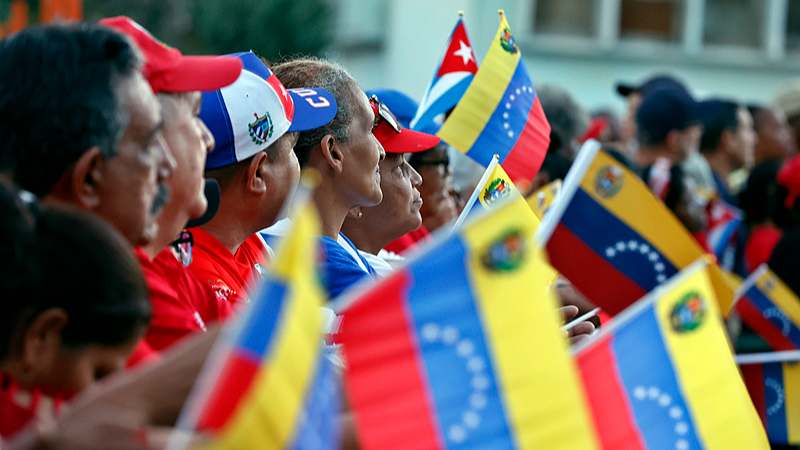
People hold up Cuban and Venezuelan national flags during a rally in support of Venezuela, in Havana, Cuba, October 17, 2025. Photo: CGTN

The demonstration rejected US interference in Venezuela’s internal affairs as US military operations in the Caribbean Sea increase.

On October 17, tens of thousands of Cubans took to the streets of Havana to show their support for Venezuela in the face of a potential intervention by the United States following its recent military deployment in the Caribbean Sea.

Under anti-imperialist and pro-sovereignty slogans, nearly 50,000 participants gathered in front of the statue of Simón Bolívar, the Venezuelan military leader and independence politician. The event was led by the country’s president, Miguel Díaz-Canel.

The event was also attended by Pedro Infante Aparicio, vice president of the United Socialist Party of Venezuela and the National Assembly, who told those present that both Cuba and Venezuela are victims of the supremacism and warmongering of the White House. He added: “From this platform, we join President Nicolás Maduro in calling for an end to the xenophobic attempts to compare the dignity of Venezuelans with criminal groups, and we demand an end to the policy of terrorism against our people.”

For his part, Díaz-Canel wrote on X: “At a time when the empire and its misguided leader are approving covert CIA operations against Venezuela, we express our solidarity with that brotherly people and, especially, with its President Nicolás Maduro. Today, Cuba is more mindful than ever of the words of [José] Martí: ‘Give me Venezuela to serve, she has in me a son,’ and of Fidel [Castro]: ‘For Venezuela, we must give everything. We are confident that Venezuela and its popular, military, and police forces will once again overcome the threats and actions of the empire.”

Read More: Trump’s military escalation against Venezuela repeats the Iraq War blueprint

In addition, Díaz-Canel presented a book containing more than 4 million signatures from Cubans who support the Bolivarian Revolution and condemn attempts to destabilize the government of Nicolás Maduro. 

For his part, Roberto Morales Ojeda, secretary of organization of the Central Committee of the Communist Party of Cuba, stated: “We are one soul, which does not give up. Receive these signatures as the greatest and most eloquent show of love that can be offered to a sister nation, led by constitutional President Nicolás Maduro and with an admirable military-popular fusion, which is preparing to face and defeat any aggression that may occur.”

For its part, the official newspaper of the Communist Party of Cuba, Granma, wrote in an editorial: “Because the sister nation of Venezuela is not alone and because its resistance symbolizes the history of all peoples who believe in sovereignty, more than 50,000 Havana residents, representing all Cubans, gathered today in front of the statue of liberator Simón Bolívar in solidarity with that country.

Military pressure against Venezuela intensifies

Several weeks ago, the United States deployed a large number of ships and troops to the Caribbean Sea to supposedly stop drugs from entering the United States. In addition, Washington declared the Cartel of the Suns an international terrorist organization and claimed that Maduro and other senior Chavista leaders were running the cartel.

Read More: Trump chooses war over diplomacy in the Caribbean

The United States is offering a USD 50 million reward for information leading to Maduro’s arrest and conviction. These accusations have been categorically denied by Venezuelan authorities, who see them as an attempt to legitimize a possible armed invasion of the South American country.

Under this premise, which many have questioned, Washington has claimed that it has sunk five small boats allegedly carrying drugs, killing 27 people on board. This type of pressure is in addition to the economic sanctions and trade blockades imposed by Washington for several years.

In addition, it was revealed a few days ago that Donald Trump had authorized secret CIA operations in Venezuela, according to the New York Times. Among the covert operations are lethal actions carried out in coordination with or independent of the US military.

This article by Pablo Meriguet republished from peoples dispatch under a Creative Commons Attribution-ShareAlike 4.0 (CC BY-SA) license.

Donald Fuhrump says that Amerikkka doesn't bother with crimes or charges anymore, not being 100% Amerikkkan and opposing his real estate intentions is enough.
Donald Fuhrump says that Amerikkka doesn’t bother with crimes or charges anymore, not being 100% Amerikkkan and opposing his real estate intentions is enough.
Orcas discuss how Trump was re-elected and him being an obviously insane, xenophobic Fascist.

Continue ReadingTens of thousands of Cubans march in support of Venezuela’s sovereignty amid US aggression

Drawing lessons from the Cuban Revolution: organization, unity, and internationalism

Spread the love

This article by republished from peoples dispatch under a Creative Commons Attribution-ShareAlike 4.0 (CC BY-SA) license.

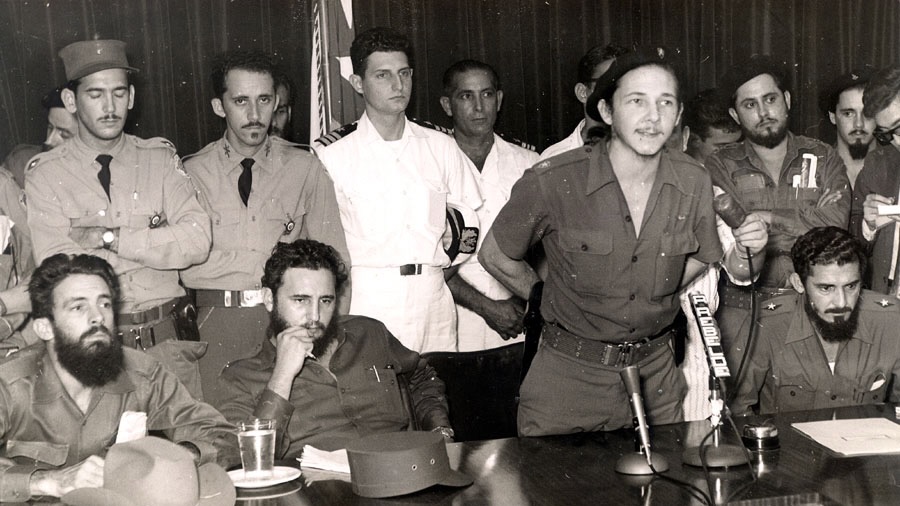
On February 16, 1959, Cuba established the Ministry of the Revolutionary Armed Forces, the executive body of their defense force, and its first Army General, Raúl Castro Ruz. Photo: Miguel Díaz-Canel/X

A recent webinar by Pan Africanism Today and the International Peoples’ Assembly looked at global struggles, from Africa to Latin America, showing how Cuba’s enduring resistance offers vital lessons in organization, unity, and internationalism for today’s movements fighting oppression and war.

The world is in an era marked by relentless wars and overlapping crises, from the devastating civil war in Sudan and violence in the Democratic Republic of Congo to the unfolding genocide in Palestine. The demand to end all wars has never carried greater urgency. And in the midst of all these visible battlegrounds persists a more enduring and insidious conflict; the hybrid war and economic blockade waged against the Cuban people and their revolution.

This was the central focus of a recent global webinar convened under the banner of Pan-African and internationalist solidarity, bringing together progressive voices to draw lessons from Cuba’s anti-imperialist struggle. The session, held on October 15, was facilitated by Mbali Gwenda from Pan Africanism Today, who situated the discussion within a broader historical and moral framework, invoking the revolutionary spirits of Thomas Sankara, martyred on the same date in 1987, and Assata Shakur who recently passed, and whose life consistently symbolized uncompromising resistance to oppression.

“We are dealing with the question of the hybrid war and blockade against the Cuban Revolution and her people,” Gwenda said. “A revolution that has been a source of inspiration for all oppressed peoples throughout the world till this day.”

The keynote address was delivered by Manolo De Los Santos, executive director of The People’s Forum and a researcher at the Tricontinental: Institute for Social Research, who framed Cuba’s defiance not as a miracle, but as the outcome of a centuries-long process of people’s struggle, organization, and consciousness.

The long arc of revolution

De Los Santos began by looking at Cuba’s revolution more than an event confined to the years 1953–1959, when Fidel Castro, Che Guevara, and others led the guerrilla war against the Batista dictatorship. Revolutions, he reminded the audience, are not events but processes, collective journeys of resistance that unfold across generations.

Cuba’s revolution, he argued, has roots reaching back to centuries of anti-colonial and anti-slavery resistance, when the island was still a colony of the Spanish Empire. Unlike many independence movements in Latin America, Cuban revolutionaries understood that genuine freedom required addressing three interlinked questions:

  1. Could Cuba truly be independent if it remained a slaveholding society?
  2. Could it be free if it continued under the exploitative system of capitalism?
  3. Could it claim sovereignty while dominated by imperial powers, first Spain and later the United States?

These questions shaped the consciousness of generations of Cuban patriots, culminating in the 1959 triumph of the socialist revolution. But as he explained, the revolution’s endurance has rested on three essential pillars: organization, unity, and internationalism.

Organization: the bedrock of resistance

Organization, De Los Santos emphasized, has been the Cuban people’s greatest weapon against imperial aggression. From the early independence wars to the 26th of July Movement led by Fidel Castro, Cubans have understood that only a disciplined, organized people can confront an empire with infinite resources.

This organizational spirit persisted after 1959, with the creation of mass democratic structures that unite workers, women, peasants, students, and youth. The Federation of Cuban Women, for example, mobilizes millions in defense of gender equality and revolutionary ideals, while student and peasant organizations remain vital spaces for political education and collective problem-solving.

Even under today’s extreme shortages such as the lack of fuel to power garbage collection, Cuban communities respond not with despair but with collective initiative, a reflection of their revolutionary organization and social consciousness.

Unity, he continued, has been the second indispensable lesson from Cuba. Every time the people were divided, the empire gained the upper hand; every time they stood together, they won. This unity has transcended class, race, and regional divisions, dismantling the legacies of slavery and racism that imperialism imposed.

The Cuban Revolution’s unity was forged not just through ideology but through practice, through collective participation in building a new society. It remains, as Manolo put it, “the most important defense the Cuban people have.”

Internationalism is the soul of the revolution

If organization is the body and unity the shield, then internationalism is the soul of the Cuban Revolution.

Quoting Fidel Castro, the New York-based researcher reminded participants that “a people who are not willing to fight for the freedom of others will never be able to fully fight for their own freedom.”

This principle drove Cuba to send tens of thousands of its sons and daughters to fight alongside liberation movements in Angola, Namibia, and South Africa, contributing directly to the defeat of apartheid. As he noted, “Cuba doesn’t need gold or minerals from Africa, it knows that its freedom is tied to the freedom of the peoples of the African continent.”

Even today, with over 24,000 Cuban doctors working abroad, many across Africa, Cuba continues this legacy of solidarity. The US, in its campaign of distortion, now accuses Cuba of “human trafficking” for this very act of humanitarianism.

Read more: Cuba’s medical brigades in Africa embody a long tradition of solidarity

The anatomy of a hybrid war

The United States’ war against Cuba has been fought through unconventional means. It is a hybrid war, a combination of economic blockade, financial strangulation, media disinformation, and covert sabotage.

For more than 65 years, the blockade has inflicted immense human and economic damage. In 2024 alone, it cost Cuba USD 7.5 billion, money that could have been used to buy food, medicine, or oil for its 11 million citizens.

The US uses its control of global financial systems to punish any country or institution that trades with Cuba. Banks in Africa or Latin America face sanctions simply for handling Cuban transactions. The blockade’s reach extends into every corner of global trade, designed to isolate Cuba and make daily life unbearable for its people.

Read More: Tens of thousands of Cubans march in support of Venezuela’s sovereignty amid US aggression

The war is also fought in the terrain of ideas. US-funded media campaigns spread false narratives about repression and poverty in Cuba while erasing the country’s achievements in health, education, and solidarity.

Socialism and survival

When asked on how Cuba has managed to survive more than six decades of blockade, Manolo’s answer was clear: because Cuba made a socialist revolution.

Socialism, he said, allowed Cuba to create a system where the needs of the people come before profit. In capitalist societies, when crises hit, the rich survive and the poor starve. In Cuba, food, healthcare, and education are distributed equitably, even in times of scarcity. This social organization transforms a siege economy into a community of resilience.

This difference, he explained, is what makes Cuba unique among nations facing US aggression. It’s also what inspires global movements seeking alternatives to neoliberalism and imperial domination.

Cuba, Sankara, and the spirit of resistance

The session also honored Thomas Sankara linking a symbolic bridge between the African and Latin American revolutionary traditions. Both embodied a commitment to self-reliance, dignity, and international solidarity.

Sankara’s vision of a self-determined Africa resonated deeply with the Cuban experience. His assassination on October 15, 1987 marked a turning point in African politics, yet his ideas continue to inspire movements across the continent, just as Cuba continues to stand as living proof that another world is possible.

Read More: Thomas Sankara’s legacy lives on in Burkina Faso 38 years after his death

A call for global solidarity

In closing, Manolo issued a clear call; the Cuban people will overcome the blockade, but they cannot and should not do it alone. Their survival depends on the solidarity of all who believe in justice, sovereignty, and equality.

Cuba’s endurance is not simply a Cuban story; it is a lesson for all peoples resisting imperial domination. As the world faces renewed militarization and economic warfare, the spirit of organization, unity, and internationalism must also be crucial as ever.

“When they stand with the Palestinians, when they stand with the Congolese, when they stand with the peoples of the African continent,” Manolo concluded, “they are breaking the blockade too.”

This article by republished from peoples dispatch under a Creative Commons Attribution-ShareAlike 4.0 (CC BY-SA) license.

Continue ReadingDrawing lessons from the Cuban Revolution: organization, unity, and internationalism