Lula demands respect for Brazil’s sovereignty after Trump’s statements

Spread the love

Original article by Pablo Meriguet republished from peoples dispatch under a Creative Commons Attribution-ShareAlike 4.0 (CC BY-SA) license.
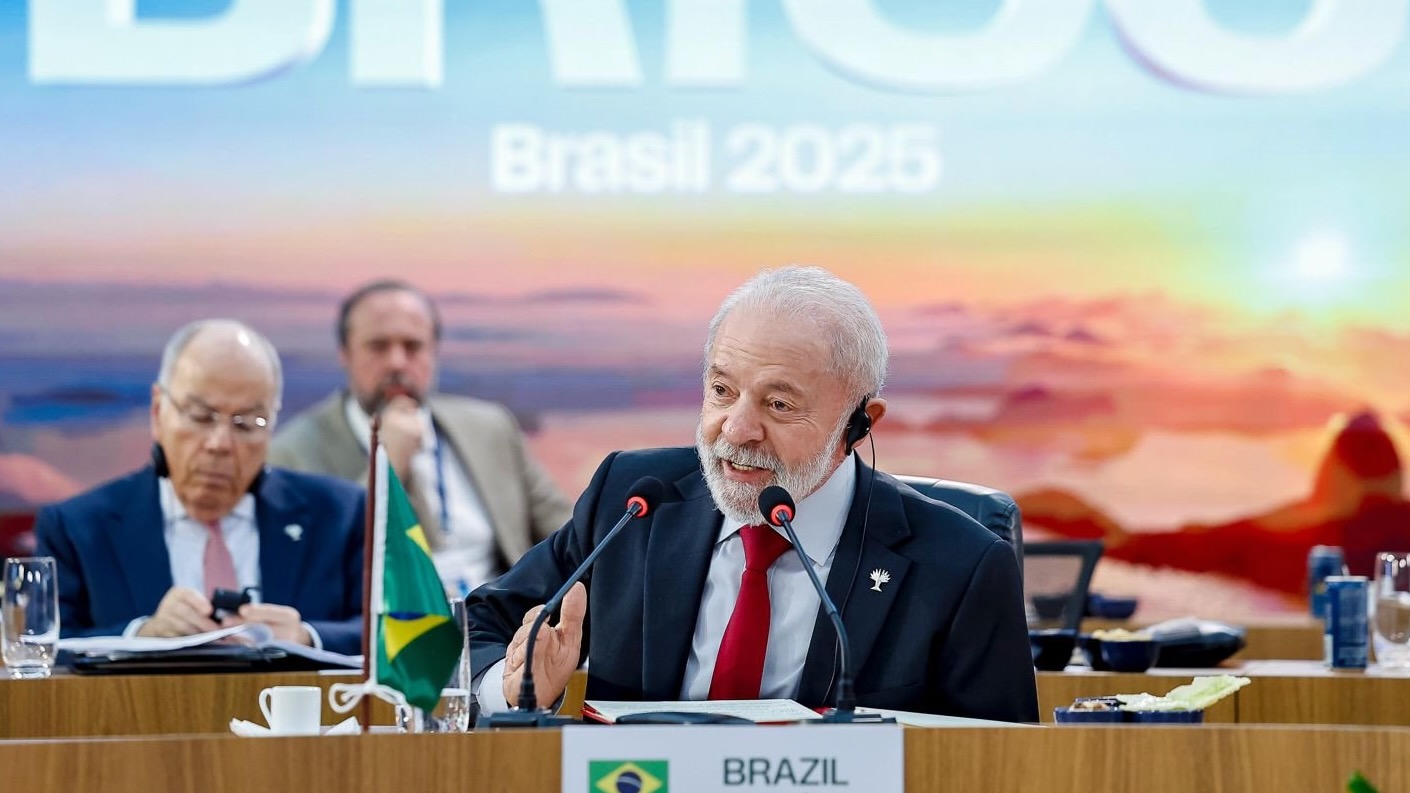
Brazilian President Lula da Silva leads the 17th BRICS Summit in Rio de Janeiro, Brazil, July 6, 2025. Photo: X

New tensions have arisen between the United States and Brazil after Trump claims that former Brazilian President Jair Bolsonaro, an ultra-right-wing leader, is innocent

On July 7, the president of the United States, Donald Trump, published a message on Truth Social defending former Brazilian President Jair Bolsonaro and claiming he has been mistreated and is innocent. Bolsonaro was los reelection in the 2022 elections and later the Supreme Court declared that he was ineligible to serve in public office due to his numerous violations.

Trump wrote: “Brazil is doing a terrible thing on their treatment of former President Jair Bolsonaro. I have watched, as has the World, as they have done nothing but come after him, day after day, night after night, month after month, year after year! He is not guilty of anything, except having fought for THE PEOPLE… This is nothing more, or less, than an attack on a Political Opponent — Something I know much about! It happened to me, times 10, and now our Country is the “HOTTEST” in the World! The Great People of Brazil will not stand for what they are doing to their former President.”

He also claimed that the alleged persecution of Bolsonaro is a “witch hunt”: “I’ll be watching the WITCH HUNT of Jair Bolsonaro, his family, and thousands of his supporters, very closely. The only Trial that should be happening is a Trial by the Voters of Brazil — It’s called an Election. LEAVE BOLSONARO ALONE!”

In response to these statements, Brazilian President Luiz Inácio Lula da Silva asserted that the US president’s declaration is interference and that Brazilian sovereignty must be respected. “The defense of democracy in Brazil is a matter for Brazilians. We are a sovereign country,” Lula reminded Trump. “We do not accept interference or tutelage from anyone. We have solid and independent institutions. No one is above the law. Especially those who attack freedom and the rule of law.”

For her part, Brazil’s secretary of state, Gleisi Hoffmann, was more confrontational: 

“Donald Trump is very mistaken if he thinks he can interfere in the Brazilian judicial process. The period when Brazil was subservient to the US was during Bolsonaro’s presidency, when he saluted his flag and failed to defend national interests. Today, he is answering for the crimes he committed against democracy and the electoral process in Brazil. You can’t talk about persecution when a sovereign country complies with due process in the democratic rule of law, which Bolsonaro and his coup plotters have tried to destroy. The US president should take care of his problems, of which there are many, and respect the sovereignty of Brazil and our judiciary.”

Trump’s comments were made while Lula leads the 17th BRICS Summit in Rio de Janeiro, where the economic bloc denounced “unilateral, punitive, and discriminatory protectionist measures” and called for the strengthening of multilateralism to create a more equitable global order.

What is Bolsonaro accused of?

Former President Jair Bolsonaro (2019-2023), a longtime friend of Donald Trump, thanked the US president for his support: “I was delighted to receive the note from President Donald Trump. This lawsuit to which I am responding is a legal aberration (Lawfare), clear political persecution, already perceived by everyone with common sense … I thank the illustrious President and friend. You went through something similar … Your struggle for peace, justice, and freedom echoes across the planet. Thank you for existing and for giving us an example of faith and resilience.”

According to the Brazilian justice system, Bolsonaro led, together with several high-ranking military officers and other far-right politicians, an attempt to delegitimize and reverse the electoral results that marked his defeat in October 2022 by the current President Lula da Silva, who obtained 50.9% of the valid votes, to the far-right’s 49.1%. On January 8, 2023, hundreds of Bolsonaro supporters stormed the headquarters of the legislative and judicial branches in Brasilia.

The protesters entered the Three Powers Square a week after Lula assumed his mandate as president of the country. Following the declaration of a state of emergency, security forces took several hours to expel Bolsonaro’s supporters, while most governments around the world condemned the incursion.

Read more: Jair Bolsonaro will stand trial for coup attempt

For his part, Bolsonaro has denied his participation in the events, in which, according to the Brazilian justice system, generals Augusto Heleno and Walter Braga (former Secretary of Defense), as well as former Secretaries, Anderson Torres, Augusto Heleno, and the 2022 electoral campaign aide, Mauro Cid, are also involved.

The charges are attempted coup d’état, participation in an armed criminal organization, attempted abolition of the democratic rule of law, aggravated damages, and deterioration of historical heritage. The final decision of justice will be known in the coming months and will surely affect the political future of the Amazonian nation.

Original article by Pablo Meriguet republished from peoples dispatch under a Creative Commons Attribution-ShareAlike 4.0 (CC BY-SA) license.

Continue ReadingLula demands respect for Brazil’s sovereignty after Trump’s statements

Nearly two-thirds of voters think Starmer doesn’t respect them – new poll

Spread the love
Simon Dawson/Number 10/Flickr, CC BY-NC-ND

Marc Stears, UCL

Exhausted from a long campaign but buoyed by an extraordinary victory, Keir Starmer stood on the steps of Downing Street just over one year ago to deliver his victory speech. “Your government,” the new prime minister said, “should treat every single person in this country with respect.”

This message of respect resonated strongly in the year leading up to the campaign, coming as close as anything to providing a central argument to Labour’s case for government. And, according to polling and focus groups that my team at UCL Policy Lab designed along with polling company More in Common, it seemed to work.

As our research at the time showed, voters felt that “respecting ordinary people” was the most important attribute that any politician could have, more important than having ideas for the future, managing effectively or having real experience. And they thought Starmer was the leader who displayed that respect most.

A year later, the picture looks quite different. In new polling, we asked a representative sample of over 7,000 people to evaluate the government one year on. On respect, the judgement has not been good.


Want more politics coverage from academic experts? Every week, we bring you informed analysis of developments in government and fact check the claims being made.

Sign up for our weekly politics newsletter, delivered every Friday.


During the general election campaign, 41% of the electorate said that they believed that Starmer “respected people like them”. One year on, that stands at only 24%. At the same time, the number who say that he does not respect them has risen from 32% to 63%. Starmer is now outstripped on that question by Nigel Farage – 33% say the Reform UK leader respects people like them.

Losing support

This view has had crucial political consequences. Of those who voted for Labour in the general election, only 60% of our respondents say they would vote for the party in an election held tomorrow.

And that is not because some other political party is suddenly swooping in for their supporters. Labour’s voters are defecting in a host of different directions: 11% say they would vote Reform; 8% would vote Liberal Democrat; 4% would vote Green and 4% would vote Conservative. A further one in ten say they simply don’t know how they would vote.

Labour’s losses have been most dramatic among their first-time voters. Of those who voted for Labour in 2024 but not in any other general election since 2010, barely a third still support the party, while a fifth would vote for Reform UK.

These political failures, our report contends, are directly related to the declining sense of respect. The top reason voters gave for turning away from Labour are the broken promises and U-turns made by Labour in government, followed by the party’s failure to reduce the cost of living and changes to the winter fuel payment.

The idea of “respect” being key to the public’s sense of whether a government is on their side or not has been growing for many years now, both in academia and in politics itself. Since at least the 2007/8 financial crisis there has been a sense that large swathes of the public feel neglected, overlooked and even disdained by those who govern them.

When people talk about wanting to see “change” in Britain, this is often what they mean. It was a theme I touched on recently in two books, Out of the Ordinary and, with my co-author Tom Baldwin, England.

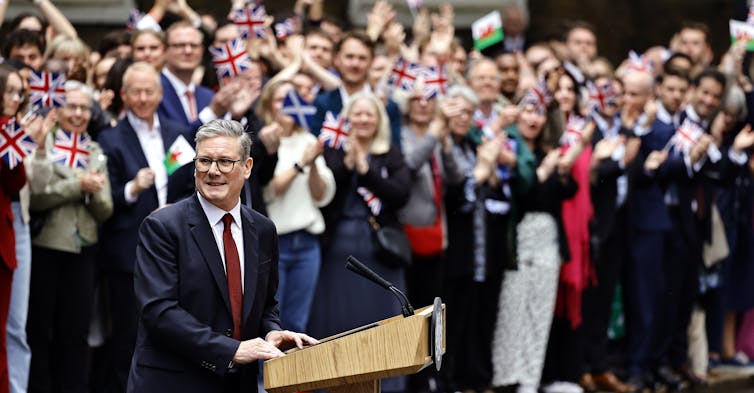
A smiling Keir Starmer delivers his victory speech, with a crowd of supporters behind him
Just over a year ago, a happier Starmer delivers his victory speech. Shutterstock

But respect is not just an abstract idea. People appear to judge whether they are respected by those who govern them or not primarily on the basis of whether the government stands up for them against powerful vested interests.

Our earlier research demonstrated that there is a widespread sense among the British public that certain groups have had it too easy for too long. This is either because they have been able to intimidate the government, or because government ministers and advisers have themselves been recruited from among these groups.

In our new report, therefore, we see that the new government’s most popular act was their willingness to raise the minimum wage by £1,400 in April, against the objections of some in business who suggested that such a move was too burdensome on them.

Changes to the winter fuel allowance and proposed changes to the disability benefits system, on the other hand, registered poorly. They suggest that the interests of ordinary and vulnerable people count for too little in decision-making.

These judgements currently shape the mood of the country and probably top the list of issues that the government now needs to address. There is still time for the government to rebuild its appeal, of course. Indeed, our respondents who said they would vote for Labour said they would do so because the party needs more time to fix the problems they inherited.

But as it seeks to do so, voters will want to know who this government stands for. Whose interests does it put first? What kind of people does it respect?

Much of the electorate thought they knew the answer to these questions one year ago. Now they’re not so sure.

Marc Stears, Director of UCL Policy Lab and Professor of Political Science, UCL

This article is republished from The Conversation under a Creative Commons license. Read the original article.

Keir Starmer says that the Labour Party under his leadership all feel a small part of Scunthorpe.
Keir Starmer objects to criticism of the IDF. He asks how could anyone obect to them starving people to death, forced marches like the Nazis did, bombing Gaza's hospitals and universities,mass-murdering journalists, healthworkers and starving people queuing for food, killing and raping prisoners and murdering children. He calls for people to stop obstructing his genocide for Israel.
Keir Starmer objects to criticism of the IDF. He asks how could anyone obect to them starving people to death, forced marches like the Nazis did, bombing Gaza’s hospitals and universities,mass-murdering journalists, healthworkers and starving people queuing for food, killing and raping prisoners and murdering children. He calls for people to stop obstructing his genocide for Israel.
Keir Starmer chases Nigel Farage's racist bigot vote.
Keir Starmer chases Nigel Farage’s racist bigot vote.

Continue ReadingNearly two-thirds of voters think Starmer doesn’t respect them – new poll

UK police arrest protesters after ban on Palestine Action goes into effect

Spread the love

This work by Middle East Monitor is licensed under a Creative Commons Attribution-NonCommercial-ShareAlike 4.0 International License

Police arrest Palestine Action activist during a solidarity protest outside Royal Courts of Justice as co-founder of Palestine Action Huda Ammori takes Home Secretary to High Court over proscription of the group in London, United Kingdom on July 4, 2025. [Tayfun Salci – Anadolu Agency]

Scores of protesters were arrested in London on Saturday after a ban on the group Palestine Action officially came into effect, Anadolu reports.

The UK government will, for the first time, legally redefine a non-violent protest group, Palestine Action, as a terrorist organization after a last-minute legal challenge to suspend the group’s ban under anti-terrorism laws failed at a high court on Friday.

As of this Saturday, membership in, or showing support for, Palestine Action will become a criminal offense in Britain.

The Metropolitan Police confirmed on Saturday afternoon that officers were responding to a demonstration in Parliament Square and had begun making arrests.

READ: AOHR UK calls on British Gov’t to sanction GHF officials

“The group is now proscribed, and expressing support for them is a criminal offense,” the force said in a statement. “Arrests are being made.”

Officers have arrested more than 20 people on suspicion of offenses under the Terrorism Act 2000.

It added: “There are a number of events taking place in London this weekend and anyone attending should be aware that officers policing these will act where criminal offenses, including those related to support of proscribed groups or organizations, are committed.”

MPs overwhelmingly voted in favor of Home Secretary Yvette Cooper’s decision to proscribe the group under the Terrorism Act 2000 on Wednesday. The House of Lords has also approved the move.

UN experts, civil liberties organizations, cultural figures, and hundreds of lawyers have condemned the ban as “draconian.”

They argue that it sets a dangerous precedent by conflating protest with terrorism.

Palestine Action said it is seeking an “urgent appeal to prevent a dystopian nightmare, which criminalizes thousands of people overnight.”

Another court hearing is scheduled for July 21, when Palestine Action will apply for permission to launch a judicial review in an effort to overturn the order.

Unless the review is successful, being a member of or inviting support for the group that protests Israeli genocide in Gaza will carry a maximum sentence of 14 years in prison.

Meanwhile, pro-Palestine activists disrupted the London Pride parade by covering a float in red paint.

Four protesters from the group Youth Demand targeted a truck belonging to US-based company CISCO, accusing the firm of “genocide” and claiming it has “no place” at the event.

The incident comes less than 24 hours after the protest group Palestine Action was officially banned and designated a terrorist organization.

READ: Palestine Action again targets Israeli defense firm in UK amid risk of being placed on terror list

This work by Middle East Monitor is licensed under a Creative Commons Attribution-NonCommercial-ShareAlike 4.0 International License

Keir "I support Zionism without Qualification" Starmer supporting genocide.
Keir “I support Zionism without Qualification” Starmer supporting genocide.
UK Labour Party government ministers Keir Starmer, Angela Rayner and Rachel Reeves explain that they are partners complicit in Israel's Gaza genocide. The UK has provided Israel with arms, military and air force support. They explain that they don't do gas chambers but do do forced marches, starvation, destroy hospitals, mass-murders of journalists and healthcare workers.
UK Labour Party government ministers Keir Starmer, Angela Rayner and Rachel Reeves explain that they are partners complicit in Israel’s Gaza genocide. The UK has provided Israel with arms, military and air force support. They explain that they don’t do gas chambers but do do forced marches, starvation, destroy hospitals, mass-murders of journalists and healthcare workers.
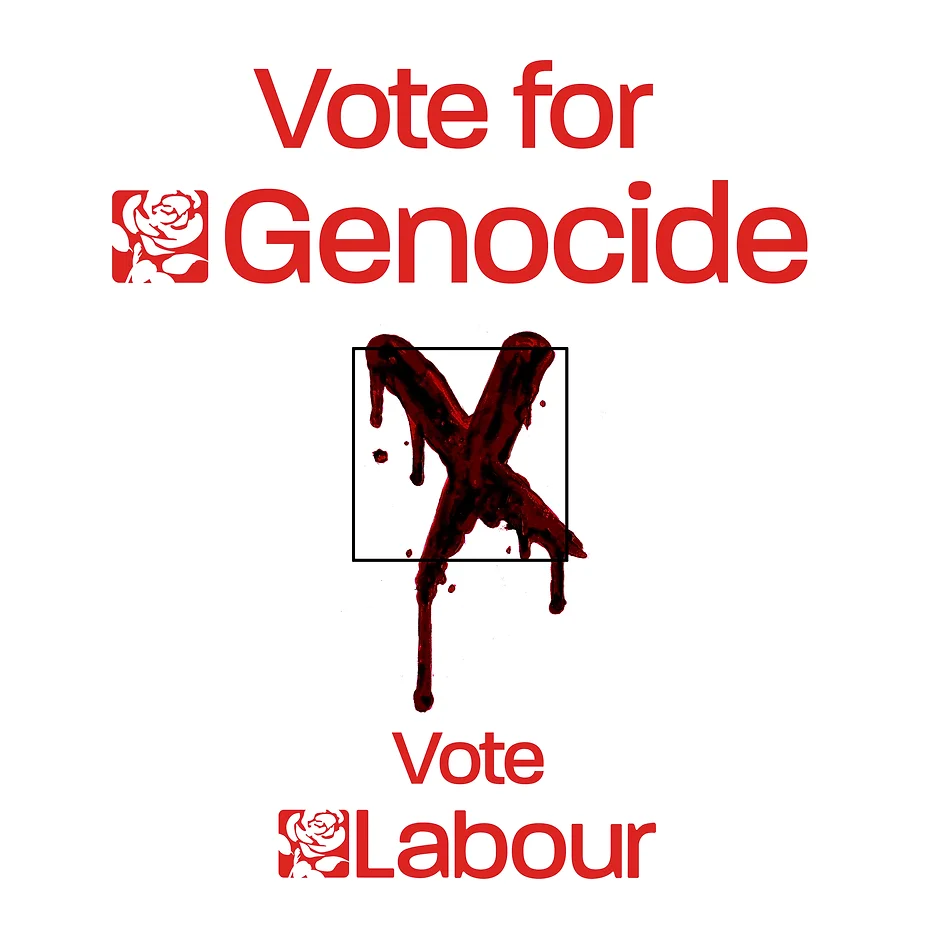
Vote Labour for Genocide.
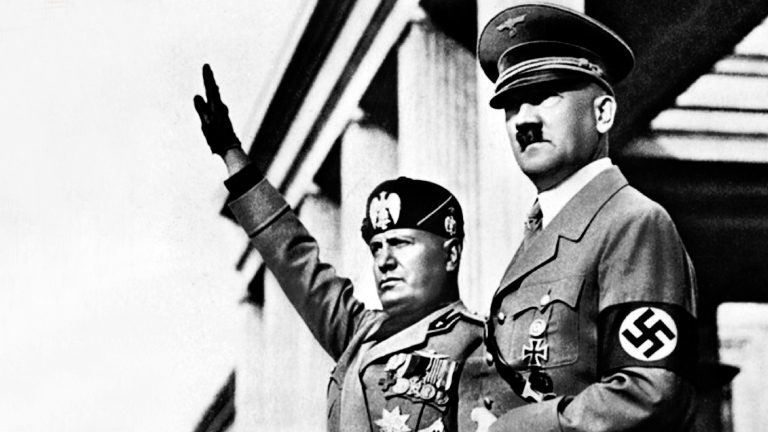
Image of the original Fascists Mussolini and Hitler.
The original Fascists Mussolini and Hitler

Continue ReadingUK police arrest protesters after ban on Palestine Action goes into effect

Italian left party demands answers over police infiltration scandal

Spread the love

Original article by Ana Vračar republished from peoples dispatch under a Creative Commons Attribution-ShareAlike 4.0 (CC BY-SA) license.

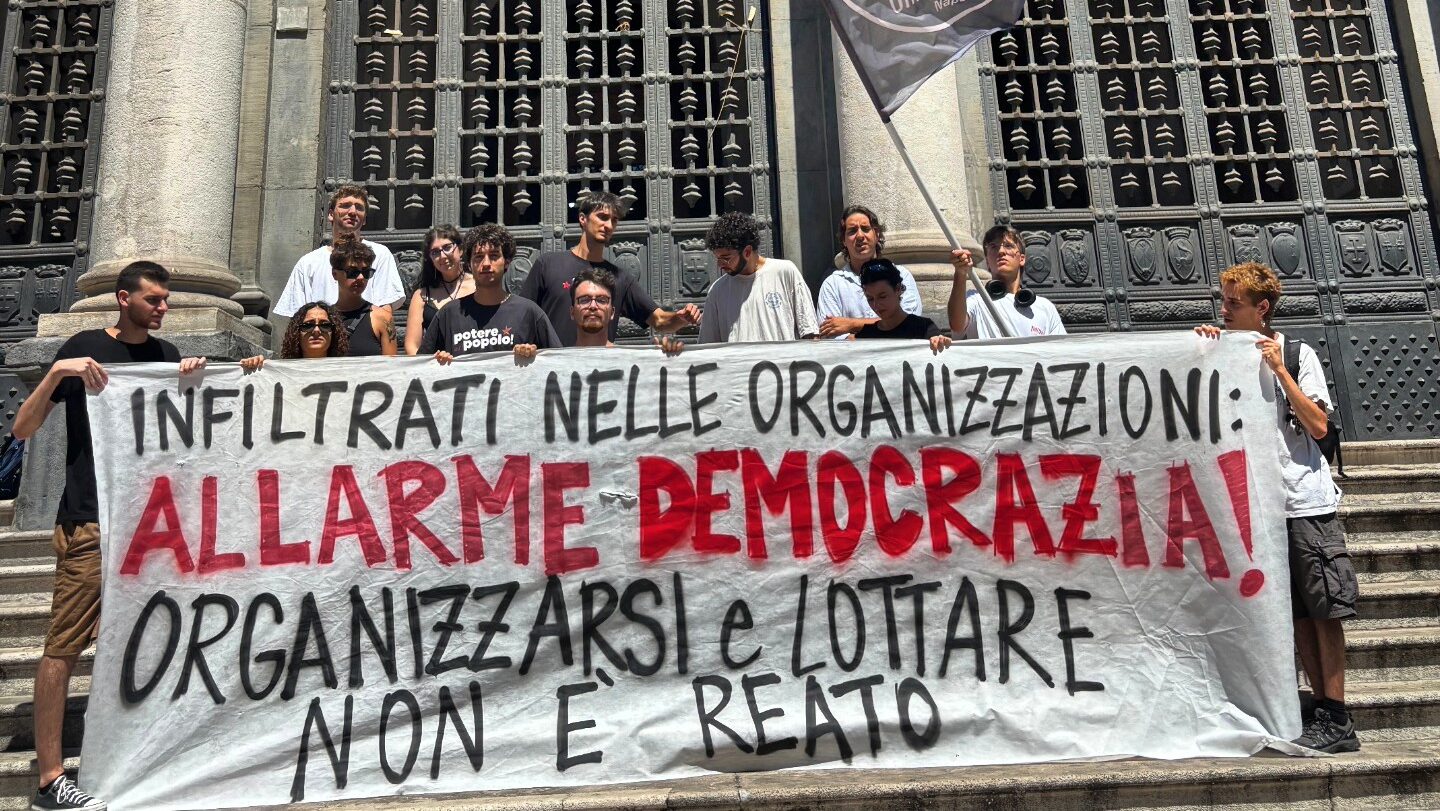
Activists protesting against police infiltrations in Italy. Source: Cambiare Rotta/Facebook

Potere al Popolo is pressing the Meloni government to explain five police infiltration attempts targeting the party’s youth organizations.

Italian left party Potere al Popolo! (Power to the People!) continues to demand full government transparency following revelations that multiple police agents infiltrated the party’s youth groups, Collettivo Autorganizzato Universitario (Self-Organized University Collectives, CAU) and Cambiare Rotta (Changing Course). For approximately eight months, undercover police officers infiltrated or attempted to infiltrate chapters in Naples, Milan, Bologna, and Rome, only to be uncovered through by the party’s internal investigation and independent media outlet Fanpage.

Speaking to Peoples Dispatch, Giuliano Granato, one of Potere al Popolo’s spokespeople, stated that the party is exploring all potential avenues for action, emphasizing that it will not wait passively in the meantime. A key priority is compelling the relevant institutions, including Prime Minister Giorgia Meloni and Interior Minister Matteo Piantedosi, to publicly explain what happened. “They owe the public some answers,” Granato says. “Who ordered this operation? Who planned it? And on what grounds?”

Read more: Italian left party uncovers more cases of police infiltration in their ranks

Meloni’s government and institutions, however, are not known for responding transparently to uncomfortable questions. This became evident again after the first case was exposed in May, when official statements ranged from evasive to outright absurd. One explanation offered, Granato recalls, was that the officer who infiltrated the youth group in Naples had done so not as part of an official assignment, but rather because he had “fallen in love with a Potere al Popolo activist.”

“Are we now supposed to believe five officers from the same training course all suddenly fell in love with five of our activists at the same time?”

Another line of defense claimed that while the infiltrations were official operations, they did not target Potere al Popolo as a political party, but only the specific youth collectives. Yet, even if one was to accept the dubious legitimacy of undercover operations in youth organizations on campuses, that explanation raises new questions. As Granato notes, there are many youth collectives across Italy active on similar issues, including Palestine solidarity and housing. “And yet, the only ones where infiltrators were discovered are the ones organically tied to Potere al Popolo.”

A state increasingly intolerant of dissent

Granato also stresses the importance of keeping public attention on the issue. Since the revelations in May, Potere al Popolo! has received solidarity from grassroots networks and trade unions, civil society organizations, and even a few opposition parties that submitted formal inquiries to the government. “In contrast to this, there has been no media uptake of the case,” Granato said. “Apart from Fanpage, only Il Fatto Quotidiano and il manifesto covered it. The rest of the mainstream media landscape? Radio silence. All the big self-declared progressive media ignored it.”

“This is a very grave thing,” he continues, “because these are the same center-left media that now and then raise concerns about Meloni’s authoritarian drift.” By choosing not to cover the infiltrations in Potere al Popolo, Granato suggests, they show that they will only raise issues when it benefits them, ignoring the public interest when it doesn’t.

The tendency is particularly worrying in the current context, Granato says, considering the infiltration of Potere al Popolo is not an isolated case but part of a broader trend. He points to connections to other recent cases, such as the surveillance of Fanpage journalists and of activists from Mediterranea Saving Humans, who have challenged the government’s deadly migration policies through their work. He also mentions the government’s so-called security decree and an ongoing campaign against the right to strike. “If we connect all these little dots, what emerges is a picture of a government and institutions that are less and less tolerant of dissent,” Granato explains.

Read more: “Disarmiamoli!” brings 30,000 to Rome against NATO and war

Yet it is not individual dissent they are afraid of. Instead, what state authorities and institutions fear is collective dissent that organizes people and gives them the tools to change the status quo, Granato says. This fear is one of the reasons why they would want to infiltrate Potere al Popolo, as they recognize it as a political force capable of posing a real threat to the structures they want to protect.

One way to resist this tendency, Granato concludes, is to remain persistent in showing solidarity, including to those who have been infiltrated by the police. “Publicly showing solidarity means publicly showing there’s still a democratic fabric that hasn’t been destroyed, both in Italy and beyond.”

Original article by Ana Vračar republished from peoples dispatch under a Creative Commons Attribution-ShareAlike 4.0 (CC BY-SA) license.

Continue ReadingItalian left party demands answers over police infiltration scandal

An Onaquietday editorial: UK’s active participation in genocide, the most evil of crimes

Spread the love

by dizzy, RIT

Keir Starmer objects to criticism of the IDF. He asks how could anyone obect to them starving people to death, forced marches like the Nazis did, bombing Gaza's hospitals and universities,mass-murdering journalists, healthworkers and starving people queuing for food, killing and raping prisoners and murdering children. He calls for people to stop obstructing his genocide for Israel.
Keir Starmer objects to criticism of the IDF. He asks how could anyone obect to them starving people to death, forced marches like the Nazis did, bombing Gaza’s hospitals and universities,mass-murdering journalists, healthworkers and starving people queuing for food, killing and raping prisoners and murdering children. He calls for people to stop obstructing his genocide for Israel.


Genocide is the most evil of crimes – it’s a mass-murder, a wholesale slaughter of an identifiable group. Israel is engaged in genocide in Gaza and the West Bank, with the United Kingdom supporting Israel as an active participant providing air force and army support as well as providing arms and more that we have yet to learn.

Keir "I support Zionism without Qualification" Starmer supporting genocide.
Keir “I support Zionism without Qualification” Starmer supporting genocide.


Genocide cannot be tolerated in today’s World. It belongs in the far distant past, we should have moved on to respect all peoples’ right to life in dignity rather than being treated as worthless, less than animals.

UK Labour Party government ministers Keir Starmer, Angela Rayner and Rachel Reeves explain that they are partners complicit in Israel's Gaza genocide. The UK has provided Israel with arms, military and air force support. They explain that they don't do gas chambers but do do forced marches, starvation, destroy hospitals, mass-murders of journalists and healthcare workers.
UK Labour Party government ministers Keir Starmer, Angela Rayner and Rachel Reeves explain that they are partners complicit in Israel’s Gaza genocide. The UK has provided Israel with arms, military and air force support. They explain that they don’t do gas chambers but do do forced marches, starvation, destroy hospitals, mass-murders of journalists and healthcare workers.


I hold Keir Starmer, UK’s prime minister as ultimately responsible for UK’s active participation in Israel’s genocides. He couldn’t get away with it alone of course. His cabinet ministers, the UK government, his party advisors, Labour MPs are also guilty, supporting Starmer’s active participation in Israel’s genocides. Then there are the armed forces – they cannot escape that they are participating in genocide. We must hold them to account for this most serious of crimes.

UK Foreign Minister David Lammy confirms that UK government and military are active participants in Israel’s genocides and that the F-35 parts that they suspended from supplying to Israel are instead simply diverted via the United States. He says see https://youtu.be/QILgUHrdWRE

TBC, likely to be altered and expanded.

4 July:

Keir Starmer warns against following the https://onaquietday.org blog.

4 July 2025 1.20pm

It appears that Jeremy Corbyn has yet to comment regarding Zarah Sultana’s announcement. I don’t know what’s going on and can only speculate.

There have been been false starts of a new left party before, the announcement itself is a political event signalling that there is an extent of opposition organising against shameless genocidalist Keir Starmer. I would expect the old school Socialist like Jeremy Corbyn and John McDonnell would prefer to stay in the Labour Party. That’s where they’ve always been, after all. Is there a plan or is it just testing the waters?

Continue ReadingAn Onaquietday editorial: UK’s active participation in genocide, the most evil of crimes