In short, this doesn’t happen and is part of a frenzy of demonization of disabled benefits claimants whipped-up by the right-wing including Labour Health Secretary Wes Steeting. The Guardian explains:
Queen Elizabeth inspects the classic Invacar, as she hosts a ceremony to celebrate the 40th Anniversary of Motability, at Windsor Castle in 2017. Photograph: Richard Pohle/AFP/Getty Images.
A common refrain in the coverage – “Do you want a free new car?” the Times’ Alice Thomson asked – but one which misses a central point: the Pip funding that goes to Motability is money that customers would have been getting anyway.
If they weren’t getting a car, they’d have it to spend on something else. And if they want a more expensive car – perhaps needing a bigger vehicle for essential equipment, perhaps shockingly able to have preferences despite also having a disability – they have to make a down payment out of their own pocket.
The cars are new, meanwhile, so that they retain a significant resale value at the end of the lease. “It’s just not true that it’s ‘free’,” Carew said. “And because it comes out of an existing Pip award, it’s at no additional cost to the taxpayer.” Scrapping Motability wouldn’t save a penny from the benefits bill.
…
So where did this story come from?
Allegations that Motability is infested with people making bogus claims have existed for manyyears. Hardy perennial though the story is, it’s also worth tracking the genesis of the latest iteration. Part of the timeline is familiar enough: first a fascinating Bloomberg piece focusing on Motability’s impact on the car market, then the Daily Mail, then everyone else.
Before that, though, the story gained momentum in a stranger corner of the internet – through a couple of rightwing X accounts, @loftussteve and @maxtempers, with fewer than 28,000 followers between them. The anonymous user behind Max Tempers, in particular, has been banging the drum since at least December, when he suggested that claimants should only be allowed to drive a hideous old car with MOTABILITY written on it. A few weeks later, a post of his about grooming gangs was shared by Elon Musk, and became the ground zero of a whole other dodgy social media frenzy.
As the Motability story went viral, it got picked up by accounts like Politics UK, a popular X news source, and later by prominent users like GB News’ deputy political editor Tom Harwood, who even borrowed Max Tempers’ idea for a car of shame. With crushing inevitability, after the Daily Mail piece, Wes Streeting told GB News the story showed why the welfare system needs reform.
Wednesday’s spring statement has been overshadowed by where the cuts are due to fall, with some departments asked to model cuts of up to 11%. Photograph: pxl.store/Alamy
‘You can’t cut your way to growth,’ says PCS head as Reeves confirms move to cut administrative costs by 15% by 2030
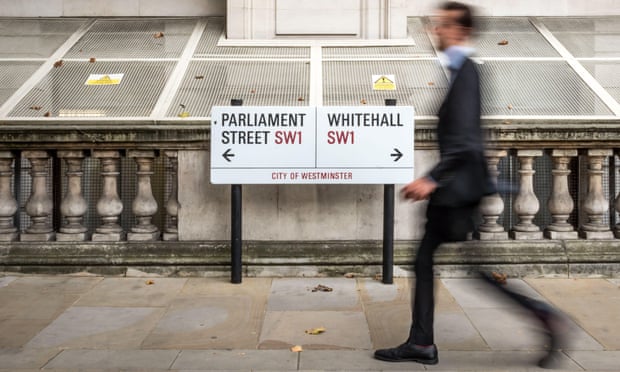
Rachel Reeves’s planned cuts of £2bn to government departments will hit frontline services from jobcentres to HMRC phone lines and efforts to cut the asylum backlog, a union has said.
On Sunday the chancellor confirmed plans to seek a 15% reduction in admin costs across Whitehall, amounting to about £2bn a year, by the end of the decade. She said this would also result in about 10,000 job losses in the civil service, although this was not a target.
As she prepares to give her spring statement on Wednesday, Reeves is under pressure to balance the books in line with her fiscal rules, meaning some departments are in line for spending cuts to avoid more tax rises or higher borrowing.
But the Public and Commercial Services Union (PCS) warned her that there would be consequences for public services after 15 years of underfunding by the Tories.
Fran Heathcote, the general secretary of the PCS, said: “You hear that every day from the public, that they wait too long on the phone when they try to make tax payments, jobseekers rushed through the system in just 10 minutes because there aren’t enough staff to see them, victims of crime waiting until 2027 to have their cases heard in the courts as well as the backlog in the asylum system which results in additional hotel costs.
“The impact of making cuts will not only disadvantage our members but the public we serve and the services they rely on. We’ve heard this before under Gordon Brown when cuts were made to backroom staff and [the] consequences of that were chaos.”
Keir Starmer, Angela Rayner and Rachel Reeves wear the uniform of the rich and powerful. They have all had clothes bought for them by multi-millionaire Labour donor Lord Alli. CORRECTION: It appears that Rachel Reeves clothing was provided by Juliet Rosenfeld.Keir Starmer confirms that he’s proud to be a red Tory continuing austerity and targeting poor and disabled scum.
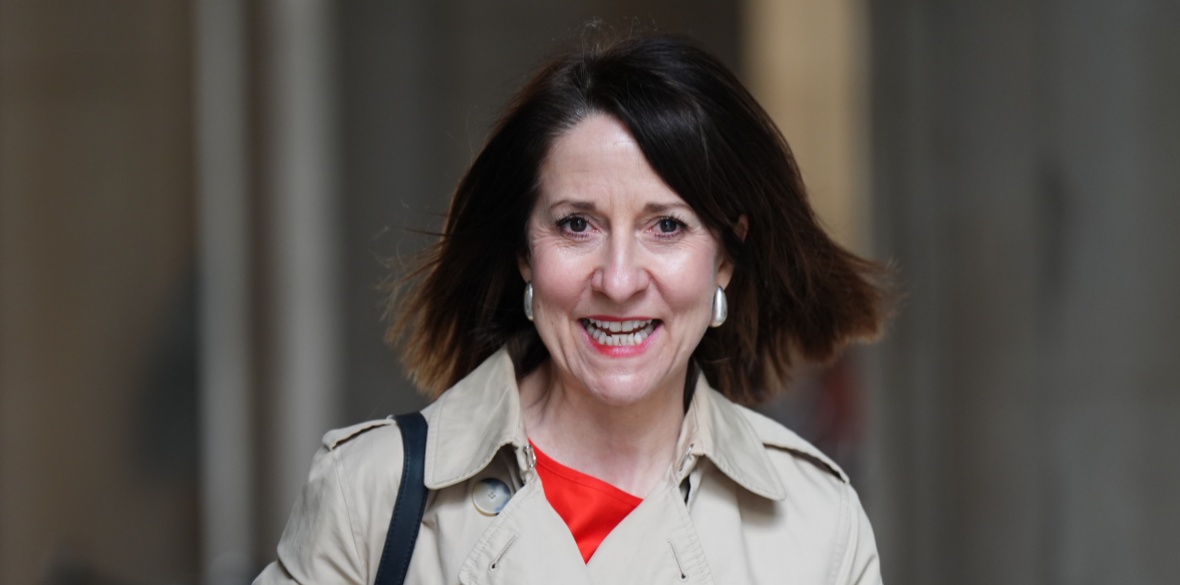
Work and Pensions Secretary Liz Kendall arrives in Downing Street, London, for a Cabinet meeting, March 11, 2025
ALMOST two-thirds of disabled people on Personal Independence Payments (PIP) “will not cope” without it, a charity has warned, amid reports that the government will reduce the benefit.
Work and Pensions Secretary Liz Kendall is expected to unveil reforms aimed at reducing welfare costs that ministers have described as “unsustainable.”
Reports suggest that PIP, the main benefit for working-age adults both in and out of work, could be frozen rather than increased in line with inflation, delivering a real-terms cut for 3.6 million claimants.
A new analysis from Sense has found that 38 per cent of PIP recipients with complex needs are already behind on energy bills. Almost half — 46 per cent — are struggling to afford essential costs such as council tax and water, while 41 per cent are living in debt due to benefits failing to cover the cost of essentials like food.
Fifty-eight per cent of those polled reported significant ongoing extra costs due to disability and 53 per cent said their PIP payments were insufficient to cover those expenses.
Sense chief executive James Watson-O’Neill said PIP “exists because living with a disability means facing higher costs, from increased energy bills to specialised equipment and specific diets.”
“These additional expenses won’t disappear if eligibility is tightened. It will only plunge more disabled people into poverty.
“Making it harder to access benefits won’t help disabled people find jobs either. It will only deepen the struggle.”
Keir Starmer confirms that he’s proud to be a red Tory continuing austerity and targeting poor and disabled scum.Keir Starmer, Angela Rayner and Rachel Reeves wear the uniform of the rich and powerful. They have all had clothes bought for them by multi-millionaire Labour donor Lord Alli. CORRECTION: It appears that Rachel Reeves clothing was provided by Juliet Rosenfeld.
The spat between Nigel Farage, the leader of the Reform party, and Rupert Lowe, the MP for Great Yarmouth, burst into the open when Lowe was suspended from the party. The allegation was that he had threatened violence to the party leadership, which he denies. The matter is currently being investigated by the police.
The row does not appear to have affected support for Reform in the polls. A YouGov poll completed on March 10, after Lowe’s suspension, shows Reform on 23% in vote intentions, compared with 24% for Labour and 22% for the Conservatives. It is still a three-party race at the top of British party politics.
In the 2024 general election a good deal of Reform’s support came from protest voters. These are voters who dislike all the mainstream parties and so see a vote for the party as a way of choosing “none of the above”. They are not attached to any party and can easily switch support when circumstances change. So why has support for the party not been affected by this row?
Protest politics and support for Reform
The answer to this question is that while Reform attracted a lot of discontented protest voters in the election, it has since acquired a more stable niche in British party politics. It is primarily a party of English nationalism, equivalent to the SNP in Scotland and Plaid Cymru in Wales. These three parties differ greatly in outlook and politics, but they occupy a similar place in the public’s minds.
Want more politics coverage from academic experts? Every week, we bring you informed analysis of developments in government and fact check the claims being made.
To examine Reform’s support from protest voters we can look at the relationship between spoilt ballots in the 2024 general election and support for the party in the 632 constituencies in England, Scotland and Wales. Normally, observers of British elections pay little attention to spoilt ballots (or “invalid votes” as they are described in official statistics). However, it turns out that they played an important role in the 2024 election which has a bearing on support for Reform.
Research shows that voters who spoil their ballots can be classified into two categories: those who simply make a mistake when filling in the ballot and those who are protesting about the current system.
Mistakes are easy to make in countries with complex electoral systems. However, in Britain, the first-past-the-post system in which everyone has just one vote, ensures that this is not a significant factor because ballot papers are so simple. The bulk of spoilt ballots are protests of various kinds, taking the form of blank ballots, write-in candidates, or abusive messages about parties and candidates.
This is illustrated in the Lancashire seat of Chorley, which is held by the speaker of the House of Commons, Lindsay Hoyle. By tradition none of the major parties challenge the Speaker by campaigning in his constituency. In the election there were no less than 1,198 spoilt ballots in his constituency. It is fairly clear that these were a result of some voters feeling disenfranchised by the absence of their preferred party on the ballot paper.
The relationship between the Reform vote share and the number of spoilt ballots in constituencies in the 2024 election
Protest voting takes different forms. P Whiteley, CC BY-ND
There is a strong negative relationship (a correlation of -0.46) between the share of a constituency vote that went to Reform in 2024 and the number of ballots spoiled in that constituency. Where people were voting Reform, in other words, fewer people were spoiling their ballots. The implication is that the party picked up votes from people who would normally spoil their ballots or would not have voted at all if Reform had not stood in their constituency. These are the protest voters.
Identity politics and support for Reform
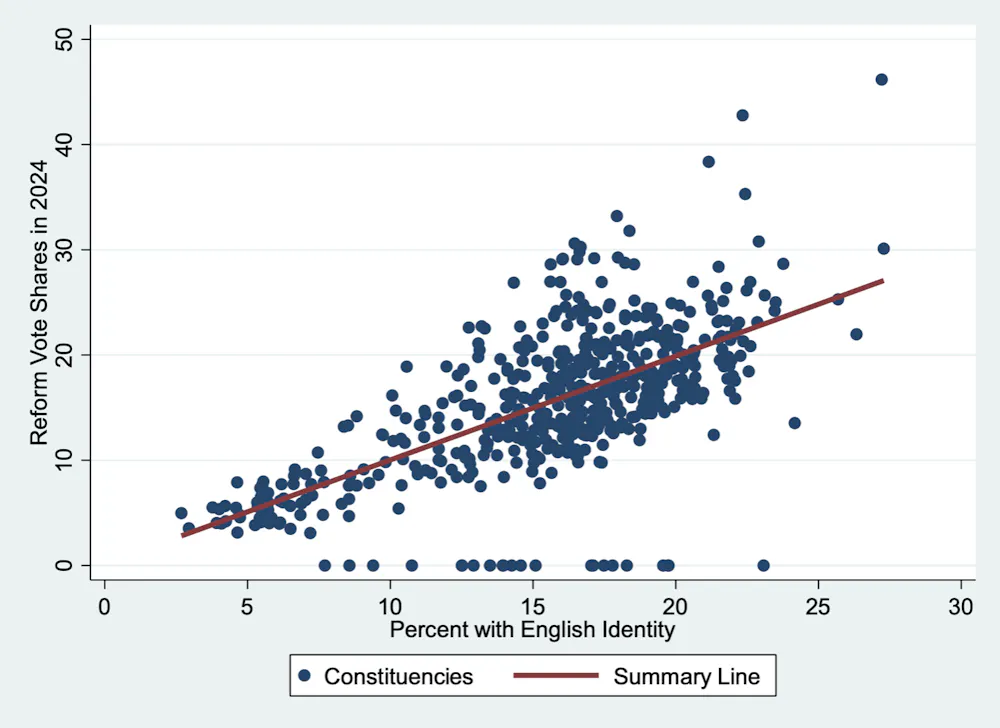
Not all support for Reform came from protest voters, however. The chart below compares the percentage of Reform voters with those who identified as English in the 2021 census in England. There is a strong relationship between the two measures (a correlation of 0.66). The more English identifiers there are in a constituency, the greater support for Reform. In effect, Reform has become an English national party.
The relationship between Reform voting and English identity in 2024
An English national party in the making. P Whiteley, CC BY-ND
National identities can change over time, but the process of change is slow. There has been a growth in “Englishness” at the expense of “Britishness” over time and this is undoubtedly reinforcing support for Reform.
It means the party has a relatively solid base of supporters to rely on in future elections. While the row between the party’s leader and one of his MPs could play out in any number of different directions at this early stage, it would be wrong to suggest that Reform isn’t thinking big picture and long term.
Farage has clearly learnt from his past and will not let his current party disintegrate into chaos like UKIP or the Brexit party before it.
Nigel Farage explains the politics of Reform UK: Racism, Fake anti-establishmentism, Deregulation, Corporatism, Climate Change Denial, Mysogyny and Transphobia.Elon Musk urges you to be a Fascist like him, says that you can ignore facts and reality then.
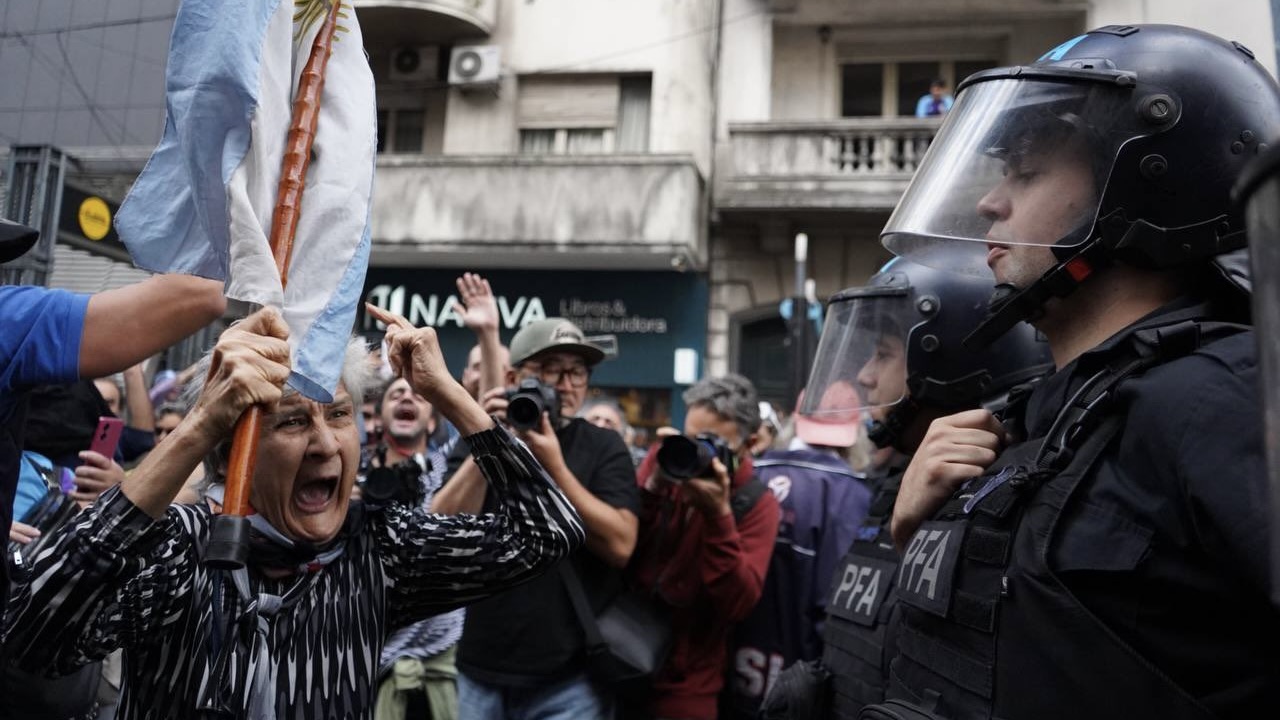
Interaction between a pensioner and a cop in Buenos Aires on March 12. Photo: Argentina Humana / X
More than a hundred people were arrested and dozens were injured in the police repression. Movements and press organizations have called for the resignation of the Secretary of Security, Patricia Bullrich.
On March 12, Javier Milei’s right-wing government brutally repressed a demonstration of retirees and their supporters, including fan clubs of football teams, demanding better living conditions. The Buenos Aires Police reported that at least 124 people were arrested in the protests outside Congress. For its part, the Emergency Medical Attention System (SAME) reported that, at the end of the day of protests, 46 people were injured.
Early on March 13, a judge in Buenos Aires, Karina Andrade, ruled to free 114 of the detainees arguing that the constitutional rights to protest, to manifest in democracy, and free speech, had been put at risk. She added that elderly people are “one of the most vulnerable sectors of our country” and they are protected.
Retirees demand to live with dignity
For the past several months, retirees have been protesting every Wednesday to demand an improvement in their living conditions. Thanks to Milei’s neoliberal adjustments, their quality of life has drastically declined.
According to data from the Ombudsman’s Office for the Elderly, a pensioner needs at least 1,200,523 pesos (USD 1,066) per month to cover their basic expenses. However, the minimum pension in February was 343,086 pesos (USD 321), including a bonus of 70,000 pesos (USD 65). The glaring gap between the cost of living and the income of pensioners has been the key motivating factor driving adults of 70-90 years old to take to the streets every week and risk brutal repression from Milei’s right-wing government.
According to Florencia Abreju, an Argentine journalist, “The cuts to medicines, the reduction of medical assistance, and the excessive increase of basic services have aggravated the situation even more. Why always with the retirees? The answer is clear: Milei’s government destroys the rights of all, starting with the weakest.”
Repression was ordered by Milei’s government
This Wednesday was not the first time that the Minister of Security Patricia Bullrich had ordered repression, but the level of force used by the police was certainly more extreme. Tear gas, rubber bullets, water cannons, pepper spray, blows with batons, etc., were some of the means of repression used by the Argentine police to confront the demonstrators, who were mostly retirees.
Pensioner dousing his face with milk after being tear gassed. Photo: Argentina Humana / X
One of the victims is photographer Pablo Grillo, who suffered a serious head injury while taking pictures of the protest and the repression. As seen in a video, the police fired a tear gas bomb at him which directly impacted his head, causing a severe wound that kept him on the verge of death at the Ramos Mejía hospital in Buenos Aires.
The Executive justified the widespread repression of the protests by citing the participation of several fan organizations of various Argentine soccer clubs, such as Chacaritas, Boca Juniors, River Plate, and Rosario Central, among others. According to Bullrich, the members of the so-called “barras bravas” are dangerous groups and this justified the forceful response of the National Police, even though several of the injured and detained do not belong to such groups. On her X account, the Security Secretary wrote “Our forces are deployed to enforce the protocol: traffic is not cut and the barras bravas, on the sidewalk.”
However, for Florencia Abreju, this type of rhetoric seeks to discredit the legitimate claims of the protesters. “The most alarming thing is that the government, through Bullrich and her officials, justified the repression and stigmatized the protesters… This discourse seeks to criminalize social protest and delegitimize the demands of people who take to the streets to defend their rights. The stigmatization of militancy and fierce repression are tools typical of an authoritarian government that is willing to do anything to stay in power.”
Several journalists demand Bullrich’s resignation
In response to the repression ordered by the Secretary of Security and in solidarity with the injured journalist, several journalists have begun calling for Patricia Bullrich’s resignation. The Association of Graphic Reporters of Argentina expressed in a communiqué “Institutional violence and impunity for crimes committed by the security forces have increased…Today [we demand] that the President [Milei] immediately remove [Patricia Bullrich] and place her and her subordinates at the disposal of the justice system. Otherwise, we make him morally, politically, and criminally complicit in the crimes committed by his [Security] Secretary.”
“They shot a colleague in the Congress…Tomorrow all the journalists in Argentina must be asking for the resignation of whoever ordered the shooting of the colleague,” said a journalist on the Crónica TV Show as images of the repression flashed on the screen.
For now, Milei shows no signs of backing down from his internal security policy of openly and forcefully repressing demonstrators opposing his neoliberal agenda. In this regard, Abreju points out “Repression, stigmatization, and authoritarian discourse are signs of a government that is in decline but does not hesitate to resort to excessive force to impose its agenda through terror. It is time to be alert and united in the face of this subjugation of rights. What is at stake is not only the future of retirees but democracy and the future of the nation. Today, as never before, it is necessary to defend what has been conquered and repudiate the systematic violence that seeks to install fear in the people with an already known recipe.”