RAF fighter jets have taken part in joint bombing exercises over western Asia with the US Central Command (CENTCOM) and F-15 and F-35 fighters of the Israeli air force, believed to be preparation for attacks on Iran.
The 4 March exercise – the third in two weeks – involved giant US B-52H ‘Stratofortress’ bombers that took off from Fairford RAF base in England and conducted the exercise in CENTCOM’s ‘area of responsibility’, which comprises the ‘Middle East’ and parts of southern Asia.
The latest exercise follows a live-weapon drop on 20 February that the US military said involved B-52s conducting “multiple missions over the Arabian Peninsula and Red Sea”. With typically Orwellian language, the Pentagon said that these missions ‘promote security and stability’ in the region. In the past twelve months the US has used the B-52s, along with B-1 and B-2 bombers, to bomb Iraq, Syria and Yemen.
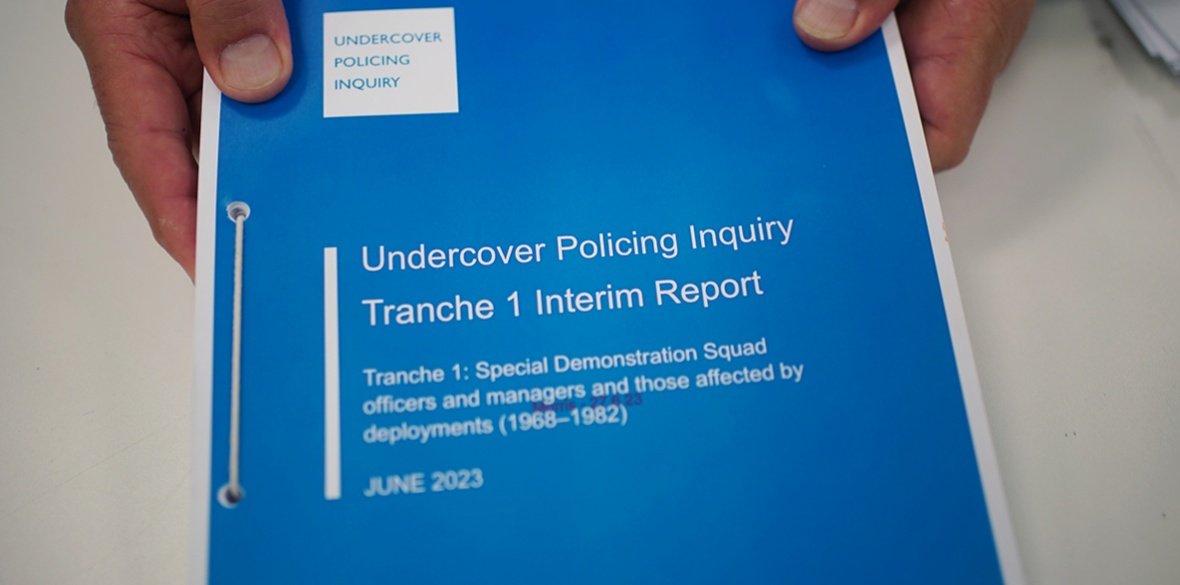
Campaigners from Police Spies out of Lives speak to the media after the publication of first part of the report from the Undercover Policing Inquiry, at Blackfriars Settlement, south east London, June 29, 2023
MORE than 100 victims have threatened to walk away from the long-running “unfair” spycops inquiry.
A total of 92 individuals and 20 activist groups have signed an open letter alleging mistreatment by the probe which began in July 2015.
They have threatened to withhold giving evidence to the next stage of the inquiry covering abuses by the Metropolitan Police’s political undercover units between 1993 and 2014.
The non-state “core participants” called for “full disclosure and reasonable timetables” and that “witnesses must not be excluded as a result of insufficient time to prepare — we seek assurances our evidence will be heard.”
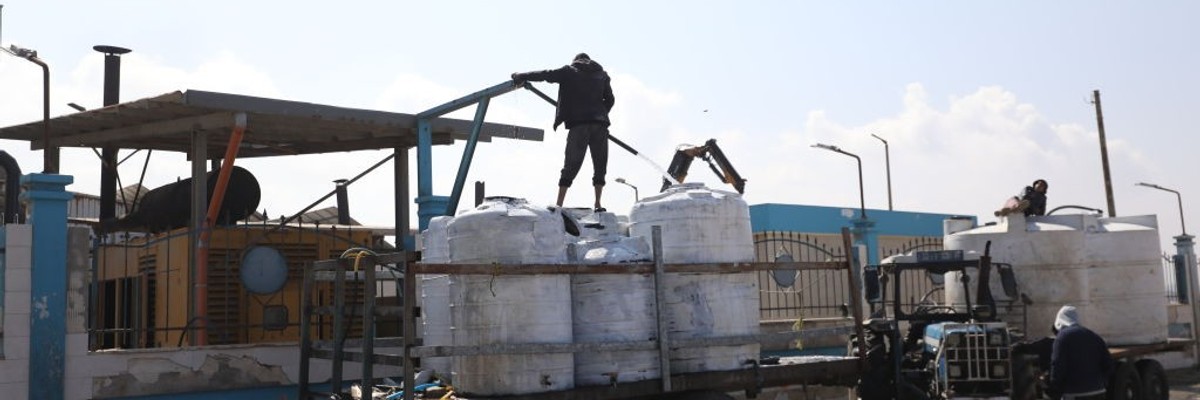
A water treatment plant in Deir al-Balah, Gaza is on the verge of shutting down due to Israel’s order to cut electricity flow on March 10, 2025. (Photo: Moiz Salhi/Anadolu via Getty Images)
One expert noted that “this collective punishment of civilians” violates the Geneva Convention as well as a preliminary injunction from the International Court of Justice.
Outrage over the Israeli government’s decision to cut off electricity to a water treatment plant in the decimated Gaza Strip mounted on Monday.
As Common Dreams reported Sunday, Israeli Energy Minister Eli Cohen said that he “signed an order for the immediate halt of electricity to the Gaza Strip” as part of a policy to use “all of the tools that are at our disposal to ensure the return of all the hostages” taken by Hamas on October 7, 2023.
The Times of Israel noted that the new move by Israeli Prime Minister Benjamin Netanyahu’s government “was mainly expected to affect a single desalination plant, the only facility in the strip still running on a power line supplied from Israel.”
Responding on social media Monday, the Peace & Justice Project—founded by Jeremy Corbyn, an Independent member of the U.K. Parliament—condemned the cutoff as Israel’s “latest act of genocidal collective punishment against the Palestinian people.”
“This latest despicable act must be condemned by all governments and Israel must be sanctioned,” the group added.
Also speaking out on social media, Francesca Albanese, United Nations special rapporteur on the situation of human rights in the Palestinian territory occupied since 1967, declared, “GENOCIDE ALERT!”
“Israel cutting off electricity supplies to Gaza means, among others, no functioning desalination stations, ergo: no clean water,” Albanese said. “STILL NO SANCTION/NO ARMS EMBARGO against Israel means, among others, AIDING AND ASSISTING Israel in the commission of one of the most preventable genocides of our history.”
Unconscionable, and immoral:Israel stops electricity supply to Gaza to ratchet up pressure on Hamas | The Times of Israel www.timesofisrael.com/liveblog_ent…
Izzat al-Rishq, a member of Hamas’ political bureau, called the move “a desperate attempt to pressure our people and their resistance through cheap and unacceptable blackmail tactics,” according to The Times of Israel.
He tied the decision to Israel halting all humanitarian aid into the Palestinian enclave last week, saying that “we strongly condemn the occupation’s decision to cut off electricity to Gaza, after depriving it of food, medicine, and water.”
Clean water has been a key issue in Gaza since October 2023. Oxfam said last July that Israel had systematically reduced the water available by 94%, with just 4.74 liters per resident obtainable each day—less than a third of the recommended minimum amount in emergencies.
A Human Rights Watch report from December accuses Israel of “extermination and acts of genocide” in Gaza “by intentionally depriving Palestinian civilians there of adequate access to water, most likely resulting in thousands of deaths.”
Netanyahu said that last week’s block on aid was done “in full coordination” with U.S. President Donald Trump, who proposed an American takeover of Gaza—a plan that Israeli Finance Minister Bezalel Smotrich said Sunday “is taking shape.”
Israel and Hamas reached a fragile three-part cease-fire and hostage-release deal in January. Stage one expired on March 1, and negotiators have not yet agreed to terms for the second phase, but talks are being held in Qatar this week.
“Food cut off, almost all electricity cut off, with the remaining energy now cut off too, in order to cut off water supply. This is a ‘cease-fire’ Israel-style,” said Nick Dearden, director of the U.K.-based group Global Justice Now. “Barbaric collective punishment. Stop all weapons, suspend trade deals, economic sanctions now.”
Since we made this statement Israel has announced it is cutting off electricity to Gaza. We say again: the threat of starvation and denial of vital humanitarian aid and services should never be used as a tool of war or a bargaining chip in negotiations. www.quaker.org.uk/news-and-eve…
University of Michigan professor Juan Cole wrote Monday on his website, Informed Comment, that “the Israeli government is cutting Palestinian civilians in Gaza off from staples as a means of pressuring Hamas to release all Israeli hostages with no quid pro quo so that Netanyahu can start bombing again.”
“This collective punishment of civilians violates the Geneva Convention and other elements of internationally agreed on laws of war to which Israel is signatory,” noted Cole. “It also violates the preliminary injunction of the International Court of Justice, in which Israel also has membership.”
Israel faces an ongoing genocide case at the Hague-based court over its deadly blockade and assault of Gaza—assisted by billions of dollars in U.S. weapons. Like his predecessor, Trump’s administration is working to send even more arms to Israel.
Zionist Keir Starmer is quoted “I support Zionism without qualification.” He’s asked whether that means that he supports Zionism under all circumstances, whatever Zionists do.
Neo-Fascist Climate Science Denier Donald Trump says Burn, Baby, Burn.
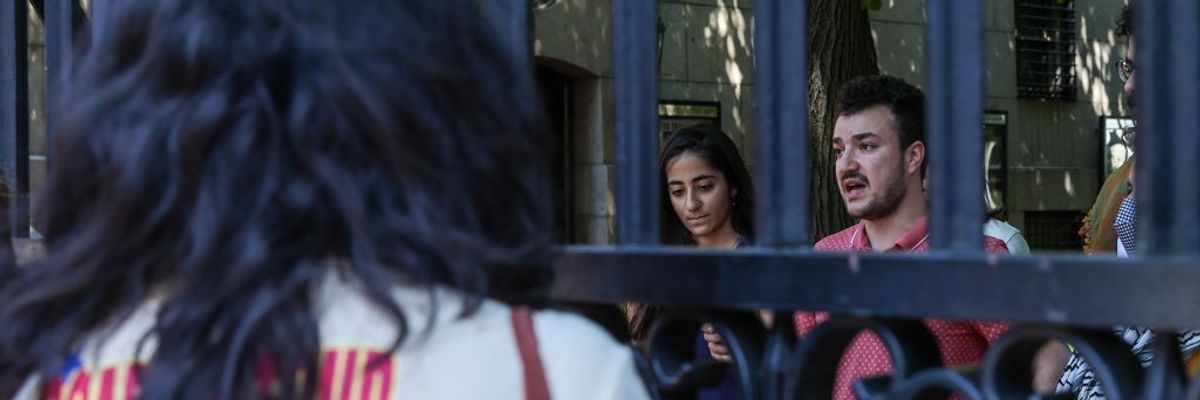
Mahmoud Khalil was pictured speaking to the press during a briefing organized by pro-Palestinian protesters at Columbia University on June 1, 2024. (Photo: Selcuk Acar/Anadolu via Getty Images)
“Arresting and threatening to deport students because of their participation in political protest is the kind of action one ordinarily associates with the world’s most repressive regimes.”
Civil rights organizations, legal experts, and lawmakers were among the chorus voicing alarm Sunday and into Monday over the dire implications of the Trump administration’s brazen arrest of Mahmoud Khalil, a Palestinian rights organizer who helped lead Columbia University student protests against Israel’s assault on Gaza.
“The Trump administration’s outrageous detention of Mahmoud is designed to instill terror in students speaking out for Palestinian freedom and immigrant communities,” said Jewish Voice for Peace (JVP), which has helped organize nationwide demonstrations against Israel’s catastrophic war on the Palestinian enclave.
“This is the fascist playbook,” the group added. “We all must fiercely reject it, and universities must start protecting its students.”
Khalil, a permanent U.S. resident with a green card, was arrested on Saturday by Immigration and Customs Enforcement (ICE) agents who stormed his university-owned apartment in Manhattan. Khalil’s attorney told The Associated Press that the ICE agents also threatened to arrest his pregnant wife, an American citizen.
As of Monday morning, Khalil—an Algerian citizen of Palestinian origin—was being held in an ICE facility in Louisiana, and the Trump administration is moving to revoke his green card.
While the State Department CAN revoke *visas* with very little legal process involved, stripping someone of a green card is done by DHS (not the State Department) and requires filing formal charges alleging a violation of immigration law and a removal hearing in front of an immigration judge.
The Department of Homeland Security (DHS), which oversees ICE, said Sunday that Khalil’s arrest was carried out “in support of President Trump’s executive orders prohibiting antisemitism.”
But JVP and other advocacy groups warned that the administration’s purported crackdown on antisemitism is a pretext for a dangerous assault on civil liberties, including those of Palestinian rights advocates.
“We are not fooled by the Trump administration’s claims that this blatantly unconstitutional and authoritarian attack is somehow in the name of Jewish safety,” said JVP. “Deporting anti-war students who are trying to end genocide and silencing political speech endangers all of us. We will not be divided.”
“The unlawful detention of Mr. Khalil reeks of McCarthyism. It’s clear that the Trump administration is selectively punishing Mr. Khalil for expressing views that aren’t MAGA-approved.”
Jameel Jaffer, executive director of the Knight First Amendment Institute at Columbia University, said in a statement that “arresting and threatening to deport students because of their participation in political protest is the kind of action one ordinarily associates with the world’s most repressive regimes.”
“It’s genuinely shocking that this appears to be what’s going on right here,” Jaffer added. “Universities must recognize that these actions pose an existential threat to academic life itself. They must make clear, through action, that they will not sit on the sidelines as the Trump administration terrorizes students and faculty alike and runs roughshod over individual rights and the rule of law.”
Khalil’s arrest came days after Trump threatened to imprison students engaged in what he described as “illegal protests.” AP reported that “Khalil’s arrest is the first publicly known deportation effort under Trump’s promised crackdown on students who joined protests against the war in Gaza that swept college campuses last spring.”
Donna Lieberman, executive director of the New York Civil Liberties Union, said in a statement Sunday that “the Trump administration’s detention of Mahmoud Khalil—a green card holder studying in this country legally—is targeted, retaliatory, and an extreme attack on his First Amendment rights.”
“The unlawful detention of Mr. Khalil reeks of McCarthyism. It’s clear that the Trump administration is selectively punishing Mr. Khalil for expressing views that aren’t MAGA-approved—which is a frightening escalation of Trump’s crackdown on pro-Palestine speech, and an aggressive abuse of immigration law,” Lieberman added. “Ripping a student from their home, challenging their immigration status, and detaining them solely based on political viewpoint will chill student speech and advocacy across campus. Political speech should never be a basis of punishment, or lead to deportation.”
Neo-Fascist Climate Science Denier Donald Trump says Burn, Baby, Burn.Elon Musk urges you to be a Fascist like him, says that you can ignore facts and reality then.
Women chant slogans during a protest marking International Women’s Day in Istanbul, Turkey, March 8, 2025
WOMEN took to the streets of cities across Europe, Africa, South America and elsewhere to mark International Women’s Day with demands for ending inequality and gender-based violence.
On the Asian side of Istanbul, Turkey’s biggest city, a rally in Kadikoy saw members of dozens of women’s groups listen to speeches, dance and sing in the spring sunshine.
The colourful protest was overseen by a large police presence, including officers in riot gear and a water cannon truck.
Protesters pushed back against the idea of women’s role being confined to marriage and motherhood, carrying banners reading “Family will not bind us to life” and “We will not be sacrificed to the family.”
…
From Athens to Madrid, Paris, Munich, Zurich and Belgrade and in many more cities across the continent, women marched to demand an end to treatment as second-class citizens in society, politics, family and at work.