Despite international pressure to free Hiba, Jordanian authorities held her for her full sentence in a “huge setback for press freedoms.
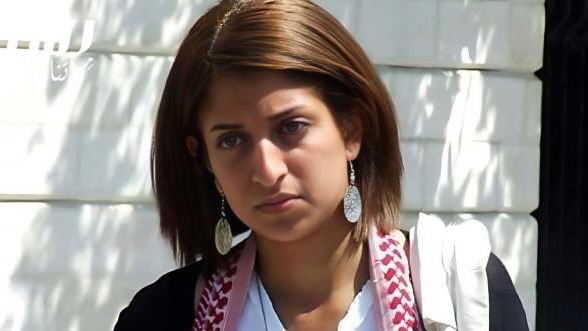
Jordanian authorities released journalist Hiba Abu Taha on Thursday, February 13, upon completing her prison sentence.
In June, 2024, Hiba was sentenced to one year in prison for violating Jordan’s controversial Cybercrime Law by allegedly “spreading false news, slandering, insulting or defaming a governmental authority or an official body,” and “inciting discord and strife among members of society, targeting community peace, and inciting violence.”
One of those charges was reportedly imposed on Abu Taha for an article she wrote, in which she criticized Jordan’s interception of Iranian drones and rockets launched against Israel in April, 2024.
Meanwhile, she faced the other charge for writing an investigative report, exposing Jordanian companies, which were transporting goods to Israel through the Jordanian territory during Israel’s genocidal aggression on Gaza.
The imprisonment of Abu Taha and the enactment of the Cybercrime Law were widely criticized by international human rights and press freedom organizations. These organizations described Hiba’s imprisonment as a “huge setback for press freedom” in Jordan. They labelled the Cybercrime Law “draconian.”
In October 2024, an online campaign titled “We stand in solidarity with Hiba Abu Taha” was also launched by 24 media platforms, including Peoples Dispatch. However, the Jordanian authorities ignored the widespread opposition from organizations and grassroots campaigns, and continued Hiba’s incarceration until the last day of her prison sentence.
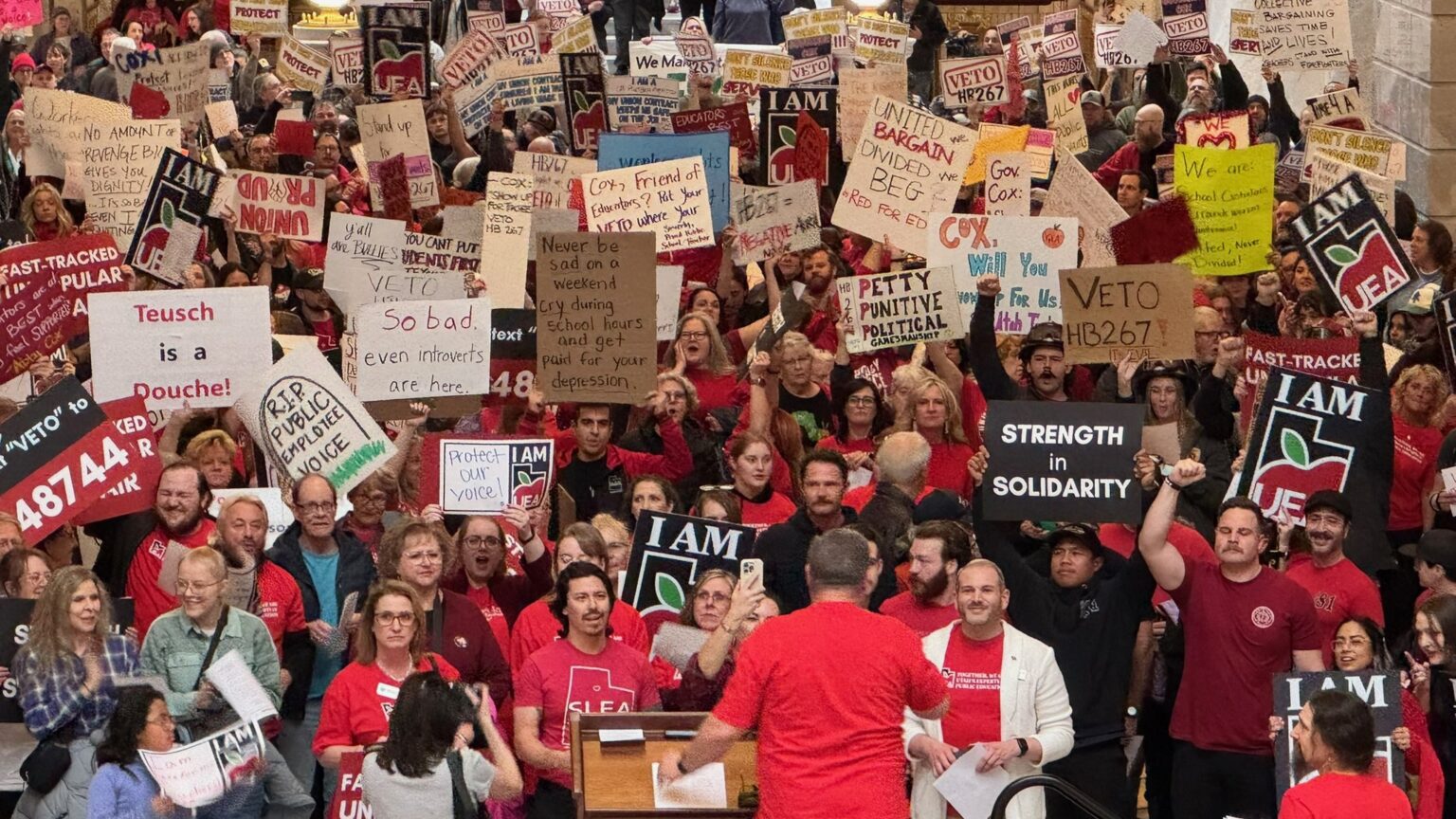
Workers pack the State Capitol building in Salt Lake City, Utah demanding Governer Cox veto HB 267. Photo: UEA
Utah’s controversial HB 267 seeks to ban collective bargaining for federal workers, drawing fierce opposition from unions and activists.
A controversial bill in the US state of Utah, HB 267, is making its way through the state legislature, sparking intense debate and widespread opposition.
If signed into law, the bill would make it illegal for any federal agency in Utah to recognize labor unions or engage in collective bargaining with their employees. This sweeping measure would impact thousands of workers, including teachers, health care workers, emergency responders, and a variety of other workers employed by federal agencies. Many federal employees rely on unions to fight for fair wages, benefits, and working conditions.
The bill has been met with fierce opposition from labor unions, federal workers, civil rights groups, and grassroots organizations. Many of whom see HB 267 as not just harmful to individual employees, but having far-reaching consequences for the broader labor movement and worker’s rights in Utah.
Despite the opposition, HB 267 passed the House floor on January 26 with a 42-32 vote and narrowly passed the Senate on February 6 with a 16-13 vote. It now awaits a decision from Utah Governor Spencer Cox, who must choose to either sign or veto the bill in the coming days.
Labor movement fights back against HB 267
The American Federation of Government Employees (AFGE), Utah AFL-CIO, and the Utah Education Association (UEA) have held several rallies at the State Capitol in protest of HB 267. Thousands of workers packed the building after the Senate passed the bill, demanding a veto from the Governor.
Workers carried signs with statements like, “Workers rights are worth the fight!” and “Bust the billionaires, not the unions!”
Michael, a pipefitter with Local 140 who is involved in the growing movement against HB 267 explained:
“I feel like it’s a power grab. I feel like they’re taking away our voice…Teachers, first responders, nurses. Those industries are under huge attacks since COVID. So therefore, you’re taking an industry that’s already been depleted and depleting it even further by taking away their voice.”
The anti-union bill, and the fight against it, reminds labor leaders of a similar anti-union bill in Wisconsin in 2011, called Act 10. That bill sparked an unprecedented worker’s movement that almost culminated into a general strike in Madison.
UEA leads resistance against legislative attacks
In response to the Utah bill passing the House floor, the UEA stated:
“We believe HB 267 represents a dangerous precedent that undermines the principles of democracy and the rights of public employees to organize and advocate for their professions. It is an attack on public educators who dedicate their lives to teaching Utah’s children, ultimately threatening the quality of public education across the state.”
The UEA is the largest teacher’s union in the state. In 2024, they led a broad coalition in a successful fight to shut down Constitutional Amendment A, which would have opened up the use of the income tax fund allocated to public education for other “needs” like private school vouchers.
“The teachers were able to fight hard and [Constitutional Amendment A] got removed from the ballot. It’s clear that the legislature is retaliating against teachers and retaliating against unions,” said Dodge Hovermale, a member of United Campus Workers of Utah Local 7765, speaking with Peoples Dispatch.
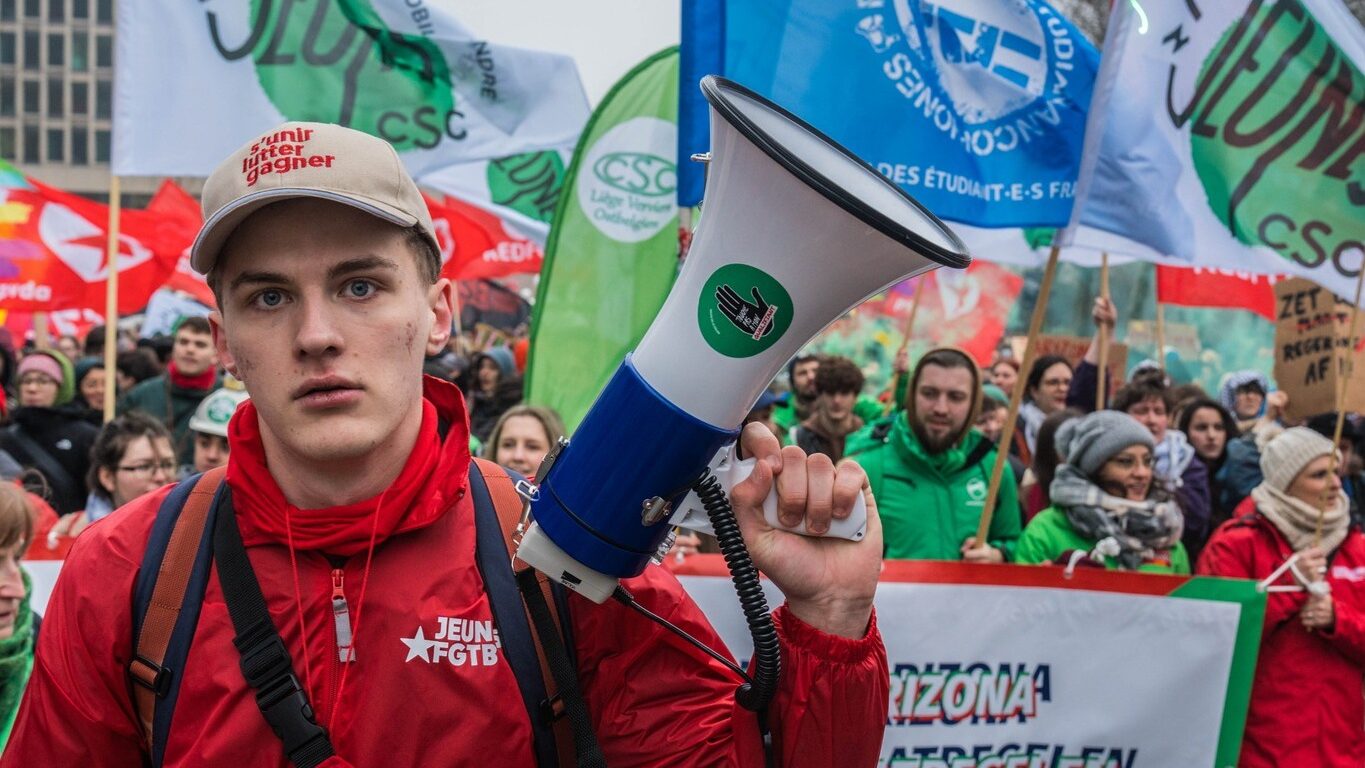
Trade union youth bloc during protest against austerity and cuts. Source: MPLP-GVHV/Facebook
A mass protest filled the streets of Brussels, rejecting the Arizona coalition’s plans to attack social and labor rights
100,000 people, led by trade unions, took to the streets of Brussels on Thursday, February 13, to protest the anti-worker policies of the newly appointed Arizona coalition government. The demonstrators demanded respect for labor rights, including pension policies that ensure dignified lives, as well as the protection of the right to protest. They called for a society built on solidarity, peace, and social progress, rejecting the “every-man-for-himself” mentality promoted by the government.
Workers who joined the protest expressed their fears of losing their livelihoods under the new administration but also spoke of the inspiration they felt in standing together. “It’s incredible to see so many people—firefighters, soldiers, childcare workers, warehouse workers,” an Industeel worker told the Workers’ Party of Belgium (PTB-PVDA) during the protest. “I even ran into one of my old teachers who is now retired. I hadn’t seen him in years.”
If implemented, the government’s program is expected to deal serious blows to the working class. Planned changes to the pension system would force many to work longer, including in physically demanding sectors like construction and healthcare, where exhaustion takes an early toll. At the same time, protections in the workplace would be reduced, including through the liberalization of night work and overtime, while social services crucial to workers’ well-being would face severe cuts.
According to a brief published by Medics for the People (MPLP-GVHV), healthcare services are projected to suffer half a billion euros in losses compared to earlier plans—and approximately 1.5 billion euros less than what is actually needed. This is despite claims from the governing majority that healthcare funding will remain stable or increase. The cuts will undoubtedly impact both workers and patients. Healthcare staff, already stretched to their limits, will face further strain, while patients will experience declining service quality and accessibility. Similar repercussions are expected across other sectors, while the wealthiest will remain unaffected.
Another major shift outlined by the Arizona government targets trade unions. Under the pretense of ensuring accountability for trade union actions—framed as preventing “economic damage” by the administration—the government seeks to weaken organized labor. “The aim is for trade unions to be held liable for any economic impact arising from their actions, forcing them into costly and time-consuming legal battles,” the PTB-PVDA stated in its analysis. “This way, unions will have less money and time to engage with workers.”
These attacks on labor rights come as no surprise, given the widespread opposition workers across Belgium have already voiced against Bart De Wever’s cabinet. The protests have been supported by collectives of health and education workers, international solidarity groups, civil society organizations, and youth networks—all of whom expect to bear the burden of the reforms. The administration is also planning to limit public dissent. “To push through its plan for social destruction, the Arizona government is launching an unprecedented attack on democratic rights in Belgium,” PTB-PVDA warned. “The objective is clear: to weaken and silence any opposition.”
However, social movements are ready to fight back. Following this week’s protest, they have already announced new actions, including mobilizations on March 8, International Working Women’s Day, and a general strike on March 31.
Hate speech on X was consistently 50% higher for at least eight months after tech billionaire Elon Musk bought the social media platform, new research has found.
The research looked at the prevalence of overt hate speech including a wide range of racist, homophobic and transphobic slurs.
The study, published today in PLOS ONE, was conducted by a team of researchers led by Daniel Hickney from the University of California, Berkeley.
On October 27 2022, Musk officially purchased X (then known as Twitter) for US$44 billion and became its CEO. His takeover was accompanied by promises to reduce hate speech on the platform and tackle bots and other inauthentic accounts.
But after he bought X, Musk made several changes to the platform to reduce content moderation. For example, in November 2022 he fired much of the company’s full time workforce. He also fired outsourced content moderators who tracked abuse on X, despite research showing social medial platforms with high levels of content moderation contain less hate speech.
This new study is the first to show that this wasn’t an anomaly.
Hate speech including homophobic, racist and transphobic slurs was significantly higher on X after Elon Musk bought the platform. The black lines represent standard errors. Hickey et al., 2025 / PLOS One
More than 4 million posts
The study examined 4.7 million English language posts on X from the beginning of 2022 through to June 9 2023. This period includes the ten months before Musk bought X and the eight months afterwards.
The study measured overt hate speech, the meaning of which was clear to anyone who saw it – speech attacking identity groups or using toxic language. It did not measure covert types of hate speech, such as coded language used by some extremist groups to spread hate but plausibly deny doing so.
As well as measuring the amount of hate speech on X, the study also measured how much other users engaged with this material by liking it.
The researchers’ access to X data was cut off during the study due to a policy change by the platform, replacing free access to approved academic researchers with payment options which are generally unaffordable. This significantly hampered their ability to collect sample posts. But they don’t mention whether it affected their results.
A clear increase in hate
The study found “a clear increase” in the average number of posts containing hate speech following Musk’s purchase of X. Specifically, the volume of posts containing hate speech was “consistently” 50% higher after Musk took over X compared to beforehand – a jump from an estimated average of 2,179 to 3,246 posts containing hate speech per week.
Transphobic slurs saw the highest increase, rising from an average of roughly 115 posts per week before Musk’s acquisition to an average of 418 afterwards.
The level of user engagement with posts containing hate speech also increased under Musk’s watch. For example, the weekly rate at which hate speech content was liked by users jumped by 70%.
The researchers say these results suggest either hate speech wasn’t taken down, hateful users became more active, the platform’s algorithm unintentionally promoted hate speech to users who like such content – or a combination of these possibilities.
The study also detected no decrease in the activity of inauthentic accounts on X. In fact, it found a “potential increase” in the number of bot accounts partly based on a large upswing in posts promoting cryptocurrency, which are typically associated with bots.
An important data-driving deep dive
There were a number of limitations to the study. For example, it only measured hate speech posts in English, which accounts for only 31% of posts on the platform.
Even so, the study is an important, data-driven deep dive into the state of X. It shows it is a platform where hate speech is prolific. It also shows Musk has failed to fulfil his earlier promises to address problems on X such as hate speech and bot activity.
As Musk himself said at the White House earlier this week: “Some of the things I say will be incorrect and should be corrected”.
Elon Musk urges you to be a Fascist like him, says that you can ignore facts and reality then.Power-mad orange gasbag Donald Trump says Burn, Baby, Burn.
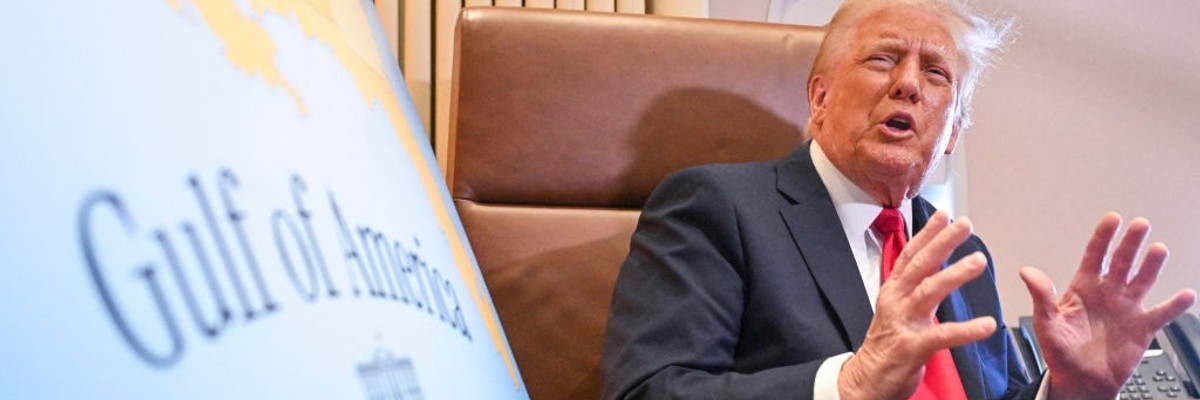
U.S. President Donald Trump speaks to reporters aboard Air Force One after signing a proclamation renaming the Gulf of Mexico as the Gulf of America on February 9, 2025. (Photo: Roberto Schmidt/AFP via Getty Images)
“It’s at times like these that journalists need to put down their pens and advocate for accountable leadership,” asserted one campaigner.
First Amendment defenders are calling on media organizations and journalists to stand up to bullying and intimidation by U.S. President Donald Trump, whose administration on Friday confirmed the indefinite exclusion of one of the world’s largest news agencies from White House press briefings and Air Force One flights over its refusal to adopt the Republican leader’s new name for the Gulf of Mexico.
White House Deputy Chief of Staff Taylor Budowich said that because The Associated Press “continues to ignore the lawful geographic name change” of the Gulf of Mexico to the Gulf of America, it will be indefinitely banned from White House news conferences and the president’s official airplane.
“The level of pettiness displayed by the White House is so incredible that it almost hides the gravity of the situation.”
The New York-based AP, which provides news content to roughly 15,000 media outlets in over 100 countries, has explained that, because the gulf is an international body of water, it will continue to call it the Gulf of Mexico because Mexico—whose president on Thursday threatened to sue Google for adopting Trump’s name change—and other countries do not recognize the new name.
In contrast, the AP said it will call Denali, the highest peak in North America, Mt. McKinley following a name change by Trump because the Alaska mountain is located entirely inside the United States.
Budowich said the AP‘s decision on the Gulf of Mexico exposes the agency’s “commitment to misinformation.”
“While their right to irresponsible and dishonest reporting is protected by the First Amendment, it does not ensure their privilege of unfettered access to limited spaces,” he argued.
But critics said the Trump administration’s behavior is about a lot more than just a spat over a name change.
“Of course, this is just more petty behavior by a president seeking to punish any news organization that doesn’t follow his dictates, regardless of how ridiculous they may be,” Timothy Karr, the senior director of strategy and communications at Free Press, told Common Dreams on Friday.
“It’s at times like these that journalists need to put down their pens and advocate for accountable leadership,” Karr stressed. “They need to advocate for themselves, their colleagues, and for journalism writ large.”
“The good news is that more than a dozen of the mass market news outlets have refused to adopt Trump’s name change for the Gulf of Mexico,” he added. “That’s a start. They now need to speak out against his First Amendment threats, despite the consequences. There is much more at stake now than just having access to the White House.”
“By defying Trump, the AP has created a rallying point for other organizations and individuals to find their spines and defy him as well.”
Writing for Public Notice Friday, Noah Berlatsky commended the AP for “not changing their style to suit the whims of a would-be tin-pot dictator.”
“And by defying Trump, the AP has created a rallying point for other organizations and individuals to find their spines and defy him as well,” Berlatsky added.
“The White House cannot dictate how news organizations report the news, nor should it penalize working journalists because it is unhappy with their editors’ decisions,” WHCA president Eugene Daniels said earlier this week.
RSF USA executive director Clayton Weimers said in a statement that “the level of pettiness displayed by the White House is so incredible that it almost hides the gravity of the situation.”
“A sitting president is punishing a major news outlet for its constitutionally protected choice of words,” Weimers added. “Donald Trump has been trampling over press freedom since his first day in office.”
President Trump banning the Associated Press from an event over their usage of "Gulf of Mexico" instead of "Gulf of America" may seem more absurd than alarming, but Trump's attacks on the free press are no joke.
Numerous experts highlighted what they called the unconstitutionality of banning a media outlet from press briefings for political reasons.
“The AP—a major news agency that produces and distributes reports to thousands of newspapers, radio stations, and TV broadcasters around the world—has had long-standing access to the White House,” Aaron Terr, director of public advocacy at the Foundation for Individual Rights and Expression, wrote on Friday.
“It is now losing that access because its exercise of editorial discretion doesn’t align with the administration’s preferred messaging,” Terr added. “That’s viewpoint discrimination, and it’s unconstitutional.”
Berlatsky wrote: “As ABC, Meta, the LA Times, The Washington Post, and Google demonstrate, you lose 100% of the fights you preemptively and despicably surrender. The AP has already won an important victory by refusing to change the Gulf of Mexico to some random other name at the whim of a power-mad orange gasbag.”
“If any portion of Trump’s agenda is to be stopped, we need people and organizations who are willing to defy him and speak truths he doesn’t want to hear,” he added. “Despite Trump, the AP still calls the Gulf of Mexico the Gulf of Mexico. In doing so, it’s reminding us what freedom looks like. It’s also demonstrating us that if you don’t want to lose your freedoms, you have to use them.”
Power-mad orange gasbag Donald Trump says Burn, Baby, Burn.Elon Musk urges you to be a Fascist like him, says that you can ignore facts and reality then.