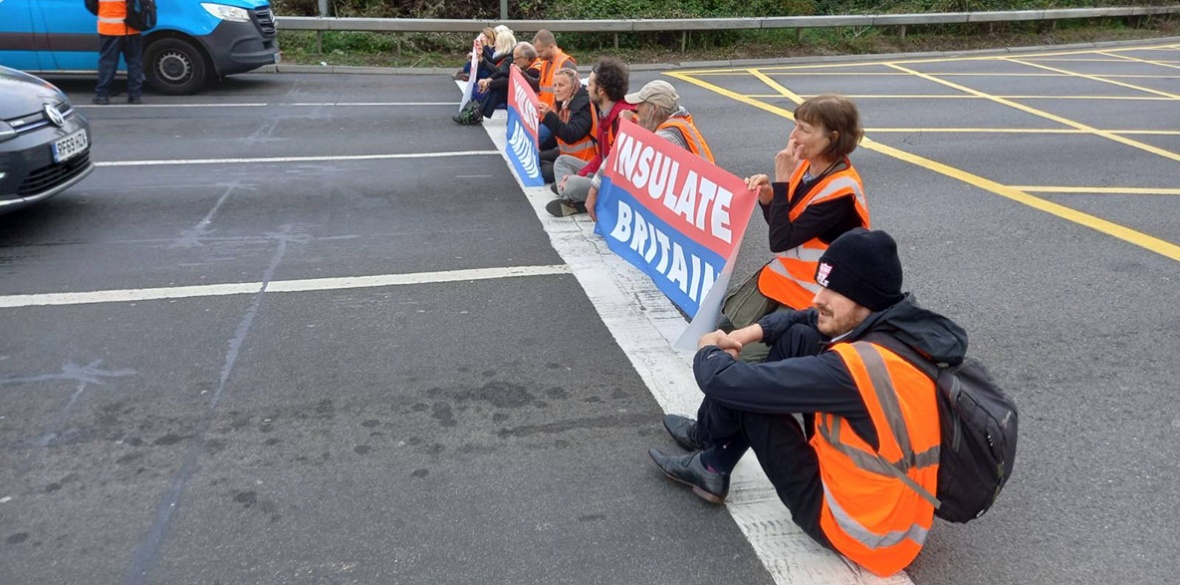
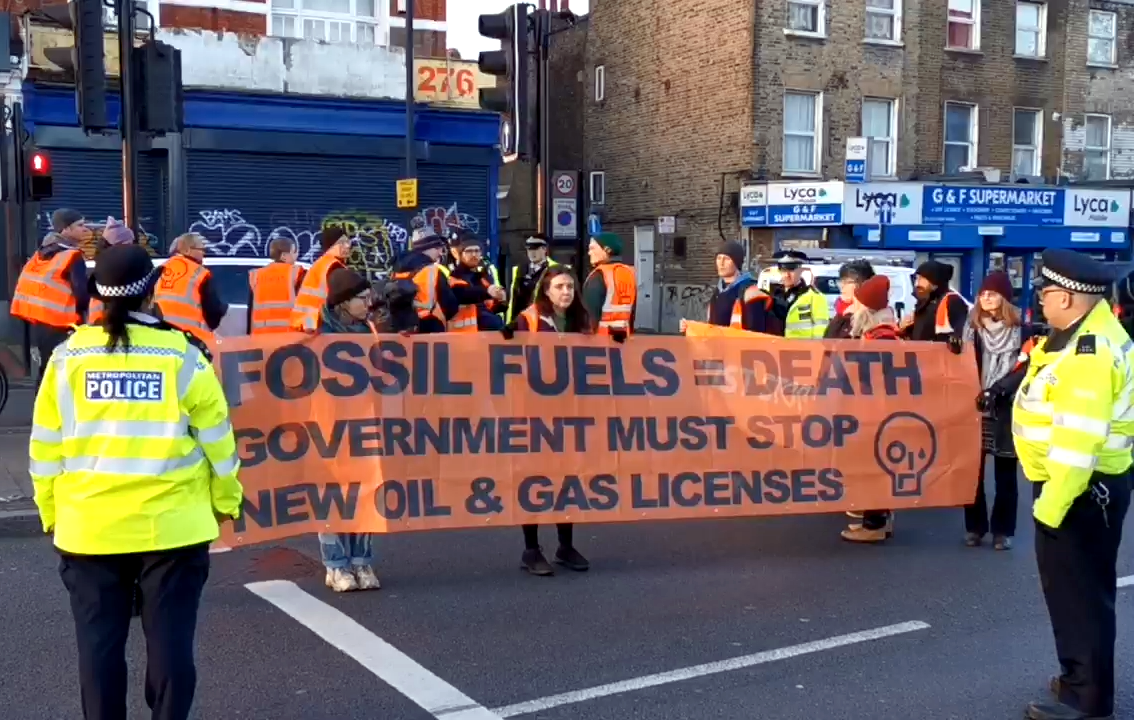
Insulate Britain activists block a road during a protest Photo: Insulate Britain
TRIALS of 18 climate activists who participated in non-violent action are set to begin next week as the government enforces authoritarian laws curbing the right to protest.
Five Extinction Rebellion activists are accused of causing criminal damage to the European headquarters of the half-a trillion-dollar financial firm JP Morgan, during a protest in September 2021 against its funding of fossil fuel firms.
Eight Insulate Britain supporters are accused of causing public nuisance by peacefully stopping traffic on the M25 motorway in the same month to press the government to insulate Britain’s homes to end fuel poverty and cut carbon emissions.
And five Just Stop Oil supporters face trial for alleged conspiracy to cause a public nuisance after they they occupied tunnels close to Grays oil terminal in August 2022 in pursuit for their demand for a halt to all new oil, coal and gas projects.
The trials coincide with fresh government attempts to undermine trials by jury.
Day X is here: The last chance in the British courts to stop Julian Assange’s extradition
The UK High Court has confirmed that a public hearing will take place on Tuesday 20 February and Wednesday 21 February2024. The two-day hearing may be the final chance for Julian Assange to prevent his extradition to the United States. If extradited, Julian faces a sentence of 175 years for exposing war crimes committed by the United States in the Afghan and Iraq wars.
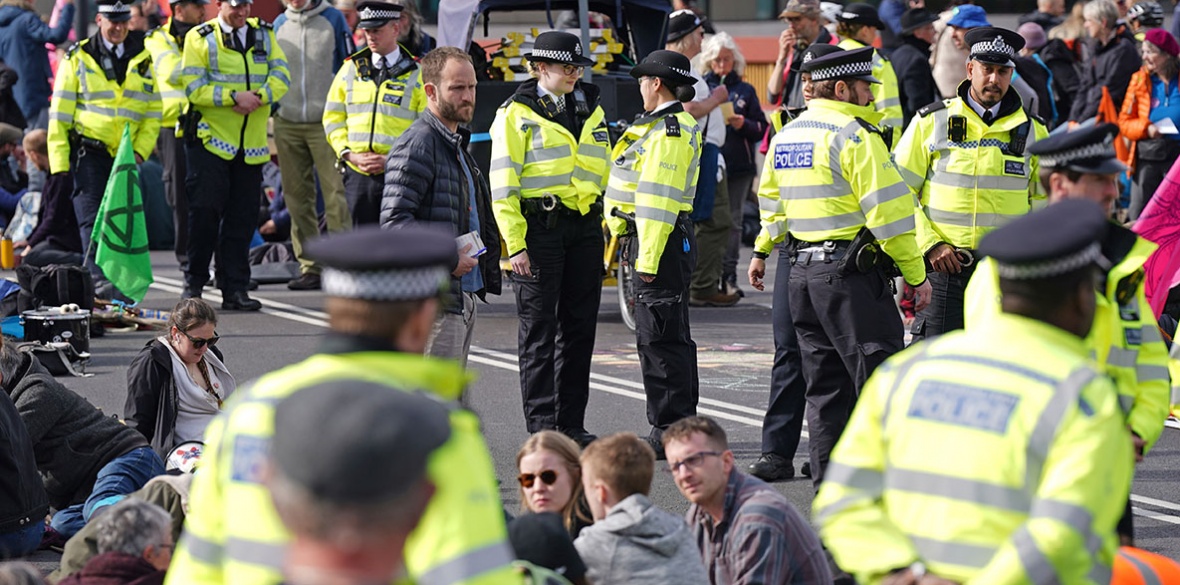
Police during an Extinction Rebellion demonstration blocking Vauxhall Bridge in central London, April 10, 2022
Right to protest comes under fresh attack as Tories unveil new measures and fines
THE right to protest came under fresh attack today as the Tory government unveiled new measures directed at demonstrators.
Rattled by the repeated huge solidarity marches with Palestine in recent months, ministers presented amendments to criminal justice legislation designed to make protesting harder.
Among the acts now to be criminalised are wearing masks at a demonstration, climbing on war memorials or the use of flares or fireworks.
Protesters engaging in any of these activities now risk fines of up to £1,000.
Nor will they any longer be able to use the right to protest as a defence if they cause serious disruption, a change driven by the refusal of a jury to convict anti-racists charged with hauling down the statute of slave trader Edward Colston in Bristol.
…
Leading human rights lawyer and peer Shami Chakrabarti said: … “This is more culture war nonsense from the government while children go hungry and the planet burns.”
…
Suella Braverman, who lost office trying to ban a Gaza ceasefire protest on Armistice Day, has demanded further measures.
These would include giving ministers, rather than the police, the power to ban marches they do not approve of; prohibit the use of particular slogans or phrases and proscribe groups deemed “extremist” even if they are entirely peaceful.
The Tories and Labour competing over hardline immigration policies only helps to mainstream far-right ideas
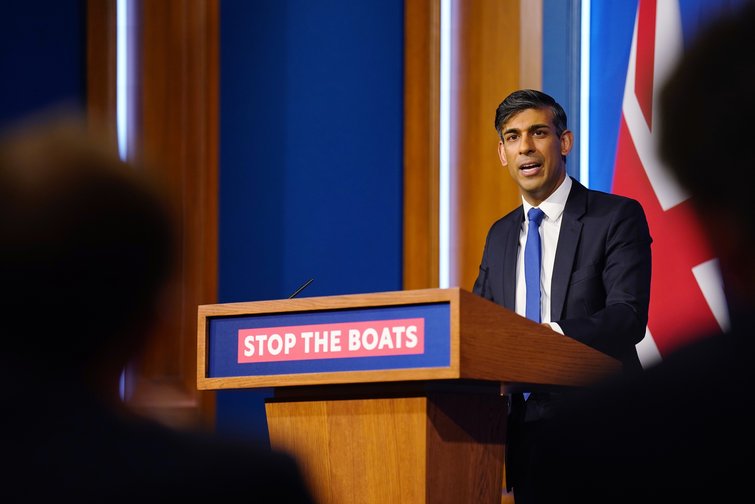
Rishi Sunak conducts a press conference in December 2023 | James Manning (WPA Pool)/Getty Images
Standing at a lectern with the familiar slogan, “STOP THE BOATS”, Rishi Sunak evoked the “will of the people” as the so-called Rwanda Bill made its fractious passage through the Commons last week.
The prime minister’s summoning of “the people” to push through an inhumane and unpopular policy smacks of the misuse of populism that we have come to associate with this government. The insistence that stopping people seeking asylum is “an urgent national issue” deliberately ignores that the priority issues for the British public remain the cost of living and the NHS.
We have seen both main political parties eagerly trading punches for the prize of who can appear most punitive on blocking people seeking asylum. Not only does this stale consensus manufacture a sense of crisis that is a distortion of public opinion, but it also pretends it has nothing to do with racism. And yet whether it’s warning about a “hurricane” or “invasion” of migrants and the failures of multiculturalism, or condemning Britain’s “immigration dependency”, the messaging relies on innuendo and euphemism that stoke racial tensions.
The Runnymede Trust, where I am the interim co-CEO, has today published a report warning of the dangers of this rotten politics that helps mainstream far-right, racist political ideas. Political debate on immigration, based on racialised ideas of who is welcome and who belongs, has become the norm. Whether directly or indirectly, historic and contemporary migration policies are predicated on the exclusion of people of colour. As exemplified by the Windrush scandal, this cheap politics has a high cost – and it is people of colour, regardless of their citizenship status, who bear the ugly consequences.
These toxic anti-migrant policies are coupled with a sustained assault on our democratic infrastructure. In 2022, the government passed the Elections Act, which made it a requirement that voters present ID at polling stations. There was strong opposition about the impact on people of colour. The first UK elections to use them – the May 2023 local elections – confirmed these fears. The Electoral Commission reported about 14,000 people were turned away, and that people of colour and disabled people were most likely to be impacted. The commission predicts 800,000 people could be blocked from voting at the next general election – an incredible price to pay when there were just six cases of voter fraud in 2019.
It’s not just legislation, but also through rhetoric that politicians have persistently attacked the right to protest. Indeed, former home secretary Suella Braverman labelled pro-Palestine marches “hate marches” and compared them with wicked vexation to Black Lives Matter protests – both causes which have high levels of support among communities of colour.
And dare I even mention the ‘culture war’ and the injuries it has inflicted on the strength of civil society? In recent years we have seen the vilification of organisations across the arts, heritage, charity sector and our higher education spaces. The targets have often been those that have dared to embark on progressive racial justice work, who have been demonised with the absurd inversion of the term ‘woke’.
The fact it is the likes of Braverman and her replacement James Cleverly – ministers of colour – who have designed and executed these policies, shows diversity at the top does not protect against racist impact, nor does it mean people in those positions won’t have divergent or indeed opposing political interests to those with whom they may share some points of affinity.
The politics of representation may prioritise superficial visibility, but we mustn’t forget people in positions of power have always designed and inflicted policies that have harmed those they are deemed to share some interest with.
As we prepare for the 2024 general election, we must act to stop the rot of our democracy. Pandering to far-right politics by creating a crisis around small boats and invoking the “will of the people” to implement punitive and racist policies while ignoring the needs of the very people they invoke is unacceptable. On every count, it is people of colour that lose.
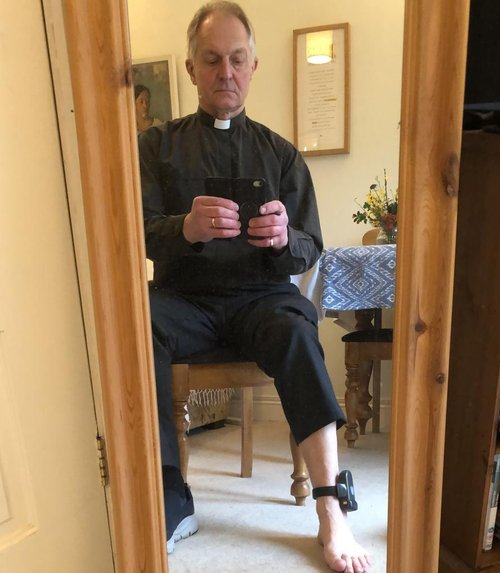
Just Stop Oil member Tim Hewes has to lead church services with an ankle tag on – despite not yet having faced trial
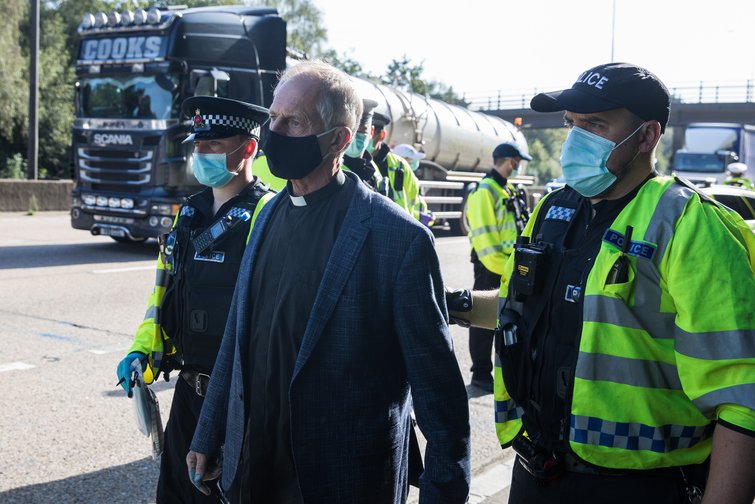
The 73-year-old priest has long taken part in direct action with other campaign groups including Insulate Britain, Extinction Rebellion and Christian Climate Action calling for climate justice | Mark Kerrison/In Pictures via Getty Images
A 73-year-old priest accused of helping plan a climate protest on the M25 has been forced to lead church services while wearing a GPS ankle tag for two years.
Tim Hewes, from Oxfordshire, is among at least ten members of Just Stop Oil who were given the tags despite not having been convicted of a crime. Hewes, who previously sewed his lips shut outside a newspaper office, is also barred from going on the M25 or taking part in any actions to oppose the climate crisis.
On one occasion, Hewes said he was thrown into the back of a police van and locked up overnight after being accused of breaking his bail conditions because his ankle monitor failed to charge. He says the tag was faulty and he was released once the court realised.
“Now if there’s a knock at the door, I think, well, it’s either the tag team or the police,” he told openDemocracy.
“The difficulty with the GPS is that, although I don’t have a curfew, I’ve still got to sleep at home.
“I asked my solicitor: ‘What if I want to go and see the dawn, or something like that?’ and she said: ‘Well, between 12 and five is probably about your limit.’ So, that would rule out midnight mass… Why should I not be able to do that? You know where I am.
“We’re supposed to be able to protest… The perpetrators of real, serious harm in this country are actually in government. What are we supposed to do?”
Hewes, who was speaking to openDemocracy in December and was in fact able to attend midnight mass without a hitch on Christmas Day, had been arrested in November 2022 and charged with conspiracy to cause a public nuisance. He has worn the tag since January 2023 after being held on remand at Wandsworth Prison for six weeks, and has to keep it on until his trial begins in February 2025. Tags must be worn at all times for as long as the court decides.
While he denies the charge, Hewes’s tag prohibits him from going on the M25 and taking part in or organising climate protests. Following previous action with other climate campaign groups such as Extinction Rebellion, Insulate Britain and Christian Climate Action, he says he has faced increasingly harsh treatment from the police and justice system.
Hewes was arrested on a Sunday afternoon. He said he had just put his collar on as he prepared to take part in a church service when he looked out of the window and saw his garden “swarming with police”.
“They shouted up: ‘If you don’t come down and open the door, we’re going to break it down now.’ And they got what they call a ‘big red key’, which is a euphemism for the battering ram. It was scary.”
He added: “Sunday afternoon was just never the same for me.”
Hewes said he was initially embarrassed to lead services with his tag on, and believes climate activists are being heavily criminalised in order to silence and discredit them.
“Suella Braverman talked about Just Stop Oil in the same breath as terrorists,” he told openDemocracy. “That’s outrageous. We’re peaceful protesters. The climate crisis is an existential threat.”
Braverman, the former home secretary who was forced out after inciting a far-right mob to storm the Cenotaph in November, referred to the activist group as “extremists” in 2022 and said they were “out of control” following a series of protests on the M25.
Marcin Wawrzyn, 42 – who was arrested after 20 minutes of ‘slow marching’ with Just Stop Oil in November – told openDemocracy that being given a tag felt “unfair” and “disproportionate”.
“It felt like a punishment and for what?” he said. “I was marching in the road – where else would you protest? The judges of ECHR say roads are the most appropriate places for protests and anything under 90 minutes cannot be seen as disruptive.”
Mentally, it was harsh – I felt like a dog on a leash
Wawrzyn was charged under section 7 of the Public Order Act 2023, which bans any act that “interferes with the use or operation of any key national infrastructure”. He has pleaded not guilty, and his case is expected to begin in 2025.
Under the conditions of his tag, Wawrzyn was prohibited from crossing the River Thames from his home in Wandsworth, south-west London, and from going into north London for a month. Though his tag has now been removed, he described feeling isolated.
“Despite my work being in north London, I was excluded from my office for a month, which is something a court shouldn’t do. But that’s what happened to me. Mentally, it was harsh – I felt like a dog on a leash.
“I felt detached and like I was prevented from having human contact with people I really care about.”
Hewes agreed. “I’m a marked and tracked man,” he said. “It’s really frustrating. As activists, one of the things that helps our mental health is the fact that you are trying to do something, however feeble it might appear to other people.”
Last month, Just Stop Oil wrote to the Met Police after the force claimed that policing the group’s protests cost almost £20m. Just Stop Oil said that “arresting non-violent grandmothers, teenagers, vicars, medics, engineers” was a “waste” of resources.
But Wawrzyn added that campaigners have not been deterred by the crackdown. “The fact that the state reacts in such a way only emboldens us and gives us the assurance that they’re actually noticing what we’re doing and they are actively fighting us,” he said. “If anything, we’re galvanised and we’re drawing more and more people in.”