Green Party co-leaders Carla Denyer and Adrian Ramsay, October 2022. Image: Bristol Green Party, Creative Commons CC0 1.0 Universal Public Domain Dedication.
Green Party Co-Leaders, Adrian Ramsay and Carla Denyer released a joint statement ahead of President Trump’s inauguration saying:
“We must stand up for peace and democracy in what will be a dangerous turn toward right-wing populism in the wake of Donald Trump taking office.
“The antidote to Trump in the US, and the likes of Reform in the UK, is to offer people a real hope for real positive change that will transform their lives.
“That means a new offer to people beaten down by decades of low wages, insecure work, decimated public services and a realisation that the impact of the climate crisis is all around us in the form of floods, wildfires and a devastating loss of nature.
“We need the green investment to deliver the jobs of the future – well-paid, meaningful and secure – and we need the UK government to invest properly in schools and the NHS, and stand up for international law and human rights.
“A greener future is a more just and fairer future.
“The Green Party is clear – President Trump is a misogynist, a racist, a convicted criminal and, we believe, a fascist.
“We will be pressing the Labour government to recognise that to defeat fascism, political parties that believe in democratic values must work together to keep the flame of democracy alive and show people that democratic politics can deliver real change.”
Chris Nineham – deputy leader of the Stop the War Coalition and Chief Steward for many of London’s demonstrations against the Israel Hamas War and the British government’s involvement (source) – was arrested for some reason at the Gaza protest in London yesterday. There’s also a video of him getting arrested.
This video is from 2 months ago. Among other things, he says
The police and the establishment in this country … are conducting a campaign of vilification and repression against the movement … it’s really a campaign against freedom of speech in general in this country and certainly on the issue of Palestine.
…
We should take no lectures from the Metropolitan Police or any other police force about hate crime and about intimidation …
FORMER Labour leader Jeremy Corbyn has hit out at the Met Police over its handling of a Palestine rally in London on Saturday.
More than 70 demonstrators were arrested on suspicion of breaching protest conditions after reportedly breaking through a police line as they marched from a rally in Whitehall.
Police clash with protesters at the rally (Image: Jeff Moore/PA Wire)
…
Corbyn, who sits as an independent MP, responded to a post from the Met Police on Twitter/X which said: “The group that forced its way through the police line is now held at the north west corner of Trafalgar Square.
“Anyone in that group should now disperse and leave the area. Anyone remaining in breach of the conditions, or inciting further breaches, will be arrested.”
In his response, the former Labour leader said: “This is not an accurate description of events at all.
“I was part of a delegation of speakers, who wished to peacefully carry and lay flowers in memory of the children in Gaza who had been killed.
“This was facilitated by the police. We did not force our way through. When we reached Trafalgar Square, we informed police that we would go no. further, lay down flowers and disperse.”
…
This is not an accurate description of events at all.
I was part of a delegation of speakers, who wished to peacefully carry and lay flowers in memory of children in Gaza who had been killed.
This was facilitated by the police. We did not force our way through.
Original article by Jasper Jackson republished from TBIJ under This work is licensed under a Creative Commons Attribution-NonCommercial-NoDerivs 3.0 Unported License.
With tech titans openly disregarding the truth ahead of Trump’s second term, 2025 is likely to herald a new era of disinformation
The online information ecosystem has been in critical condition for some years now, but the prognosis for 2025 is looking more dire than ever.
Already this year two of the world’s richest men, who between them control a huge chunk of our communications infrastructure, have made it clear that they are not interested in our access to the truth.
On Tuesday, Mark Zuckerberg announced that his company Meta – which owns Facebook, Instagram and WhatsApp – would be scrapping its fact checking programme. The only exception to this for now will be in the EU, where strong regulations require it to police its platform.
The core purpose of this programme was to check content that had been flagged as containing potentially harmful misinformation, such as false claims about vaccines or military conflicts. These checks were carried out by third-party organisations, which had to follow rules around process and transparency – and which received significant funding from Meta.
In their place, Meta will now adopt a “community notes-style” system, which enables users themselves to weigh in on content that might be false. A similar set-up has already been adopted by X, where it has proven open to manipulation and failed abysmally to curb misinformation on the platform.
To be clear, Meta’s fact checking programme was not without its problems. For a start, there was no way it could catch every falsehood on the platforms. Meta’s financial arrangements with these organisations also raised questions. And ultimately, there is no definitive proof that showing people fact checks has any real impact on whether they believe the false claims.
But the programme did provide vital financial support to newsrooms that did hugely valuable work, from uncovering Russian propaganda campaigns to exposing online scam artists. And while it was only ever a partial solution at best, Meta’s programme was a sign that the company at least wanted to be seen to care about the accuracy of the information spreading across its platforms.
Zuckerberg’s about-turn came after a week in which another tech tycoon, Elon Musk, had been weighing in on UK politics, most notably with twisted falsehoods about the handling of child grooming cases and messages of support for Tommy Robinson, the far-right figure currently in prison for contempt of court after targeting a Syrian refugee with lies. On Monday, Musk suggested in a poll posted on X that “America should liberate the people of Britain from their tyrannical government”.
The recent behaviour of Zuckerberg and Musk can only be seen in light of the impending second term of Donald Trump, whose propensity for lying is legendary. Musk was already all in on Trump’s presidency. But since the election, much of the rest of the tech world has sought to curry favour with the incoming president, with many prominent figures making big donations to his inauguration.
Like the Trump presidency itself, Musk and Zuckerberg’s dismantling of systems that help protect the truth are logical consequences of the digital structures we have built. An online economy that rewards attention above all else has given new power to false claims. Outlandish lies spread quicker than boring truths. Telling people what they want to hear is more engaging than telling them what they need to hear.
And all the signs suggest that the problem will only be worsened by the tech world’s latest obsession: generative AI. Systems such as ChatGPT, which can come up with content that seems human and accurate but is often simply a convincing lie, are rapidly being incorporated into all our major channels of information and communication. Apple is putting inaccurate headlines on curated news articles. Meta is planning to flood its social networks with AI bots mimicking humans. Google is pushing AI-driven search that regularly throws up false results.
A huge amount of money has been poured into generative AI, and much of the tech industry is banking on it to deliver another lucrative boom. But it has turned out to be even worse than humans at telling fact from fiction – and even more willing to make things up. Dealing with this problem is vital for democracy, but it also threatens the industry’s next big payout. As Zuckerberg proved this week, it’s a lot easier to simply give up on accurate information altogether.
Big Tech is no longer even keeping up the pretence that it is committed to the truth. Keeping our information ecosystem healthy is going to be up to the rest of us.
Reporter: Jasper Jackson Deputy editor: Katie Mark Editor: Franz Wild Production editor: Alex Hess Fact checker: Frankie Goodway
TBIJ has a number of funders, a full list of which can be found here. None of our funders have any influence over editorial decisions or output.
Original article by Jasper Jackson republished from TBIJ under This work is licensed under a Creative Commons Attribution-NonCommercial-NoDerivs 3.0 Unported License.
This image added 11/1/25
Elon Musk urges you to be a Fascist like him, says that you can ignore facts and reality then.
Climate and environmental protest is being criminalised and repressed around the world. The criminalisation of such protest has received a lot of attention in certain countries, including the UK and Australia. But there have not been any attempts to capture the global trend – until now.
We recently published a report, with three University of Bristol colleagues, which shows this repression is indeed a global trend – and that it is becoming more difficult around the world to stand up for climate justice.
This criminalisation and repression spans the global north and south, and includes more and less democratic countries. It does, however, take different forms.
Our report distinguishes between climate and environmental protest. The latter are campaigns against specific environmentally destructive projects – most commonly oil and gas extraction and pipelines, deforestation, dam building and mining. They take place all around the world.
Climate protests are aimed at mitigating climate change by decreasing carbon emissions, and tend to make bigger policy or political demands (“cut global emissions now” rather than “don’t build this power plant”). They often take place in urban areas and are more common in the global north.
The intensifying criminalisation and repression is taking four main forms.
1. Anti-protest laws are introduced
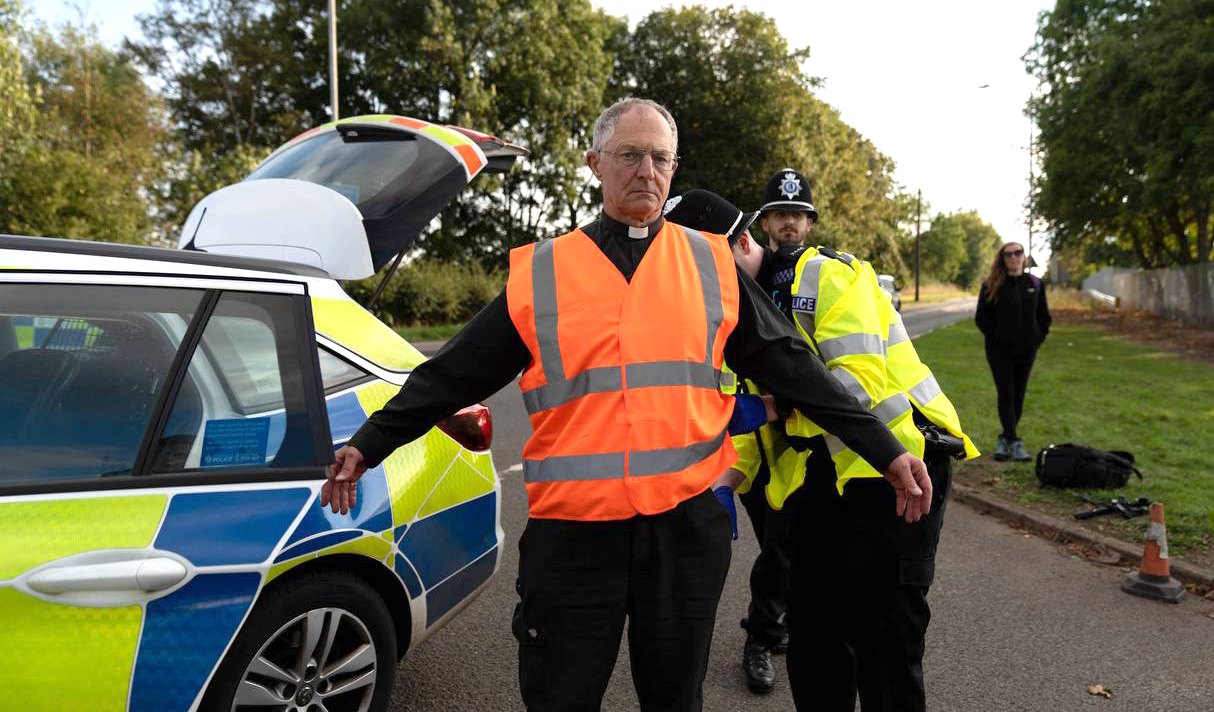
Anti-protest laws may give the police more powers to stop protest, introduce new criminal offences, increase sentence lengths for existing offences, or give policy impunity when harming protesters. In the 14 countries we looked at, we found 22 such pieces of legislation introduced since 2019.
2. Protest is criminalised through prosecution and courts
This can mean using laws against climate and environmental activists that were designed to be used against terrorism or organised crime. In Germany, members of Letzte Generation (Last Generation), a direct action group in the mould of Just Stop Oil, were charged in May 2024 with “forming a criminal organisation”. This section of the law is typically used against mafia organisations and had never been applied to a non-violent group.
Criminalising protest can also mean lowering the threshold for prosecution, preventing climate activists from mentioning climate change in court, and changing other court processes to make guilty verdicts more likely. Another example is injunctions that can be taken out by corporations against activists who protest against them.
3. Harsher policing
This stretches from stopping and searching to surveillance, arrests, violence, infiltration and threatening activists. The policing of activists is carried out not just by state actors like police and armed forces, but also private actors including private security, organised crime and corporations.
In Germany, regional police have been accused of collaborating with an energy giant (and its private fire brigade) to evict coal mine protesters, while private security was used extensively in policing anti-mining activists in Peru.
4. Killings and disappearances
Lastly, in the most extreme cases, environmental activists are murdered. This is an extension of the trend for harsher policing, as it typically follows threats by the same range of actors. We used data from the NGO Global Witness to show this is increasingly common in countries including Brazil, Philippines, Peru and India. In Brazil, most murders are carried out by organised crime groups while in Peru, it is the police force.
Protests are increasing
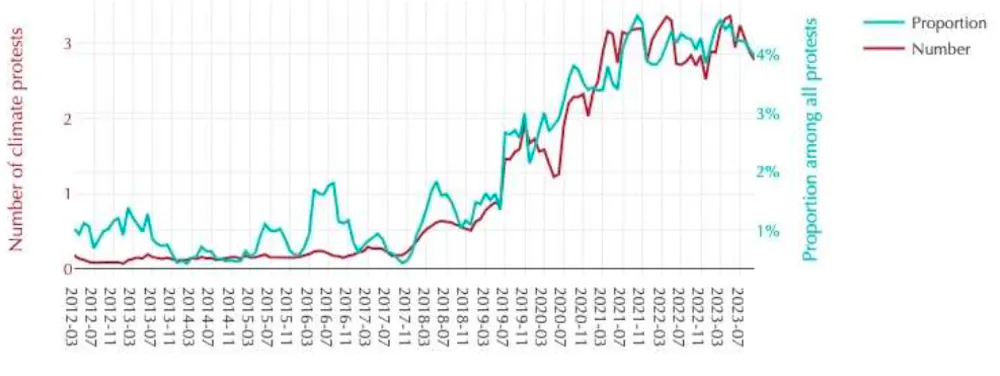
To look more closely at the global picture of climate and environmental protest – and the repression of it – we used the Armed Conflicts Location Event database. This showed us that climate protests increased dramatically in 2018-2019 and have not declined since. They make up on average about 4% of all protest in the 81 countries that had more than 1,000 protests recorded in the 2012-2023 period:
Climate protests increased sharply in the late 2010s in the 14 countries studied. (Data is smoothed over five months; number of protests is per country per month.) Berglund et al; Data: ACLED, CC BY-SA
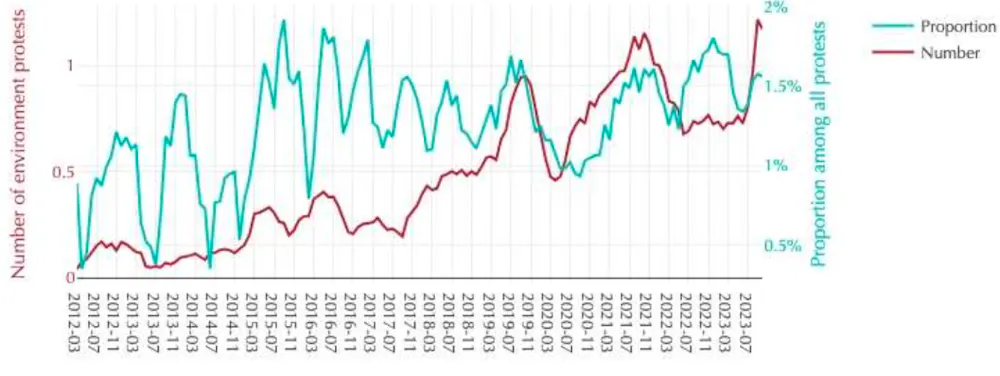
This second graph shows that environmental protest has increased more gradually:
Environmental protests in the same 14 countries. Data: ACLED, CC BY-SA
We used this data to see what kind of repression activists face. By looking for keywords in the reporting of protest events, we found that on average 3% of climate and environmental protests face police violence, and 6.3% involve arrests. But behind these averages are large differences in the nature of protest and its policing.
A combination of the presence of protest groups like Extinction Rebellion, who often actively seek arrests, and police forces that are more likely to make arrests, mean countries such as Australia and the UK have very high levels of arrest. Some 20% of Australian climate and environmental protests involve arrests, against 17% in the UK – with the highest in the world being Canada on 27%.
Meanwhile, police violence is high in countries such as Peru (6.5%) and Uganda (4.4%). France stands out as a European country with relatively high levels of police violence (3.2%) and low levels of arrests (also 3.2%).
In summary, while criminalisation and repression does not look the same across the world, there are remarkable similarities. It is increasing in a lot of countries, it involves both state and corporate actors, and it takes many forms.
This repression is taking place in a context where states are not taking adequate action on climate change. By criminalising activists, states depoliticise them. This conceals the fact these activists are ultimately right about the state of the climate and environment – and the lack of positive government action in these areas.