Category: new authoritarianism

  • ‘Small boat’ pilot Ibrahima Bah faces life in jail. He’s a scapegoat

    Spread the love

    Original article by Danai Avgeri republished from OpenDemocracy under a Creative Commons Attribution-NonCommercial 4.0 International licence. 
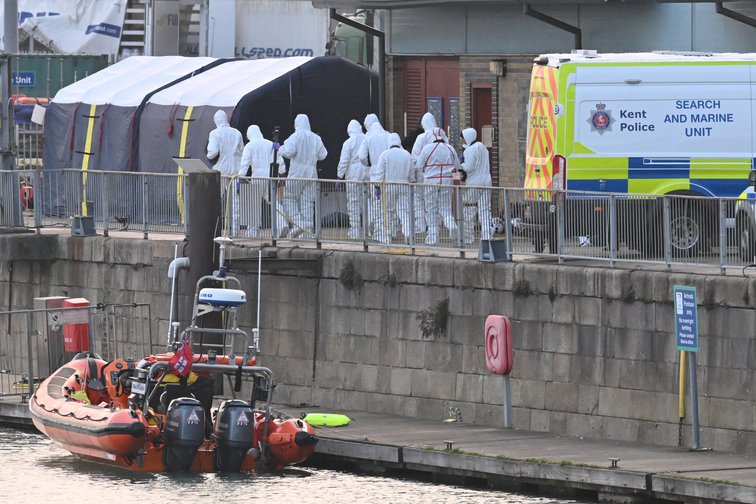
    Forensic officers enter a tent containing the bodies of people who drowned while trying to cross the Channel in the boat piloted by Ibrahima Bah, who will be sentenced today under new legislation to criminalise ‘facilitating arrival’ for asylum seekers in the UK. ‘By convicting Bah of manslaughter, the jury effectively exonerated the UK of responsibility for its lethal border policies.’  | Leon Neal/Getty Images

    Those who drive boats are often simply the poorest people on board. Those really at fault still walk free

    Ibrahima Bah is today facing a possible life sentence for facilitating illegal entry into the UK, and for four counts of manslaughter by gross negligence. But the real culprits here remain off the hook – and this will almost certainly lead to more deaths.

    Arrested in December 2022, Bah was steering an unseaworthy dinghy across the English Channel when it collapsed. The floor of the dinghy ripped when it approached the fishing vessel Arcturus and everyone stood up to try and be rescued. According to Utopia 56, a refugee charity that has announced legal action against the British coastguard and French agencies for this case, authorities failed to launch a search and rescue operation despite being alerted by Alarmphone, a hotline for migrants in distress at sea.

    Eventually, four people were found dead while four were recorded missing. Some 39 survivors, most from Afghanistan, were rescued and claimed asylum in the UK.

    Asylum seekers dying in the English Channel is not something new. In November 2021, 31 people, including a girl aged five and her teenage siblings, died after their dinghy sank in the Channel. And in October 2020, seven people, including five from one Iranian Kurdish family, lost their lives after a small boat carrying 20 migrants capsized off the French coast.

    These are only a few examples in the long deadly history of the French-UK border. But Bah’s case marks a historic and troubling milestone: he is the first shipwreck survivor in the UK to face manslaughter charges for the deaths of fellow passengers.

    A network called Captain Support that acts in solidarity with those accused of driving boats to Europe has been closely monitoring Bah’s case. Its members are right to point out the conviction marks a violent escalation in the criminalisation of migration by the UK government under its ‘stop the boats’ campaign and measures to cut net migration.

    These have included unlawful and unenforceable schemes, such as the plan to deport asylum seekers to Rwanda; the launch of the Bibby Stockholm barge, leading to suicide and harm among detainees; and the planned introduction of an unattainable 50% increase in salary threshold for foreign workers to be allowed to come to the UK. Britain has also laid out plans to bar international students and care workers from bringing dependents to the UK.

    Ironically, this frontal assault on migrant rights comes at a time when polls for the first time since 2016 suggest that most British people hold positive views of immigration, exposing the ‘stop the boats’ battle for its deeply ideological nature. But other aspects of the policy, less routinely covered in the media, have been no less damaging – and these directly relate to Ibrahima Bah’s unjust conviction.

    The Nationality and Borders Act came into force in June 2022, expanding the scope of immigration crimes in the UK in response to the so-called ‘small boats crisis’. This act introduced the offence of ‘illegal arrival’ with a maximum penalty of four years in jail. It also expanded the scope of the more serious offence of ‘facilitating arrival’, of which Bah was convicted, and increased the maximum penalty to life imprisonment.

    Hundreds of people have since been arrested and imprisoned for simply trying to reach the UK to claim asylum, according to a forthcoming report by Victoria Taylor, published by the Centre for Criminology at the University of Oxford and Border Criminologies.

    While the government repeatedly invokes the mantra of favouring ‘safe and legal routes’ when justifying this increasingly draconian legislation, existing laws don’t provide any. As Amnesty International has pointed out: “The UK government does not allow anyone to make a claim for asylum unless they are physically present in the UK… It is impossible to come to the UK for the purpose of seeking asylum in any way permitted by the government’s immigration rules.”

    openDemocracy revealed last year that a toddler and a father were among those who had died while waiting vainly for officially sanctioned UN routes to take them to safety; their families remain stranded in Turkey.

    Aside from two temporary visa schemes that have been beset with their own problems – for asylum seekers from Ukraine with family or hosts in the UK, and Afghans who are in danger due to having worked with the UK government – anyone wishing to apply for asylum in the UK has no choice but to travel to the UK in an unauthorised manner.

    In simple terms, the UK government requires asylum seekers to endanger their lives and break the law in order to exercise their lawful right to claim asylum.

    Countering this means more than debunking the myths of ‘safe and legal’ routes. It’s also about addressing the criminalisation of ‘facilitating arrival’ – often presented as a necessary measure to uproot the ‘criminal gangs’ exploiting vulnerable individuals.

    In fact, human rights organisations and academic researchers have time and again shown that counter-smuggling policies and targeting of boat drivers harms migrant communities the most. These policies overlook the reality that, in many instances, those piloting boats are the poorest and least resourced among asylum seekers, agreeing to steer these vessels and take on significant legal risks in exchange for free passage.

    And indeed, Ibrahima, who is from Senegal – a country still grappling with the effects of colonialism and with 40% of its population living below the poverty line – asserted that this was precisely why he agreed to pilot the boat.

    Having journeyed from Senegal to Mali, then Algeria and Libya, before taking a boat from Libya to Italy with the aid of smugglers, Bah decided to pilot the vessel in exchange for free passage. During his trial, Bah said when he realised the boat was unseaworthy, he refused to drive it, but he was then assaulted by those that organised the trip who coerced him into complying. The jury not only dismissed Bah’s claims but also the testimonies of the survivors themselves, who portrayed Ibrahima as an “angel” trying to save lives.

    As detailed in Captain Support’s court report, a witness statement from the captain of the Arcturus presented Bah as “mouthy” and ungrateful, both racial stereotypes. The all-white jury concluded that Bah, a Black teenager, had failed in his duty of care towards his fellow passengers. By convicting Bah of manslaughter, the jury effectively exonerated the UK of responsibility for its lethal border policies.

    The UK is not alone in this regard. In Italy, four survivors of the Cutro shipwreck are on trial for the deaths of at least 94 people, with one already convicted, despite evidence that the Italian authorities deemed the migrant boat ‘not of interest’ just before the shipwreck. And Greece prosecuted nine Egyptians over the 2023 shipwreck of the Adriana, which killed 600 near the coast of Pylos, despite mounting evidence for the Greek coastguard’s role in the boats capsizing.

    Britain’s emulation of these policies is both predictable and deeply alarming. British prime minister Rishi Sunak recently teamed up with Italy’s far-right leader Giorgia Meloni in her attempts to crack down on ‘illegal migration’. And in November 2023, Suella Braverman – then the UK home secretary and the architect of the ‘stop the boats’ campaign – lauded Greece’s “tough but fair migration policy” following her tour of one of Europe’s most harrowing borders. This dangerous coalition, which wields death and scapegoating as tools of deterrence, must be dismantled immediately.

    Ibrahima Bah’s sentencing hearing is scheduled for Friday 23 February. Solidarity actions have been called in response, including a call for support at 2pm at Canterbury Crown and a demonstration at 6pm at the Home Office.

    Original article by Danai Avgeri republished from OpenDemocracy under a Creative Commons Attribution-NonCommercial 4.0 International licence. 
    OpenDemocracy free Daily Email

  • Campaigners insist draconian limits on right to protest will be resisted

    Spread the love

    https://morningstaronline.co.uk/article/campaigners-insist-draconian-limits-right-protest-resisted

    PLANS for even more draconian limits on people’s right to protest — including outside Parliament — will be resisted, campaigners insisted today.

    Government “violence adviser” Baron Walney, who was Labour MP John Woodcock before his elevation, has recommended that “threatening” protests outside Parliament, MPs’ offices and council buildings be banned and dispersed by police.

    The clampdown adds to existing new limits on protests including for being “too noisy” or causing inconvenience.

    The Stop the War Coalition pledged to mobilise against any new laws or regulations banning protests outside Parliament, and humanitarian campaign group Liberty condemned the proposals as “knee-jerk and deeply concerning.”

    …

    Peaceful protests have been condemned by reactionary politicians and the media as “hate marches” and calls for Palestinians to have freedom “from the river to the sea” have been dubbed “anti-semitic.”

    …

    Sam Grant, advocacy director at human rights campaign group Liberty, said: “When people care deeply about an issue, it’s natural for them to make their voices heard at the place where decisions are made.

    “For centuries, protesting outside Parliament has been how people have campaigned for positive change in society, from the right to vote to equal marriage.

    …

    “We’ve already seen a tightening on how people protest outside Parliament through the Policing Act 2022, and these plans could extend that much further.”

    …

    https://morningstaronline.co.uk/article/campaigners-insist-draconian-limits-right-protest-resisted

  • Judgment day for free press

    Spread the love

    https://morningstaronline.co.uk/article/judgment-day-for-free-press

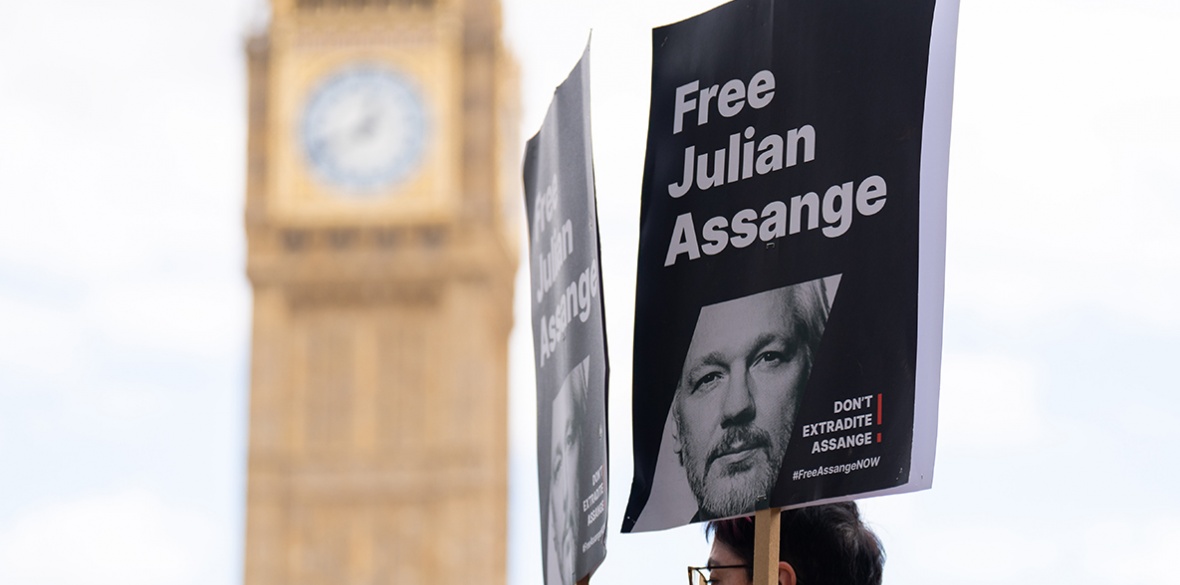
    People protest outside the Houses of Parliament in London, to step up demands for the release from prison of WikiLeaks founder Julian Assange, June 24, 2023

    Assange’s appeal against extradition to the US set to begin

    WIKILEAKS founder Julian Assange’s appeal against extradition to the United States will be heard in the High Court on Tuesday in a final leg of the legal battle for free journalism.

    Mr Assange, who exposed US war crimes in Iraq and leaked thousands of military secrets, will face court on Tueday and Wednesday.

    He is wanted by US authorities on 18 counts, relating to WikiLeaks’ publication of hundreds of thousands of classified documents.

    Mr Assange has been in Belmarsh prison since he was removed from the Ecuadorian embassy in 2019 where he was given political asylum for nearly seven years.

    If Mr Assange is denied permission to appeal, he will be at risk of extradition to the US and prosecution under the century-old 1917 Espionage Act, and faces a 175-year prison sentence.

    …

    https://morningstaronline.co.uk/article/judgment-day-for-free-press

  • ‘Enough Is Enough’: Australia Says Free Assange

    Spread the love

    Original article by AMY GOODMAN DENIS MOYNIHAN republished from Common Dreams under Creative Commons (CC BY-NC-ND 3.0). 

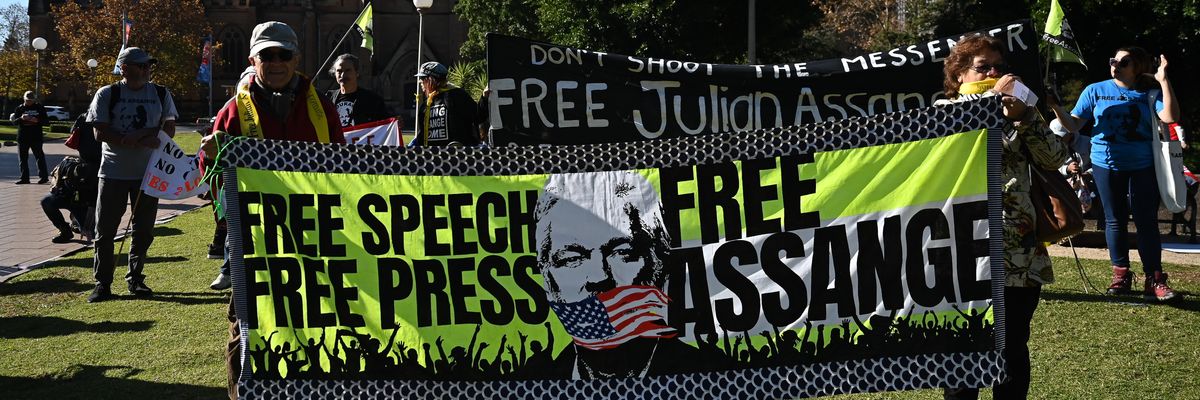
    People participate in a rally demanding freedom for imprisoned WikiLeaks founder Julian Assange in Sydney, Australia, on May 24, 2023.  (Photo: Steven Saphore/Anadolu Agency via Getty Images)

    U.S. and U.K. persecution of Assange has been continuous and severe.

    Australian Prime Minister Anthony Albanese said during Prime Minister’s Questions on February 15, “This thing cannot just go on and on and on, indefinitely.”

    The Prime Minister was addressing an action he took a day earlier, on Valentine’s Day. No, not his marriage proposal to his partner, Jodie Haydon (she said yes). He was explaining his support for a parliamentary motion that passed overwhelmingly, calling for the release of an Australian citizen, imprisoned WikiLeaks founder Julian Assange.

    Albanese’s support builds on a growing demand from Australians across the political spectrum that the United Kingdom not extradite Assange to the United States, and for the U.S. to drop its espionage and hacking charges against him. Assange, who has been imprisoned in London’s notorious maximum-security Belmarsh Prison since 2019, has a court hearing in the UK.

    Assange’s counsel, Jennifer Robinson, texted us on Thursday:

    “The appeal next week could be Julian’s final appeal against U.S. extradition. If permission to appeal is denied, there are no further appeals available to us in the U.K.” If extradited, Assange faces up to 175 years in prison in the United States. Said Prime Minister Albanese, “Enough is enough.”

    Prior to his imprisonment in Belmarsh, Julian Assange spent seven years cramped inside Ecuador’s small London embassy, where he’d been granted political asylum.

    Assange founded WikiLeaks, a website that publishes leaked material while protecting the identity of the whistleblowers. While it launched in 2006, it wasn’t until 2010 that the U.S. government forcefully and publicly targeted Wikileaks and Assange, after Wikileaks made several massive disclosures of leaked documents related to the U.S. invasions and occupations of Iraq and Afghanistan.

    On Monday, April 5, 2010, Julian Assange released a shocking video at the National Press Club in Washington, D.C. The video, which WikiLeaks titled “Collateral Murder,” was shot in 2007 from a U.S. military Apache helicopter flying over Baghdad, Iraq. The video shows in grainy black and white detail the gunship’s attack on a group of people on the ground. Twelve civilians, including two Reuters news employees, were mowed down by automatic fire from the helicopter. The voices of the crew were recorded, as they sought permission to “engage” with their targets, and as they laughed and cursed through the slaughter. It was a chilling video, documenting a war crime.

    The video’s release was followed by the publication on Wikileaks.org of hundreds of thousands of digital records from the U.S. military, dubbed the Iraq War Logs and the Afghan War Diary. These documents provided further proof that the U.S. was committing war crimes. Some elected officials in the U.S. called for Assange to be assassinated. Then-Vice President Joe Biden called him a “high-tech terrorist.”

    Not long after, the U.S. Justice Department convened a secret grand jury which issued a sealed indictment against Assange. Existence of that indictment itself was revealed on WikiLeaks, in a subsequent leak, in 2012. U.S. and U.K. persecution of Assange since then has been continuous and severe. In 2017, as revealed in 2021 by journalist Michael Isikoff and colleagues, the CIA hatched plans to either kidnap Assange from the Ecuadorian embassy or even to assassinate him.

    Andrew Wilkie, an independent member of the Australian Parliament from Tasmania, introduced the resolution in support of Assange this week, saying, “This House notes that on 20 and 21 February 2024, the High Court of Justice in the United Kingdom will hold a hearing into whether Walkley Award-winning journalist Julian Assange can appeal against his extradition to the United States of America… both the Australian Government and Opposition have publicly stated that this matter has gone on for too long; and underlines the importance of the U.K. and USA bringing the matter to a close so that Mr Assange can return home to his family in Australia.”

    The Australian government is not alone in calling for Assange’s release. In November, 2022, five major newspapers that collaborated with WikiLeaks—The New York Times, The Guardian, Le Monde, El Pais, and Der Spiegel—released a joint letter calling for an end to the prosecution. “Obtaining and disclosing sensitive information when necessary in the public interest is a core part of the daily work of journalists. If that work is criminalized, our public discourse and our democracies are made significantly weaker,” the letter read.

    Assange’s attorney Jennifer Robinson will be in the London court for the hearing. She told us, “We have been saying for years: This is a political case which requires a political solution. The unprecedented showing of political support in the Australian Parliament overnight shows that Julian’s case is a priority for the Australian government, our parliament, and the people. The U.S. should listen to the concerns of its ally—and drop the case.”

    Original article by AMY GOODMAN DENIS MOYNIHAN republished from Common Dreams under Creative Commons (CC BY-NC-ND 3.0). 

  • Australian lawmakers call for Julian Assange’s release ahead of extradition appeal

    Spread the love

    Original article by Tanupriya Singh republished from peoples dispatch under a Creative Commons Attribution-ShareAlike 4.0 (CC BY-SA) license.

    The motion in parliament, which was supported by Prime Minister Anthony Albanese, has called for the return of imprisoned WikiLeaks founder Julian Assange to his family in Australia. Assange is days away from a final court hearing in the UK against his extradition to the US.

    On February 14, lawmakers in Australia’s parliament voted 86-42 in support of a motion calling on the UK and the US to return arbitrarily imprisoned WikiLeaks founder and journalist, Julian Assange, to his home and family in Australia.

    The move, which was also supported by Prime Minister Anthony Albanese, came just days before the High Court of Justice in London will decide if Assange can continue to contest his extradition to the US through the UK’s legal system.

    The US has indicted Assange on 18 charges, 17 of which are under the notorious Espionage Act, in relation to the publication of confidential documents on WikiLeaks that exposed the war crimes and atrocities committed by US forces during the invasions of Iraq and Afghanistan. If convicted, Assange would face up to 175 years in a maximum security prison.

    The 52-year-old journalist has already been held at the UK’s high security Belmarsh prison for nearly five years, without charge or conviction, amid serious concerns over his mental and physical health.

    “Mr. Assange has been deliberately exposed, for a period of several years, to progressively severe forms of cruel, inhuman or degrading treatment or punishment, the cumulative effects of which can only be described as psychological torture.” Nils Melzer, the former UN Special Rapporteur on torture, had said of the journalist’s condition back in 2019.

    Addressing a press conference on February 15, Assange’s partner, Stella, stated that his “life is at risk every single day he stays in prison– and if he is extradited he will die”, warning that Assange could be “on a plane within days”.

    The public hearings on February 20 and 21 will mark the culmination of a protracted legal battle for Assange. A two-judge bench of the High Court will review a June 6, 2023 decision by Justice Jonathan Swift, in which he had rejected all eight grounds of appeal filed by Assange’s legal team.

    If approved, the appeal will challenge the extradition order approved by the UK Home Office in June 2022.

    Read more: Assange completes four years in UK jail, struggle against US extradition continues

    On Wednesday, independent lawmaker Andrew Wilkie introduced a motion in the Australian parliament, calling on the US and the UK to bring “the matter to a close so that Mr. Assange can return home to his family in Australia”.

    “This will be the time for all of us to take a stand, to stand up and to take a stand, and to stand with Julian Assange, stand for the principles of justice, stand for the principles of media freedom and the rights of journalists to do their job…This has gone on too long, that it must be brought to an end.”

    Commenting directly on the matter in Parliament on February 15, PM Albanese stated that there was a “common view” that “enough is enough”. “People will have a range of views about Mr. Assange’s conduct… but regardless of where people stand, this thing cannot just go on and on indefinitely.”

    He went on to state, “I hope it can be resolved amicably. It’s not up to Australia to interfere in the legal processes of other countries, but it is appropriate for us to put our very strong view that those countries need to take into account the need for this to be concluded.”

    The Prime Minister’s ambiguous statements throughout the legal proceedings, including a refusal to outrightly call for a withdrawal of the extradition order, has been criticized by progressive, anti-imperialist forces, with the late renowned journalist John Pilger having called it a “betrayal” in March 2023.

    Read more: The betrayers of Julian Assange 

    Addressing reporters outside Parliament House on Thursday, Assange’s brother, Gabriel Shipton, warned that his extradition would mean that “all the ties to his family, his lifeline that are keeping him alive inside that prison will be cut off and he’ll be lost into a horrific prison system in the United States”.

    He added that the vote in parliament had given the Australian government a “real mandate to advocate very, very strongly for a political solution” to bring Assange home.

    “It’s not just about being extradited. Julian should never have been put in prison in the first place,” Stella Assange implored on Thursday, as journalists and activists across the world have warned of the impact Assange’s case could have on the press.

    “We are seeing a critical attack on press freedom worldwide. It is like a disease, an anti-press pandemic, creeping up on us that has been incrementally taking shape over the years”, said WikiLeaks editor-in-chief Kristinn Hrafnsson, adding that Assange had been the “canary in the gold mine”.

    Read more: Julian Assange case: 4 things that the media doesn’t tell you

    Assurances about conditions in US prison are “dubious”, say advocates

    This was reiterated by over 35 law professors in the US in a letter sent to the Department of Justice on February 14, stating that Assange’s prosecution posed an “existential threat” to the freedom of speech and press enshrined under the First Amendment.

    These “constitutional implications” could “extend beyond the Espionage Act and beyond national security journalism [to] enable prosecution of routine newsgathering under any number of ambiguous laws and untested legal theories.”

    Assange’s extradition to the US was approved on the basis of supposed “assurances” given by the US regarding his safety, including the avoidance of what are called “special administrative measures” (SAMs) — a horrific punitive measure that combines “the brutality and isolation of maximum-security units with additional restrictions that deny individuals almost any connection to the human world”.

    However, human rights organizations and observers had immediately warned that these “assurances” were unreliable and could be arbitrarily revoked.

    “The US assurances cannot be trusted. Dubious assurances that he will be treated well in a US prison ring hollow considering that Assange potentially faces dozens of years of incarceration in a system well known for its abuses, including prolonged solitary confinement and poor health services for inmates,” stated Julia Hall, the international expert on counter-terrorism and criminal justice in Europe at Amnesty International.

    If the High Court of Justice in London does not rule in favor of Julian Assange next week, Stella Assange has stated that he will then approach the European Court of Human Rights (ECHR), seeking urgent measures to halt his extradition under Rule 39— granted when there is an “imminent risk of irreparable harm” — pending a full consideration of his case.

    The present UN Special Rapporteur Dr. Alice Edwards, has also pointed out that outside of the legal process, the ultimate decision to actually proceed with the extradition will lie with the US Secretary of State. Antony Blinken, for his part, had rebuffed calls by the Australian government last year to drop the prosecution.

    “The UK is a party to the UN convention against torture as well as the European convention on human rights, both of them have Article 3 which prohibits states from sending people to where they may face this type of treatment [torture],” Edwards said.

    Original article by Tanupriya Singh republished from peoples dispatch under a Creative Commons Attribution-ShareAlike 4.0 (CC BY-SA) license.