Category: Palestine

  • Did Israel meet US Gaza aid requirements? Israel, UN respond

    Spread the love

    This work by Middle East Monitor is licensed under a Creative Commons Attribution-NonCommercial-ShareAlike 4.0 International License.

    Palestinians wait in line to receive aids at the school where UNRWA distributes food parcels in Deir al-Balah, Gaza on November 07, 2024. [Ashraf Amra – Anadolu Agency]

    The United States, on Tuesday, said Israel is not currently impeding humanitarian aid for the Gaza Strip and, therefore, is not violating US law, avoiding restrictions on US military aid.

    Israel has said it met most of the 16 specific demands put forward by Washington but was still discussing some items. International aid groups, however, said that Israel failed to meet any of them completely.

    In a 13 October letter, the US gave 30 days to comply.

    Below are the requirements and responses by Israel’s COGAT military agency, the UN Office for the Coordination of Humanitarian Affairs and a report by a coalition of eight aid groups.

    1. Enable a minimum of 350 trucks per day to enter Gaza through all four major Crossings and open a new fifth Crossing.

    Israel: Israel allowed a daily average of 76 trucks over the past 30 days. Israel said it was planning to reopen a fifth Crossing, Kissufim.

    United Nations: An average of some 50 truckloads a day entered Gaza over the past month.

    From 1 October to 10 November, three Crossings were open and no new Crossings opened. Kissufim appeared to have opened on 12 November.

    Aid groups: Over 25 days, an average of 42 trucks per day entered Gaza. Three Crossings regularly had trucks entering; a fourth averaged zero trucks a day and a fifth did not open.

    READ: US wants extended pauses in fighting in Gaza, Blinken says

    1. Institute adequate humanitarian pauses across Gaza as necessary to enable humanitarian activities for at least the next four months.

    Israel: “Subject to operational considerations, attempts are made to implement, on an almost daily basis, tactical pauses along certain routes, allowing for safer movement and facilitating that aid convoys reach their destinations without interference, as well as daily humanitarian pauses in various areas.”

    United Nations: No response.

    Aid groups: Israel has not complied. In October, only 11 per cent of goods that reached warehouses were distributed.

    1. Allow people in Al-Mawasi and the humanitarian zone to move inland before winter.

    Israel: A spokesperson said people from those areas were allowed to move inland but he did not know how many had.

    United Nations: “We cannot quantify this,” said OCHA.

    Aid groups: Partial compliance as only a limited number of people were allowed to move inland in the 30-day period.

    1. Enhance security for fixed humanitarian sites and movements.

    Israel: Security is in place but was not enhanced during the past month.

    United Nations: “Humanitarian convoys still face serious security incidents upon picking up humanitarian supplies from Karm Abu Salem. Humanitarian facilities have come under fire.”

    Aid groups: “Israel not only failed to take demonstrable actions to improve security for the humanitarian response, but also worsened security risks for humanitarians. Israeli forces repeatedly attacked humanitarian sites and frontline responders during the 30-day period.”

    READ: Report: Israel killed more than 12,000 Palestine students since October 2023

    1. Rescind evacuation orders when there is no operational need.

    Israel: Evacuation of civilians from combat areas was for their protection and the Israeli military “is committed to international law and operates accordingly”.

    United Nations: As of 25 August, nearly 90 per cent of Gaza was under evacuation orders. About 79 per cent of Gaza remains under evacuation orders as of 11 November.

    Aid groups: Israel’s evacuation orders are not compatible with international law. During the 30 days, one evacuation order was rescinded. Six new evacuation orders were implemented in October and early November.

    1. Facilitate rapid implementation of the UN World Food Program winter and logistics plan to repair roads, install warehousing and expand platforms and staging areas.

    Israel: It has “absolutely” met this requirement, the spokesperson said. A winter humanitarian assessment was done and was now being executed, including bringing in shelter equipment and repairing roads.

    United Nations: No response

    Aid groups: Israel has failed to do this and denied WFP requests for movement to repair roads, new warehousing and expanded staging areas. Israel rejected requests to transport blankets, heating supplies and clothes.

    WATCH: Trump’s envoy to Israel: ‘West Bank does not exist’

    1. Ensure Israeli Coordination and Liaison officers can communicate with humanitarian convoys at checkpoints

    Israel: COGAT sits with representatives from international organisations in a joint task force room and they are in constant contact with the trucks on the ground.

    United Nations: CLA officers can communicate with humanitarian convoys at checkpoints, “however, UN convoys rarely come across CLA officers at checkpoints”.

    Aid groups: CLA officers do not communicate with humanitarian convoys at checkpoints.

    1. Assign division-level liaison officers from Southern Command to the Joint Coordination Board.

    Israel: This has not happened.

    United Nations: No response.

    Aid groups: No officers have been assigned as required.

    1. Remove restrictions on the use of container and closed trucks and increase the number of vetted drivers to 400.

    Israel: Israel does not allow closed trucks to cross into Gaza because they are a security threat, the spokesperson said. “It will be used to smuggle weapons. Last week they found a sack of bullets in an aid truck, for example.”

    The spokesperson said that there are around 75 drivers with security clearance and talks are under way about increasing that number.

    United Nations: No response.

    Aid groups: Israel did not comply with either requirement.

    1. Remove an agreed list of essential items from the dual-use restricted list.

    Israel: “We are making efforts to do this,” said the COGAT spokesperson.

    United Nations: No response.

    Aid groups: Most of the list remains highly restricted and the list is administered inconsistently.

    1. Provide expedited clearance processing at the Port of Ashdod for Gaza-bound humanitarian assistance.

    Israel: “Israel has implemented targeted measures to significantly enhance the volume and efficiency of aid entering through the Ashdod Port, primarily from Cyprus,” Israel said. This involved improved logistics and coordination.

    United Nations: No response.

    Aid groups: Israel has failed to consistently expedite clearance processing at the port.

    READ: Biden reiterates his ‘ironclad’ commitment to Israel

    1. Waive customs requirements on the Jordan corridor until the UN can implement its own process.

    Israel: Israel streamlined the customs treatment for the UN to allow for standardised processing of humanitarian shipments.

    United Nations: Aid deliveries are classed as donations and no customs or import charges are paid to Israel. As agreed, a UN mechanism under UN Security Council resolution 2720 facilitates Israeli customs clearance processes.

    Aid groups: A problematic customs clearance requirement introduced by Israel in the summer was waived during the 30 days. But burdensome processes remain for humanitarian organisations.

    1. Allow aid via a Jordanian corridor to enter Gaza through the northern Crossings, and others as agreed.

    Israel: The COGAT spokesperson said that, every week, 30-50 trucks enter through the western Erez Crossing.

    United Nations: Jordan corridor trucks have been offloading their goods at Zikim (Erez West) to access northern Gaza.

    It said that since 10 October, 374 truckloads have been sent to Gaza through the Jordan corridor.

    Aid groups: The corridor is “ostensibly functional but nowhere near capacity”. They gave Israel a rating of partial compliance.

    1. Reinstate a minimum of 50-100 commercial trucks per day.

    Israel: The COGAT spokesperson said no commercial goods are allowed to enter Gaza because Hamas controls the merchants.

    United Nations: Israel has not let commercial goods into Gaza since 2 October.

    Aid groups: No commercial trucks have entered since 30 September.

    1. Reaffirm there will be no Israeli government policy of forced evacuation of civilians from northern to southern Gaza.

    Israel: Israel’s military operates in northern Gaza to target Hamas infrastructure. To minimise harm to civilians, it warns the population and removes non-involved people from combat zones. Humanitarian aid will continue for northern Gaza and the Jabalia area.

    United Nations: There were forced evacuations.

    Aid groups: Israel has ordered civilians to leave including patients from hospitals. Over the prior four weeks, some 100,000 people were displaced from North Gaza.

    1. Ensure humanitarian organisations have continuous access to northern Gaza from Israel and from southern Gaza.

    Israel: “Yes, we allow it,” said the COGAT spokesperson.

    United Nations: OCHA said humanitarians do not have continuous access to northern Gaza.

    Aid groups: Israel failed to do this.

    READ: US finds that Israel is not impeding assistance to Gaza

    This work by Middle East Monitor is licensed under a Creative Commons Attribution-NonCommercial-ShareAlike 4.0 International License.

    Keir Starmer objects to criticism of the IDF. He asks how could anyone object to them starving people to death, forced marches like the Nazis did, bombing Gaza's hospitals and universities, mass-murdering journalists, healthworkers and starving people queuing for food, killing and raping prisoners and murdering children. He calls for people to stop obstructing his genocide for Israel.
    Keir Starmer objects to criticism of the IDF. He asks how could anyone object to them starving people to death, forced marches like the Nazis did, bombing Gaza’s hospitals and universities, mass-murdering journalists, healthworkers and starving people queuing for food, killing and raping prisoners and murdering children. He calls for people to stop obstructing his genocide for Israel.
    Vote Labour for Genocide.
    Vote Labour for Genocide.
    Orcas discuss Genocide-supporting and complicit Zionists. Donald Trump, Keith Starmer, David Lammy, Rachel Reeves, Angela Rayner and Wes Streeting are acknowledged as evil genocide-complicit and supporting cnuts.
    Orcas discuss Genocide-supporting and complicit Zionists. Donald Trump, Keith Starmer, David Lammy, Rachel Reeves, Angela Rayner and Wes Streeting are acknowledged as evil genocide-complicit and supporting cnuts.

  • At least 98 Palestinians died in Israeli prisons over 2 years, rights group says

    Spread the love

    This work by Middle East Monitor is licensed under a Creative Commons Attribution-NonCommercial-ShareAlike 4.0 International License.
    A view of the site as Israeli forces take measures in front of the Ofer Prison in West Bank, in Jerusalem on January 19, 2025. [Mostafa Alkharouf – Anadolu Agency]

    At least 98 Palestinians have died in Israeli prisons since the start of Gaza war in October 2023, an Israeli human rights group said Monday, Anadolu reports.

    The findings were published in a report issued by Physicians for Human Rights–Israel, which said the report is based on official responses, medical documents, autopsy reports, testimonies from medical staff and released detainees, and other human rights sources.

    The organization said Israel has concealed the causes of death among Palestinian detainees in its prisons and continues to hide the true number of victims, warning that the real figure is likely much higher.

    It accused Israel of carrying out a policy of systematic killing, ill-treatment, and medical neglect against Palestinian prisoners.

    “The unprecedented toll, together with extensive findings and evidence of deaths caused by torture and medical neglect, points to a deliberate Israeli policy of killing Palestinians in custody,” said Oneg Ben Dror, a project coordinator in the organization’s Prisoners and Detainees Department.

    The rights group said 98 Palestinians lost their lives in Israeli custody, including 94 documented deaths between October 2023, and August 2025. It added that four other fatalities were recorded during October and November of this year alone.

    The report includes only deaths that occurred inside Israeli prisons and detention centers and does not include seven additional documented cases of Palestinians executed by gunfire shortly after their arrest.

    The rights group said that the fatalities included 52 detainees from Gaza.

    There was no comment from the Israel Prison Service nor the army on the report.

    READ: Palestinian rights group reports systematic sexual violence against detainees in Israeli prisons

    Severe violence

    The Israeli group said the report revealed a repeated pattern of severe violence by prison guards alongside serious medical neglect of Palestinian detainees.

    It said that an examination of ten autopsy reports showed signs of physical violence in nearly half the cases, including head injuries, internal bleeding, and rib fractures.

    Other medical reports documented cases of extreme malnutrition, denial of insulin for diabetic patients, failure to treat cancer, and the presence of life-threatening infections.

    The organization noted that these findings correspond with extensive documentation over the past two years of hunger, dehydration, and prolonged exposure to extreme cold and heat in Israeli detention centers.

    The report dedicated significant space to describing the methods used by Israeli authorities for “concealing the causes of death and obstructing families from uncovering the truth about the circumstances in which their relatives died.”

    The Israeli army launched a brutal offensive on Gaza in October 2023, killing more than 69,000 people, mostly women and children, injuring over 170,000 others, and arresting thousands. The assault came to a halt under a ceasefire agreement that took effect on Oct. 10.

    READ: Autistic Palestinian boy allegedly sexually assaulted in Israeli prison

    This work by Middle East Monitor is licensed under a Creative Commons Attribution-NonCommercial-ShareAlike 4.0 International License.

    Keir Starmer objects to criticism of the IDF. He asks how could anyone object to them starving people to death, forced marches like the Nazis did, bombing Gaza's hospitals and universities, mass-murdering journalists, healthworkers and starving people queuing for food, killing and raping prisoners and murdering children. He calls for people to stop obstructing his genocide for Israel.
    Keir Starmer objects to criticism of the IDF. He asks how could anyone object to them starving people to death, forced marches like the Nazis did, bombing Gaza’s hospitals and universities, mass-murdering journalists, healthworkers and starving people queuing for food, killing and raping prisoners and murdering children. He calls for people to stop obstructing his genocide for Israel.
    Vote Labour for Genocide.
    Vote Labour for Genocide.
    Orcas discuss Genocide-supporting and complicit Zionists. Donald Trump, Keith Starmer, David Lammy, Rachel Reeves, Angela Rayner and Wes Streeting are acknowledged as evil genocide-complicit and supporting cnuts.
    Orcas discuss Genocide-supporting and complicit Zionists. Donald Trump, Keith Starmer, David Lammy, Rachel Reeves, Angela Rayner and Wes Streeting are acknowledged as evil genocide-complicit and supporting cnuts.
  • British journalist returns to London after two weeks in ICE detention

    Spread the love

    https://morningstaronline.co.uk/article/british-journalist-returns-london-after-two-weeks-ice-detention

     British political commentator Sami Hamdi speaks to the media in London, Thursday, Nov. 13, 2025, on his return to the U.K. after he was arrested by Immigration and Customs Enforcement on Oct. 26 while on a speaking tour in the U.S

    A BRITISH journalist and vocal advocate for Palestinian rights touched down at Heathrow airport today after being detained for more than two weeks by US immigration authorities.

    Sami Hamdi was held by Immigration and Customs Enforcement (ICE) officers at San Francisco International Airport on October 26.

    He had been in the middle of a speaking tour discussing Israel’s genocide in Gaza when the government revoked his visa. 

    The State Department did not specify what triggered the revocation. But the California chapter of the Council on American-Islamic Relations (CAIR-CA), whose lawyers challenged Mr Hamdi’s detention in federal court, said he was detained over his support for Palestine and “punished for criticising Israel.”

    After arriving back in Britain today, Mr Samdi told the press: “This wasn’t just an attack on me, it was an attack on the freedoms of ordinary Americans and citizens worldwide. 

    “ It was an attack on their freedom to speak the truth in the face of hatred. 

    …

    Article continues at https://morningstaronline.co.uk/article/british-journalist-returns-london-after-two-weeks-ice-detention

    Donald Fuhrump says that Amerikkka doesn't bother with crimes or charges anymore, not being 100% Amerikkkan and opposing his real estate intentions is enough.
    Donald Fuhrump says that Amerikkka doesn’t bother with crimes or charges anymore, not being 100% Amerikkkan and opposing his real estate intentions is enough.
  • Zarah Sultana: Keir Starmer and Wes Streeting are like the Kray twins

    Spread the love

    https://www.facebook.com/reel/859307746435909

    Keir Starmer says that the Labour Party under his leadership is intensely relaxed about assaulting those least able to defend themselves - the very poorest and most vulnerable.
    Keir Starmer says that the Labour Party under his leadership is intensely relaxed about assaulting those least able to defend themselves – the very poorest and most vulnerable.
    Keir Starmer objects to criticism of the IDF. He asks how could anyone object to them starving people to death, forced marches like the Nazis did, bombing Gaza's hospitals and universities, mass-murdering journalists, healthworkers and starving people queuing for food, killing and raping prisoners and murdering children. He calls for people to stop obstructing his genocide for Israel.
    Keir Starmer objects to criticism of the IDF. He asks how could anyone object to them starving people to death, forced marches like the Nazis did, bombing Gaza’s hospitals and universities, mass-murdering journalists, healthworkers and starving people queuing for food, killing and raping prisoners and murdering children. He calls for people to stop obstructing his genocide for Israel.
    Orcas discuss Genocide-supporting and complicit Zionists. Donald Trump, Keith Starmer, David Lammy, Rachel Reeves, Angela Rayner and Wes Streeting are acknowledged as evil genocide-complicit and supporting cnuts.
    Orcas discuss Genocide-supporting and complicit Zionists. Donald Trump, Keith Starmer, David Lammy, Rachel Reeves, Angela Rayner and Wes Streeting are acknowledged as evil genocide-complicit and supporting cnuts.
  • A new face of ethnic cleansing: From siege to demographic engineering

    Spread the love


    by Dr Oroub El-Abed

    This work by Middle East Monitor is licensed under a Creative Commons Attribution-NonCommercial-ShareAlike 4.0 International License.

    Protesters hold a banner accusing Israel of ethnic cleansing in Gaza at the Nakba 76 March for Palestine against Israeli attacks on Gaza in central London, UK on 18 May 2024 [Soloman/UCG/Universal Images Group via Getty Images)

    When a chartered flight carrying more than 150 Palestinians from Gaza landed in Johannesburg last week, confusion filled South African airwaves. As reported by The Guardian (15 Nov 2025), the passengers — weary, hungry, and bewildered — were held on board for hours, unable to explain where they had come from or who had organised their journey. Most had no exit stamps or official travel documents. To many observers, it looked like a logistical mishap amid the chaos of war. Yet behind the scenes, a far more disturbing pattern appears to be emerging: the quiet transformation of forced displacement into a new, bureaucratic face of ethnic cleansing.

    For decades, Zionist Israel has pursued systematic methods to dispossess Palestinians. The open violence — bombardment, blockade, and home demolitions — is merely the most visible. Yet the subtler machinery of displacement has never ceased. It operates quietly, through psychological exhaustion, bureaucratic restriction, and controlled mobility.

    Palestinians released from Israeli prisons are often expelled directly from their homeland or denied permits to return to their cities and villages. Others are subjected to constant harassment and surveillance, confined by administrative orders that make normal life impossible. Many former detainees describe being pushed to the conclusion that leaving Palestine is their only viable escape from unending humiliation and control.

    The same logic extends to the younger generation. Students and youth activists live under perpetual monitoring — their academic lives, social gatherings, and even online presence are tracked, creating a climate of fear that narrows both their physical and intellectual space. The goal is not only to punish resistance but to suffocate hope, turning departure into a coerced choice.

    The latest events merely reveal another layer of this long continuum: expulsion through paperwork, or more precisely, through the deliberate absence of it. Multiple investigations show that passengers were escorted through the Karam Salem crossing and transferred to Israel’s Ramon Airport without their passports being stamped. Bureaucratically, this erases their legal identity; without proof of exit, their right of return dissolves. Politically, it signals a chilling shift from siege to disappearance — the continuation of ethnic cleansing by administrative means.

    The organisation behind these “humanitarian” flights calls itself Al-Majd Europe. On its own website, the group describes itself as a humanitarian organisation “founded in 2010 in Germany” and “specialising in providing aid and rescue efforts to Muslim communities in conflict and war zones.” Its self-presentation is steeped in religious language — “Our roots are rooted in the values and heritage of Islam, and our headquarters are located in Jerusalem” — projecting an image of benevolent rescue and offering “evacuation services” to Gazans. Yet the site also includes a disclaimer warning against “hidden smugglers using our name and asking for money.”

    Red ribbons in London: A silent uprising bringing Palestinian hostages back into view

    Investigative journalists from AP and Al Jazeera  have since uncovered a digital mirage: a domain registered abroad, cryptocurrency payment options, AI-generated staff photos, and no verifiable headquarters. Families in Gaza reportedly paid thousands of dollars to secure passage, only for the organisation to vanish once the flights landed. Is this the latest form of smuggling — not into, but away from the homeland? What masquerades as rescue thus becomes complicity, a humanitarian mask concealing the machinery of erasure.

    The spectacle is disturbingly familiar. In 1933, Nazi Germany signed the Haavara (“Transfer”) Agreement with Zionist agencies — a plan enabling German Jews to emigrate to Palestine by exporting their assets as German industrial and agricultural equipment. At the time, the scheme was advertised as humanitarian relief; in retrospect, it functioned as a logistical mechanism for demographic engineering. The parallel is unsettling: ninety years later, Palestinians are again being moved through networks that speak the language of rescue while erasing their legal and territorial claims. Al-Majd Europe, like Haavara before it, turns displacement into a business of reconfiguration — transforming a colonised population into mobile labour, and dispossession into managed mobility.

    That the first of these flights ended up in South Africa is profoundly symbolic. The country that dismantled apartheid recognised, almost instinctively, the echo of its own past. When the passengers were finally released, President Cyril Ramaphosa intervened personally — welcoming them on humanitarian grounds but warning that South Africa would not become a corridor for disguised deportations. His statement cut through global indifference: this was not migration; it was the outsourcing of displacement.

    The pattern is neither isolated nor accidental. Reports suggest earlier flights organised through similar channels and an expanding number of “relocation” offers targeting Palestinians trapped between war and economic despair. The Israeli role in facilitating undocumented departures cannot be dismissed as bureaucratic oversight. It aligns with a long-standing objective to depopulate Gaza without the spectacle of expulsion. By transforming refugees into “migrants,” Israel reframes dispossession as voluntary mobility and absolves itself of legal responsibility.

    As AP reported, the operation remains shadowy. Rights groups fear it signals an attempt by Israel to push Palestinians from Gaza under the pretext of humanitarian coordination. The Washington Post reported that Israel’s Foreign Ministry referred questions to the Coordinator of Government Activities in the Territories (COGAT), which confirmed that Palestinians left Gaza “after approval from a third country” under a government policy permitting exits. It declined to name that third country. Since the start of the war, some 40,000 people have reportedly left Gaza under this arrangement as reported by AP.

    The roots of this policy reach back to the Trump administration, when Washington briefly endorsed a plan to “empty Gaza permanently” of its population which international lawyers described as ethnic cleansing. Though President Trump later abandoned that rhetoric while brokering a ceasefire, the underlying ambition in order to reduce Gaza’s demographic weight has quietly persisted through administrative means.

    Testimonies from Jerusalem and Jordan reveal that this machinery of quiet transfer extends well beyond Gaza. Each week, buses reportedly depart through neighbouring countries or via Ramon Airport, carrying Palestinians enticed by online campaigns promising “legal migration opportunities” — framed as educational scholarships, job offers, medical treatment, or family reunification. Applicants fill out forms, pay fees, and are told they have “won” relocation — an illusion of luck masking financial exploitation. Locals point to a web of intermediaries linked to international entities and private offices such as Al-Majd, believed to have ties in Jerusalem and Countries in the West. One of its figures allegedly sought to run for municipal elections in Israel years ago.

    READ: Reframing the terminology of war

    Economic predation is only one layer of harm. Beneath it lies a deeper political design: demographic re-engineering. While select groups are quietly granted Israeli citizenship or residency through new administrative channels, restrictions on Palestinians holding temporary or permanent Jordanian passports intensify. Bureaucratic obstacles such as delays at bridge crossings, arbitrary “security reviews,” the rising cost of renewals , create pressure to leave or to seek new documents abroad. The cumulative effect is to blur identity, exhaust mobility rights, and fracture the continuity of Palestinian belonging.

    This is ethnic cleansing by other means: the slow unmaking of a people through procedures, incentives, and silence. The humanitarian façade only deepens the crime, for it invites the world to mistake coercion for compassion. International law has yet to catch up with these invisible forms of transfer with no gunfire, no camps, no headlines.

    Equally troubling is the regional silence. No Arab government has demanded clarification on how Palestinians, still under siege, were escorted through Israeli territory to foreign airports. No official has questioned who authorised their passage or why their identities were left deliberately undocumented. The international community, meanwhile, treats the case as a “migration anomaly,” reducing a political crime to a bureaucratic curiosity. In an age obsessed with migration management, the border has become both weapon and excuse.

    What emerges is a new humanitarian economy ; one that profits from despair while serving geopolitical agendas. Each “evacuation” flight reduces the demographic pressure Israel seeks to erase; each visa issued elsewhere shifts responsibility from the occupier to the host. Even well-meaning aid actors risk becoming instruments of this design when oversight fails.

    South Africa’s stance offers a rare moment of moral clarity. Its refusal to participate reminds us that apartheid , whether in the form of walls or airports ,  can only persist through global complicity. Yet moral clarity alone is not enough. The Palestinian displacement project has entered officially a new phase that is quieter, procedural, almost invisible. Unless states, journalists, and civil society expose the networks behind these operations, the world may soon awaken to find an emptied Gaza and a scattered people — all with paperwork, but without rights.

    The image of Palestinians stepping onto unmarked planes with no flag and no stamp may seem benign beside the devastation of Gaza’s ruins. But it captures the next chapter of erasure. The weapon is no longer the bomb but the boarding pass; the target no longer the body, but the legal trace that ties it to home. When the architecture of expulsion is rebuilt in the language of humanitarianism, silence becomes complicity.

    History will not forgive the world for ignoring these silent flights. They are not anomalies. They are the future blueprint of ethnic cleansing — refined, digital, and deniable.

    The views expressed in this article belong to the author and do not necessarily reflect the editorial policy of Middle East Monitor.

    Keir Starmer objects to criticism of the IDF. He asks how could anyone object to them starving people to death, forced marches like the Nazis did, bombing Gaza's hospitals and universities, mass-murdering journalists, healthworkers and starving people queuing for food, killing and raping prisoners and murdering children. He calls for people to stop obstructing his genocide for Israel.
    Keir Starmer objects to criticism of the IDF. He asks how could anyone object to them starving people to death, forced marches like the Nazis did, bombing Gaza’s hospitals and universities, mass-murdering journalists, healthworkers and starving people queuing for food, killing and raping prisoners and murdering children. He calls for people to stop obstructing his genocide for Israel.
    Orcas discuss Genocide-supporting and complicit Zionists. Donald Trump, Keith Starmer, David Lammy, Rachel Reeves, Angela Rayner and Wes Streeting are acknowledged as evil genocide-complicit and supporting cnuts.
    Orcas discuss Genocide-supporting and complicit Zionists. Donald Trump, Keith Starmer, David Lammy, Rachel Reeves, Angela Rayner and Wes Streeting are acknowledged as evil genocide-complicit and supporting cnuts.
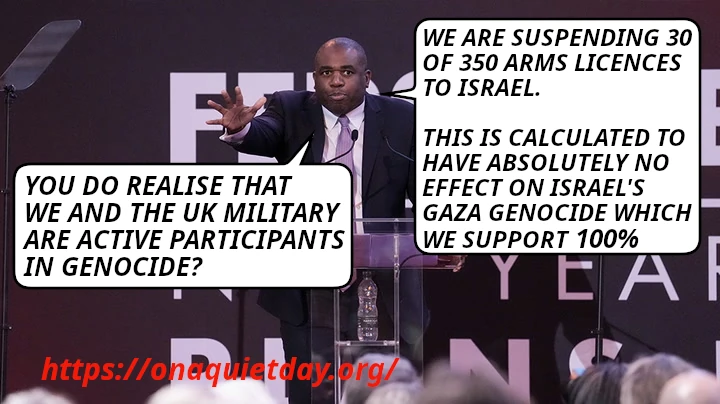
    Genocide denying UK Foreign Secretary David Lammy says that UK is suspending 30 of 350 arms licences to Israel. He also confirms the UK government's support for Israel's Gaza genocide and the UK government and military's active participation in genocide.
    Genocide denying UK Foreign Secretary David Lammy says that UK is suspending 30 of 350 arms licences to Israel. He also confirms the UK government’s support for Israel’s Gaza genocide and the UK government and military’s active participation in genocide.