Category: Palestine
Media Afraid to Call Ethnic Cleansing by Its Name
Original article by Gregory Shupak republished from FAIR under a Creative Commons Attribution-NonCommercial-NoDerivs 3.0 Unported License.

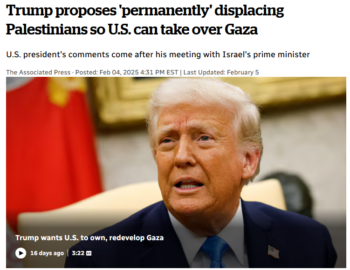
News outlets often preferred euphemisms like “displacing” or “resettling” to the more accurate “ethnic cleansing, as in this CBC headline (2/4/25). Earlier this month, President Donald Trump said that the US will “take over the Gaza Strip” and “own” it for the “long-term” (AP, 2/5/25), and that its Palestinian inhabitants will be “permanently” exiled (AP, 2/4/25). Subsequently, when reporters asked Trump whether Palestinians would have the right to return to Gaza under his plan, he said “no” (BBC, 2/10/25).
After Trump’s remarks, United Nations Secretary-General Antonio Guterres (Reuters, 2/5/25) said “it is essential to avoid any form of ethnic cleansing.”
Navi Pillay (Politico, 2/9/25), chair of the UN Commission of Inquiry on the Occupied Palestinian Territory, said that
Trump is woefully ignorant of international law and the law of occupation. Forcible displacement of an occupied group is an international crime, and amounts to ethnic cleansing.
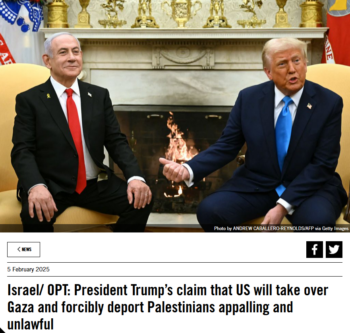
Human Rights Watch (2/5/25) said that, if Trump’s plan were implemented, it would “amount to an alarming escalation of forced displacement and ethnic cleansing of Palestinians in Gaza.”
Clarity in the minority
Amnesty International (2/5/25) called Trump’s proposal to forcibly transfer the population of Gaza a flagrant violation of international law”—but the phrase “international law” was usually missing from news reports on the plan. I used the news media aggregator Factiva to survey coverage of Trump’s remarks from the day that he first made them, February 4 through February 12. In that period, the New York Times, Wall Street Journal and Washington Post combined to run 145 pieces with the words “Gaza” and “Trump.” Of these, 19 contained the term “ethnic cleansing” or a variation on the phrase. In other words, 87% of the articles these outlets published on Trump’s plan to ethnically cleanse Gaza chose not to call it ethnic cleansing.
A handful of other pieces used language that captures the wanton criminality of Trump’s scheme reasonably well. Three articles used “forced displacement,” or slight deviations from the word, while five others used “expel” and another nine used “expulsion.” Two of the articles said “forced transfer,” or a minor variation of that. In total, therefore, 38 of the 145 articles (26 percent) employ “ethnic cleansing” or the above-mentioned terms to communicate to readers that Trump wants to make Palestinians leave their homes so that the US can take Gaza from them.
Furthermore, the term “international law” appears in only 27 of the 145 articles, which means that 81% failed to point out to readers that what Trump is proposing is a “flagrant violation of international law” (Amnesty International, 2/5/25).
A ‘plan to free Palestinians’
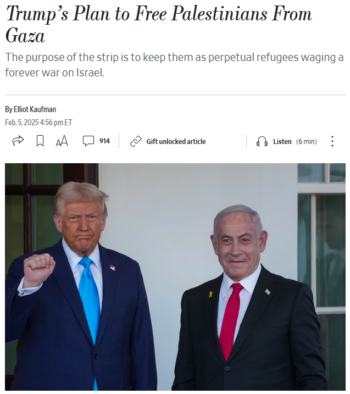
A Wall Street Journal op-ed (2/5/25) hailed “Trump’s Plan to Free Palestinians From Gaza”—in the same sense that the Trail of Tears “freed” the Cherokee from Georgia. Several commentators in the corporate media endorsed Trump’s racist fever dream, in some cases through circumlocutions and others quite bluntly. Elliot Kaufman (Wall Street Journal, 2/5/25) called Trump’s imperial hallucination a “plan to free Palestinians from Gaza.”
While the Journal’s editorial board (2/5/25) called what Trump wants to do “preposterous,” the authors nonetheless put “ethnic cleansing” in scare quotes, as if that’s not an apt description. The paper asked, “Is his idea so much worse than the status quo that the rest of the world is offering?”
Sadanand Dhume (Wall Street Journal, 2/12/25) wondered why “If Indians and Pakistanis Can Relocate, Why Can’t Gazans?” To bolster his case, Dhume noted that 2 million people died as a result of the India-Pakistan partition, and cited other shining moments in 20th century history, such as Uganda’s expulsion of Indians in the 1970s. That these authors implicitly or explicitly advocate Trump’s plan for mass, racist violence demonstrates that they see Palestinians as subhuman impediments to US/Israeli designs on Palestine and the region.
Bret Stephens (New York Times, 2/11/25) wrote that
Trump also warned Jordan and Egypt that he would cut off American aid if they refused to accept Gazan refugees, adding that those refugees may not have the right to return to Gaza. The president’s threats are long overdue.
Ethnically cleansing the West Bank
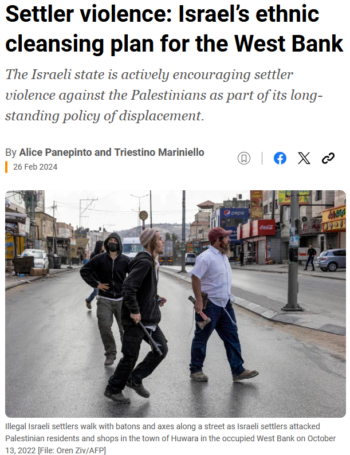
Al Jazeera (2/26/24): “Settler violence is a central part of the Israeli state’s policy and plan to ethnically cleanse the occupied Palestinian territory.” A similar pattern exists in coverage of the West Bank, where evidence of ethnic cleansing is hard to miss, but corporate media appears to be finding ways to do just that.
Legal scholars Alice Panepinto and Triestino Mariniello wrote an article for Al Jazeera (2/26/24) headlined “Settler Violence: Israel’s Ethnic Cleansing Plan for the West Bank”:
Supported by the Israeli security forces and aided and abetted by the government, settler violence is a central part of the Israeli state’s policy and plan to ethnically cleanse the occupied Palestinian territory in order to establish full sovereignty over it and enable settlement expansion.
The authors noted that, at the time they wrote their article, 16 Palesti nian communities in the West Bank had been forcibly transferred since October 7, 2023.
In October 2024, UN Special Rapporteur Francesca Albanese found that throughout the Gaza genocide, “Israeli forces and violent settlers” have “escalated patterns of ethnic cleansing and apartheid in the West Bank, including East Jerusalem.” In the first 12 months after October 7, Albanese reported, “at least 18 communities were depopulated under the threat of lethal force, effectively enabling the colonization of large tracts” of the West Bank.
Euro-Med Human Rights Monitor (2/10/25) said that Israel’s “latest ethnic cleansing efforts” entail “forcibly uproot[ing] thousands of Palestinians in the West Bank,” accompanied by
the bombing and burning of residential buildings and infrastructure, the cutting off of water, electricity and communications supplies, and a killing policy that has resulted in the deaths of 30 Palestinians…over the course of 19 days.
According to the United Nations Relief and Works Agency for Palestine Refugees in the Near East (UNRWA) (2/10/25), Israeli military operations in Jenin camp, which expanded to Tulkarm, Nur Shams and El Far’a, displaced 40,000 Palestinian refugees between January 21 and February 10.
Unnoteworthy violations
I used Factiva to search New York Times, Wall Street Journal and Washington Post coverage and found that, since Panepinto and Mariniello’s analysis was published just under a year ago, the three newspapers have combined to run 693 articles that mention the West Bank. Thirteen of these include some form of the term “ethnic cleansing,” a mere 2%. Nine more articles use “forced displacement,” or a variation on the phrase, 31 use “expel,” 11 use “expulsion” and five use some variety of “forced transfer.”
Thus, 69 of the 693 Times, Journal and Post articles that mention the West Bank use these terms to clearly describe people being violently driven from their homes—just 10%. Many of the articles that address the West Bank are also about Gaza, so the 69 articles using this language don’t necessarily apply it to the West Bank.
Of the 693 Times, Journal and Post pieces that refer to the West Bank, 106 include the term “international law.” Evidently, the authors and editors who worked on 85% of the papers’ articles that discuss the West Bank did not consider it noteworthy that Israel is engaged in egregious violations of international law in the territory.
‘Battling local militants’
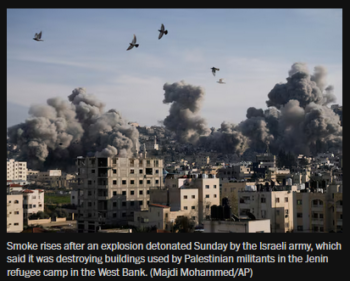
The Washington Post (2/2/25) captioned this image of IDF bombing with Israel’s claim that it was “destroying buildings used by Palestinian militants.” Rather than equip readers to understand the larger picture in which events in the West Bank unfold, much of the coverage treats incidents in the territory discretely. For instance, the Wall Street Journal (1/22/25) published a report on Israel’s late January attacks on the West Bank. In the piece’s 18th paragraph, it cited the Palestinian Authority saying the Israeli operations “displaced families and destroyed civilian properties.” In the 24th paragraph, the article also quoted UNRWA director Roland Friedrich, saying that Jenin had become “nearly uninhabitable,” and that “some 2,000 families have been displaced from the area since mid-December.” Palestinians being driven from their homes are an afterthought for the article’s authors, who do nothing to put this forced displacement in the longer-term context of Israel’s US-backed ethnic cleansing.
A Washington Post report (2/2/25) on Jenin says in its first paragraph that the fighting is occurring “where [Israeli] troops have been battling local militants.” The article then describes Palestinian “homes turned to ash and rubble, cars destroyed and small fires still burning amid the debris.” It cited the Palestinian Health Ministry noting that “at least five people were killed in Israeli strikes in the Jenin area, including a 16-year-old.”
Establishing a “troops vs. militants” frame at the outset of the article suggested that that is the lens through which the death and destruction in Jenin should be understood, rather than one in which a racist colonial enterprise is seeking to ethnically cleanse the Indigenous population resisting the initiative.
The rights of ‘neighbors’
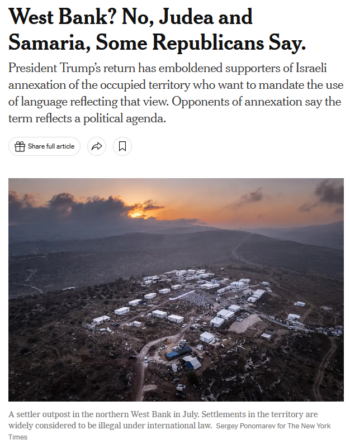
This New York Times piece (2/4/25) acknowledges that Israeli settlements have “steadily eroded the land accessible to Palestinians”—but doesn’t call this process ethnic cleansing. The New York Times (2/4/25) published an article on Republican bills that would require US government documents to refer to the West Bank as “Judea and Samaria,” the name that expansionist Zionists prefer. The report discusses how Trump’s return to office “has emboldened supporters of Israeli annexation of the occupied territory.”
The piece notes that hundreds of thousands of Israelis have “settled” the West Bank since Israel occupied it in 1967, and that Palestinians living there have fewer rights than their Israeli “neighbors.” The author points out that “the growing number and size of the settlements have steadily eroded the land accessible to Palestinians.”
Yet the article somehow fails to mention a crucial part of this dynamic, namely Israel violently displacing Palestinians from their West Bank homes. Leaving out that vital information fails means that readers are not a comprehensive account of the ethnic cleansing backdrop against which the Republican bills are playing out.
Recent coverage of Gaza and the West Bank illustrates that, while corporate media occasionally outright call for expelling Palestinians from their land, more often the way these outlets support ethnic cleansing is by declining to call it ethnic cleansing.
FAIR’s work is sustained by our generous contributors, who allow us to remain independent. Donate today to be a part of this important mission.
Original article by Gregory Shupak republished from FAIR under a Creative Commons Attribution-NonCommercial-NoDerivs 3.0 Unported License.

Elon Musk urges you to be a Fascist like him, says that you can ignore facts and reality then. 
Neo-Fascist Climate Science Denier Donald Trump says Burn, Baby, Burn. Talking about Palestine “not a crime,” reminds UN Rapporteur Albanese
Original article by Ana Vračar republished from peoples dispatch under a Creative Commons Attribution-ShareAlike 4.0 (CC BY-SA) license.
Francesca Albanese during the event “Reclaiming the Discourse: Palestine, Justice, and Truth”. Source: screenshot UN Special Rapporteur Francesca Albanese’s talks have faced intense state pressure across Europe, with Germany at the forefront
Talks by UN Special Rapporteur on the occupied Palestinian territories Francesca Albanese in Europe continue to face fierce pressure. Following the withdrawal of an invitation by some Dutch parliamentarians, German authorities have gone to great lengths to obstruct events where Albanese was scheduled to speak. Two German universities canceled events that had already been announced and had garnered widespread interest. However, activists secured alternative venues, ensuring Albanese could still present the results of her work.
Yet even non-institutional venues were not spared from pressure. The publisher of Junge Welt, which stepped in to host the event “Reclaiming the Discourse: Palestine, Justice, and Truth“ after it was cast out from its original location, found itself facing nearly 100 police officers. Inside the hall, around 200 attendees gathered to hear Albanese speak. Despite protests, the police remained stationed at the venue throughout the event, serving as a clear reminder of the dire state of free expression in Germany. While the hosts are considering legal action against the police, such repression is expected to persist, as left-wing activists remain under surveillance and students organizing Palestine solidarity events at universities face persecution.
Read more: German state continues crackdown on Palestine solidarity
Organizations hosting Albanese, including the political platform DiEM25, have described these pressures as “a direct assault on the rule of law and the core principles of democracy.” Similarly, the Sahra Wagenknecht Alliance – Reason and Justice, along with members of the left party Die Linke, condemned the suppression of academic freedom and the silencing of discussions on Palestine soon after the news of the cancellations.
According to Albanese, Germany is the first country she has visited recently where universities have capitulated to pressure and canceled her speeches. “This gives me a sense of the state of the debate in this country,” she told attendees of Reclaiming the Discourse. Throughout the discussion, the UN Special Rapporteur emphasized the lengths to which many European governments are willing to go to suppress debates on Palestine—Germany, in particular, leading the charge. Despite the authorities’ repressive actions, she insisted that “it’s not a crime to talk about Germany’s implications and responsibilities vis-à-vis what’s happening in Palestine.”
She also urged participants to reject fear and organize against the climate of repression surrounding discussions on Palestine in Europe, describing it as an atmosphere lacking oxygen. “It’s no longer [just] about Palestine,” she continued. “When I see police officers in Europe using the stick against people standing against injustice, when I see Jewish people in this country being lectured about what antisemitism is—I say something has gone wrong.”
“I wouldn’t feel comfortable living in a country where you cannot talk about a people who are being genocided,” she added.
Read more: A year of struggle for Palestine in the belly of the beast
In their attempts to silence Albanese, Zionist groups and other right-wing organizations have attempted to smear her as antisemitic. Some have fallen for this ruse, but many more continue to stand by her and amplify her work. While audience members noted that university staff largely failed to publicly support her or defend academic freedom following the cancellations, Albanese pointed to the legal and academic experts, including in the Global South, who have spoken out, urging institutions to refuse such repression.
“While our politicians and universities fail to show respect for a UN Special Rapporteur, we, as international lawyers, fail a colleague and a luminary in these dark times by not standing up for her against false and unfounded accusations,” wrote public and international economic law expert and professor Isabel Feichtner. “Most of all, however, we fail our students, broader society, and the very idea of human rights, which—if they are to have any meaning—must serve the powerless.”
Original article by Ana Vračar republished from peoples dispatch under a Creative Commons Attribution-ShareAlike 4.0 (CC BY-SA) license.
What’s So Dangerous About Trump’s Plan for Ethnically Cleansing Gaza?
Original article by Ramzy Baroud republished from Common Dreams under Creative Commons (CC BY-NC-ND 3.0).
U.S. President Donald Trump and Israeli Prime Minister Benjamin Netanyahu participate in a joint statement in the East Room of the White House on January 28, 2020 in Washington, D.C. (Photo: Sarah Silbiger/Getty Images) Let’s be clear: The forced displacement of Palestinians is not a new idea. U.S. President Donald Trump’s latest proposal to take “long-term ownership” of Gaza, to “clean out” the “mess,” and to turn it into a “Riviera of the Middle East” is just the latest iteration of efforts aimed at ethnically cleansing Palestinians from their homeland.
What makes Trump’s comments dangerous is not the immediate threat of U.S. military intervention in Gaza followed by the expulsion of its 2.2 million residents. The real danger lies elsewhere.
First, Israel may interpret Trump’s words as a green light to push Palestinians out of Gaza or the West Bank. Second, the U.S. could tacitly endorse another Israeli offensive under the guise of fulfilling the president’s wishes. Third, Trump’s remarks suggest his foreign policy on Palestine will remain largely unchanged from his predecessor’s.
Trump’s so-called “humanitarian” ethnic cleansing proposal will similarly go down in history as another failed attempt, particularly as Arab and international solidarity with the steadfast Palestinian people is stronger than it has been in years.
Some Democrats have seized this moment to criticize Arab and Palestinian Americans who voted for Trump or abstained from supporting Democratic presidential nominee Kamala Harris in the last elections. However, the idea of ethnic cleansing was already being floated during the Biden administration.
While then-Secretary of State Antony Blinken reiterated that “Palestinian civilians… must not be pressed to leave Gaza,” former President Joe Biden created the conditions for displacement through unconditional military support for Israel. This allowed one of the most devastating wars in modern Middle Eastern history to unfold.
Just days into the war, on October 13, 2023, Jordan’s King Abdullah II warned Blinken in Amman against any Israeli attempt to “forcibly displace Palestinians from all Palestinian territories or cause their internal displacement.”
The latter displacement became a reality as most of northern Gaza’s population was crammed into overcrowded refugee encampments in central and southern Gaza, where conditions have been and remain inhumane for over 16 months.
At the same time, another displacement campaign is underway in the West Bank, particularly in its northern regions, accelerating in recent weeks. Thousands of Palestinian families have already been displaced in the Jenin governorate and other areas.
Despite this, the Biden administration has done little to pressure Israel to stop.
Arab concerns over Palestinian expulsion were real from the war’s outset. Almost every Arab leader raised the alarm, often repeatedly.
Egyptian President Abdel Fattah el-Sisi addressed the issue multiple times, warning of Israeli efforts—and possibly U.S. involvement—in a “population transfer” scheme.
“What is happening now in Gaza is an attempt to force civilian residents to seek refuge and migrate to Egypt,” Sisi stated, insisting that such an outcome “should not be accepted.”
Fifteen months later, under Trump, he repeated his rejection, vowing that Egypt would not participate in this “act of injustice.”
The Saudi statement was issued almost immediately after Trump doubled down on the idea during a joint press conference with Israeli Prime Minister Benjamin Netanyahu on February 4. The Saudi foreign ministry went further than rejecting Trump’s “ownership” of Gaza but articulated a political discourse that summarized Riyad’s, in fact, the Arab League’s position on Palestine.
“The Ministry of Foreign Affairs affirms that the Kingdom of Saudi Arabia’s position on the establishment of a Palestinian state is firm and unwavering,” the statement said, adding that the Kingdom “also reaffirms its unequivocal rejection of any infringement on the legitimate rights of the Palestinian people, whether through Israeli settlement policies, land annexation, or attempts to displace the Palestinian people from their land.”
The new U.S. administration, however, seems oblivious to Palestinian history. Given the mass displacement of Palestinians in 1948, no Arab government—let alone the Palestinian leadership—would support another Israeli-U.S. effort to ethnically cleanse millions into neighboring states.
Beyond the immorality of expelling an Indigenous population, history has shown that such actions destabilize the region for generations. The 1948 Nakba, which saw the ethnic cleansing of Palestine, ignited the Arab-Israeli conflict, whose repercussions continue today.
History also teaches us that the Nakba was not an isolated event. Israel has repeatedly attempted ethnic cleansing, starting with its intense attacks on Palestinian refugee camps in Gaza in the early 1950s, and ever since.
The 1967 war, known as the Nakba or “Setback,” led to the ethnic cleansing of hundreds of thousands of Palestinians, both internally and externally. In the years that followed, various U.S.-Israeli initiatives throughout the 1970s sought to relocate the Palestinian population to the Sinai desert. However, these efforts failed due to the steadfastness and collective resistance of the people of Gaza.
Trump’s so-called “humanitarian” ethnic cleansing proposal will similarly go down in history as another failed attempt, particularly as Arab and international solidarity with the steadfast Palestinian people is stronger than it has been in years.
The key question now is whether Arabs and other supporters of Palestine worldwide will go beyond merely rejecting such sinister proposals and take the initiative to push for the restoration of the Palestinian homeland. This requires a justice-based international campaign, rooted in international law and driven by the aspirations of the Palestinian people themselves.
Original article by Ramzy Baroud republished from Common Dreams under Creative Commons (CC BY-NC-ND 3.0).
Climate Science Denier Donald Trump says Burn, Baby, Burn. Elon Musk urges you to be a Fascist like him, says that you can ignore facts and reality then. 
Genocide denier and Current UK Prime Minister Keir Starmer is quoted that he supports Zionism without qualification. He also confirms that UK air force support has been essential in Israel’s mass-murdering genocide. Includes URLs https://www.declassifieduk.org/keir-starmers-100-spy-flights-over-gaza-in-support-of-israel/ and https://youtu.be/O74hZCKKdpA - Shock, Awe, and Ethnic Cleansing: Trump’s Policy in Gaza
- 100+ Groups ‘Decry and Oppose’ Trump Push to Ethnically Cleanse Gaza
- Trump’s Ethnic Cleansing of Gaza Is a Brutal Form of Colonial Capitalism
- Palestinians Reclaiming Their Gaza Homes Is a Profound Response to Trump’s Ethnic Cleansing Threat
- Trump Son-in-Law Jared Kushner Calls for Ethnic Cleansing of Gaza to ‘Finish the Job’
- ‘We’ll Own It’: Trump Floats US Takeover of Gaza—After Ethnically Cleansing Palestinians