

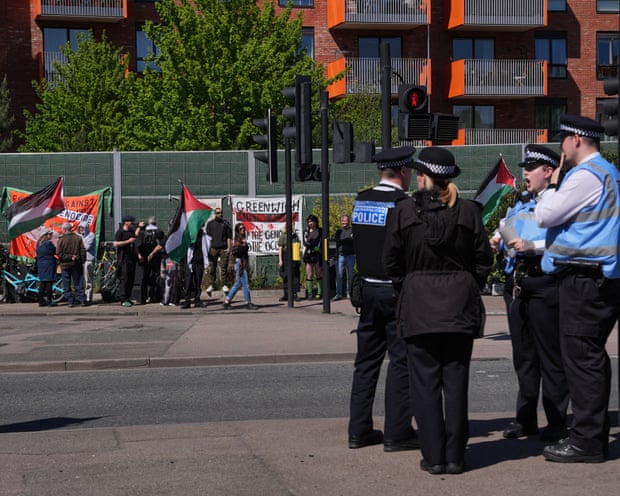
Yvette Cooper wrote a newspaper column about Palestine Action despite prosecutors warning it could prejudice criminal proceedings against six activists from the group, it can be revealed.
The then-home secretary wrote the column justifying Palestine Action’s proscription even though the Crown Prosecution Service advised it might unfairly impact a trial concerning a 2024 break-in at an Israeli arms manufacturer’s factory.
After a retrial, four of the defendants were convicted last week in relation to the raid on the Elbit Systems UK site near Bristol. It can now be reported that defence lawyers sought to halt the proceedings for alleged abuse of process, claiming Cooper’s column for the Observer was “an egregious example of contemptuous reporting which directly interferes with the court process”.
The article, on 17 August, said that charges against Palestine Action activists included a “terrorism connection” and also referred to violence, intimidation and “disturbing information” about future attacks.
…

This work by Middle East Monitor is licensed under a Creative Commons Attribution-NonCommercial-ShareAlike 4.0 International License.

Spanish actor Javier Bardem said the Nakba “never ended,” describing Israel’s actions in Gaza as “genocide” and its policies in the occupied West Bank as “ethnic cleansing and apartheid” in a message marking the anniversary of the 1948 mass displacement of Palestinians, Anadolu reports.
The US social media company X account of the Permanent Observer Mission of Palestine to the United Nations on Friday shared Bardem’s recorded remarks during a screening for UN representatives of the Palestinian-themed film All That’s Left Of You.
In his message, Bardem stressed that the Palestinian people have long struggled against what he described as Israel’s policies of genocide and ethnic cleansing.
“We understand that the Nakba never ended. It is playing out today in Gaza as genocide and in the West Bank as ethnic cleansing and apartheid,” Bardem said.
READ: Palestinians mark 78th Nakba anniversary amid war, ongoing displacement
The Spanish actor also praised the Palestinians’ century-long “determination to remain on their land and to thrive as a people with a rich culture who deserve to be free and to return home,” describing their struggle against erasure as one defined by extraordinary resilience, courage, and steadfast resolve.
The film, which portrays the trauma and search for hope experienced by three generations of a Palestinian family following the 1948 Nakba, was selected by Jordan as its submission for the 98th Academy Awards for Best International Feature Film.
Palestinians commemorate May 15 as the “Nakba” (“Great Catastrophe”) following Israel’s declaration of independence on May 14, 1948, and the subsequent forced displacement of Palestinians from their homes.
During the Nakba, Israel expelled nearly 1 million Palestinians from their homes and destroyed 675 Palestinian towns and villages. More than 70 massacres were carried out by Zionist militias, killing over 15,000 Palestinians.
While Israel continues what Palestinians and rights groups describe as genocide in Gaza, Israeli forces have also intensified raids, violence, and repression against Palestinians in the occupied West Bank.
READ: ‘No to war, and free Palestine’ says Javier Bardem at the Oscars
This work by Middle East Monitor is licensed under a Creative Commons Attribution-NonCommercial-ShareAlike 4.0 International License.
This work by Middle East Monitor is licensed under a Creative Commons Attribution-NonCommercial-ShareAlike 4.0 International License.

The Israeli army secretly seized and deleted parts of the 7 October security camera footage, according to a report published by Israel Hayom yesterday, in the latest revelation to deepen suspicion over the official Israeli account of the events of that day.
The Hebrew-language daily reported that on the evening of 9 October 2023, a classified reserve unit operating under the Israeli army’s Ground Forces Command arrived at Kibbutz Be’eri and asked members of the kibbutz’s rapid-response squad to hand over the device storing all the community’s security camera recordings. The unit commander told the exhausted residents that he needed the material “to bring the hostages home” and promised it would not be shared and would be returned in full.
No written commitment was given. By the following morning, the officer had left Be’eri with the recordings and headed to the Kirya, the Israeli army’s headquarters complex in Tel Aviv.
According to the report, the classified unit — composed of reservists drawn from elite formations including Sayeret Matkal, Shaldag, Shayetet 13 and Duvdevan, and founded around a decade ago by former officer Yoaz Hendel — “operates in the gray zones,” a reference to covert, legally ambiguous missions that fall outside the army’s regular chain of command and conventional rules of engagement.
On the morning of 7 October, the commander of the unit, identified only as “N,” activated the group on his own initiative and dispatched the teams to collect visual material from security cameras, dashcams and GoPro cameras belonging to Palestinian fighters.
OPINION: Why Israel insists on defending its lies about the October attack
Material seized from Kibbutz Be’eri’s command room was subsequently passed to the Hostages and Missing Persons Families’ Management, to the Israeli army Spokesperson’s Unit and to other unspecified bodies inside the Israeli defence establishment, Israel Hayom reported.
From there, the unit lost control of the footage. Two days after the recordings were handed over, one of the kibbutz security squad members watching television recognised the now-iconic footage of an elderly Palestinian man hobbling on crutches into a Gaza border community.
“At that moment I was seething with rage,” he told the paper. “Because I recognised that the material came from the perimeter fence camera at Be’eri — the same camera whose footage had been handed to the officer.” The footage had been broadcast without the kibbutz’s knowledge or consent.
Residents of Kibbutz Be’eri who reviewed the returned material this week told Israel Hayom that the recordings had been “tampered with” and returned with deletions. The paper noted that it was unable to independently verify the claim, but pointed out that residents’ suspicions had been reinforced by a separate investigation by Israeli journalist Gali Ginat for Uvda, the country’s leading investigative current affairs television programme, which uncovered footage from the Dor Alon petrol station near neighbouring Kfar Aza — footage that the Israeli army had previously insisted no longer existed.
READ: Israel becomes world’s most disliked country, global survey finds
“October 7 is defined by a profound crisis of trust,” one Be’eri resident told the paper. “The decisions to delete materials were made ‘under fluorescent lights’ — it’s a conscious decision, not one made in the chaos of combat. These are recordings that belong to the community, of people from the community, and you simply take them and delete them without giving them back.”
Asked why he believed portions of the footage had been deleted, the resident replied: “The day will come when an investigative commission is established here. The fewer witnesses there are, the less damage certain people in the military will sustain. I know it sounds conspiratorial, but the more I think about it, the more that is the conclusion I reach.”
The disclosure is the latest in a series of revelations that have chipped away at Israel’s official narrative of 7 October.
Israel’s most widely circulated atrocity claims have collapsed under scrutiny. The “40 beheaded babies” story, repeated by Israeli officials and amplified by US President Joe Biden in the immediate aftermath of the attack, was never substantiated and is now widely treated as propaganda.
Allegations of systematic sexual violence by Palestinian fighters, propagated by a now-discredited New York Times investigation, have similarly been undermined: Israeli prosecutors have confirmed that no rape complaints were ever filed in connection with 7 October, the Associated Press has reported that key accounts were untrue, and a UN Commission of Inquiry said it had been “unable to independently verify specific allegations” due to Israel’s obstruction of its investigations. Tel Aviv has separately blocked a UN probe into the alleged sexual violence.
Mounting evidence has also confirmed that the Israeli army itself killed an unknown number of its own citizens on 7 October through its activation of the so-called “Hannibal Directive” — a controversial standing order authorising the use of overwhelming force, including against captured Israelis, to prevent their being taken hostage.
READ: Israel has manufactured an industrial-scale version of Jim Crow rape hoaxes
This work by Middle East Monitor is licensed under a Creative Commons Attribution-NonCommercial-ShareAlike 4.0 International License.

This work by Middle East Monitor is licensed under a Creative Commons Attribution-NonCommercial-ShareAlike 4.0 International License.

Israeli forces and armed Jewish settlers are carrying out increasingly coordinated attacks on Palestinian children across the occupied West Bank, with documented incidents including shootings, stabbings, beatings and the use of pepper spray, the UN’s children’s agency has said.
Speaking to reporters in Geneva on Tuesday, UNICEF spokesperson James Elder said: “We’re seeing attacks become increasingly coordinated. Documented incidents include children shot, stabbed, children beaten and children pepper-sprayed.”
At least 70 Palestinian children have been killed in the occupied West Bank since January 2025 — an average of one a week — and a further 850 have been injured, the vast majority by live Israeli ammunition, according to UNICEF figures.
The agency said March 2026 had recorded the highest number of Palestinians injured by settler attacks in the past 20 years. “All this comes amid historic levels of settler attacks,” Elder said.
Recalling a recent visit to the occupied territory, the UNICEF spokesperson described meeting an eight-year-old Palestinian boy who had been beaten with a piece of wood during a settler attack and hospitalised for head injuries. The boy’s mother, he said, “had both her arms broken when she reached across to protect her four-month-old baby, putting therefore her arms between her baby and the attacker’s club.”
READ: Palestinian children injured in Israeli raids, as illegal settlers step up attacks in West Bank
Elder also highlighted a sharp increase in attacks targeting Palestinian education, including the killing, injury and detention of students and the demolition of schools by Israeli forces. “Schools, which should be places of safety and stability, are increasingly becoming places of panic,” he said.
The spokesperson described accompanying Palestinian schoolchildren on their journey to class in an effort to help them avoid being attacked. “It’s interesting to watch them walk… They don’t walk in a straight line because they’re constantly looking over their shoulder,” he said. “This is a walk to school. It’s become a walk through fear.”
UNICEF also reported a “sharp rise” in the arrest and detention of Palestinian children by Israeli occupation forces. Some 347 Palestinian children are currently being held in Israeli military detention “for alleged security-related offences” — the highest figure in eight years, Elder said.
“Alarmingly, more than half of these children, 180, are held under administrative detention and without the procedural safeguards, including detention without regular access to legal counsel and the right to challenge detention,” Elder added.
Administrative detention is a system inherited from the British Mandate era that allows the Israeli military to hold Palestinians indefinitely without charge or trial, on the basis of secret evidence.
Turning to the Gaza Strip, Elder said the UN had documented the killing of at least 229 Palestinian children and the injury of 260 more since the October 2025 ceasefire — agreed after nearly two years of Israel’s genocidal assault on the besieged enclave.
Dr Reinhilde Van de Weerdt, the World Health Organization’s representative in the Occupied Palestinian Territories, told the same briefing that some 10,000 children in Gaza are now living with life-changing injuries.
An estimated 43,000 of the 172,000 Palestinians injured in Gaza since October 2023 have sustained such trauma — including injuries to limbs, the spinal cord or the brain — she said. Almost 2,500 people have been injured since the October 2025 ceasefire alone.
“Of the 2,277 people that have had a limb amputated, less than 25 per cent have been fitted with permanent prosthetics,” Van de Weerdt said, blaming a severe shortage of prosthetics inside the Strip.
READ: Illegal Israeli settlers attack Palestinians in 13 locations across occupied West Bank
