Category: plutocracy

  • How Gaza’s genocide is reshaping US domestic politics

    Spread the love

    This work by Middle East Monitor is licensed under a Creative Commons Attribution-NonCommercial-ShareAlike 4.0 International License

    by Dr Mustafa Fetouri  MFetouri

    A large group of Jewish and Muslim demonstrators carrying banners and Palestinian flags march from Bryant Park toward the United Nations headquarters to protest the policies of Israeli Prime Minister Benjamin Netanyahu and US President Donald Trump regarding the war in Gaza in New York, United States, on September 24, 2026. [Waleed Zein – Anadolu Agency]

    To claim that Israel’s genocidal war in Gaza has fundamentally changed the internal politics of the United States and the wider world might be an overstatement. But what cannot be overstated is a simple fact: Israel and its policies no longer enjoy the virtually unlimited approval and support in the US that they once taken for granted. At both the local and national levels, support for Israel has weakened significantly, while across Europe, too, political attitudes toward Israel have changed in ways that would have been difficult to imagine just three years ago.

    To see that change in Europe just consider the new position taken by the United Kingdom toward Israel, particularly over the occupied West Bank. In earlier September, Foreign Secretary Ed Miliband accused Israeli settler terrorists of perpetrating ethnic cleansing against Palestinians and announced new measures targeting Israel’s settlement enterprise, including sanctions and a ban on imports. Prime Minister Andy Burnham, who just two months before taking office, apologized for Labour’s initial response to the war on Gaza for being too slow to respond to Israel’s genocide. He has said Britain must put more pressure on the Israeli government and consider further sanctions. These are not the positions Britain was taking just a few years ago.

    In America it is even more evident that Israel is losing the support it once enjoyed. It would have been unthinkable just three years ago that large sections of the American public would challenge their government’s traditionally unconditional support for Israel.

    Opinion polls are showing a trend of negative opinion toward Israel. Last July, an Economist/YouGov poll found that 47 percent of Americans believed Israeli Prime Minister Benjamin Netanyahu was guilty of war crimes in Gaza, while 43 percent said Israel was committing genocide against Palestinians. Nearly half, 49 percent, said the US should arrest Netanyahu if he entered the country. Even more strikingly, a February 2026 Gallup poll found that 41 percent of Americans sympathized more with Palestinians in the Middle East conflict. From 2001 through 2025, Israelis had consistently enjoyed a double-digit advantage on this measure. In 2026, for the first time in Gallup’s long-running series, Palestinians moved ahead of Israelis in Americans’ sympathies.

    The change is visible beyond polling booths and political rallies.

    On September 24, Oscar-winning actress Susan Sarandon and Emmy-winning actress Hannah Einbinder were among more than 100 people arrested in New York during a protest against Netanyahu outside the United Nations, where demonstrators demanded an end to U.S. arms supplies to Israel.

    Hollywood star Mark Ruffalo was among more than 1,800 actors, entertainers and producers, including Nicolas Gage and Emma Stone, who signed a pledge to boycott Israeli film institutions over the war. What was once largely confined to the margins of American political debate has consequently become part of mainstream public discourse.

    READ: Satellite images reveal vast destruction across Gaza following Israel’s genocide

    Politically speaking, the shift is becoming increasingly visible at the grassroots level and in electoral contests across the US. One of the clearest examples is the rise of Zohran Mamdani, who defeated former New York Governor Andrew Cuomo in the Democratic mayoral primary before going on to win the general election. Cuomo had made support for Israel one of the central issues of his campaign, while Mamdani was an outspoken critic of Israel’s conduct in Gaza and a supporter of Palestinian rights, going as far as to threaten to have Israeli Prime Minister Benjamin Netanyahu arrested if he came to New York. The ability of a candidate with such positions to win in New York — home to the largest Jewish population outside Israel — was itself politically significant. It indicates even Jewish people are not supporting Israeli actions.

    The same shift is visible in the growing difficulty faced by AIPAC, the most powerful pro-Israel lobby in the United States, and its affiliated groups in some Democratic primaries.

    In Michigan, AIPAC and its affiliated groups spent nearly $30 million backing pro Israel Representative, Haley Stevens, against progressive candidate Abdul El-Sayed, a vocal critic of U.S. military aid to Israel. El-Sayed nevertheless won the Democratic Senate primary on August 4 by about 48.5% of the vote.

    The November midterm elections will provide a much broader test of whether this change in public opinion is beginning to translate into electoral politics.

    Furthermore, the shift has also begun to show itself inside Congress in ways that would have been extremely difficult to imagine only a few years ago. On July 15, the House of Representatives voted on an amendment that would have cut $3.3 billion in military aid to Israel from a broader national security spending bill. True the amendment failed but 103 Democrats and one Republican voted in favour of the cut. In other words, more than half of all House Democrats backed an effort to cut military aid to Israel — an extraordinary departure from the traditionally strong bipartisan support for Israel in Congress. The vote is significant because of the number of lawmakers prepared to break with the established position on U.S. military support for Israel. With the November midterm elections approaching, such a vote provides another indication that the political debate over Israel and U.S. support for it is no longer confined to the margins of American politics.

    What has changed in the US is not simply the intensity of criticism of Israel, but the political space in which it now operates. What was once largely treated as a settled pro-Israel bipartisan consensus is increasingly being challenged by voters, activists, candidates and members of Congress. The shift is visible in opinion polls, in the streets, in Democratic primaries and even on the floor of the House of Representatives. None of this means that support for Israel has disappeared from American politics; it plainly has not. But the political consensus surrounding it is no longer what it was. The November midterm elections will show whether this change in public opinion and political activism has become a lasting force in American electoral politics or just a temporary shift.

    Whatever the outcome of the midterms, however, it will be difficult for Israel to return to the position it once occupied in American public life — as a state that could count on being treated by much of American public opinion and the political establishment as virtually beyond criticism.

    It will be interesting to watch whether Democrats on the left who make it into the next Congress will use foreign policy, including U.S. support for Israel, as an issue in their dealings with pro-Israel Democrats and Republicans, including the president himself.

    OPINION: AI isn’t a future threat—it is already erasing Gaza

    The views expressed in this article belong to the author and do not necessarily reflect the editorial policy of Middle East Monitor.

    This work by Middle East Monitor is licensed under a Creative Commons Attribution-NonCommercial-ShareAlike 4.0 International License

    Climate science denier Donald Trump confirms that he knows nothing about democracy and that more liquid gold is being secured according to his policy of global privateering.
    Climate science denier Donald Trump confirms that he knows nothing about democracy and that more liquid gold is being secured according to his policy of global privateering.
    Orcas discuss Donald Trump and the killer apes' concept of democracy. Front Orca warns that Trump is crashing his country's economy and that everything he does he does for the fantastically wealthy.
    Orcas discuss Donald Trump and the killer apes’ concept of democracy. Front Orca warns that Trump is crashing his country’s economy and that everything he does he does for the fantastically wealthy.
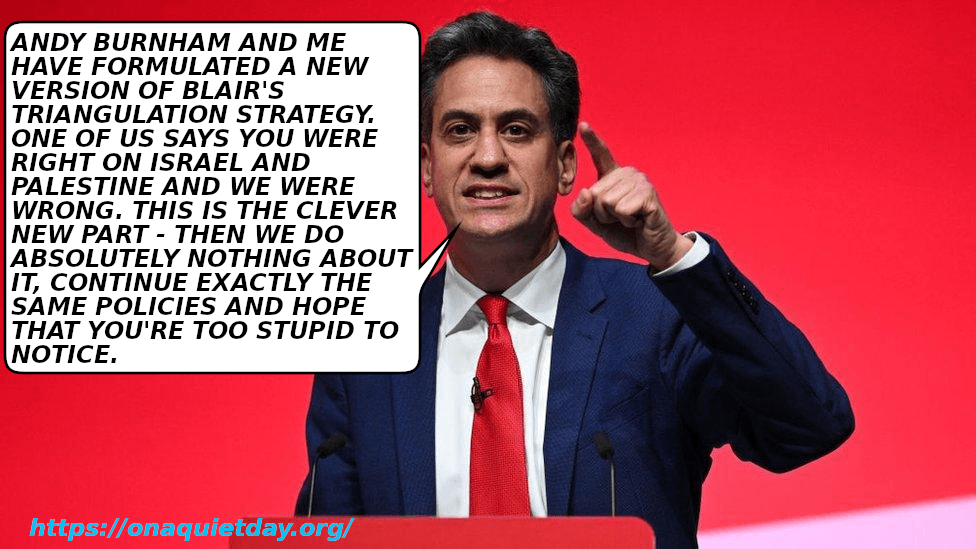
    Ed Miliband claims that he and Andy Burnham have reformulated Blair's triangulation strategy. Their new formulation entails acknowledging that they were wrong on Israel and Palestine but entails doing absolutely nothing about it and continuing exactly the same policies hoping that you're too stupid to notice.
    Ed Miliband claims that he and Andy Burnham have reformulated Blair’s triangulation strategy. Their new formulation entails acknowledging that they were wrong on Israel and Palestine but entails doing absolutely nothing about it and continuing exactly the same policies hoping that you’re too stupid to notice.
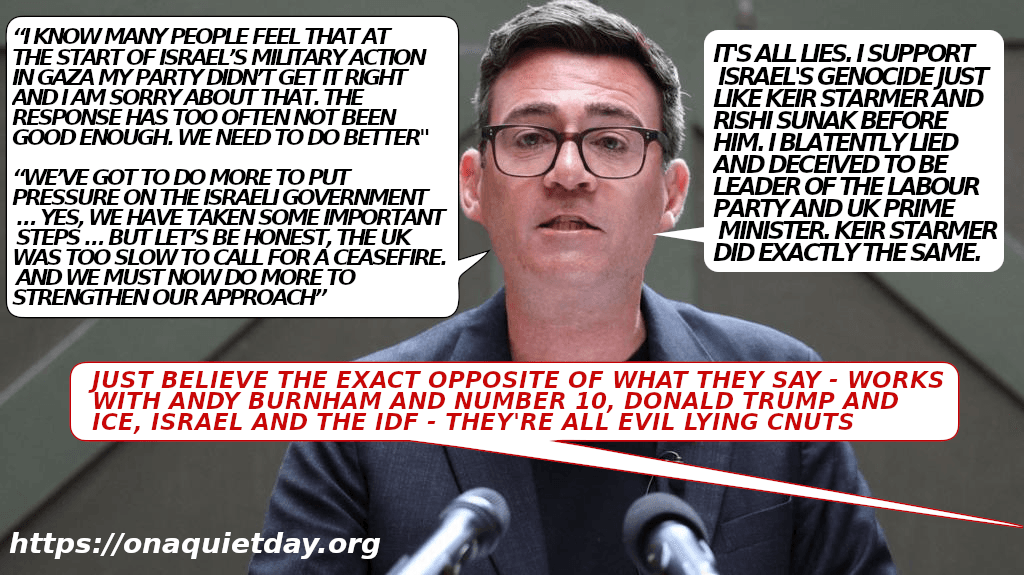
    UK Prime Minister Andy Burnham admits to blatently lying and engaging in deception to become leader of the UK Labour Party and Prime Minister.
    UK Prime Minister Andy Burnham admits to blatently lying and engaging in deception to become leader of the UK Labour Party and Prime Minister.

    Andy Burnham “stands by Israel”

  • Why is the UK’s suppressed climate national security report significant?

    Spread the love

    https://www.theguardian.com/environment/2026/sep/24/explainer-uk-climate-crisis-national-security-report-suppressed

    A satellite image of Hurricane Lowell, left, Hurricane Karina, centre, and Hurricane Marie, right, over the Pacific Ocean earlier this month. Photograph: NOAA/AFP/Getty Images

    Warnings about the catastrophic effects of vital ecosystems collapsing were not published under previous PM

    UK spy chiefs warned government ministers of the catastrophic impacts on national security from the collapse of vital ecosystems around the world, driven by the climate crisis and the overexploitation of nature. But their report, which was supposed to be published almost a year ago, was suppressed under Keir Starmer. Now the government is briefing foreign ministers from other countries on the findings, with a view to gathering global support for more concerted action on the risks.


    …


    The report, which was originally commissioned under the previous Tory government, looked at the potential consequences of a range of scenarios such as the collapse of the Amazon rainforest, which scientists have warned could be close to switching from a rainforest to a savannah-like system under the impact of heating and deforestation. The authors found these could result in food shortages in the UK, which imports about 40% of its food. The report also reviewed the development of new pandemics from areas deforested and overexploited, border disputes among countries affected by the climate crisis, increased Russian and Chinese influence over critical mineral supply chains, and civil tensions within the UK as these impacts play out.

    Collapsing ecosystems overseas – the Congo basin was also a focus – could result in mass migration as people are forced to leave areas no longer habitable, triggering potential unrest and “more polarised and populist politics in the UK and its allies”, along with “more strain on national infrastructure”, and conflict could result from countries fighting over scarce food supplies. While the risk of nuclear war is still regarded as small, it is a potential impact.

    One person who had seen the whole report described it to the Guardian as “apocalyptic”.

    https://www.theguardian.com/environment/2026/sep/24/explainer-uk-climate-crisis-national-security-report-suppressed

  • Turkish-Israeli rift grows irreversibly amid Israeli expansionism and aggression

    Spread the love

    This work by Middle East Monitor is licensed under a Creative Commons Attribution-NonCommercial-ShareAlike 4.0 International License. 

    by Ahmed Asmar

    Turkish President Recep Tayyip Erdoğan (L) and Israeli Prime Minister Benjamin Netanyahu (R). [Photo/AA]

    The 81st United Nations General Assembly session once again exposed a diplomatic rupture that has been taking place for several years. In his address to the world body, Turkish President Recep Tayyip Erdoğan deliberately refused to name Israeli Prime Minister Benjamin Netanyahu, a calculated diplomatic strategy that Turkish analysts describe as a “legal and moral quarantine” designed to strip the Israeli leader of any legitimacy or diplomatic standing. Instead, Erdoğan focused his remarks on Gaza, the Palestinians, and the dysfunction of the international system, calling for greater pressure on Israel and the recognition of Palestine as an independent state.

    Netanyahu, by contrast, responded with a direct and personal attack. From the UN podium, the Israeli prime minister called Erdoğan a “tyrant,” accused Turkiye of being “the latest country to become a super spreader of antisemitic lies,” and claimed Ankara hosts the Palestinian Hamas resistance group leadership. He further incited against Turkiye, accusing it of “illegally occupying northern Cyprus,” violating the rights of Greece, and seeking to govern Jerusalem. However, as he started his speech dozens of delegates walked out of the chamber, reflecting growing international outcry against him and his government policy whether in Palestine or in the entire region. 

    Erdoğan’s response was swift and unequivocal. Speaking in Istanbul, he declared that the place for “war criminals” is not the UN platform but the courtrooms where they stand trial for their crimes.

    The contrast in rhetorical strategy—one leader focused on the system and the principles, the other on personal attacks and aggressiveness—reflects a deeper divergence. The policies of each indicate that Ankara and Tel Aviv have reached an almost irreversible divergent point on every file of contention between them.

    Already collapsing bilateral ties

    The deterioration of Turkish-Israeli relations has moved far beyond diplomatic rhetoric. In August 2026, Turkiye’s Justice Ministry formally requested that Interpol issue a red notice for Netanyahu and another Israeli official, following arrest warrants issued by an Istanbul court on 14th July  2026, on charges of genocide and crimes against humanity. The case stems from Israel’s armed interception of the Global Sumud Flotilla in international waters, which had set sail to deliver humanitarian aid to Gaza. Turkish Justice Minister Akın Gürlek stated that proceedings involve 35 defendants and that Ankara “will not allow the crimes committed in Gaza to be covered up or those responsible to be protected by a shield of impunity.” Furthermore, Turkiye also took economic measures against Israel, severing trade ties and closing its airspace to Israeli officials.

    On the other side, Israeli officials don’t hide their enmity and incitement against Turkiye, according to Israeli media, Israeli Finance Minister Bezalel Smotrich revealed that Israel has been working “openly and behind the scenes” to block the sale of F-35 fighter jets to Turkiye, stating that “Erdoğan’s access to weapons that would change the rules of the game must not be allowed.” Smotrich further claimed that “Erdoğan is a very dangerous man” and that “Turkiye, in its current state, is a very significant threat to Israel,” clearly adopting the language of an adversary.

    In a retaliatory move, Netanyahu, who is wanted by the International Criminal Court (ICC) for war crimes and genocide in Gaza, ordered an official Israeli legal team this week to prepare a case against President Erdoğan over alleged Turkish policies against the Kurds and for hosting Hamas.

    Netanyahu has neither the standing as himself a fugitive from international justice nor the legal basis to sue on behalf of the Kurds. It is nothing but a further demonstration of how Israel and Netanyahu are obsessed with confronting Turkiye.

    READ: Turkiye rejects East-West divide, says Mecca defense pact not aimed at Iran or Israel: President

    Clashing over regional files

    The rift is most visible in the regional arenas where Turkish peace-building efforts directly collide with Israeli expansionism and aggression. 

    In Gaza, Turkiye has repeatedly expressed readiness to contribute to an international stabilization force, with Foreign Minister Hakan Fidan confirming Ankara’s willingness to send troops as part of such a mission. Yet Israel has categorically rejected any Turkish role. Netanyahu declared that Israel would not permit Turkish or Qatari soldiers to participate in the International Stabilisation Force. Fidan later confirmed that Turkiye had received no request to deploy forces, attributing this to Israeli opposition. While Turkiye seeks to calm the situation and support reconstruction, Israel blocks every Turkish effort.

    In Syria, the dynamic is equally stark. Turkiye has invested heavily in supporting Syria’s transition and stability. Israel, by contrast, has expanded its military occupation in Syrian territory, including airstrikes on a military airbase near the Turkish border in August 2026, which Israeli officials claimed was intended to prevent Turkiye from expanding its military presence. The strike was widely interpreted as a direct message to Ankara that Israel will not tolerate Turkish influence in Syria. Netanyahu’s allegations that Turkiye sought to deploy troops in Syria—denied by both Ankara and Damascus—further illustrate the depth of Israeli hostility toward Turkish involvement in Syria.

    In Lebanon, Turkiye has expressed readiness to contribute to post-UNIFIL security arrangements once the UN mission’s mandate expires at the end of 2026. Erdoğan stated that Turkiye wants to participate in any plan to support regional security and guarantee Lebanese sovereignty after the international force withdraws. Yet Turkish analysts note that Israel is “very unlikely” to agree to any Turkish role, and that it would veto such a role for Ankara. Israel has made clear it will spend significant diplomatic pressure to distance Turkiye from any post-war security arrangements in Lebanon.

    On Cyprus, the confrontation takes a different but equally dangerous form. Israel has deepened its military partnership with Greece and the Greek Cypriot Administration (GCA), signing a 2026 military cooperation plan that includes joint naval and air exercises, training, and strategic dialogue. Greece has acquired Israeli missile systems worth billions of euros, including the €3.5 billion “Achilles Shield” air defense system, and has approved the purchase of 36 PULS artillery systems specifically to strengthen its defense along the border with Turkiye. A trilateral rapid reaction force involving Israel, Greece, and GCA has been discussed with the explicit aim of deterring Turkish military activities in the Eastern Mediterranean. By this move, Israel is effectively seeking to encircle Turkiye through different schemes and tactics.

    Conclusion: Recognizing the adversary

    It is clear that Israel is doing everything in its power to harm and confront Turkiye, and it is no longer hiding these policies. From lobbying against Turkish F-35 acquisition to bombing supposed “Turkish interests” in Syria, from vetoing Turkish participation in Gaza stabilisation to building a military bloc with Greece and GCA against Ankara, Israel treats and classifies Turkiye as a strategic obstacle that must be contained and weakened.

    Turkiye must recognise these adversarial policies and incitement for what they are, and to realise much more clearly that expansionist Israel – seeking to dominate the region – will go further in its hostility toward Turkiye.

    This is not a temporary dispute that can be resolved through diplomatic means or restrained by bilateral agreements. The trajectory of Israeli policy  points to an irreversible rift, whereby Israel would not stop from working against and harming all those it believes would stand against its expansionist designs in the region.

    The question is no longer whether such rift is limited or temporary, as it has almost reached a point of irreversibility, with Israel having chosen confrontation in every sphere, necessitating that Turkiye fully recognize this reality, react accordingly, and prepare for a future in which confrontation is not merely likely, but inevitable.

    OPINION: The Board of Peace: The same old prejudice and injustice of the US administration

    The views expressed in this article belong to the author and do not necessarily reflect the editorial policy of Middle East Monitor.

    This work by Middle East Monitor is licensed under a Creative Commons Attribution-NonCommercial-ShareAlike 4.0 International License. 

    Ed Miliband claims that he and Andy Burnham have reformulated Blair's triangulation strategy. Their new formulation entails acknowledging that they were wrong on Israel and Palestine but entails doing absolutely nothing about it and continuing exactly the same policies hoping that you're too stupid to notice.
    Ed Miliband claims that he and Andy Burnham have reformulated Blair’s triangulation strategy. Their new formulation entails acknowledging that they were wrong on Israel and Palestine but entails doing absolutely nothing about it and continuing exactly the same policies hoping that you’re too stupid to notice.
    UK Prime Minister Andy Burnham admits to blatently lying and engaging in deception to become leader of the UK Labour Party and Prime Minister.
    UK Prime Minister Andy Burnham admits to blatently lying and engaging in deception to become leader of the UK Labour Party and Prime Minister.

    Andy Burnham “stands by Israel”

  • ‘You were right’: Ed Miliband tells critics Labour was wrong on Gaza

    Spread the love

    https://www.theguardian.com/politics/2026/sep/28/ed-miliband-labour-former-stance-palestine-fell-short

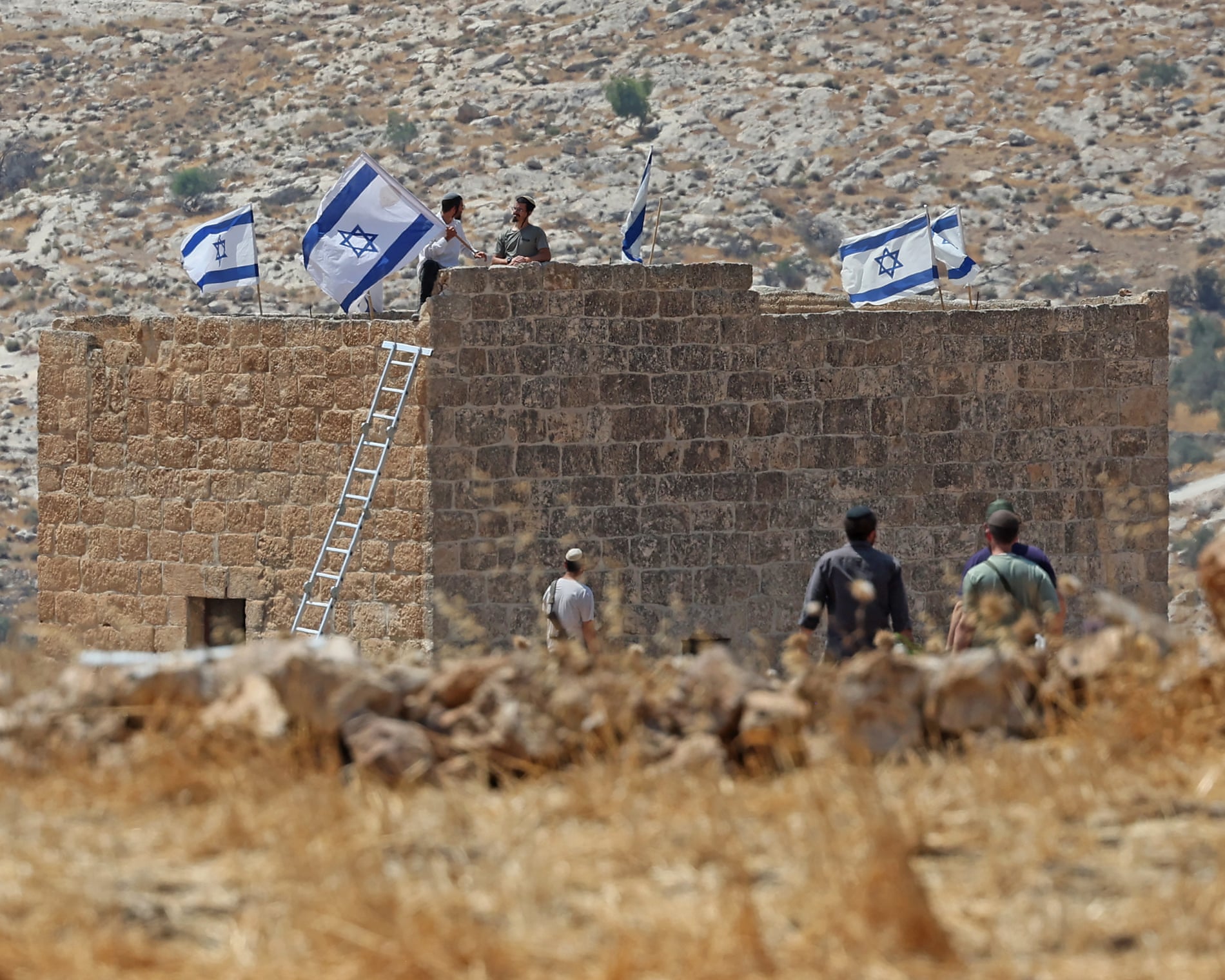
    Israeli settlers fly flags over a home they seized from a Palestinian family south of Bethlehem in the occupied West Bank in August. Photograph: Ahmad Gharabli/AFP/Getty Images

    …

    The Guardian understands Miliband will say in his speech that the sanctions marked a definitive change in how Labour will approach the situation in the Middle East.

    “I want to say to the millions of people in this country and indeed elsewhere who have been moved and outraged by the plight of the Palestinian people: we hear you, you were right,” he will say.

    “And under Andy’s leadership, we have reset our approach. We call out ethnic cleansing by the settler terrorists in the West Bank. We call out the evidence of war crimes in Gaza. We call out Israel’s illegal occupation of Palestine. And we match words with actions.

    …


    https://www.theguardian.com/politics/2026/sep/28/ed-miliband-labour-former-stance-palestine-fell-short

    Report: UK’s ‘double lock’ on arms to Israel suspends nothing

    The British government has not suspended or revoked a single additional arms export licence for Israel since announcing what Foreign Secretary Ed Miliband described as a “double lock” on military sales, according to an investigation by Declassified UK.

    Miliband announced a package of measures on 8 September targeting Israel’s illegal occupation and settlement activity. The measures included plans to prohibit trade with illegal settlements and refuse applications for arms and other exports that materially contribute to the occupation of Palestinian territory.

    However, responding to a parliamentary question from independent MP Iqbal Mohamed, the Department for Business, Innovation, Science and Trade confirmed that no further licences had been suspended or revoked since the announcement.

    …

    Labour reformulates Blair’s triangulation strategy

    This is how it works. Andy Burnham or Ed Miliband say “You were right on Israel and Palestine, we were wrong.” That’s 2 corners of the triangle.

    The new formulation is “Having acknowledged that you were right and we were wrong, we’re going to continue in exactly the same way. We won’t do anything differently. Hopefully you’re too stupid to notice.”

    Ed Miliband claims that he and Andy Burnham have reformulated Blair's triangulation strategy. Their new formulation entails acknowledging that they were wrong on Israel and Palestine but entails doing absolutely nothing about it and continuing exactly the same policies hoping that you're too stupid to notice.
    Ed Miliband claims that he and Andy Burnham have reformulated Blair’s triangulation strategy. Their new formulation entails acknowledging that they were wrong on Israel and Palestine but entails doing absolutely nothing about it and continuing exactly the same policies hoping that you’re too stupid to notice.
    UK Prime Minister Andy Burnham admits to blatently lying and engaging in deception to become leader of the UK Labour Party and Prime Minister.
    UK Prime Minister Andy Burnham admits to blatently lying and engaging in deception to become leader of the UK Labour Party and Prime Minister.
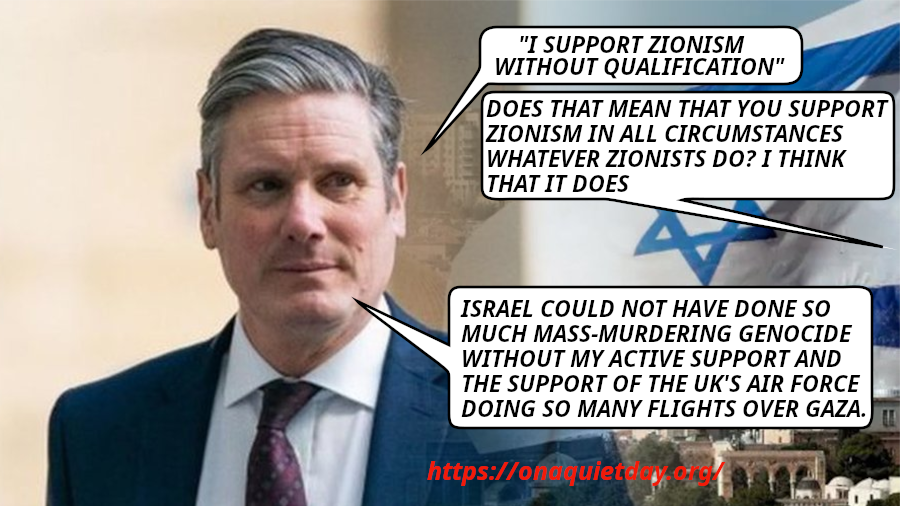
    Current UK Prime Minister Keir Starmer is quoted that he supports Zionism without qualification. He also confirms that his active support and that of UK's air force has been essential in Israel's mass-murdering genocide.
    Current UK Prime Minister Keir Starmer is quoted that he supports Zionism without qualification. He also confirms that his active support and that of UK’s air force has been essential in Israel’s mass-murdering genocide.