Category: plutocracy

  • Thousands March Across Europe Against Inequality and ‘for Young People’s Future’

    Spread the love

    Article by Olivia Rosane republished from Common Dreams under Creative Commons (CC BY-NC-ND 3.0).
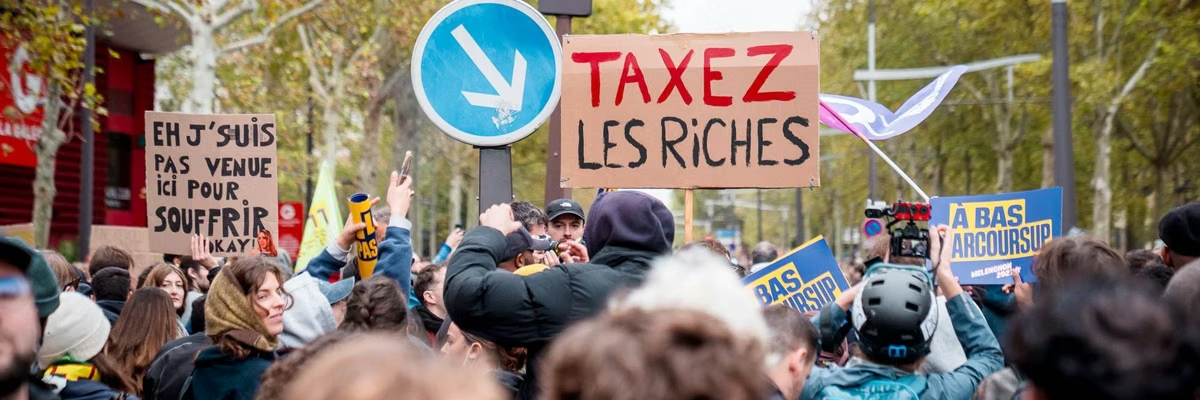
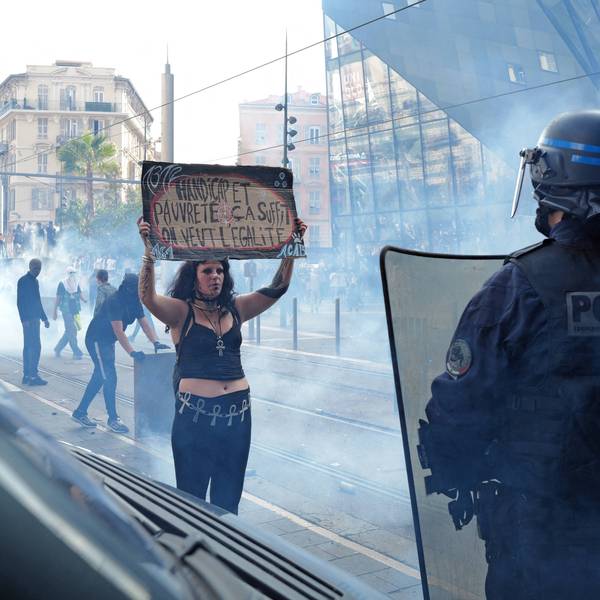
    People march in Paris for education reform and against inequality on October 24, 2026.
    (Photo by Jean-Luc Mélenchon /X)

    “Looking at countries like the United States, we don’t want to end up like them, where part of the population has everything and the others have nothing,” one French protester said.

    Hundreds of thousands of people took to the streets across Europe on Saturday as anger continues to build over the rising cost of living and deteriorating social services.

    While demonstrators emphasized different demands in different countries, the protest wave reflects a sense that the status quo has ceased to work for ordinary people, especially the young.

    RECOMMENDED…
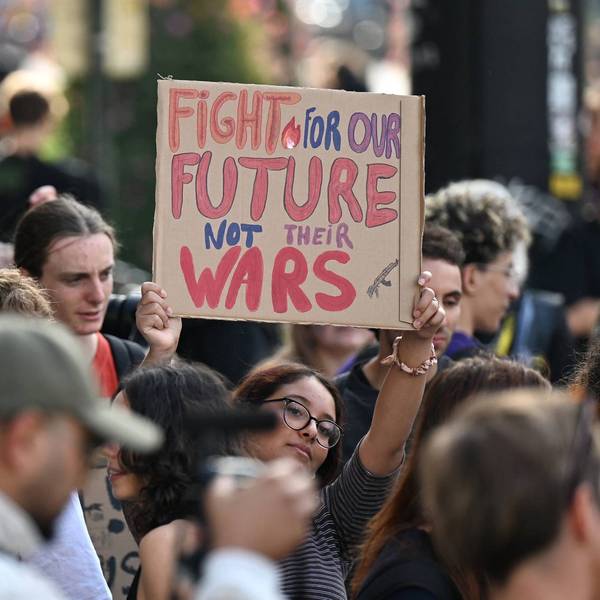
    Student Protests in Belgium

    ‘This Is Going Global’: Anti-Austerity Protests Spread From Spain and France to Chile, Belgium, and Beyond
    'The Government Is Trembling': Protests Erupt in France, Spreading to 140 Cities

    ‘The Government Is Trembling’: Protests Erupt in France, Spreading to 140 Cities

    “I see so many more similarities than differences,” Alice de Brito, the vice president of French student union UNEF, told CNN of the protests. “We are all talking about the need for investments in education, in the universities, in youth in general. But we are also talking about the cost of living, about housing.”

    France

    Across France, between 410,000 and 800,000 people turned out in the continuation of protests that erupted in September when students began to mobilize against underfunding, teacher shortages, and other poor conditions in their schools. Adult workers have joined with the students, criticizing widespread inequality and the rising cost of living, leading to mass demonstrations on October 17 and again a week later.

    “Looking at countries like the United States, we don’t want to end up like them, where part of the population has everything and the others have nothing,” Paris protester Louis Ledoux–Xatard told The Associated Press.

    “Too many billionaires; we are preparing the revolution,” one group of protesters chanted, according to Al Jazeera.

    There were 289 protests in France, including in Marseilles, Nantes, Nice, Lyon, Bordeaux, and Orleans. Interior Minister Laurent Nunez said that almost 1,000 people were arrested, though the number was expected to grow. Two people sustained significant injuries.

    “Behind every police officer, a compliant camera.”

    The protest in Paris had originally been scheduled to run through the center of the city, but authorities relocated it to outskirts and banned marches organized by groups other than unions.

    “It won’t stop the movement. It won’t stop students from demanding better conditions in schools,” nurse Soumaya Abed told AP of the changes.

    Jean-Luc Mélenchon, who leads the left-wing France Unbowed party, criticized the government of President Emmanuel Macron for changing the route, but also praised the marchers for carrying on.

    “Total victory for the social movement,” Mélenchon wrote on social media. “The march gathered at the new authorized point and is now flowing calmly over more than four kilometers. The provocations for disorder by the Paris police prefect and [French Prime Minister Sébastien] Lecornu are a total failure. For the authorities, it is time to give in, or soon they will have only the exit door left.”

    Media reported that the Parisian demonstration was largely peaceful until the end, when police released tear gas and fired water cannons and some black-clad protesters threw projectiles.

    Reporters with Agence France-Presse said they saw:

    police charge several times and vigorously use tear gas and batons against some, mostly young, protesters.
    “The police started moving towards everyone, telling them to get down and back off. They were just taking people down, you know, beating protesters,” one demonstrator bleeding from a baton blow to his face, who gave his first name as David, told AFP.

    Other witnesses also described a repressive police response to The Guardian:

    Mike, a 23-year-old student who also declined to give his surname, said: “Look around, they’re just teenagers. Is it normal for teenagers to be teargassed and beaten with batons?”

    For Jessica, a 24-year-old student, said: “I just don’t understand why there’s so much violence. I feel like our right to protest is being trampled on.”

    Mélenchon lambasted the police and the media for working together to discredit the movement.

    “In Paris, to ruin the day and unwind, the so-called forces of law and order gas and fire into the crowd at the back of the procession, all in a bid to get footage for the domestic news channels that spent the whole week airing the images that spurred the Trappes killer,” he wrote on social media, referring to a racially motivated shooting west of Paris on Friday that killed one and wounded five.

    In a second post, he added: “It continues with the policing of minds through the televisions of power. Tonight, staging of the « tails of the procession » to spew hatred against the popular movement. Without a single image of the masses in peaceful action. Behind every police officer, a compliant camera.”

    He encouraged readers to “turn off the televisions! Form your own opinion without a guardian. Journey through social networks. Stay free to think for yourselves.”

    Belgium

    In neighboring Belgium, hundreds of people marched in Brussels in a continuation of demonstrations for improvements in the education system.

    “We are here for young people’s future, for better work,” rally speaker Celia Ponce told the crowd, as The Brussels Times reported.

    She also accused governments of wanting to “destroy public services.”


    Police used tear gas to disperse some protesters and, in an incident reported by Reuters, kicked and hit one demonstrator after they fell during a chase.

    Spain

    Approximately 25,000 people marched in Madrid to support Spain’s pension system and demand that it keep pace with inflation and that a gender gap be eliminated, according to Al Jazeera.

    “How beautiful Madrid is when it defends its rights,” Emilio Delgado, deputy spokesperson for left party Mas Madrid, wrote on social media. “We propose that no pension should be below the minimum wage. A lifetime of work deserves a dignified retirement.”

    The protests come a month ahead of Spain’s general election, in which current Prime Minister Pedro Sanchez’s Spanish Socialist Workers’ Party will face off against the right-wing Popular Party. Popular Party leader Alberto Nunez Feijoo has promised to adjust pensions according to inflation if his party wins, but demonstrators are still concerned about what a right-wing victory would mean for the pension system.

    Portugal

    In Portugal, meanwhile, the main demand was affordable housing.

    People marched in Lisbon, continuing a movement that began October 10 in the city of Porto calling on the government to address the country’s housing crisis, according to The Resident.

    “We have no home, so we set up tents!” read the slogan of the March, organized by the Acampada de Lisboa movement.

    The protesters also opposed new policies from Prime Minister Luis Montenegro that would weaken a limit on annual rent increases and make it easier to evict people who are unable to make rent payments, according to AP.

    Italy

    Thousands of people joined demonstrations across Italy to protest the affordability crisis as well as the right-wing government of Prime Minister Giorgia Meloni. Protests were called for eight cities including Milan, Turin, and Rome, with 10,000 attending the Milan demonstration alone.

    “We are here because of the rising prices and because I believe that our government has no respect for its citizens,” a 17-year-old student participant, who did not give a name, told Al Jazeera. “There are four people in my family. My mother works in a factory, but my father is about to lose his job. It’s hard to make ends meet on just one salary.”

    The Italian protests were a continuation of demonstrations that have taken place throughout October. There were fewer clashes between police and demonstrators on Saturday compared with earlier marches, though some protesters tried to enter the Colosseum before being pushed back.

    Albania

    In Albania, outrage over plans by US President Donald Trump’s son-in-law Jared Kushner to build a luxury resort near a protected wildlife area—which is widely seen as an example of government corruption—has dovetailed with demands by students for less corruption in the education system specifically as well as lower tuition fees and more funding.

    A demonstration in the capital of Tirana on Saturday marked the 12th day of anti-government protests this month following a summer of mobilizations against the luxury hotel.

    Some protesters lit fires and threw projectiles, while police used tear gas, rubber bullets, and water cannons.

    One demonstrator, the ⁠28-year-old Daniel Tahiri, told Reuters that the Albanian government was a “dictatorship with the clothes of democracy.”

    “Albanians have woken up,” Tahiri said.

    Article by Olivia Rosane republished from Common Dreams under Creative Commons (CC BY-NC-ND 3.0).

  • Greens back STUC plans for frequent flyer levy

    Spread the love

    https://morningstaronline.co.uk/article/greens-back-stuc-plans-frequent-flyer-levy

    ‘We all want first-class public services and the frequent flyer levy is a direct route to funding them’

    THE Scottish Greens have backed STUC calls for a new tax on frequent fliers to cut the cost of travelling by bus and train.

    The plans, first outlined by the STUC’s landmark 2023 Raising Taxes to Deliver for Scotland report, suggested the levy could not only raise as much as £50 million and act as a progressive replacement for the present flat air departure tax.

    Scottish Green co-leader Gillian Mackay said the party “believe in taxing wealth, and protecting our planet.”

    “A frequent flyer levy would allow us to do both of those, while cutting the cost of public transport and investing in services that communities across Scotland urgently need,” she said.

    Arguing the cash raised could be “invested in cheaper train tickets, better public transport and continuing to cut the cost of bus travel until we have a service that is free for everyone,” she added: “With public finances under pressure, the answer cannot be to ask ordinary working people to pay more or accept cuts.

    …

    Article continues at https://morningstaronline.co.uk/article/greens-back-stuc-plans-frequent-flyer-levy

  • Revealed: Palantir led secret review of how the MoD spends billions

    Spread the love

    https://democracyforsale.substack.com/p/revealed-palantir-led-secret-review

    The Ministry of Defence asked the controversial US tech firm how to fix its procurement rules. Its answer? Fewer obstacles for companies like Palanti

    Palantir led a closed-door review of how the Ministry of Defence buys software at the same time as the ministry handed the controversial US tech firm a £240m contract without competition, Democracy for Sale can reveal.

    The review, presented personally to defence minister Luke Pollard by Palantir’s UK boss Louis Mosley in February, urged the MoD to cut “paperwork”, relax scrutiny of new deals and expand existing contracts without fresh competition.

    Of the review’s 35 recommendations, only one was rejected outright. Internal documents obtained by Democracy for Sale – and published below this newsletter – show that the MoD subsequently reported significant progress in implementing the proposals.

    Palantir’s role in shaping MoD procurement policy was not disclosed to the public and was only revealed following Freedom of Information requests by this newsletter.

    Responding to our findings, Spotlight on Corruption’s Dr Sue Hawley called for “a full review by the National Audit Office as to whether the MoD is following conflict of interest rules”.

    …

    This a small excerpt from the article by Lucas Amin and Peter Geoghegan at https://democracyforsale.substack.com/p/revealed-palantir-led-secret-review

  • Western Media Accept Trump’s Plundering of Venezuelan Oil as Business as Usual

    Spread the love

    Article by Ricardo Vaz republished from FAIR under a Creative Commons Attribution-NonCommercial-NoDerivs 3.0 Unported License.

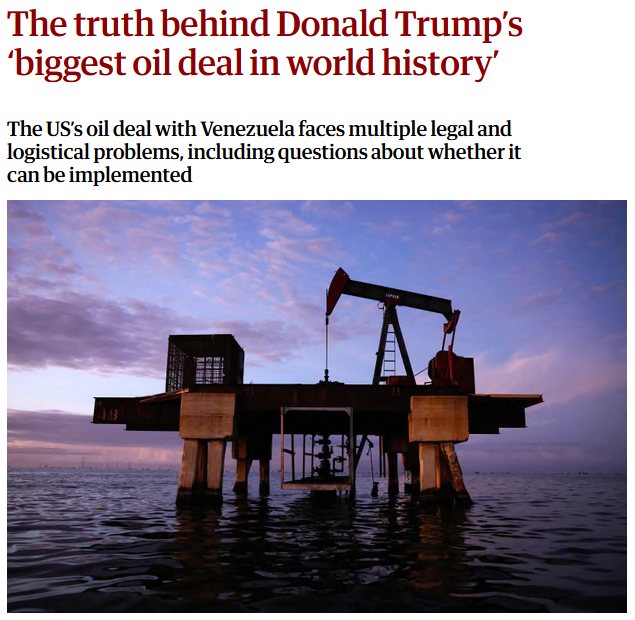
    Guardian: The truth behind Donald Trump’s ‘biggest oil deal in world history’

    Guardian (9/26/26): “Donald Trump has long coveted the oilfields of other nations.” [26/9/26]

    Since the January 3, 2026, military strikes and kidnapping of President Nicolás Maduro, the Trump administration has imposed semi-colonial rule over Venezuela, forcing dramatic shifts in the country’s domestic and foreign policies.

    The capstone of the new tutelary regime is an oil deal announced in late August that Trump called “the biggest in history.” The agreement turns over 17 prime oilfields, holding over 20% of the country’s reserves, to a Pentagon-controlled corporation tasked with supplying cheap fuel to the US war machine for decades to come.

    After spending years manufacturing consent for US-sponsored regime change in Venezuela (e.g., FAIR.org, 6/4/21, 1/11/23, 2/12/25), having a government in Caracas subservient to Washington represented a new scenario for the corporate media. The novel conditions have raised few significant qualms for Western outlets. Tactical objections notwithstanding, there is no fundamental disagreement with the US running the affairs of a Global South country.

    Not ‘stealing Venezuela’s oil’

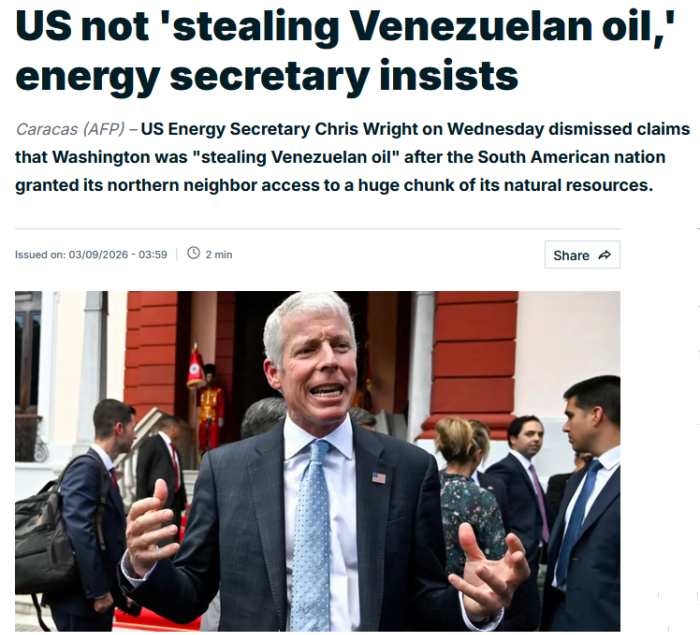
    France 24: US not 'stealing Venezuelan oil,' energy secretary insists

    Energy Secretary Chris Wright (France 24, 3/9/26): “I’ve seen those headlines. ‘We’re Stealing Venezuelan Oil.’ Of course, that’s not true at all.”

    Working hand in glove with the Trump administration, the acting Delcy Rodríguez government has overhauled Venezuela’s hydrocarbon legislation (Venezuelanalysis, 7/13/26) to offer what oil experts consider a business environment more favorable to foreign capital than at any point in the country’s history. The new oil agreement with the White House manages to go even further.

    The 17 oilfields in question will be taken over by North American Blue Energy Partners (NABEP), a private company in which the Pentagon’s Office of Strategic Capital (OSC) will get a 35% stake while investing nothing—and wielding veto power over its board.

    Furthermore, according to the White House, the US State Department will secure 20% of NABEP’s output at cost, and have a right of first refusal over the remaining 80%. On top of this, Venezuelan officials have already suggested Washington would be given an additional “sales discount”  (Venezuelanalysis, 9/9/26).

    In summary, Trump is looking to secure cheap crude supplies at a time when his disastrous Iran debacle has thrown global energy markets into upheaval. The agreement is so blatantly skewed that US Energy Secretary Chris Wright felt he needed to clarify that Washington was not “stealing Venezuela’s oil” (AFP, 9/3/26).

    Nevertheless, Western media outlets were largely unfazed by such an obvious oil grab, euphemistically referring to the deal as “highly unusual” (New York Times, 8/29/26) or “remarkable” (BBC, 9/1/26), at most as “contentious” (Guardian, 9/1/26).

    Corporate journalists did raise objections over the central role played by NABEP owner Alejandro Betancourt, a shady Venezuelan businessman who faced multiple money-laundering probes before the Trump administration intervened, and pressured judicial authorities at home and abroad to drop the investigations (BBC, 9/2/26; CNN, 9/4/26; New York Times, 9/4/26).

    But media seemed satisfied with Trump’s state and energy secretaries Marco Rubio and Chris Wright pledging that US oversight will keep proceedings honest (Reuters, 9/2/26; New York Times, 9/4/26), despite the fact that billions in Venezuelan oil revenues, controlled by the US Treasury Department since January, are unaccounted for (Council on Foreign Relations, 6/3/26; Financial Times, 7/22/26).

    Procedurally transparent plunder

    NYT: Trump Promised Transparency in Venezuela, but Oil Secrets Linger

    The New York Times (5/5/26) wrote positively of “a new era of accountability” in which “the United States would control Venezuelan oil sales” and “Venezuela would submit monthly budgets to the White House.”

    Objections to the Venezuela/NABEP/Pentagon venture were mostly procedural and out of concern for appearances, not driven by any principled opposition to US imperialist predation. Faced with outright colonial plunder of Venezuela, the political and media establishment only demands “accountability” and “transparency” (New York Times, 5/5/26; Financial Times, 9/18/26).

    For months, the White House has controlled Venezuelan oil export revenues, with Trump officials openly calling them “one of the largest assets ever to go on the US balance sheet,” and a source of “leverage” over Caracas. Yet Trump’s Democratic opponents have found no issue with seizing another country’s income, raising only questions about the allocation of the funds in reference to alleged corruption on the part of Caracas and Trump insiders (The Hill, 9/30/26; Washington Post, 9/17/26). This despite the fact that the Venezuelan government has to submit a “monthly budget” to access its own funds (New York Times, 1/28/26) and is subjected to US-imposed auditors (Reuters, 4/27/26).

    The other source of disappointment with Trump stomping all over Venezuelan sovereignty, but prioritizing oil over regime change, is impatience for the restoration/recovery/return of “democracy” to Venezuela (Politico, 9/2/26; Guardian, 8/30/26; CBC, 9/3/26). Despite  widely acknowledgement that Trump is eroding democracy at home (New York Times, 8/20/26, 10/14/26; Guardian, 10/8/26), somehow pundits expected him to prioritize it in an oil-rich foreign country.

    In the establishment’s consensus, “democracy” does not mean a political system that meaningfully reflects the Venezuelan people’s collective will, but simply one that empowers opposition figures that have been groomed for years, like far-right María Corina Machado, their undemocratic credentials notwithstanding (FAIR.org, 10/23/25).

    Eager to stay in power, Rodríguez has over-complied with every US demand, going as far as adopting language about Venezuela undergoing a “democratic transformation.” Her pliancy has earned her favorable corporate media profiles that completely contrast with the demonization of Maduro.

    After securing an exclusive interview, Time (7/30/26) described the acting leader as a “disciplined operator” who “advocate[s] for greater economic openness,” in contrast to the “authoritarian” Maduro, who oversaw “economic collapse.” Along the same lines, the Guardian (9/12/26) presented Rodríguez as a “a pragmatic, witty and intelligent workaholic,” unlike her “authoritarian” and “incompetent” predecessor in the presidential palace.

    Nevertheless, given the broad Beltway consensus for comprehensive regime change, it is unlikely that the Rodríguez administration’s subservience to Trump will secure any leeway in determining its political path forward, free from outside meddling—especially if, as is anticipated, the GOP lawmakers most likely to be impressed by such obsequiousness lose power in the US’s upcoming midterm elections (Axios, 9/23/26; Financial Times, 10/9/26).

    Please think of the corporations!

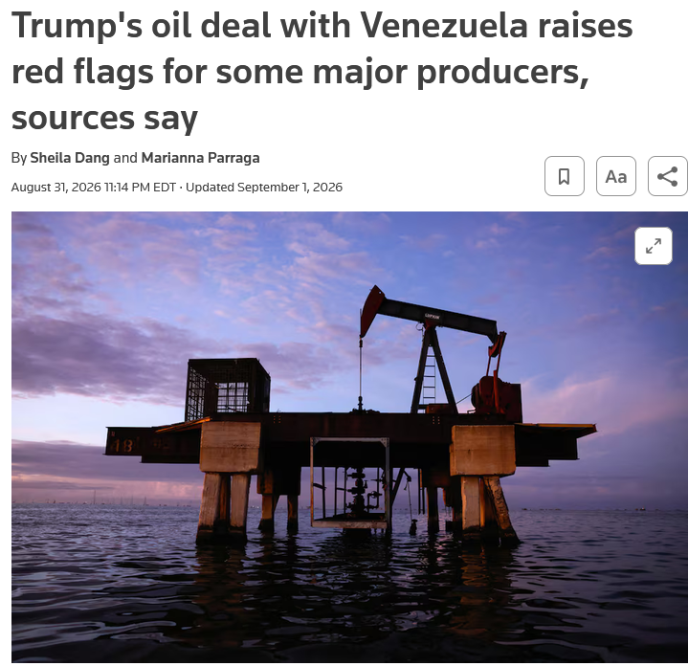
    Reuters: Trump's oil deal with Venezuela raises red flags for some major producers, sources say

    Reuters (9/1/26): ExxonMobil and ConocoPhillips “have repeatedly said that their requirements of legal certainty and contract sanctity ‌have not ⁠yet been met.”

    Alongside their exceptionalist expectations about “democracy,” legacy outlets also focus on those they consider the true victims of Trump’s neocolonial offensive in Venezuela: multinational oil corporations.

    According to Reuters (9/1/26), the recent oil deal “raises red flags for major producers,” who fear having their reputation sullied by being “seated at the same table with Betancourt,” as well as the prospect of the US government becoming a “competitor.”

    Bloomberg (8/30/26) raised concerns that the agreement “reprises [the] neocolonial past” of Venezuela’s oil industry. The warning stems not from apprehension that the Venezuelan people’s future is being determined by a foreign nation, but from fear that the US’s “out-sized power” might lead to “popular unrest.” This could create conditions for what the business mouthpiece views as a catastrophic outcome: the nationalization of foreign-owned oil assets.

    “The troubled history of Venezuela’s oil offers a cautionary tale,” Bloomberg’s Kevin Crowley and Patricia Garip wrote:

    The country was once dominated by US and European operators and was among the world’s largest producers. But assets owned by ExxonMobil Holdings Corps. and ConocoPhillips were seized and nationalized during political upheaval in the 2000s.

    Corporate media present companies that made massive profits in Venezuela for decades as victims, because the Chávez government wanted them to comply with new laws and accept minority stakes in joint ventures.

    The New York Times (9/1/26) complains that the two corporations “have spent years trying to get the country to repay them for their seized assets, with little success.” The statement conceals the fact that the Venezuelan government, when it enacted the 2007 decree imposing state majority in all Orinoco Oil Belt projects, offered to compensate ExxonMobil and ConocoPhillips for their transition to minority partners, or to buy out their assets altogether. However, both corporations rejected the offers in order to pursue international arbitration. The former has already recouped most of what it was granted, while the latter will eventually collect on a significant award.

    Despite the fact that Chevron, BP, Shell and other energy giants have signed deals in recent months taking advantage of the reformed hydrocarbon law (Venezuelanalysis, 9/3/26), pundits complain that ExxonMobil and ConocoPhillips remain “hesitant” (CBS, 8/31/26) and need to be “lured” (Reuters, 9/1/26). Still, the Western corporations are likely to return to the country with favorable deals (Reuters, 9/16/26).

    The victor and his spoils

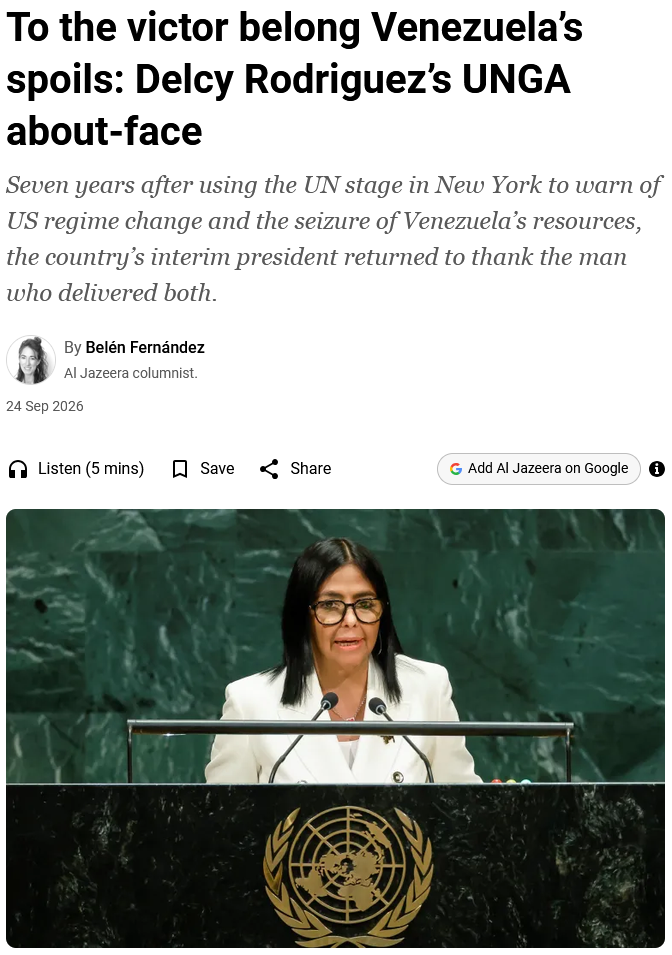
    Al Jazeera: To the victor belong Venezuela’s spoils: Delcy Rodriguez’s UNGA about-face

    Belén Fernández (Al Jazeera, 9/24/26): “You’re not technically supposed to admit that you attacked a country just to get its oil.”

    Faced with strategic defeat in West Asia, Trump has clung to his Venezuela success, stating on multiple occasions that “to the victor belong the spoils,” in reference to the US hijacking the Venezuelan oil industry following the January 3 attacks and presidential kidnapping (Al Jazeera, 9/24/26; Guardian, 9/26/26).

    Furthermore, Trump has not been shy in boasting about the US winning a “war” against Venezuela (Financial Times, 9/18/26; New York Times, 6/26/26). Corporate journalists have rarely pointed out that this stance directly contradicts the administration’s official position that the kidnapping of Maduro and Flores was a “law enforcement” operation (New York Times, 1/6/26; PBS, 1/8/26) in order to justify bypassing congressional approval.

    The US president has likewise claimed to have recovered the costs of the military operation “many times over” (Al Jazeera, 3/3/26; Guardian, 6/28/26), a fact confirmed by Luigi Pisella, a business sector spokesperson with close ties to the acting Rodríguez administration (Venezuelanalysis, 8/10/26). Pisella stated that the US has retained $4.7 billion from the Venezuelan export revenues it controls to cover the costs of its military operation.

    In spite of their ostensible hostility to Trump, corporate outlets have historically been complicit with his Venezuela policies, from whitewashing a deadly sanctions program (FAIR.org, 6/13/22) to endorsing a military buildup over debunked “narcoterrorism” accusations (FAIR.org, 11/19/25). The New York Times and Washington Post went as far as to withhold information in order to not jeopardize the January 3 operation (FAIR.org, 1/13/26).

    Now, with a semi-colonial regime in place, the only concerns are about procedural transparency, democratic appearances and the well-being of multinational corporations. The Venezuelan people always get the short end of the stick.

    FAIR’s work is sustained by our generous contributors, who allow us to remain independent. Donate today to be a part of this important mission.

    Article by Ricardo Vaz republished from FAIR under a Creative Commons Attribution-NonCommercial-NoDerivs 3.0 Unported License.

    Climate science denier Donald Trump confirms that he knows nothing about democracy and that more liquid gold is being secured according to his policy of global privateering.
    Climate science denier Donald Trump confirms that he knows nothing about democracy and that more liquid gold is being secured according to his policy of global privateering.

  • Palantir Targets MPs With ‘Intimidating’ Letters

    Spread the love

    https://novaramedia.com/2026/10/22/palantir-targets-mps-with-intimidating-letters/

    Artwork: Filippo Marra/Novara Media | Photo: Roger Harris/House of Commons

    ‘They will not shut me up.’

    …

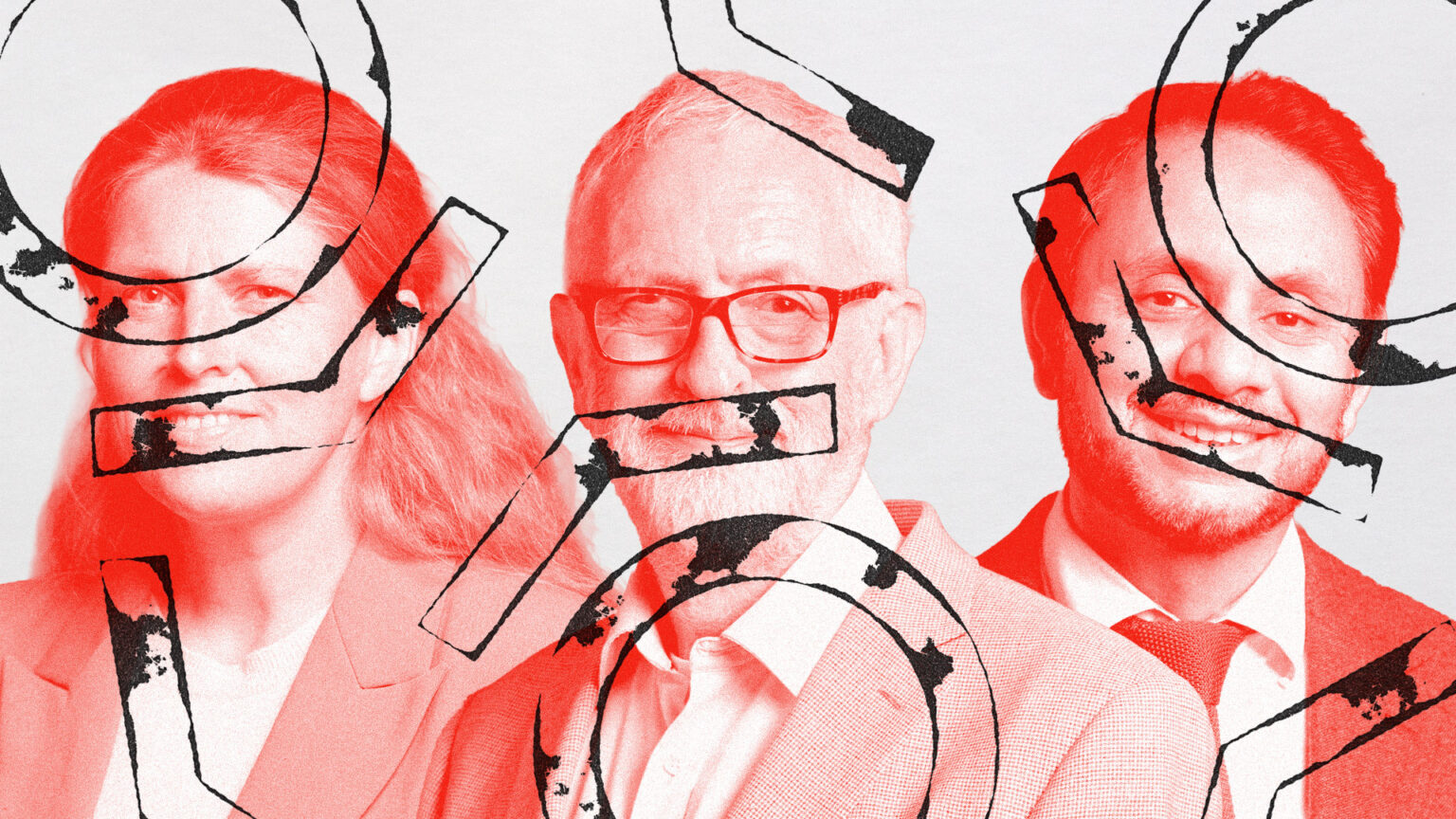
    Clive Lewis, the Labour MP for Norwich South, revealed that he had received a letter from Palantir’s new UK senior VP, Tom Watson, warning him that the company was surveilling his activities relating to Palantir last month. Lewis described this as “very Big Brother” and an “implicit threat”. 

    Watson is a former minister and Labour party deputy leader who now sits in the House of Lords, alongside his Palantir job. 

    Lewis told Novara Media the Mosley letters in June indicate that Palantir was panicking as the Starmer administration crumbled. “They put all their eggs in one basket with Starmer, and then the writing on the wall was that he wasn’t going to be around much longer.” 

    Corbyn has repeatedly questioned the wisdom of using Palantir’s tech in the NHS, given the company’s role in supplying military tech to the IDF during the genocide in Gaza and surveillance tools to ICE as it conducts brutal a [sic] immigration crackdown in the US. 

    …

    A small excerpt of a longer article here: https://novaramedia.com/2026/10/22/palantir-targets-mps-with-intimidating-letters/