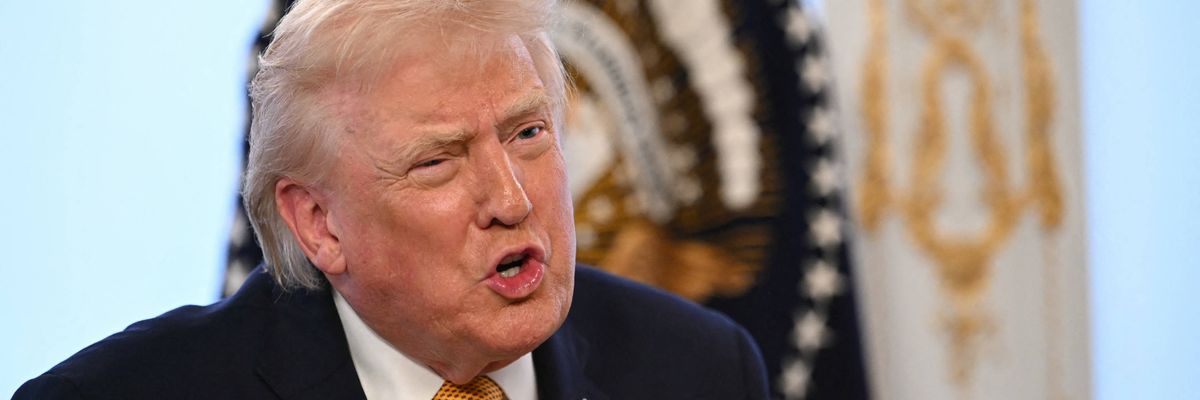
US President Donald Trump speaks to reporters as he departs from the South Lawn of the White House in Washington, DC on December 19, 2025. (Photo by Brendan Smialowski/AFP via Getty Images)
Trump’s latest threat came shortly after he once against lashed out at late-night host Stephen Colbert.
President Donald Trump sent out a cheery Christmas greeting early Wednesday morning just three minutes after threatening to shut down US broadcasters if their programs did not provide him with more positive coverage.
In a Truth Social post sent out at 12:36 am, Trump renewed his threat to once again strip broadcast licenses from networks that cover or portray him and his administration in a negative light.
“If Network NEWSCASTS, and their Late Night Shows, are almost 100% Negative to President Donald J. Trump, MAGA, and the Republican Party, shouldn’t their very valuable Broadcast Licenses be terminated?” Trump wrote. “I say, YES!”
Just three minutes afterward, at 12:39 am, Trump posted an all-caps message that read, “MERRY CHRISTMAS!!!!!”
It is unclear what sparked Trump’s latest threat, although shortly before it was posted he lashed out at comedian Stephen Colbert, whose time hosting CBS’ “The Late Show” is set to end in May 2026.
“Stephen Colbert is a pathetic trainwreck, with no talent or anything else necessary for show business success,” he wrote. “Now, after being terminated by CBS, but left out to dry, he has actually gotten worse, along with his nonexistent ratings. Stephen is running on hatred and fumes. A dead man walking! CBS should, ‘put him to sleep,’ NOW, it is the humanitarian thing to do!”
While Trump frequently delivered angry rants about media coverage throughout his first term, his words appear to be carrying significantly more weight during his second term.
For example, the announcement of Colbert’s cancellation raised eyebrows earlier this year because it came shortly before the Federal Communications Commission (FCC) signed off on an $8 billion deal for CBS parent company Paramount to be bought by Skydance Media, the company founded by David Ellison, son of Trump ally Larry Ellison.
Weeks after this, Trump-appointed FCC Chairman Brendan Carr threatened to rescind broadcast licenses for Disney-owned ABC unless it took late-night host Jimmy Kimmel, a frequent Trump critic, off the air. Hours after Carr’s threat, Kimmel’s show was suspended before being put back on the air days later amid a public outcry.
Over the weekend, CBS News boss Bari Weiss spiked a segment on the network’s flagship news program “60 Minutes” that cast a critical eye on the Trump administration for sending hundreds of Venezuelan immigrants to a notorious El Salvadoran prison where they were allegedly subjected to abuse and torture.
Weiss’ decision to at least temporarily quash the story came as Larry Ellison is making a hostile bid to buy Warner Brothers Discovery that will once again need FCC approval in the future in order to succeed.
Donald Fuhrump says that Amerikkka doesn’t bother with crimes or charges anymore, not being 100% Amerikkkan and opposing his real estate intentions is enough.Orcas discuss how Trump was re-elected and him being an obviously insane, xenophobic Fascist.
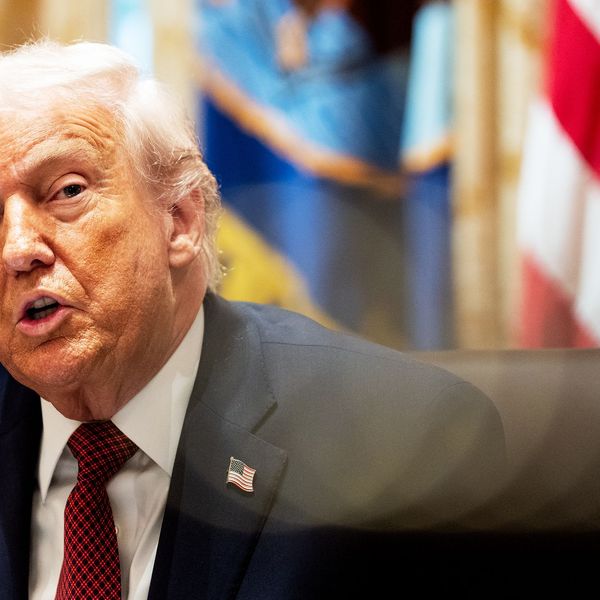
President Donald Trump makes phone calls to US troops on Christmas Eve, from the Mar-a-Lago resort in Palm Beach, Florida, on December 24, 2025. (Photo by Andrew Caballero-Reynolds/AFP via Getty Images)
Trump—who calls himself “the most anti-war president in history”—has now bombed more countries than any president in history.
President Donald Trump—the self-described “most anti-war president in history”—has now ordered the bombing of more countries than any president in history as US forces carried out Christmas day strikes on what the White House claimed were Islamic State militants killing Christians in Nigeria.
“Tonight, at my direction as Commander in Chief, the United States launched a powerful and deadly strike against ISIS Terrorist Scum in Northwest Nigeria, who have been targeting and viciously killing, primarily, innocent Christians, at levels not seen for many years, and even Centuries!” Trump said Thursday in a post on his Truth Social network.
“I have previously warned these Terrorists that if they did not stop the slaughtering of Christians, there would be hell to pay, and tonight, there was,” the president continued. “The Department of War executed numerous perfect strikes, as only the United States is capable of doing.”
“Under my leadership, our Country will not allow Radical Islamic Terrorism to prosper,” Trump added. “May God Bless our Military, and MERRY CHRISTMAS to all, including the dead Terrorists, of which there will be many more if their slaughter of Christians continues.”
.@POTUS “Tonight, at my direction as Commander in Chief, the United States launched a powerful and deadly strike against ISIS Terrorist Scum in Northwest Nigeria, who have been targeting and viciously killing, primarily, innocent Christians, at levels not seen for many years, and… pic.twitter.com/ct7rUW128t
A US Department of Defense official speaking on condition of anonymity told the Associated Press that the United States worked with Nigeria to conduct the bombing, and that the government of Nigerian President Bola Tinubu—who is a Muslim—approved the attacks.
It was not immediately known how many people were killed or wounded in the strikes, or whether there are any civilian casualties.
The Nigerian Ministry of Foreign Affairs said that “terrorist violence in any form, whether directed at Christians, Muslims, or other communities, remains an affront to Nigeria’s values and to international peace and security.”
The US bombings followed a threat last month by Trump to attack Nigeria with “guns-a-blazing” if the country’s government did not curb attacks on Christians.
Northwestern Nigeria—including Sokoto, Zamfara, Katsina, and parts of Kaduna State—is suffering a complex security crisis, plagued by armed criminal groups, herder-farmer disputes, and Islamist militants including Islamic State West Africa Province (ISWAP/ISIS) and Boko Haram. Both Christians and Muslims have been attacked.
Since emerging in Borno State in 2009, Boko Haram has waged war on the Nigerian state—which it regards as apostate—not against any particular religious group. In fact, the majority of its victims have been Muslims.
“According to the Armed Conflict Location and Event Data Project, more Muslims than Christians have been targeted in recent years,” Chloe Atkinson recently wrote for Common Dreams. “Boko Haram has massacred worshipers in mosques, torched markets in Muslim-majority areas, and threatened their own coreligionists.”
“The crisis in Nigeria is not a holy war against Christianity.”
“It is true that Christian communities in the north-central regions have suffered unimaginable horrors as raids have left villages in ashes, children murdered in their beds, and churches reduced to rubble,” she said. “The April massacre in Zike and the June bloodbath in Yelwata are prime examples of the atrocities taking place in Nigeria.”
“The crisis in Nigeria is not a holy war against Christianity,” Atkinson continued. “Instead, it’s a devastating cocktail of poverty, climate-driven land disputes, and radical ideologies that prey on everyone and not just any distinct group.”
“By framing Nigeria’s conflict as an existential threat to Christians alone, Trump is not shining a spotlight on the victims,” she added. “Instead, he is weaponizing right-wing conspiracy theories to stoke Islamophobia, the same toxic playbook he used to fuel his ban on Muslims, and which left refugee families shattered at America’s borders.”
Former libertarian US Congressman Justin Amash (R-Mich.) noted on X that “there’s no authority for strikes on terrorists in Nigeria or anywhere on Earth,” adding that the 2001 Authorization for Use of Military Force (AUMF)—which was approved by every member of Congress except then-Rep. Barbara Lee (D-Calif.)—“is only for the perpetrators of the 9/11 attacks.”
“The War Powers Resolution doesn’t grant any authority beyond the Constitution,” Amash added. “Offensive military actions need congressional approval. The Framers of the Constitution divided war powers to protect the American people from war-eager executives. Whether the United States should engage in conflicts across the globe is a decision for the people’s representatives in Congress, not the president.”
What constitutional authority supports these strikes without a Congressinal declaration of war?
In addition to Nigeria, Trump—who says he deserves a Nobel Peace Prize—since 2017 has also ordered the bombing of Afghanistan, Iran, Iraq, Libya, Pakistan, Somalia, Syria, and Yemen, as well as boats allegedly transporting drugs in the Caribbean Sea and Pacific Ocean. Trump has also deployed warships and thousands of US troops near Venezuela, which could become the next country attacked by a president who campaigned on a platform of “peace through strength.”
That’s more than the at least five countries attacked during the tenure of former President George W. Bush or the at least seven nations attacked on orders of then-President Barack Obama during the so-called War on Terror, which killed more than 940,000 people—including at least 432,000 civilians, according to the Costs of War Project at Brown University’s Watson Institute for International and Public Affairs.
Trump continued the war on ISIS in Iraq and Syria started by Obama in 2014. Promising to “bomb the shit out of” ISIS fighters and “take out their families,” Trump intensified the US campaign from a war of “attrition” to one of “annihilation,” according to his former defense secretary, Gen. James “Mad Dog” Mattis. Thousand of civilians were killed as cities such as Mosul, Iraq and Raqqa, Syria were flattened.
Donald Fuhrump says that Amerikkka doesn’t bother with crimes or charges anymore, not being 100% Amerikkkan and opposing his real estate intentions is enough.
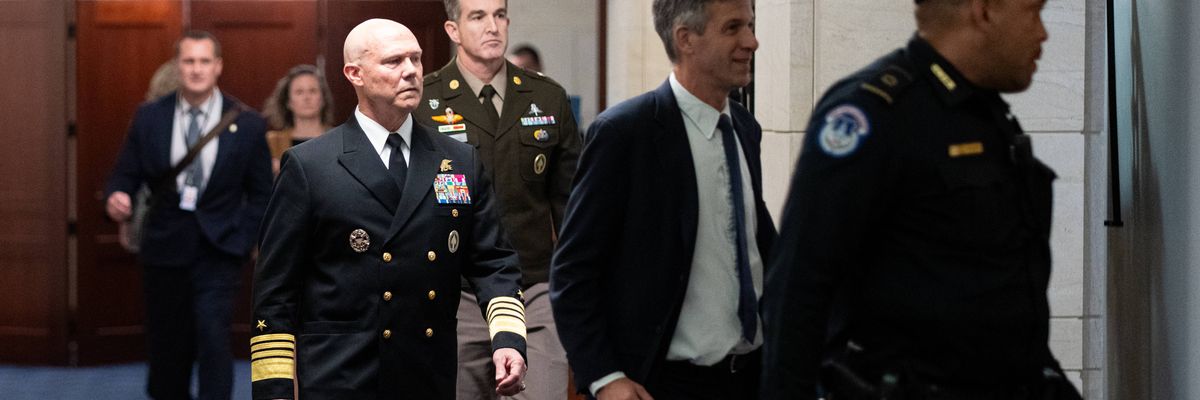
Adm. Frank “Mitch” Bradley, left, walks to a holding room in the Capitol Visitor Center on December 4, 2025, before briefing members of Congress on boat strikes. (Photo: Bill Clark/CQ-Roll Call, Inc. via Getty Images)
A military spokesperson refused to comment on what the admiral told Congress beyond confirming that “he did inform them that during the strike he sought advice from his lawyer and then made a decision.”
The journalist who initially revealed that President Donald Trump’s administration killed shipwrecked survivors of its first known boat bombing reported Tuesday that the admiral in charge consulted with a US military lawyer before ordering another strike on the two alleged drug traffickers who were clinging to debris in the Caribbean Sea.
Just days after Trump announced the September 2 bombing on social media, Intercept journalist Nick Turse exposed the follow-up strike that killed survivors, citing US officials. The attack has sparked fresh alarm in recent weeks, since late November reporting from the Washington Post and CNN that Adm. Frank “Mitch” Bradley ordered the second strike to comply with an alleged spoken directive from Defense Secretary Pete Hegseth to kill everyone on board, which Hegseth has denied.
After the first strike, “Bradley—then the head of Joint Special Operations Command—sought guidance from his top legal adviser,” according to Turse. He interviewed several sources familiar with the admiral’s recent classified briefing to Congress, former members of the Judge Advocate General’s (JAG) Corps, and ex-colleagues of the JSOC staff judge advocate to whom Bradley turned, Col. Cara Hamaguchi.
As Turse reported:
How exactly [Hamaguchi] responded is not known. But Bradley, according to a lawmaker who spoke on the condition of anonymity to discuss a classified briefing, said that the JSOC staff judge advocate deemed a follow-up strike lawful. In the briefing, Bradley said no one in the room voiced objections before the survivors were killed, according to the lawmaker.
Five people familiar with briefings given by Bradley, including the lawmaker who viewed the video, said that, logically, the survivors must have been waving at the US aircraft flying above them. All interpreted the actions of the men as signaling for help, rescue, or surrender.
Bradley, now the chief of Special Operations Command, declined to comment, the reporter noted. SOCOM also declined to make Hamaguchi available, though the command’s director of public affairs, Col. Allie Weiskopf, said: “We are not going to comment on what Admiral Bradley told lawmakers in a classified hearing. He did inform them that during the strike he sought advice from his lawyer and then made a decision.”
Tuesday’s reporting caught the attention of the former longtime executive director of Human Rights Watch (HRW), Kenneth Roth, who has stressed that not only is it “blatantly illegal to order criminal suspects to be murdered rather than detained,” but “the initial attack was illegal too.”
Did the U.S. military kill two survivors of an attack on a supposed drug-running boat because they tried to surrender by waving only one hand instead of the usual two, since they were clinging to their destroyed boat with the other? https://t.co/JnCmt0oYGL
Various other experts and US lawmakers have similarly condemned the dozens of strikes in the Caribbean and Pacific Ocean since September—which as of Monday have killed at least 105 people, according to the Trump administration—as “war crimes, murder, or both,” as the Former JAGs Working Group put it after the Hegseth reporting last month.
“Extrajudicial executions,” declared public interest lawyer Robert Dunham on social media Wednesday, sharing Turse’s new report and tagging the groups Amnesty International USA, HRW, and Reprieve US, as well as the Office of the United Nations High Commissioner for Human Rights and independent experts who report to the UN Human Rights Council.
Those experts on Wednesday rebuked Trump’s recent aggression toward Venezuela, including not only the boat strikes but also threats to bomb the South American country and attempts to impose an oil blockade. They said that “the illegal use of force, and threats to use further force at sea and on land, gravely endanger the human right to life and other rights in Venezuela and the region.”
Donald Fuhrump says that Amerikkka doesn’t bother with crimes or charges anymore, not being 100% Amerikkkan and opposing his real estate intentions is enough.
Reform UK leader Nigel Farage arrives at the Reform UK South East conference, at Sandown Park Racecourse in Esher, Surrey, January 10, 2025
LABOUR slammed Reform UK today amid a deluge of damning evidence against the right-wing party’s mayoral candidate Chris Parry, who said David Lammy should “go home to the Caribbean.”
Nigel Farage’s party has faced calls to drop the retired Royal Navy officer as mayoral candidate for Hampshire and the Solent after it emerged he had posted on X in February: “Lammy must go home to the Caribbean where (his) loyalty lies.”
In a press conference on Tuesday, Reform deputy leader Richard Tice claimed that he was “not familiar” with Mr Parry’s remarks against the Deputy Prime Minister and Justice Secretary, but added, “whether we think he’s doing a good job or a bad job is just part of politics.”
Reform UK continued to refuse to condemn Mr Parry yesterday amid new reports that he suggested at least eight other politicians from minority ethnic backgrounds do not have a primary loyalty towards Britain.
Argentina President Javier Milei. Photo: Javier Milei / X
In this article, we review some of the general trends and attitudes of Milei’s government two years into his term.
Thousands of Argentines endured high temperatures as they took to the streets on December 18 to protest the labor reform of Javier Milei’s far-right government. The call to action by the General Confederation of Labor (CGT) was supported by several trade unions, which claimed that the measure seeks to destroy workers’ rights to benefit big business: “This reform will only deepen poverty, social exclusion, and job insecurity. We will not give up our fight for decent work,” the CGT said in a statement.
The government has justified the measure by citing an alleged need to modernize labor relations: “The text also incorporates specific incentives for the formalization of employment, new rules for the platform economy, more efficient employer contribution schemes, and mechanisms that reduce litigation, providing the system with greater predictability and long-term stability.”
However, organized workers claim that this is a labor flexibility project that aligns with President Milei’s neoliberal agenda. Cristian Jerónimo, leader of the CTE, said: “[The labor reform] does nothing to benefit the world of work; it is written in favor of Argentina’s large corporations and does not favor small and medium-sized enterprises.”
But for the protesters, this reform comes as no surprise. Long before becoming president, Milei announced that it was imperative to reform the entire structure of the Argentine state in order to put it on the “path to freedom,” which means neoliberalizing the economy, reducing state participation in the economy to a minimum, strengthening the apparatus of repression, and aligning the South American country geopolitically with Washington’s interests. In short, to return to the path of the Washington Consensus.
After the day of mass mobilization, the government announced that the debate on the reform would be postponed until February, an initial sign that Milei is feeling the pressure of the popular demonstrations. Yet, after two years in office, Milei has done everything possible to push forward his neoliberal agenda even amid many rounds of mass demonstrations. A series of laws, executive decrees, and international diplomatic engagements have been the clearest signs of the path taken by the right-wing libertarian leader who governs a country that, despite his promises, is once again returning to the path of economic crisis and political instability.
Economy: fiscal adjustment and social tension
In line with neoliberal orthodoxy, Milei has implemented a series of fiscal adjustments to eliminate the deficit, even though this has been at the expense of the material stability of the most disadvantaged sectors, who have taken to the streets to protest against cuts in health, education, and other areas that the Argentine state now refuses to cover in full or adjust in line with the current economic reality. Students, teachers, researchers, and university workers have also taken to the streets consistently, demanding improvements in higher education funding, funding for science and health research, and defending free and public education.
Repression of mass protests, ordered by Security Minister Patricia Bullrich, has been severe. Hundreds have been arrested and injured, including Pablo Grillo, a journalist who was nearly killed when a tear gas canister struck him in the head.
Nevertheless, Milei did not slow down. The elimination of subsidies, wage freezes, and widespread privatization of public companies generated the long-awaited fiscal surplus in more than a decade. Year-on-year inflation, which stood at around 211% at the end of 2023, was reduced to 3% at some point in 2025.
Despite this, several analysts have stated that the 2.3% increase in inflation in October 2025 reflects the shortcomings of a neoliberal model in sustaining a long-term surplus.
Furthermore, it is important to remember that this year, Donald Trump’s administration bailed out Argentina with a record payment of more than USD 20 billion, in addition to the IMF’s generous granting of USD 20 billion to Argentina.
In other words, the surplus that the executive branch promotes as its great economic success has been achieved thanks to enormous support from its international allies, who demand neoliberal macroeconomic change not only in Argentina but throughout the region. This, of course, comes at a price that Argentines will have to pay for decades to come. Argentina has the largest IMF debt in the world. Its debt of more than USD 64 billion is “the price of freedom.”
Politics: reduction of the state and open confrontation
Following his economic model, Milei’s government has pushed radical downsizing. More than 10 ministries and 200 government departments were eliminated in one fell swoop. This meant the dismissal of almost 50,000 people who suddenly found themselves thrown into unemployment and precarity.
These decisions were made abruptly and aggressively, political attitudes that the president has adopted as part of his communication strategy. Bypassing parliamentary approval whenever possible, Milei always sought to govern unilaterally whenever possible.
But Milei has also achieved significant legislative victories. At the beginning of his administration, he had the support of only 39 deputies and six senators; however, he managed to pass several laws, such as the Bases Law (which allowed for the radical privatization of the Argentine state) and tax reforms.
He achieved this thanks to the support of the PRO, a right-wing party led by former president Mauricio Macri, and certain dissident Peronists. The formation of the so-called “May Pact,” a major agreement between Argentina’s right-wing parties and governors, allowed him to negotiate and agree on several reforms desired by right-wing libertarianism.
This pact prevented an increase in pensions for the elderly, who have regularly protested to demand more money to buy medicine and food, which are now major obstacles in their lives. Despite this, the Pact has not budged and continues with its neoliberal drift.
Political and judicial scandals
Milei’s administration has also been marked by several scandals. Very early on, he began a dispute with Victoria Villarruel, his vice president, whom he accused of playing into the hands of his political enemies.
He was also involved in the “$LIBRA” scandal, in which he is accused of being part of an international fraud scheme related to the sale of cryptocurrencies. A parliamentary commission concluded that Milei did use his position as president to promote the scam, which caused millions in losses to investors around the world.
But the event that probably had the greatest impact on Milei’s popularity involved his sister. Karina Milei, who serves as Secretary to the President, is accused of participating in a bribery ring that operated through the National Disability Agency (ANDIS). Many saw the emergence of this scandal as the reason for his resounding defeat in the Buenos Aires Province elections on October 26.
Despite this, Milei managed to recover and his party, La Libertad Avanza (LLA), won the next legislative elections and increased its number of seats in the legislature. His strategy was the usual one: accusing Peronism of destroying Argentina and presenting himself as the only one capable of saving the country. However, this messianic communication strategy has begun to be questioned precisely because of the corruption and fraud scandals that have plagued his government.
Alignment with Washington
Milei has made a significant shift in the country’s foreign policy. Argentina’s vote against the UN resolution condemning the US economic and trade blockade of Cuba reflects an important change. Historically, Argentina has maintained a diplomatic position against any act of imperialism due to its claim over the Malvinas Islands, which, despite being off its coast, are governed by the United Kingdom. The dispute has escalated to military levels despite repeated claims by the Argentine authorities.
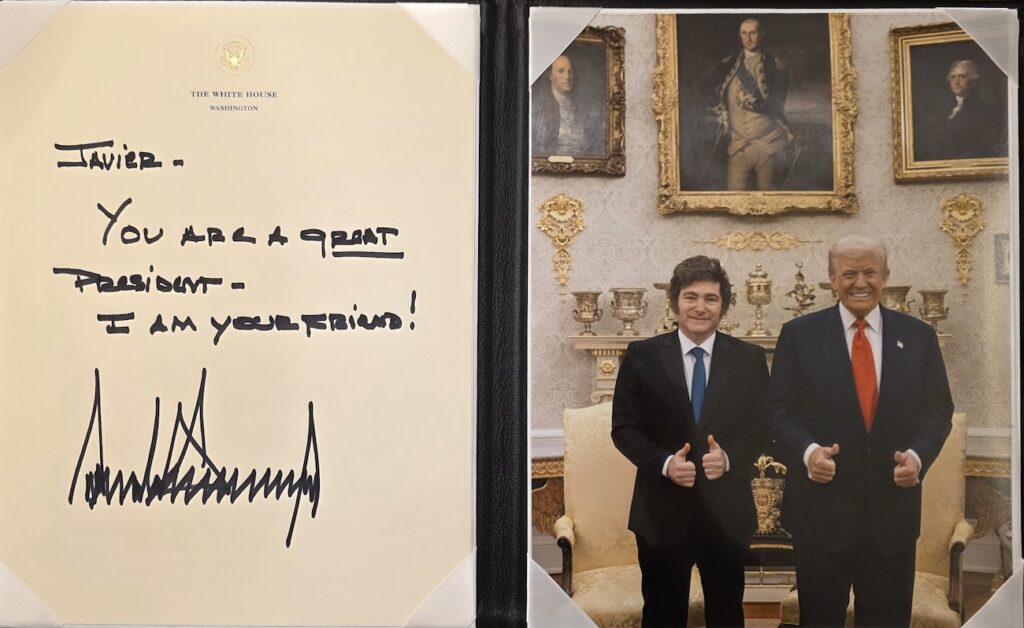
Donald Trump-signed photo of him and Javier Milei. Photo: Javier Milei / X
But the change is much more than nominal. Argentina has become the Trump administration’s greatest ally in South America. Milei has praised Trump’s personality, and Trump has publicly supported him, like when, in the last legislative elections, he suggested an end to cooperation between Buenos Aires and Washington if Milei lost. In response, the Argentine president has repeatedly declared his loyalty to Trump’s geopolitical project and has supported all of his initiatives both within and outside the region.
In this way, Milei has become a sort of archetype for the leaders of the new Latin American right. With radical fiscal adjustment at the expense of the most impoverished sectors, open confrontation with their opponents, and an international policy fully aligned with Washington (which has initiated a new chapter of the Monroe Doctrine), far-right governments are beginning to gain ground in the region: Kast in Chile, Paz in Bolivia, etc., are examples of an ideological and geopolitical shift in the region that is impossible to understand without the figure of Javier Milei.




 Reform UK leader Nigel Farage arrives at the Reform UK South East conference, at Sandown Park Racecourse in Esher, Surrey, January 10, 2025