This article was originally posted 6/12/24 but was deleted, probably my mistake.
Original article by Sam Pizzigati republished from Common Dreams under a Creative Commons Attribution-Share Alike 3.0 License.
Billions upon billions give our world’s wealthiest an overabundance of mind-boggling political power, and right now they’re wielding that power to protect their fortunes at the expense of our planet’s future.
Looking to find something special this holiday season for that mega-millionaire in your life? The Italian retailer Valextra has just what you may need: a cocktail set that offers a “vision of design fluidity and discreet luxury.” Just $13,400 for a leathered and lacquered box that includes “a shaker, cocktail tools made from silvered brass, and two martini glasses.”
Or maybe you’re looking for a nice, new waterfront condo in South Florida. The private-equity movers and shakers at Apollo Global have just advanced the $307 million needed to plop 92 sumptuous residences on Florida’s “Millionaire’s Mile” near Pompano Beach. Each of these seaside palaces will enjoy “direct access to a private beach with food and beverage service.”
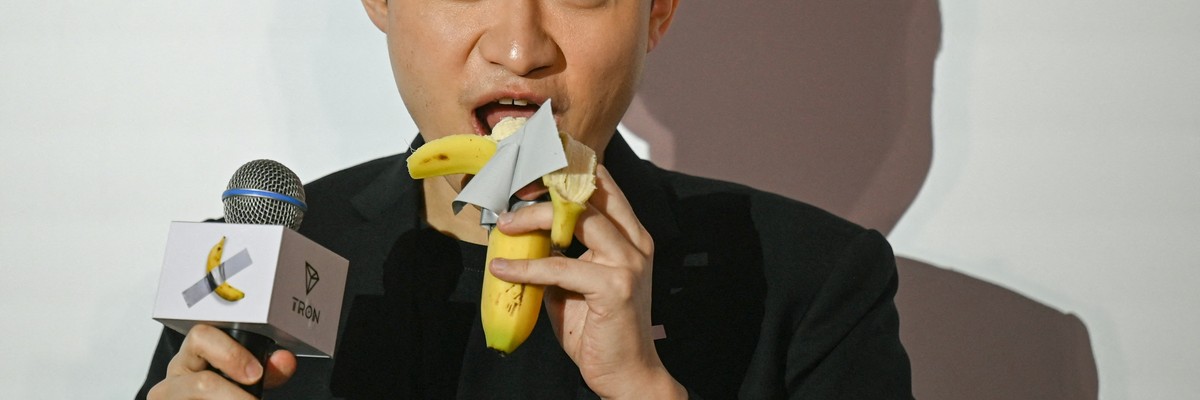
Or do you have your heart set on a thrilling new artistic experience? The billionaire crypto king Justin Sun certainly delivered one last Friday. Two days earlier, at a Sotheby’s auction, Sun had outlasted six other bidders and won—for $6.2 million—an artwork from an Italian absurdist artist. Sun proceeded to work up an appetite and then, before a packed news conference at a pricey Hong Kong hotel, ate his historic acquisition: a banana duct-taped to a wall. Only a video of the banana remains.
What wealthy nations do take seriously: the interests of their wealthy. And that seriousness is setting the world up for abject climate failure.
For Justin Sun and his fellow billionaires, no artwork or beachfront palace or luxury gift can make more—at worst—than a modest dent of their grand personal fortunes. Today’s global billionaires, a new report from the world’s top commercial tracker of grand fortunes calculates, more than doubled their combined wealth last year, to a record $12.1 trillion.
These 3,323 billionaires make up, the new data from researchers at Altrata show, less than 1% of our world’s “ultra-high net worth” population, those wealthy worth at least $30 million. But these few thousands of billionaires are sitting upon 25% of global ultra-high net worth.
Billionaires worth over $10 billion, add Altrata’s analysts in their latest annual Billionaire Census, make up only 6% of the billionaires who call our Earth home. These fortunate few hold 41% of billionaire wealth.
Billionaires who call the United States home, meanwhile, once again dominate Altrata’s latest global wealth stats. Americans hold a full third of the world’s billion-dollar fortunes, over three times the share of China, the world’s second-largest billionaire hotspot.
Another sign of America’s billionaire dominance: The world’s four richest individuals—Elon Musk, Jeff Bezos, Mark Zuckerberg, and Larry Ellison—all just happen to be Americans. The Bloomberg Billionaires Index is now listing their combined net worth at nearly $1 trillion.
Fortunes as massive as these don’t just give our richest plenty of pocket change for the world’s most extravagant luxuries. These billions upon billions give our nation’s—and our world’s—wealthiest an overabundance of mind-boggling political power, and right now they’re wielding that power to protect their fortunes at the expense of our planet’s future.
Some of our world’s most perceptive climate journalists have been tracking that wielding this past month at two pivotal global conferences.
The first of these, in Rio de Janeiro, involved what have become known as the “G20” nations, a grouping that includes some 19 top national economic powers and two regional bodies, the European Union and the African Union. Different countries chair the G20 each year, but none have done their chairing more aggressively than Brazil, this past year’s chair.
Under Brazil’s progressive president, the former union leader Luiz Inacio Lula da Silva, this home to the endangered Amazon rainforest has spent 2024 pushing the G20 to get serious about taxing the world’s super rich—and using the proceeds from those taxes to address the world’s deepening climate calamity.
Earlier this year, Brazil brought before a meeting of the G20’s national finance ministers the famed E.U. Tax Observatory economist Gabriel Zucman, one of the world’s top experts on tax-the-rich options. Zucman proceeded to make a powerful case for an annual global 2% tax on the fortunes of the world’s wealthiest.
On paper, Brazil’s tax advocacy has made a real impact. The final declaration that nations attending last month’s 2024 G20 summit in Rio adopted is overflowing with admirable egalitarian sentiments.
“We live in times of major geopolitical, socioeconomic, and climate and environmental challenges and crises, which require urgent action,” the G20 nations solemnly declared. Added their official statement: “We recognize that inequality within and among countries is at the root of most global challenges that we face and is aggravated by them.”
This noble G20 summit declaration, notes 350.org climate activist Kate Blagojevic, shows that Brazil and other G20 environmentally conscious nations have essentially “gained consensus for one of the most logical solutions to one of the world’s most pressing issues—taxing billionaires to pay for climate action.”
But now, stresses Blagojevic, G20 governments “must build on the growing popular support for taxing extreme wealth by putting words into action.”
Those rich holding that extreme wealth, agrees Emma Seery, Oxfam’s lead on development finance, have plenty of billions they could be sharing.
“Today,” Seery notes, “the world’s 16 richest individuals would still be billionaires even if 99% of their wealth vanished overnight.”
Those super rich a bit below that top-16 status have ample quantities of wealth to share as well. Since 1980, Seery points out, the G20’s richest 1% “have seen their tax rates fall by roughly a third” over the same years their share of global income was jumping by 45%.
Despite stats like these, several key G20 powerhouses—most notably the United States and Germany—have been showing little interest in moving expeditiously in any significant tax-the-rich direction. “Some” G20 leaders, as the Brazilian environment minister Marina Silva has cautiously acknowledged, have objections “to issues linked to the climate agenda, to the financing agenda, above all to the issue of taxing the super rich.”
These objections turned out to be far more upfront at last month’s second pivotal global gathering on climate chaos, the United Nations annual climate “Conference of the Parties,” COP for short, a huge assembly held this year in Baku, the capital of oil-rich Azerbaijan. This year’s COP29 ended a few days after the G20 session and focused on the pivotal questions of how much fighting climate change is going to cost and who ought to be footing the bill.
What makes these two questions so absolutely pivotal?
“Without help,” as Heated World’s Arielle Samuelson puts it, “poorer countries will be unable to transition away from fossil fuels, driving up emissions for the whole planet.”
The poorer of the nearly 200 nations attending COP29 did considerable pushing for at least $1.3 trillion a year in climate aid, an outlay that, Fiji deputy prime minister Biman Prasad observed, “pales in the face of the $7 trillion” wasted annually on subsidies for fossil fuels and the corporations they enrich.
In the end, “after marathon talks and bitter recriminations,” COP29 did produce a consensus of sorts. The gathered nations agreed on the need for $1.3 trillion in help for developing nations, but only $300 billion of that total will come in grants and low-interest loans. All the rest, reportsThe Guardian’s Fiona Harvey, “will have to come from private investors” and unspecified new sources of revenue.
This COP29 outcome, sums up a disgusted Mohamed Adow of the think-tank Power Shift Africa, amounts to a “disaster for the developing world,” a “betrayal of both people and planet by wealthy countries who claim to take climate change seriously.”
What wealthy nations do take seriously: the interests of their wealthy. And that seriousness is setting the world up for abject climate failure.
The governments of wealthy nations, as the British economist Michael Roberts reflects, ought to be bankrolling shifts to renewable energy, a power source that’s continuing to get ever less expensive. But the world’s most powerful governments are insisting instead “that private investment should lead the drive to renewable power,” and that insistence is crippling the move to renewables.
Why? Private investors, Roberts explains, only invest when investing figures to pay—in healthy profits. With prices for renewables falling, these healthy profits aren’t materializing. Investors, consequently, are making no rush to invest in renewables. They might as well, many of these wealthy have come to believe, double down on fossil fuels.
Given all these dynamics, will all the rest of us be able to save our planet? Maybe—if we double down on saving our planet from our plutocrats.
Original article by Sam Pizzigati republished from Common Dreams under a Creative Commons Attribution-Share Alike 3.0 License.
- ‘Luxury Mega-Polluters’: Climate Activists Target Private Jets of Ultra-Rich in Geneva
- IRS Expects $50 Billion Return by Closing Loophole Exploited by the Super Rich
- Tax Dodging by Super-Rich, Big Corporations Costs Nations Half a Trillion Per Year: Study
- The Ultra-Rich Are Running Scared, for Good Reason