Category: plutocracy

  • Overshooting 1.5°C: even temporary warming above globally agreed temperature limit could have permanent consequences

    Spread the love
    A wildfire raging near a residential area of Daegu, South Korea in April 2025. EPA-EFE/Yonhap

    Paul Dodds, UCL

    Earth’s surface temperature has been 1.5°C hotter than the pre-industrial average for 21 of the last 22 months.

    The 2015 Paris agreement committed countries to keeping the global temperature increase “well below 2°C”, which is widely interpreted as an average of 1.5°C over a 30-year period. The Paris agreement has not yet failed, but recent high temperatures show how close the Earth is to crossing this critical threshold.

    Climate scientists have, using computer simulations, modelled pathways for halting climate change at internationally agreed limits. However, in recent years, many of the pathways that have been published involve exceeding 1.5°C for a few decades and removing enough greenhouse gas from the atmosphere to return Earth’s average temperature below the threshold again. Scientists call this “a temporary overshoot”.

    If human activities were to raise the global average temperature 1.6°C above the pre-industrial average, for example, then CO₂ removal, using methods ranging from habitat restoration to mechanically capturing CO₂ from the air, would be required to return warming to below 1.5°C by 2100.


    Get your news from actual experts, straight to your inbox. Sign up to our daily newsletter to receive all The Conversation UK’s latest coverage of news and research, from politics and business to the arts and sciences.


    Do we really understand the consequences of “temporarily” overshooting 1.5°C? And would it even be possible to lower temperatures again?

    Faith that a temporary overshoot will be safe and practicable has justified a deliberate strategy of delaying emission cuts in the short term, some scientists warn. The dangers posed by remaining above the 1.5°C limit for a period of time have received little attention by researchers like me, who study climate change.

    To learn more, the UK government commissioned me and a team of 36 other scientists to examine the possible impacts.

    How nature will be affected

    We examined a “delayed action” scenario, in which greenhouse gas emissions remain similar for the next 15 years due to continued fossil fuel burning but then fall rapidly over a period of 20 years.

    We projected that this would cause the rise in Earth’s temperature to peak at 1.9°C in 2060, before falling to 1.5°C in 2100 as greenhouse gases are removed from the atmosphere. We compared this scenario with a baseline scenario in which the global temperature does not exceed 1.5°C of warming this century.

    Our Earth system model suggested that Arctic temperatures would be up to 4°C higher in 2060 compared to the baseline scenario. Arctic Sea ice loss would be much higher. Even after the global average temperature was returned to 1.5°C above pre-industrial levels, in 2100, the Arctic would remain around 1.5°C warmer compared to the baseline scenario. This suggests there are long-term and potentially irreversible consequences for the climate in overshooting 1.5°C.

    Comparative maps of global temperature increases in the middle of the century caused by overshooting 1.5°C, when compared to a pathway in which the global temperature does not exceed 1.5°C.
    Temperature increases caused by overshooting 1.5°C are primarily felt in the Arctic and on land. Selena Zhang, Maria Russo, Luke Abraham and Alex Archibald.

    As global warming approaches 2°C, warm-water corals, Arctic permafrost, Barents Sea ice and mountain glaciers could reach tipping points at which substantial and irreversible changes occur. Some scientists have concluded that the west Antarctic ice sheet may have already started melting irreversibly.

    Our modelling showed that the risk of catastrophic wildfires is substantially higher during a temporary overshoot that culminates in 1.9°C of warming, particularly in regions already vulnerable to wildfires. Fires in California in early 2025 are an example of what is possible when the global temperature is higher.

    Our analysis showed that the risk of species going extinct at 2°C of warming is double that at 1.5°C. Insects are most at risk because they are less able to move between regions in response to the changing climate than larger mammals and birds.

    The impacts on society

    Only armed conflict is considered by experts to have a greater impact on society than extreme weather. Forecasting how extreme weather will be affected by climate change is challenging. Scientists expect more intense storms, floods and droughts, but not necessarily in places that already regularly suffer these extremes.

    In some places, moderate floods may reduce in size while larger, more extreme events occur more often and cause more damage. We are confident that the sea level would rise faster in a temporary overshoot scenario, and further increase the risk of flooding. We also expect more extreme floods and droughts, and for them to cause more damage to water and sanitation systems.

    Floods and droughts will affect food production too. We found that impact studies have probably underestimated the crop damage that increases in extreme weather and water scarcity in key production areas during a temporary overshoot would cause.

    We know that heatwaves become more frequent and intense as temperatures increase. More scarce food and water would increase the health risks of heat exposure beyond 1.5°C. It is particularly difficult to estimate the overall impact of overshooting this temperature limit when several impacts reinforce each other in this way.

    In fact, most alarming of all is how uncertain much of our knowledge is.

    For example, we have little confidence in estimates of how climate change will affect the economy. Some academics use models to predict how crops and other economic assets will be affected by climate change; others infer what will happen by projecting real-word economic losses to date into future warming scenarios. For 3°C of warming, estimates of the annual impact on GDP using models range from -5% to +3% each year, but up to -55% using the latter approach.

    We have not managed to reconcile the differences between these methods. The highest estimates account for changes in extreme weather due to climate change, which are particularly difficult to determine.

    We carried out an economic analysis using estimates of climate damage from both models and observed climate-related losses. We found that temporarily overshooting 1.5°C would reduce global GDP compared with not overshooting it, even if economic damages were lower than we expect. The economic consequences for the global economy could be profound.

    So, what can we say for certain? First, that temporarily overshooting 1.5°C would be more costly to society and to the natural world than not overshooting it. Second, our projections are relatively conservative. It is likely that impacts would be worse, and possibly much worse, than we estimate.

    Fundamentally, every increment of global temperature rise will worsen impacts on us and the rest of the natural world. We should aim to minimise global warming as much as possible, rather than focus on a particular target.


    Don’t have time to read about climate change as much as you’d like?
    Get a weekly roundup in your inbox instead. Every Wednesday, The Conversation’s environment editor writes Imagine, a short email that goes a little deeper into just one climate issue. Join the 45,000+ readers who’ve subscribed so far.


    Paul Dodds, Professor of Energy Systems, UCL

    This article is republished from The Conversation under a Creative Commons license. Read the original article.

    Orcas comment on killer apes destroying the planet by continuing to burn fossil fuels.
    Orcas comment on killer apes destroying the planet by continuing to burn fossil fuels.
    Neo-Fascist Climate Science Denier Donald Trump says Burn, Baby, Burn.
    Neo-Fascist Climate Science Denier Donald Trump says Burn, Baby, Burn.
    Elon Musk urges you to be a Fascist like him, says that you can ignore facts and reality then.
    Elon Musk urges you to be a Fascist like him, says that you can ignore facts and reality then.
  • Morning Star Editorial: Having sold out on every working-class promise, Starmer finally stoops to migrant-bashing

    Spread the love
    Chasing racist votes Keir Starmer says that he can be just as racist and cnuty as Nigel Farage.
    Chasing racist votes Keir Starmer says that he can be just as racist and cnuty as Nigel Farage.

    https://morningstaronline.co.uk/article/having-sold-out-every-working-class-promise-starmer-finally-stoops-migrant-bashing

    …

    By pandering to racist representations of immigration and failing to explain it as the inevitable consequence of colonialism, empire and the neoliberal global order, Starmer now shares an ideological position with Nigel Farage.

    The plan to end licensed immigration by people contracted to work in the care sector will intensify the crisis in the NHS and make life miserable for people in care.

    Care sector employers are upset because it hits their supply of cheap labour and thus their profits.

    This illustrates a feature of 21st century immigration into capitalist countries that disrupts both Farage’s narrative and Labour’s imitation of the same.

    A migration-enlarged labour force increases precisely those profits — the unpaid wages that employers retain — that would be diminished if they were compelled to train locals and pay them enough to attract a sufficient supply of labour.

    A sensible strategy would be to attack Farage for his support for privatisation, his opposition to employment rights, his fawning over Trump and his works, his willingness to flog off the NHS to US corporations.

    The most productive approach would be to stand up for what most Reform UK voters want and which they share with most people in our country — public ownership, higher taxes on the rich and an end to the privileges of the plutocracy.

    https://morningstaronline.co.uk/article/having-sold-out-every-working-class-promise-starmer-finally-stoops-migrant-bashing

    Nigel Farage explains the politics of Reform UK: Racism, Fake anti-establishmentism, Deregulation, Corporatism, Climate Change Denial, Mysogyny and Transphobia.
    Nigel Farage explains the politics of Reform UK: Racism, Fake anti-establishmentism, Deregulation, Corporatism, Climate Change Denial, Mysogyny and Transphobia.
  • Spread the love

    I try to avoid long-winded videos and NovaraMedia often meets that criterion. This is an interesting video if you have a spare 20 minutes.

  • Trump’s NOAA Will Stop Tracking Costliest Climate Disasters

    Spread the love

    Original article by Julia Conley republished from Common Dreams under Creative Commons (CC BY-NC-ND 3.0). 

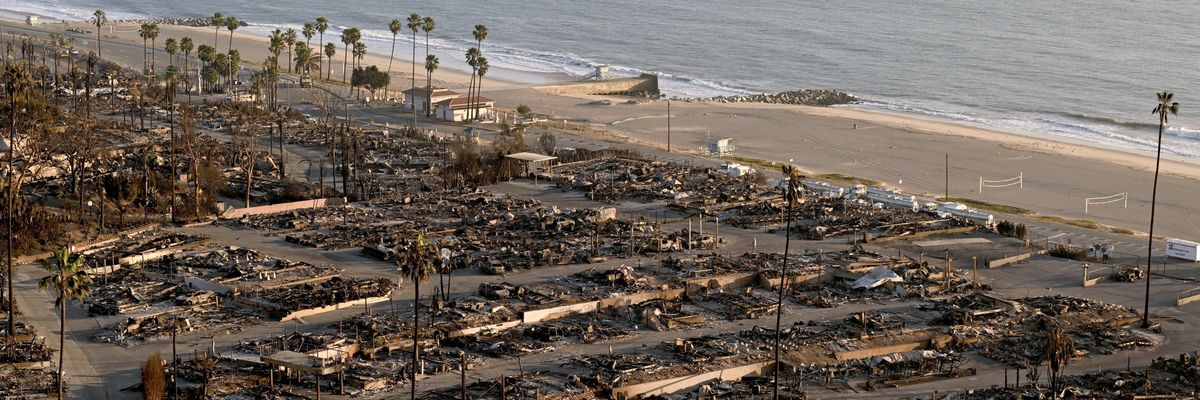
    Damaged structures and homes are seen after the Palisades fire in the Pacific Palisades neighborhood of Los Angeles on January 11, 2025.
     (Photo: Axelle/Bauer-Griffin/GC Images)

    “Their philosophy is, if we ignore it, it’s not a problem,” said one meteorologist.

    On the heels of the news that higher-than-average temperatures continued globally in April, one of the United States’ top science agencies announced Thursday that it will no longer update a database that tracks climate disasters that cause billions of dollars in damage.

    As of Thursday, the Billion Dollar Weather and Climate Disasters database on the National Oceanic and Atmospheric Administration’s (NOAA) website was replaced with a message saying there have been no such events in 2025 through April 8.

    That flies in the face of an analysis by the National Centers for Environmental Information, which has maintained the database and said before it was taken down that six to eight billion-dollar climate disasters have happened so far this year, including the wildfires that devastated parts of Los Angeles in January and caused an estimated $150 billion in damage.

    The World Weather Attribution said in late January that planetary heating, fueled by greenhouse gas emissions, caused weather conditions in Southern California that made the fires 35% more likely.

    Hundreds of people have been laid off from NOAA in recent weeks as the so-called Department of Government Efficiency, led by billionaire tech CEO Elon Musk, has pushed to slash government spending, and those who have lost their jobs include scientists who helped maintain the database.

    NOAA spokesperson Kim Doster told The Washington Post that in addition to staff changes, “evolving priorities” were also partially behind the retiring of the database, which will now show disasters that occurred only between 1980-2024.

    Between 2020-24, the number of billion-dollar disasters averaged 23 per year, compared to just a few per year in the 1980s.

    “This Trump administration move is the dumbest magic trick possible: covering their eyes and pretending the problem will go away if they just stop counting the costs. Households across the country already have to count these costs at their kitchen table as they budget for higher insurance costs and home repairs. Families and retirees dipping into their savings or going bankrupt to recover from wildfires and hurricanes know what disasters cost,” said Carly Fabian, senior insurance policy advocate with Public Citizen’s Climate Program. “Hiding the national tallies will only undermine our ability to prepare and respond to the climate crisis. Deleting the data will exacerbate the devastating delays in acting to slow climate change, and the impacts it is having on property insurance and housing costs.”

    NOAA’s “evolving priorities” have also included decommissioning other datasets, including one tracking marine environments and one tracking ocean currents.

    Without NOAA’s Billion Dollar Weather and Climate Disasters database, Jeremy Porter, co-founder of the climate risk financial modeling firm First Street, told CNN that “replicating or extending damage trend analyses, especially at regional scales or across hazard types, is nearly impossible without significant funding or institutional access to commercial catastrophe models.”

    “What makes this resource uniquely valuable is not just its standardized methodology across decades, but the fact that it draws from proprietary and nonpublic data sources (such as reinsurance loss estimates, localized government reports, and private claims databases) that are otherwise inaccessible to most researchers,” he said.

    Chris Gloninger, a meteorologist who resigned from an Iowa news station after receiving threats for his frank, science-based coverage of climate disasters, said the retiring of the database suggests the Trump administration is “okay with spending billions of dollars on disasters.”

    “Every dollar that we spend on mitigation or adaptation saves $13 in recovery costs,” said Gloninger. “But their philosophy is, if we ignore it, it’s not a problem.”

    Original article by Julia Conley republished from Common Dreams under Creative Commons (CC BY-NC-ND 3.0). 

    Elon Musk urges you to be a Fascist like him, says that you can ignore facts and reality then.
    Elon Musk urges you to be a Fascist like him, says that you can ignore facts and reality then.
    Neo-Fascist Climate Science Denier Donald Trump says Burn, Baby, Burn.
    Neo-Fascist Climate Science Denier Donald Trump says Burn, Baby, Burn.
    Orcas discuss how Trump was re-elected and him being an insane, xenophobic Fascist.
    Orcas discuss how Trump was re-elected and him being an insane, xenophobic Fascist.

  • Zia Yusuf Wants to be the UK’s Elon Musk

    Spread the love

    Original article by Rei Takver republished from DeSmog.

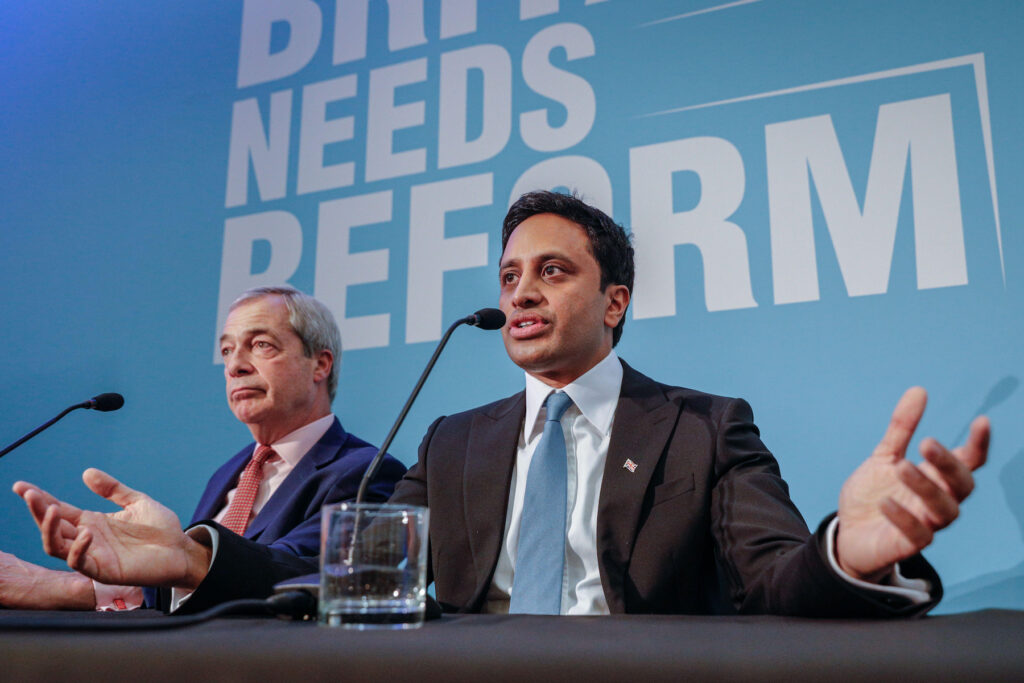
    Reform UK chair Zia Yusuf and Tesla CEO Elon Musk. DeSmog collage. Credit: Sky News / Real Time with Bill Maher / YouTube / Pexels / Graeme Maclean / Wikimedia Commons

    Reform UK leader and figurehead Nigel Farage hasn’t been alone in basking in the media spotlight of late.

    Farage has been accompanied by his party chair, Zia Yusuf, a multi-millionaire tech entrepreneur who has helped to orchestrate Reform’s explosive rise.

    Yusuf has overseen the party’s growth to over 200,000 members and 400 regional branches since he took the role in July 2024 – helping to propel Reform to a swathe of victories at last week’s local elections.

    The party is now being shaped in Yusuf’s image, who has “extraordinary” powers to kick out Reform members, and even its candidates. His position has no term limit, and there is no formal procedure to remove him – not even by Farage.

    With these vast constitutional powers in place, Yusuf appears to be following the lead of his hero in business and politics: Elon Musk.

    “The greatest entrepreneur of all time”

    Press coverage of the Reform chair often describes him as having worked in “finance”, but Yusuf refers to himself as a “tech entrepreneur” and to Reform as a “start-up”.

    While he did spend several years at the investment banks Merrill Lynch and Goldman Sachs in his early 20s, Yusuf left the world of finance for tech entrepreneurship in 2014, becoming the CEO of the luxury digital concierge company Velocity Black, which he co-founded.

    Velocity Black is a mobile app for the super rich that allows them to have anything they want at the touch of a button, from exclusive restaurant reservations to private jet holidays. Yusuf founded the firm alongside Alex MacDonald, his old classmate at the private Hampton School in London.

    They sold the company in 2023 to the U.S. bank Capitol One for £233 million, with Yusuf reportedly making £32 million on the sale.
     
    Long before he turned to politics, Yusuf credited Musk – the CEO of the electric car company Tesla – as an inspiration for the founding of Velocity Black, telling The Independent in 2018 that “we agreed with Elon Musk – it [Velocity Black] can’t be slightly better; it’s got to be amazing”.

    This fondness has continued following their mutual journeys into the political limelight. In the wake of Musk falling out with Farage over the latter’s refusal to embrace far-right organiser Tommy Robinson, Yusuf praised Musk for being, “by some distance, the greatest entrepreneur of all time”, saying that he “will be forever grateful for all [Musk] has done and will do for humanity”.

    More recently, Yusuf has called Musk the “ideal person” to run Donald Trump’s Department of Government Efficiency (DOGE), which aims to radically reduce the size of the federal government. Musk’s department has made sweeping cuts to public services – including to climate agencies – sacked government staff en masse, and closed whole departments with no oversight or transparency.

    And though Musk’s relationship with Farage has frayed in recent months, Yusuf hasn’t ruled out the possibility of receiving a major donation from Musk in the future – even despite his extreme unpopularity in the UK.

    Reform UK chair Zia Yusuf and leader Nigel Farage. Credit: Imageplotter / Alamy Stock Photo

    Yusuf’s admiration for Musk is clear, but to what extent will admiration lead to imitation?
     
    There are clues in his recent speaking engagements. “Silicon Valley has a unique culture that’s impossible for anyone else to replicate, but look, we need to stop wasting taxpayer money,” Yusuf said in March, alluding to Musk’s attempts to eliminate “government waste”.
     
    Yusuf has argued that a Reform government in Westminster should replicate the efforts of DOGE, saying that “we do need to massively cut the size of the bureaucratic state and probably cut the civil service by more than half”.

    As he’s stated on X, the social media platform owned by Musk, “Reform is drafting detailed plans to identify, immobilise and remove all elements of the Blob [a derogatory reference to the civil service] hostile to the interests of the British people. This plan will be implemented on day one of Nigel Farage becoming prime minister”.

    Reform has also vowed to set up “a British DOGE for every county and every local authority in this country” following its victories in last week’s local elections.

    This potentially poses a threat to the UK’s climate ambitions. Farage and Yusuf have stated their intention to cut local climate schemes, advocating instead for more fossil fuel production.

    Since becoming party chair, Yusuf has expressed a variety of anti-climate stances. He has claimed that North Sea oil reserves are a “gift from God”, and that the pursuit of net zero emissions by 2050 is “religious madness” and a “catastrophic act of self-harm” to the UK economy. 

    “President Trump’s victory represents the rejection of open borders, socialist economics, woke ideology, net zero fanaticism and [diversity, equity, and inclusion schemes] by right thinking people in America,” Yusuf posted in November. “The UK is next.”

    A Power Grab?

    Yusuf crashed onto the political scene in the summer of 2024, taking on the role of Reform chair shortly after donating £200,000 to the party. His contribution was the second-highest to the party of the general election campaign and almost a-third of the total funds raised by Reform in the final week before the election.

    The 38-year-old has a close relationship with Farage, who he met at a cocktail party held by Stuart Wheeler, the former treasurer of UKIP, close to a decade ago. On the general election campaign trail, Farage said that Yusuf could one day lead Reform, commenting that “aside from his generosity, [Yusuf] will be a great asset and media performer during this campaign and beyond”.

    When asked by The Guardian whether he would run for a seat in Parliament in 2029, Yusuf responded: “I’m absolutely open to it. This is a sincere comment. I will serve in whatever capacity Nigel asks of me”.

    Recently, there has been talk of Yusuf gaining an unusual amount of power in the party. The Independent’s political editor David Maddox wrote in early March that “the only person to regularly get top billing on Reform events along with Mr Farage is Mr Yusuf. […] Press notices for their mini conferences state that people will hear from ‘Nigel Farage, Zia Yusuf and many more’. No mention of MPs.”

    Maddox added that a “senior member” inside Reform had claimed that Yusuf was plotting a leadership coup “in plain sight”.

    This bears some resemblance to Musk and his role in the Trump administration. Though he is less actively involved in DOGE following plunging Tesla sales across the globe, Musk has been accused of setting the new government’s agenda from the shadows, after donating more than $290 million to Trump’s campaign.

    And there are other ways in which Yusuf is mirroring Musk.

    Reform has stated its intention to profile every UK voter, and is already facing allegations of breaching private data.

    Though the Reform privacy policy says that it aims to comply with UK data protection laws, the party is being sued by a group of 50 claimants for failing to respond to Data Subject Access Requests, through which voters can ask political parties to disclose the information they hold on them. Following the initiation of legal proceedings, Reform told the claimants that it did not hold any of their data.

    DOGE has been accused of being slapdash with data, having accessed vast amounts of highly-sensitive personal information held by the U.S. government, despite rulings from several judges that Musk’s department is violating privacy law.

    Given his constitutional powers, his party’s hunger for personal data, his anti-government ideology, and his tech background, Zia Yusuf seems to have many close parallels with Elon Musk.

    On the BBC’s Political Thinking with Nick Robinson in February, he was asked the question directly: “Are you Nigel Farage’s Elon Musk?”

    Yusuf demurred. “I am certainly no Elon Musk. I think Elon Musk is singular,” he said.

    However, he hastened to add: “I’ve tried to learn as much as I can about him”.

    The sole responsibility for any content supported by the European Media and Information Fund lies with the author(s) and it may not necessarily reflect the positions of the EMIF and the Fund Partners, the Calouste Gulbenkian Foundation and the European University Institute.

    Original article by Rei Takver republished from DeSmog.

    Nigel Farage reminds you that he's the man that brought you Brexit and asks what could possibly go wrong.
    Nigel Farage reminds you that he’s the man that brought you Brexit and asks what could possibly go wrong.
    Elon Musk urges you to be a Fascist like him, says that you can ignore facts and reality then.
    Elon Musk urges you to be a Fascist like him, says that you can ignore facts and reality then.
    Nigel Farage explains the politics of Reform UK: Racism, Fake anti-establishmentism, Deregulation, Corporatism, Climate Change Denial, Mysogyny and Transphobia.
    Nigel Farage explains the politics of Reform UK: Racism, Fake anti-establishmentism, Deregulation, Corporatism, Climate Change Denial, Mysogyny and Transphobia.