Labour is counting on the unpopularity of the Conservative Party to catapult it into power but in the absence of specific policies and failure to improve quality of life, electoral goodwill will quickly evaporate.
…
Labour and Conservatives have become slaves to arbitrary fiscal rules even though they have failed to deliver almost every target relating to economic growth, inflation, public debt, investment and more. Labour emphasises that it wants to reduce the government debt to GDP ratio in five years’ time. However, no rationale is presented for such a straitjacket. No assessment is made of the consequences of removing billions of pounds from the economy. No rationale as to why low debt to GDP ratio is an indicator of the prosperity of a nation and why this should take priority over investment or redistribution. Analogies with household budgets or maxed out credit cards are misleading as governments, especially those with global currencies such as the Pound Sterling, can create money to achieve desired social objectives and levy selective taxation to eliminate inflationary effects. But Labour is no student of the modern monetary theory.
…
Debt can be used to rebuild the economy even if Labour and Conservatives are hostile to it. The Post-Second World War boom was built upon direct public investment in new industries and social infrastructure. In 1946, public debt stood at over 270% of its GDP. This provided jobs and fuelled demand. It fuelled corporate investment as the state bought goods and services from the private sector. It laid foundations of emerging industries, such as biotechnology, information technology, aerospace and more specially as the private sector showed little appetite for long-term investment and risks. Within a generation, the public debt came down to 49% of GDP and I can’t recall our parents and grandparents fretting about the public debt.
Instead of a dynamic state, both Labour and Conservatives support further cuts in public spending even though that will reduce investment, slow economic growth, and inflict long-term damage. Too many public buildings and schools are crumbling away. The government response is that college spending per student aged 16–18 in 2024 will be 10% below 2010 levels, and about 23% below them for school sixth forms. Since 2010 local council funding has been cut by 23.3% in real terms, leading to degradation of public services and higher council tax on hard-pressed households. Hospitals in England have a waiting list of 7.6m appointments. None of this can be addressed by adherence to arbitrary fiscal rules.
There is a strong case for redistribution of income and wealth, but Hunt and Reeves ignore it even though higher disposable income for the less well-off has a greater multiplier effect. No amount of economic growth can be sustained unless people have good purchasing power to buy goods and services. Both parties reaffirm their faith in trickle-down economics which has seen wealth sucked upwards and prevent economic recovery. The UK has 171 billionaires with combined wealth of £684bn. The richest 1% of the population has more wealth than 70% of the population combined. The richest 10% of households hold 43% of all wealth, and the poorest 50% own just 9%.
The latest poll will do little to calm Tory nerves ahead of the general election, with a number of factions within the party looking at replacing Sunak.
A new poll shows just how much Tory support among the public has collapsed, as the party continues to trail the Labour Party and Tory MPs plot to remove Rishi Sunak.
The poll, carried out by YouGov for the Times, shows that the Tories are set to win just 36 seats at the General Election, handing Labour a comfortable 398 majority in the House of Commons.
It puts the Tories on just 19%, which is the same share the party received at their lowest ebb in the aftermath of Liz Truss’s mini-Budget. Meanwhile, the Labour Party is on 44% of the vote, while Reform UK received their highest ever poll rating at 15%.
U.S.-made Israeli Air Force F-35 fighters sit on a runway. (Photo: Israeli Ministry of Defense)
“After over half a million uncommitted votes and counting, it’s time Biden administration officials finally listen,” said one campaigner. “We need concrete action to stop weapons aid immediately.”
As the Biden administration wrestles with whether to certify that Israel is complying with a presidential directive requiring human rights assurances from governments receiving American weapons, Palestine defenders on Wednesday renewed calls for a suspension of U.S. arms sales to Israel’s genocidal government and military.
U.S. Secretary of State Antony Blinken has until March 25 to certify to Congress that Israel is adhering to President Joe Biden’s February 2023 memo stating that “no arms transfer will be authorized where the United States assesses that it is more likely than not that the arms to be transferred will be used by the recipient to commit… genocide, crimes against humanity, grave breaches of the Geneva Conventions of 1949… or other serious violations of international humanitarian or human rights law.”
If Israel fails to provide written assurance that it is using U.S.-supplied weapons in accordance with international law, arms sales would automatically be suspended. According to HuffPost, U.S. Ambassador to Israel Jack Lew on Tuesday privately claimed to the State Department that Israel is in compliance with domestic and international law.
However, the Israeli daily Haartez reported Wednesday that officials from three State Department bureaus—Democracy, Human Rights, and Labor; Population, Refugees, and Migration; and the Office of Global Criminal Justice—as well as the United States Agency for International Development are deeply skepitcal of Lew’s claim.
“America should follow in Canada’s steps and stop weapons sales now.”
The Uncommitted National Movement—a coalition of pro-Palestine, peace, and progressive groups urging people to vote “uncommitted” in U.S. Democratic primaries in a bid to pressure Biden to push Israel for a Gaza cease-fire—led demands for a suspension of arms transfers to Israel.
“After over half a million uncommitted votes and counting, it’s time Biden administration officials finally listen,” Uncommitted National Movement co-chair Layla Elabedsaid in a statement Wednesday. “We need concrete action to stop weapons aid immediately. America should follow in Canada’s steps and stop weapons sales now.”
The Canadian Parliament on Monday approved a nonbinding resolution calling on Prime Minister Justin Trudeau to cut off arms exports to Israel. Canadian Foreign Minister Mélanie Joly subsequently said that the government would cease future weapons sales to the country.
Other countries including Japan, Spain, the Netherlands, and Belgium have suspended or restricted weapons sales to Israel, whose military forces have killed or wounded more than 113,000 Palestinians since the October 7 attacks while forcibly displacing around 90% of Gaza’s 2.3 million people and fueling famine and disease by besieging the embattled strip. Most of those killed have been women and children.
On January 26, the International Criminal Court ordered Israel to prevent genocidal acts. Both the ICJ and a U.S. federal judge have found that Israel is “plausibly” committing genocide in Gaza. Palestinians, human rights groups, and legal experts have accused Israel of ignoring the World Court’s directive.
Common Dreams reported Tuesday that Human Rights Watch and Oxfam called Israeli assurances that U.S.-supplied weapons are not being used in violation of international law “not credible.” The groups also dismissed false Israeli claims that the country is not blocking humanitarian aid from reaching starving Gazans.
The U.S. gives Israel approximately $4 billion in annual military aid. Since October 7, the Biden administration has requested an additional $14.3 billion in armed assistance for Israel, while repeatedly circumventing Congress to fast-track emergency weapons transfers.
Getting to net zero emissions by mid-century is conventionally understood as humanity’s best hope for keeping Earth’s surface temperature (already 1.2°C above its pre-industrial level) from increasing well beyond 1.5°C – potentially reaching a point at which it could cause widespread societal breakdown.
At least one prominent climate scientist, however, disagrees.
James Hansen of Columbia University in the US published a paper with colleagues in November which claims temperatures are set to rise further and faster than the predictions of the Intergovernmental Panel on Climate Change (IPCC). In his view, the 1.5°C target is dead.
He also claims net zero is no longer sufficient to prevent warming of more than 2°C. To regain some control over Earth’s rising temperature, Hansen supports accelerating the retirement of fossil fuels, greater cooperation between major polluters that accommodates the needs of the developing world and, controversially, intervening in Earth’s “radiation balance” (the difference between incoming and outgoing light and heat) to cool the planet’s surface.
You can listen to more articles from The Conversation narrated by Noa.
There would probably be wide support for the first two prescriptions. But Hansen’s support for what amounts to the deliberate reduction of sunlight reaching Earth’s surface has brought into the open an idea that makes many uncomfortable.
Michael Mann from the University of Pennsylvania in the US and another titan of climate science, spoke for many when he dismissed solar radiation management as “potentially very dangerous” and a “desperate action” motivated by the “fallacy … that large-scale warming will be substantially greater than current-generation models project”.
Their positions are irreconcilable. So who is right – Hansen or Mann?
Earth’s radiation balance
First, an explanation.
There are only two ways to reduce global warming. One is to increase the amount of heat radiated from Earth’s surface that escapes to space. The other is to increase the amount of sunlight reflected back to space before it lands on something – whether a particle in the atmosphere or something on Earth’s surface – and is converted to heat.
There are many ways to do both. Anything that reduces the amount of greenhouse gas in the atmosphere will let more heat escape to space (replacing fossil fuels with renewables, eating less meat and tilling the soil less for example). Anything that makes the planet brighter will reflect more sunlight to space (such as refreezing the Arctic, making clouds whiter or putting more reflective particles in the atmosphere).
But the key difference between the two, in terms of their impact on global warming, is their response time. That is, the time it takes for a change in the factors that allow more heat to escape or sunlight to be reflected to appear as a change in Earth’s surface temperature.
Intervening to speed up the loss of heat from Earth’s surface cools the planet slowly, over decades and longer. Intervening to increase the sunlight Earth reflects back to space cools the planet more or less immediately.
The essence of the dispute between Mann and Hansen is whether reducing greenhouse gases, by a combination of reducing new emissions and permanently removing past emissions from the atmosphere, is now enough on its own to prevent warming from reaching levels that threaten economic and social stability.
Mann says it is. Hansen says that, while doing these things remains essential, it is no longer sufficient and we must also make Earth more reflective.
When will warming end?
Mann aligns with IPCC orthodoxy when he says that emissions reaching net zero will result, within a decade or two, in Earth’s surface temperature stabilising at the level it has then reached.
In effect, there is no significant warming in the pipeline from past emissions. All future warming will be due to future emissions. This is the basis for the global policy imperative to get to net zero.
In his new paper, Hansen argues that if the atmospheric concentration of greenhouse gases remains close to its current level, the surface temperature will stabilise after several hundred years between 8°C and 10°C above the pre-industrial level.
Of this, at least 2°C will emerge by mid-century, and probably a further 3°C a century from now. A temperature increase of this magnitude would be catastrophic for life on Earth. Hansen adds that to avoid such an outcome, brightening Earth is now necessary to halt the warming in the pipeline from past emissions.
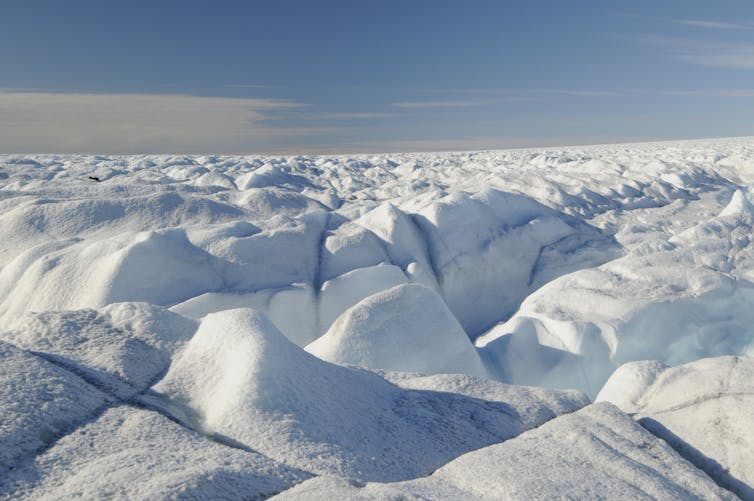
Bright surfaces, like ice sheets, reflect light to space. Tobetv/Shutterstock
But at the same time, we must also largely eliminate emissions if we are to stop recreating this problem in the future.
Still getting hotter…
We are scientists who study the feasibility and effectiveness of alternative responses to climate change, addressing both the engineering and political realities of enabling change at the scale and speed necessary.
We find Mann’s rebuttal of Hansen’s claims unconvincing. Crucially, Mann does not engage directly with Hansen’s analysis of new data covering the last 65 million years.
Hansen explains how the models used by IPCC scientists to assess future climate scenarios have significantly underestimated the warming effect of increased greenhouse gas emissions, the cooling effect of aerosols and how long the climate takes to respond to these changes.
Besides greenhouse gases, humanity also emits aerosols. These are tiny particles comprising a wide range of chemicals. Some, such as the sulphur dioxide emitted when coal and oil are burned, offset the warming from greenhouse gases by reflecting sunlight back to space.
Others, such as soot, have the opposite effect and add to warming. The cooling aerosols dominate by a large margin.
Hansen projects that in coming months, lower levels of aerosol pollution from shipping will cause warming of as much as 0.5°C more than IPCC models have predicted. This will take global warming close to 2°C as early as next year, although it is likely then to fall slightly as the present El Niño wanes.
Underpinning Hansen’s argument is his conviction that the climate is more sensitive to greenhouse gases than previously reported. The IPCC estimates that doubling atmospheric CO₂ raises Earth’s temperature by 3°C. Hansen calculates it to be 4.8°C.
This, and the much longer climate response time that Hansen calculates from the historical record, would have a significant impact on climate model projections.
Time for reflection
The differences between Mann and Hansen are significant for the global response to climate change.
Mann says that allowing emissions to reach net zero by mid-century is sufficient, while Hansen maintains that on its own it would be disastrous and that steps must now be taken in addition to brighten the planet.
Brightening Earth could also reverse the reductions in reflectivity already caused by climate change. Data indicates that from 1998 to 2017, Earth dimmed by about 0.5 watts per square metre, largely due to the loss of ice.
Given what’s at stake, we hope Mann and Hansen resolve these differences quickly to help the public and policymakers understand what it will take to minimise the likelihood of imminent massive and widespread ecosystem destruction and its disastrous effects on humanity.
While 1.5°C may be dead, there may still be time to prevent cascading system failures. But not if we continue to squabble over the nature and extent of the risks.
Don’t have time to read about climate change as much as you’d like?
Roger Hallam was involved in starting the climate activism groups Extinction Rebellion and Just Stop Oil. He is still involved with Just Stop Oil and often gets arrested and imprisoned. [22/3 Apologies had a typo calling Roger Roget]
I used to be a social science researcher at King’s College, London. The name of the game in that trade is to look at everything in context. So I will provide some context. There is overwhelming evidence that the climate science industry is structurally underestimating the realities we face. “Worst than expected” is the standard phrase of just about every article as new stats are published. A few years ago we were going to pass 1.5C around 2050 – now it is already happening. I remember reading reports that the Arctic will melt in the summer around 2100. Papers now predict 2035, if not before. AMOC – the ocean current that stops the 60 million people on these islands from starving to death – was going to collapse at some point next century. Now a recent paper tells us the odds are it will collapse by 2050. If you have not been paying attention, this will create a collapse of temperatures overnight of 3-8C across Europe. So don’t be surprised if it happens before your pension comes due.
I’m like you. I don’t like to believe things are true if they conflict with my baseline beliefs – like “we will muddle through”. But then it becomes more difficult when it actually comes true. Scientists have been telling us privately and then publicly for years that staying under 1.5C was bollocks – and now here we are. For two decades or more the best kept secret of the climate space has been that aerosols (pollution from burning fossil fuel emissions) have been holding down temperatures by .5C-1C. As we passed 1.8C last September the pretence started to collapse as scientists raged about each other on a dark corner of Twitter. It’s the start of the exposure of the world’s biggest cover up. That they knew we were fucked a decade or more ago. Not that the media is interested. Everyone is still in on the pretence, it seems.
Climate scientists don’t like surprises. It means our deep understanding of how the climate works isn’t quite as complete as we need. But unfortunately, as climate change worsens, surprises and unprecedented events keep happening.
In March 2022, Antarctica experienced an extraordinary heatwave. Large swathes of East Antarctica experienced temperatures up to 40°C (72°F) above normal, shattering temperature records. It was the most intense heatwave ever recorded anywhere in the world.
So shocking and rare was the event, it blew the minds of the Antarctic climate science community. A major global research project was launched to unravel the reasons behind it and the damage it caused. A team of 54 researchers, including me, delved into the intricacies of the phenomenon. The team was led by Swiss climatologist Jonathan Wille, and involved experts from 14 countries. The collaboration resulted in two groundbreaking papers published today.
The results are alarming. But they provide scientists a deeper understanding of the links between the tropics and Antarctica – and give the global community a chance to prepare for what a warmer world may bring.
Head-hurting complexity
The papers tell a complex story that began half a world away from Antarctica. Under La Niña conditions, tropical heat near Indonesia poured into the skies above the Indian Ocean. At the same time, repeated weather troughs pulsing eastwards were generating from southern Africa. These factors combined into a late, Indian Ocean tropical cyclone season.
Between late February and late March 2022, 12 tropical storms had brewed. Five storms revved up to become tropical cyclones, and heat and moisture from some of these cyclones mashed together. A meandering jet stream picked up this air and swiftly transported it vast distances across the planet to Antarctica.
Below Australia, this jet stream also contributed to blocking the eastward passage of a high pressure system. When the tropical air collided with this so-called “blocking high”, it caused the most intense atmospheric river ever observed over East Antarctica. This propelled the tropical heat and moisture southward into the heart of the Antarctic continent.
Luck was on Antarctica’s side
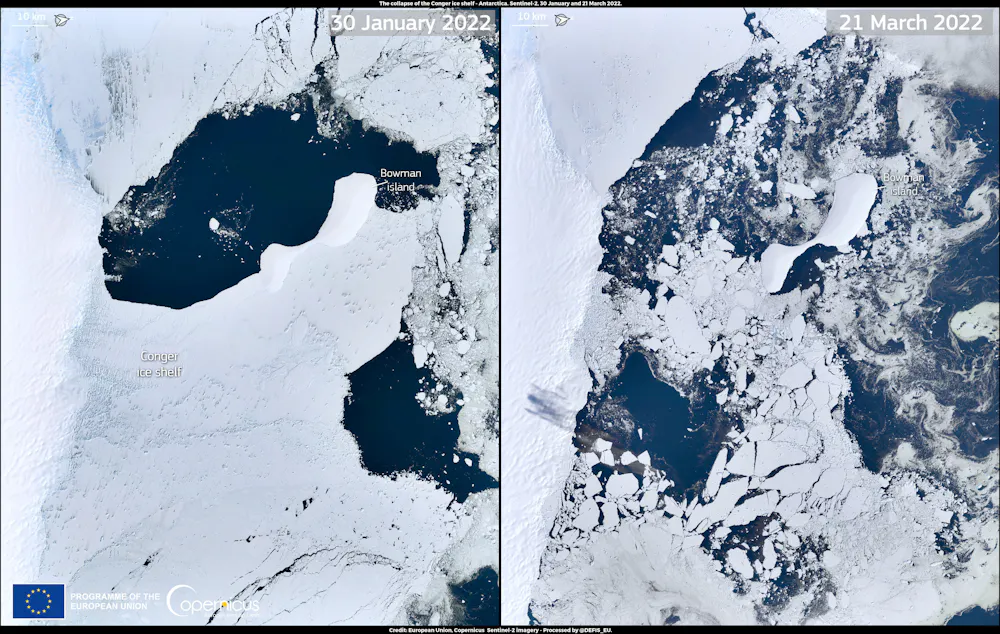
The event caused the vulnerable Conger Ice Shelf to finally collapse. But the impacts were otherwise not as bad as they could have been. That’s because the heatwave struck in March, the month when Antarctica transitions to its dark, extremely cold winter. If a future heatwave arrives in summer – which is more likely under climate change – the results could be catastrophic.
Despite the heatwave, most inland temperatures stayed below zero. The spike included a new all-time temperature high of -9.4°C (15.1°F) on March 18 near Antarctica’s Concordia Research Station. To understand the immensity of this, consider that the previous March maximum temperature at this location was -27.6°C (-17.68°F). At the heatwave’s peak, 3.3 million square kilometres in East Antarctica – an area about the size of India – was affected by the heatwave.
The impacts included widespread rain and surface melt along coastal areas. But inland, the tropical moisture fell as snow – lots and lots of snow. Interestingly, the weight of the snow offset ice loss in Antarctica for the year. This delivered a temporary reprieve from Antarctica’s contribution to global sea-level rise.
These images, acquired by the Copernicus Sentinel-2 satellites on January 30 2022 (left) and March 21 2022 (right), show the Conger ice shelf before and after the collapse, which was triggered by a shocking heatwave. European Union, Copernicus Sentinel-2 satellite imagery, CC BY
Learning from the results
So what are the lessons here? Let’s begin with the nice bit. The study was made possible by international collaboration across Antarctica’s scientific community, including the open sharing of datasets. This collaboration is a touchstone of the Antarctic Treaty. It serves as a testament to the significance of peaceful international cooperation and should be celebrated.
Less heartwarmingly, the extraordinary heatwave shows how compounding weather events in the tropics can affect the vast Antarctic ice sheet. The heatwave further reduced the extent of sea ice, which was already at record lows. This loss of sea ice was exacerbated this year resulting in the lowest summer and winter sea ice ever recorded. It shows how disturbances in one year can compound in later years.
The event also demonstrated how tropical heat can trigger the collapse of unstable ice shelves. Floating ice shelves don’t contribute to global sea-level rise, but they acts as dams to the ice sheets behind them, which do contribute.
This research calculated that such temperature anomalies occur in Antarctica about once a century, but concluded that under climate change, they will occur more frequently.
The findings enable the global community to improve its planning for various scenarios. For example, if a heatwave of similar magnitude hit in summer, how much ice melt would there be? If an atmospheric river hit the Doomsday glacier in the West Antarctic, what rate of sea level rise would that trigger? And how can governments across the world prepare coastal communities for sea level rise greater than currently calculated?
This research contributes another piece to the complex jigsaw puzzle of climate change. And reminds us all, that delays to action on climate change will raise the price we pay.
This article has been amended to correct an error in converting a 40°C temperature difference from Celsius to Fahrenheit.