Politics has failed to address the climate crisis in any meaningful way. Our contemporary politics which I regard as a plutocracy as opposed to a democracy – meaning that it serves a small elite of incredibly rich and powerful people – cannot address the climate crisis because it is serving the climate-destroying plutocrats. Since the system won’t change, we have to change the system. There’s no ifs or buts about this – climate records are getting broken month by month and in the summer it will be back to breaking climate records day by day. Our politics have absolutely failed to address this so we have to change our politics. It’s not a big deal – politicians need to start serving the electorate instead of the rich and powerful.
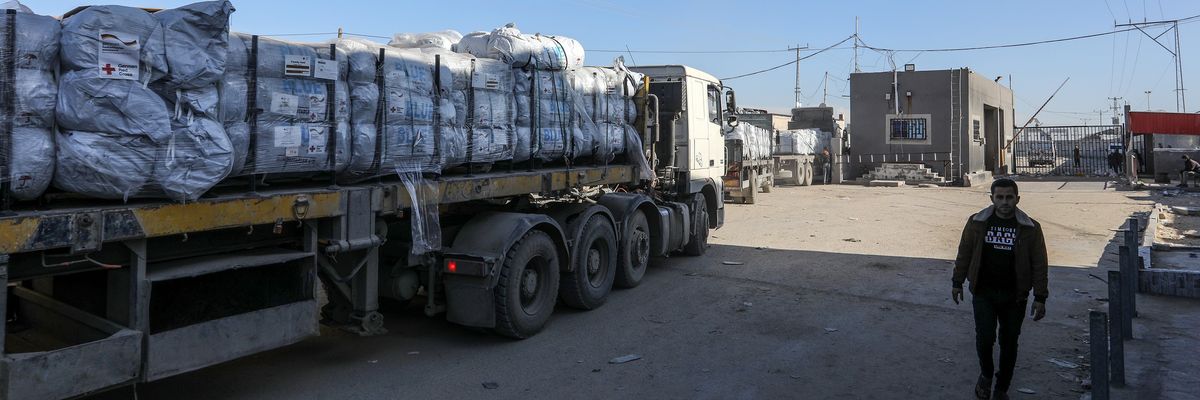
Trucks carrying aid supplies to Gaza are seen at the Karem Abu Salem border crossing on February 17, 2024. (Photo: Abed Rahim Khatib/Anadolu via Getty Images)
The decision demonstrates “why there can be no end to the genocide of Palestinians without an end of Israel’s control over Gaza,” said one human rights lawyer.
With the level of humanitarian aid reaching Gaza residents perilously low and creating what one group last week called “famine-like conditions” throughout the enclave, the United Nations’ top official overseeing relief for Palestinians on Tuesday condemned Israel’s latest reason for blocking a shipment: It included medical scissors for caring for children.
Israel flagged the scissors as a so-called “dual-use” item, suggesting the government feared medical workers in Gaza—where more than 600 attacks on hospitals have pushed the healthcare system toward collapse—would use the scissors as weapons instead of to care for people who have been injured in relentless bombings.
“Medical scissors are now added to a long list of banned items the Israeli authorities classify as ‘for dual use,’” said Philippe Lazzarini, commissioner-general of the U.N. Relief and Works Agency for Palestine Refugees in the Near East (UNRWA). “The list includes basic and lifesaving items: from anesthetics, solar lights, oxygen cylinders, and ventilators, to water cleaning tablets, cancer medicines, and maternity kits.”
#Gaza: an entire population depends on humanitarian assistance for survival. Very little comes in & restrictions increase.
A truck loaded with aid has just been turned back because it had scissors used in children’s medical kits.
The truck carrying the medical kits and other items was turned back a day after 12 Israeli human rights groups condemned the right-wing government of Prime Minister Benjamin Netanyahu for openly violating an order from the International Court of Justice (ICJ) by continuing to obstruct humanitarian aid.
The ICJ issued an interim ruling in January saying that Israel was “plausibly” committing a genocide in Gaza and ordering the government to ensure the delivery of aid.
Mai El-Sadany, executive director of the Tahrir Institute for Middle East Policy in Washington, D.C., said Israel’s latest move to block relief from reaching starving Gaza residents should eliminate any doubt that the government is flouting the ICJ’s order.
If you're somehow still wondering whether Israel is a reliable partner in aid delivery into Gaza + whether it's violating @CIJ_ICJ order on aid delivery, read this:
"A truck loaded with aid has just been turned back because it had scissors used in children’s medical kits." https://t.co/qSVYHrWk7r
The death toll from starvation in Gaza has now reached at least 25 people, mostly children. In what the International Rescue Committee called a “conservative” estimate late last month, at least 1 in 4 households—more than half a million people—are now facing “catastrophic or famine conditions.”
Juliette Touma, director of communications for UNRWA, told Al Jazeera Monday that a minimum of 500 aid trucks daily—the number that entered Gaza each day before the war—are needed to meet the needs of the civilian population. An average of 90 trucks entered the enclave per day in February, with the number as low as seven or nine on some days.
The World Health Organization said Monday that it had reached Al-Ahil Arab Hospital and Al-Sahaba Hospital in northern Gaza with trauma supplies to serve 150 patients over the weekend.
Medical teams there, however, still lack basic necessities to care for people, including “food, fuel, specialized staff, anesthetic drugs, antibiotics, and internal fixation devices,” WHO chief Tedros Adhanom Ghebreyesus said.
George Washington University professor William Lafi Youmans condemned the blocking of the aid truck carrying medical kits as “deplorable” and “nonsensical.”
Human rights lawyer Zaha Hassan of the Carnegie Endowment for International Peace said Israel’s decision underscores the need for an immediate, permanent cease-fire in Gaza and an end to Israel’s occupation of Palestinian territory including Gaza and the West Bank.
“Returning an entire truckload of humanitarian assistance because children’s scissors were part of a medical kit,” said Hassan, “is why there can be no end to the genocide of Palestinians without an end of Israel’s control over Gaza.”
Members of Jewish Voice for Peace stage a sit-in at Rep. Hakeem Jeffries’ office in Washington, D.C. on March 12, 2024. (Photo: @JvpAction/X)
“Our Jewish communities are rising up to say, ‘Never again is now,’” said organizers.
Sharpening their focus on the influence that pro-Israel lobbyists have had for decades on U.S. policy regarding Palestinians, Jewish progressives on Tuesday held a sit-in at the Capitol Hill office of U.S. House Minority Leader Hakeem Jeffries, one of the largest recipients of campaign funds from the American Israel Public Affairs Committee.
The protesters, who are members of Jewish Voice for Peace (JVP) Action, prominently displayed a sign reading, “AIPAC gave $829,835 to Hakeem Jeffries, who opposes cease-fire,” before proceeding to the New York Democrat’s office.
The sign referred to AIPAC’s contributions to Jeffries throughout his career.
“Our Jewish communities are rising up to say, ‘Never again is now,’” said JVP Action. “We refuse to be bystanders as the Israeli government wages a genocidal campaign in our name and funding by U.S. tax dollars.”
At the sit-in, the organizers held signs saying, “AIPAC funds genocide” and, “Jeffries: Reject AIPAC.”
BREAKING: As AIPAC lobbyists take to Capitol Hill to tell Congress to support Israel’s genocide of Palestinians, JVP Action members occupied the office of Rep Hakeem Jeffries, once of the largest recipients of AIPAC funding, telling him to #RejectAIPACpic.twitter.com/NCTKHXuhTp
— Jewish Voice for Peace Action (@JvpAction) March 12, 2024
Israel has killed at least 31,184 Palestinians since it began its U.S.-backed bombardment of Gaza in October, and at least 25 people have died of starvation due to Israel’s blockade on nearly all humanitarian aid. The United Nations Relief and Works Agency for Palestine Refugees in the Near East said Tuesday that more children have been killed in Gaza in the last four months than the number of children killed worldwide in wars over the last four years.
JVP Action is among several rights groups that announced a new coalition, Reject AIPAC, on Monday. AIPAC and its political action committee are planning to spend $100 million this election year to unseat lawmakers it views as insufficiently supportive of Israel.
As JVP Action noted Tuesday, while Democratic lawmakers who continue to back Israel’s assault on Gaza may retain the support of AIPAC, they are out of step with Democratic voters, 77% of whom are demanding the U.S. call for a cease-fire in Gaza.
Since October, the Israeli military has killed over 30,000 Palestinians in Gaza. Polls show that 67% of voters and 77% of Democrats support a ceasefire in Gaza, yet many US lawmakers have not yet called for an end to the genocidal bombardment.
— Jewish Voice for Peace Action (@JvpAction) March 12, 2024
“If members of Congress vote to send Israel more bombs and weapons now, it’s because AIPAC demands it,” Justice Democrats, another member of the coalition, said Monday. “Reject AIPAC because Palestinian lives should matter more to our leaders than campaign checks.”
Unhappy with large protests against the increasingly dire situation in Gaza, Prime Minister Rishi Sunak is seeking to update the UK’s definition of extremism. This, he has argued, is needed because “our democracy itself is a target” of antisemitic and Islamophobic extremists.
However, the reality is that no measures do more damage to democracy than policy proposals like the one Sunak is promoting.
The UK already has a definition for extremism, which is used in efforts to tackle terrorism. We may think of the police as leading those efforts, but the UK’s Prevent strategy now also places a duty on certain other authorities to “have due regard to the need to prevent people from being drawn into terrorism”.
These authorities include local government, education institutions and the NHS. In reality, the UK has placed teachers and NHS staff on the frontline in the fight against terrorism, on top of all their other duties that they were actually trained to do.
To help those with a duty under Prevent to identify people at risk of being drawn into terrorism, the government currently defines extremism as “vocal or active opposition to fundamental British values, including democracy, the rule of law, individual liberty and mutual respect and tolerance of different faiths and beliefs”. Also included are “calls for the death of members of our armed forces”.
This definition is not contained in any law, however. Instead, it features in the government’s Prevent guidance. A key reason why this definition is not contained in legislation is because it is so vague and unclear. It would be difficult to legally oblige anyone with a duty under Prevent to apply the definition – and even more difficult for a court to determine what it means.
Even as guidance, there are still problems with the definition. It offers enormous discretion to the people deciding who is at risk of being drawn into terrorism. Discretion can lead to inconsistent application. That, in turn, can lead to discrimination.
Vague to vaguer
It has been suggested that the new definition of extremism will include the “promotion or advancement of ideology based on hatred, intolerance or violence or undermining or overturning the rights or freedoms of others, or of undermining democracy itself”.
What does it mean to undermine or overturn the rights or freedoms of others? Would arguing for the UK to leave the European convention on human rights count meet the bar?
Likewise, what does it mean to undermine democracy? Does excessive corporate lobbying do so? What about calling for restrictions on the right to free speech or the right to protest? These are fundamental rights that are absolutely necessary for a democracy to flourish. Would they be extremist?
Existing laws are enough
Sunak is presenting the new definition of extremism as a response to protests he depicts as being out of control. But the UK already has numerous laws in place to tackle what it considers to be unacceptable behaviour at protests. The Terrorism Act (which is also incredibly broad) can be used to prosecute people who damage property or create a serious risk to public safety during protests.
Counter-terrorism laws can also capture forms of expression at public demonstrations or online. It is already a crime to express support for a proscribed (unlawful) organisation, or to wear clothing, symbols or publish images in a way which can raise suspicion that you support an unlawful organisation. So, for example, if you express support for Hamas — a proscribed organisation — you are already committing a crime and can be prosecuted for it.
Meanwhile, the Public Order Act contains offences dealing with hate speech. These include using threatening, abusive or insulting words or behaviour, or displaying written material which is intended to or likely to stir up racial or religious hatred.
In 2022, the Police, Crime, Sentencing and Courts Act expanded the criminal offence of causing a public nuisance to include “serious distress, serious annoyance, serious inconvenience or serious loss of amenity”. This can now be applied by he police to criminalise protests that are considered to be making too much noise.
It is hard, therefore, to see which bases are not already covered for a government looking to prosecute people for extremism. These mechanisms have already been used to clamp down on all kinds of activism. In reality, there is no gap in the law that needs fixing. Rather, this proposal looks like a classic example of a government talking tough on crime and terrorism in order to boost its poll ratings in an election year.
The right to protest
Adding new definitions for extremism only creates problems. The vaguer a definition gets, the easier it is to misuse. It can also have a pervasive chilling effect on free speech. People may self-censor out of fear of being identified as extremist, not least when their employer has a duty under Prevent.
The fact of the matter is that human rights law allows for protests to be disruptive. Otherwise, they could be simply ignored. Human rights law also allows people to “shock, offend, and disturb” through speech.
The government may not be happy with large public protests against its foreign policy but it should not be viewed as extremist to march for a ceasefire in Gaza. Likewise, it should not be viewed as extremist to vocalise opposition to the potential genocide being committed by the Israeli Defence Forces. If this were so, then the International Court of Justice is extremist.
There is a deep danger of conflating protest with extremism and terrorism, undermining the legitimacy of these protests. To stretch the concept of extremism to cover these views is what is actually undermining democracy and the rights and freedoms of others.
Labour leader Sir Keir Starmer (left) and Prime Minister Rishi Sunak walk through the Peer’s Lobby at the Palace of Westminster ahead of the State Opening of Parliament in the House of Lords, London, November 6, 2023
THE sickening racist abuse directed at Diane Abbott by top Tory donor Frank Hester represents a challenge to the leaders of both the major political parties.
Hester, who has given the Conservative Party £10 million over the last year, told a meeting in 2019 that looking at the MP for Hackney North and Stoke Newington made him “want to hate all black women” and added for good measure that Abbott “should be shot.”
Such remarks should be enough to immediately terminate anybody’s involvement in public life, and they may indeed constitute a criminal offence.
Hester was speaking, remember, just three years after a Labour MP, Jo Cox, was indeed shot to death by a far-right fanatic.
Everyone should first of all send their unqualified solidarity to Abbott, long the victim of more racist and misogynistic abuse than any other MP.
…
Racism is a bipartisan problem. And it is reinforced by Starmer’s own treatment of Abbott.
She has been suspended from the Labour whip in Parliament for nearly a year now. Her offence was to write a newspaper letter suggesting Jewish people, among others, had not suffered from racism.
Her letter was clearly wrong and she immediately and fulsomely apologised for it. Since then her case has been “under investigation.”
Yet it is unclear what there is to investigate. There can be no possible reason for leaving her in political suspense for such a protracted period over what is a fairly straightforward issue.
The reason for this procrastination is obvious: because Abbott has spent her life on the left of the Labour Party, and served in senior roles under Jeremy Corbyn, he wants rid of her.
If she remains whipless when the next general election is called then she will be unable to stand as a Labour candidate, allowing some gormless Starmerite or other to be imposed on Hackney North.
Abbott is Britain’s first black woman MP, and its longest-serving black MP too. For her to be treated like this ought to be a source of national shame.
It is past time that the phoney “investigation” into her was terminated and the whip restored.