Category: politics

  • Quick, blame the deep state! The tactics at play when Tories spout conspiracy theories

    Spread the love
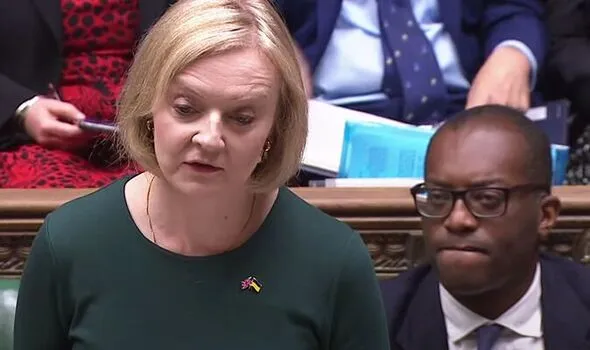
    Image of Liz Truss and Kwasi Kwarteng
    Image of Liz Truss and Kwasi Kwarteng


    Adam Koper, Cardiff University

    Conservative MPs seem increasingly willing to use the rhetoric of conspiracy. Recently, Liz Truss claimed that her brief tenure as prime minister had been ended by the deep state – shadowy forces within the British establishment and the media.

    A few days later, Lee Anderson, the Conservative party’s former deputy chairman, asserted that London’s mayor, Sadiq Khan, is being controlled by Islamists. He was adding his own twist on a similar conspiracy theory put forward by former home secretary Suella Braverman, who claimed in a Telegraph article that Islamists are in charge of the whole country.

    Why do politicians make conspiracy claims like these? It seems strange for MPs whose party has been in government for almost 14 years to imply that they aren’t really in control and that power is wielded by hidden actors.

    Maybe Truss and Anderson mean what they say, and say what they mean. But even if they do believe that Britain is governed by a deep state or Islamist plotters, knowing a bit about rhetoric can help us to see that there is more going on when politicians use the language of conspiracy.

    Context matters

    A good politician will adapt what they say to fit the moment and their audience. For example, Truss’s deep state comments were made at CPAC, a conference for American conservatives. She was speaking in part to promote her new book, Ten Years to Save the West, and so had little reason to do anything other than give her audience what it likes. Conspiracy theories have become prominent in American conservatism (think QAnon and the claims that the 2020 presidential election was stolen), so echoing the rhetoric is an obvious way for a CPAC speaker to ingratiate themselves with an audience.

    Anderson, though, was speaking in the UK, where conspiracist language is more unusual. His comments were seen by many as deliberately divisive and Islamophobic, and quickly landed him a suspension from his party. That said, government ministers were evasive when asked why his comments were wrong and whether they were Islamophobic.

    Part of the brand

    Courting controversy carries risks, as Anderson’s suspension shows. But it can also thrust a politician into the limelight, giving them a chance to speak to a broader audience and potentially gain new supporters. Much of the time, politicians make their own character – or ethos, as it is known in classical rhetoric – part of their pitch.

    In her comments alleging a deep state conspiracy, Truss took on a populist tone. She portrayed herself as an anti-establishment figure fighting for the British people against the elites. She didn’t mention her party’s long period in government in charge of the civil service that allegedly made her tenure so impossible. Nor did she refer to the economic problems brought about during her fleeting administration.

    Speaking to an audience which is likely to be less familiar with her political career, Truss was able to present herself as the protagonist in a David and Goliath narrative – albeit one in which David is defeated.

    Similarly, Anderson used the controversy around his comments to present himself as a man of the people. Rather than giving any evidence to back up his claims about Islamists controlling Khan, Anderson instead justified his views by citing the positive reaction he had received from his constituents. When told in an interview with Channel 4 News that people were puzzled by his refusal to back down, Anderson replied: “If you go and speak to people in Ashfield [Anderson’s constituency] and ask them if they’re puzzled about it, no they’re not.”

    In the aftermath of the controversy, Anderson told GB News: “When I went into pubs in Ashfield at the weekend, Friday, Saturday, Sunday, I got a round of applause when I went in. And these are normal working-class people.”

    Such comments can be seen as part of a broader trend. Politicians have learned to cite the opinions of ordinary people in order to justify spurious claims. Rather than explaining anything about how he came to view Islamists being in charge of London, Anderson’s response to questions has been to use them as an opportunity to present himself as an outsider to the political establishment – a man in tune with what voters really think.

    Pitting ‘us’ against ‘them’

    This focus on presenting a certain persona and using it to justify baseless comments tells us something important – that identity is a key ingredient in conspiracist rhetoric.

    It enables a politician to construct a conflict between an in-group and an out-group – a struggle between “us” and “them” – and asks the audience to pick a side. Rather than focusing on policies or ways of improving life for the British population, this rhetoric wants the audience to identify with the speaker’s character and join them in opposing a threatening enemy.

    In this way, conspiracist rhetoric is much like the Conservatives’ attacks on “woke ideology” – it deflects attention away from their record in government, and rallies their supporters against an enemy at a time when the party is down on its luck.

    Counteracting this is no easy task. Rhetoric is an art, not an exact science. One strategy could be to focus more on what politicians are trying to achieve when they use conspiracist rhetoric. While it is important to determine whether or not they really believe in a deep state or Islamist conspiracy, we also need to challenge the personas that politicians craft for themselves, as well the us-against-them divisions they construct. The Conversation

    Adam Koper, WISERD Civil Society Post-Doctoral Fellow, Cardiff University

    This article is republished from The Conversation under a Creative Commons license. Read the original article.
  • Lee Anderson makes antisemitic comment

    Spread the love
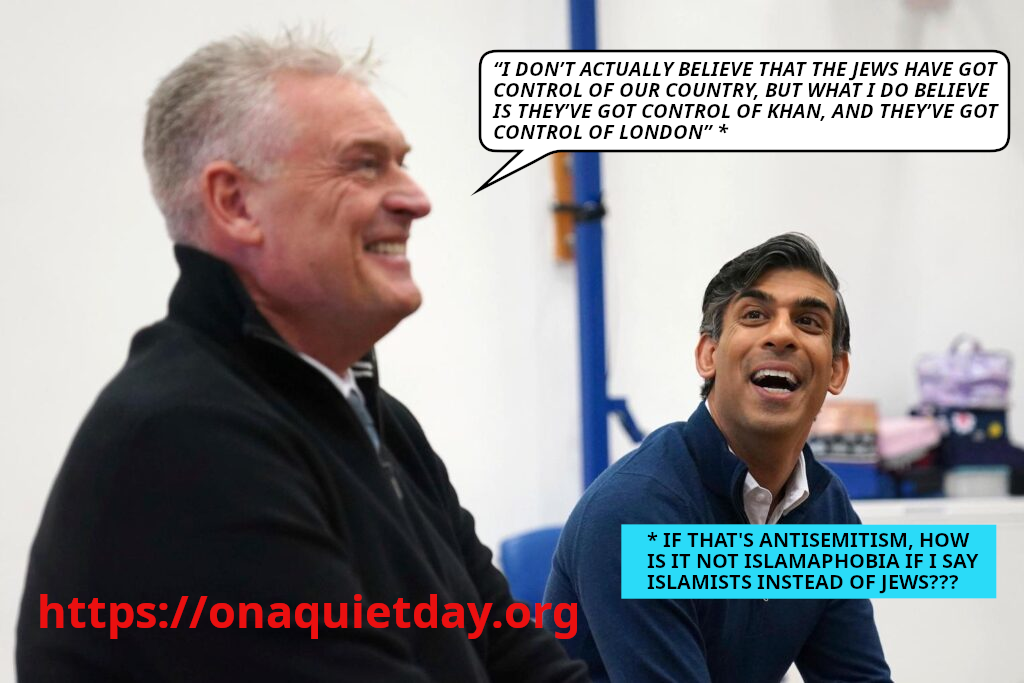
    Lee Anderson and Rishi Sunak. Anderson makes an antisemitic remark to highlight the double standard of antisemitism and Islamaphobia.
    Lee Anderson and Rishi Sunak. Anderson makes an antisemitic remark to highlight the double standard of antisemitism and Islamaphobia.
  • Theatre of Cruelty—And Its Double: From Aaron Bushnell to Biden’s Gaza Airdrop

    Spread the love

    Original article by RICHARD ESKOW at Common Dreams. I am able to but refrain from quoting this article in full – please be warned that it discusses Aaron Bushnell’s self-immolation in blunt terms.

    An image grab from video footage shows Palestinians running toward parachutes attached to food parcels airdropped from U.S. aircraft on a beach in the Gaza Strip on March 2, 2024. (Photo: AFP via Getty Images)

    The real purpose of this spectacle was to deliver votes for the president, not meals for the starving.

    The head of Save the Children described the Biden Administration’s recent airdrop of food into Gaza airdrop as “theater.” That it is. So is the Vice President’s sudden “demand” for a six-week ceasefire. For that matter, so is the ceasefire itself — if it happens. It’s likely to be characterized by ongoing immiseration and slow death, to be followed by the faster forms of killing.

    It’s an American theater of cruelty whose real purpose is to deliver votes for the president, not meals for the starving. It will end as it began: in fire. The question is, what kind of fire and for whom?

    Breadcrumbs

    The American airdrop consisted of 38,000 “MRE’s,” or “Meals Ready to Eat,” those unwholesome feed bags the US military buys by the millions to feed its underpaid and undervalued soldiers. To call this gesture a publicity stunt is unfair to publicity stunts, which are hollow but rarely lethal. It’s part of a killing strategy of deflection and deception.

    More than 2,100,000 people are starving in Gaza; the children are already dying. If divided evenly, every person in Gaza would receive precisely 1.8 percent of each bag pictured above – that is, if they got any of it, which is unlikely amidst all the US-backed chaos. Hunger can’t be cured homeopathically, with microscopic doses.

    The average weight of an MRE is 22 ounces. (I looked it up.) That means this airdrop provided roughly one-third of an ounce of food for every man, woman, and child. That’s like a bird hunter scattering breadcrumbs for pigeons before he starts killing them again.

    At the going price for MREs (I looked that up, too), the retail cost of the food dropped comes to $617,405. That’s 29 cents for every starving person in Gaza (which is pretty much all of them.) And the military probably got a discount.

    Perhaps the cost should be billed to the Biden campaign. Its real purpose is to offset the growing backlash against the administration’s support for mass slaughter, which was quantified in the Michigan primary’s surge of anti-Biden “uncommitted” votes. The president has seemed publicly insensate to the deaths of children, but even his dimming organs of perception can smell unfriendly votes. And whatever he doesn’t catch, his advisors presumably will.

    Meanwhile, the president and his party continue to push a bill that would provide $14 billion in military aid to Israel. That’s more than twenty-two thousand times as much as the US spent on this food drop. Roughly $10 billion of that would consist of weapons for the IDF, including “advanced weapons systems” like the ones that are currently destroying apartment buildings, schools, and hospitals.

    That cost should be billed to the American conscience.

    The Airdrop Show

    From the Washington Post: “Critics say airdrops are expensive and ineffective, and argue diplomatic efforts should be focused on opening Gaza’s border crossing to allow aid convoys access.” But that would require confronting Israel, which the Biden Administration has yet to do in any meaningful way.

    The United States could send food aid on ships to the Gaza shore with troops through the Rafah Crossing. It could confront Israel with a simple choice: fire on our military, or accept that the policy of mass starvation has come to an end. The fact that it doesn’t means that the dying will continue.

    The same inaction gives the lie to Kamala Harris’ belated discovery that “people in Gaza are starving” and her lofty call for “an immediate ceasefire” – which sounds good, except that the administration is absolving Israel of all responsibility for the deaths and for the lack of a ceasefire.

    …

    Who Was Aaron Bushnell, The Senior U.S. Airman Who Set Himself On … ›

  • Minnesota Dems Aim to Repeat ‘Uncommitted’ Campaign Success on Super Tuesday

    Spread the love

    Original article by OLIVIA ROSANE republished from Common Dreams under Creative Commons (CC BY-NC-ND 3.0). 

    Protesters attend a rally in St. Paul, Minnesota to divest Minnesota from apartheid Israel, free Palestine, and stop sending Minnesota money for genocide on November 19, 2023.  (Photo: Michael Siluk/UCG/Universal Images Group via Getty Images)

    “We are organizing our neighbors across the state to tell Joe Biden: permanent cease-fire now!”

    On the eve of Super Tuesday, Minnesota Democratic primary voters are looking to replicate Michigan’s success with their own “uncommitted” campaign to protest President Joe Biden’s support for Israel’s unrelenting assault on the people of Gaza.

    The uncommitted vote in Michigan earned more than 100,000 votes—well beyond the campaign’s 10,000-vote goal—and secured at least two delegates for the Democratic National Convention in Chicago in August.

    While Minnesota is not a swing state, and therefore may not have the same leverage over the Biden campaign as Michigan, organizers hope they can still send a message and inspire voters in other states.

    “We’re hoping that what we do here will just continue to push the wave of uncommitted across the United States,” Amanda Purcell of MN Families for PalestinetoldThe Guardian.

    “Voting uncommitted is a chance for Minnesotans to ask the president we fought for to change course, and recommit to all of us.”

    Progressive voters hope to use the uncommitted campaigns to persuade Biden to back a permanent cease-fire in Gaza, something that 68% of U.S. voters support, including 80% of Democrats. The campaigns seek to persuade the Biden administration that funding and arming an assault that the International Court of Justice has ruled a plausible genocide is not only immoral, but also a political liability as Biden prepares to face off against former President Donald Trump in November.

    “We are organizing our neighbors across the state to tell Joe Biden: permanent cease-fire now!” reads the Vote Uncommitted MN website. “With his approval ratings bottoming-out and a tight race for re-election, we know he is paying close attention to what happens at the ballot box.”

    Minnesota is not the only state to pick up the uncommitted call. It is, however, the Super Tuesday state with the most prominent campaign to date. Other Super Tuesday primaries that have an uncommitted or equivalent line are Alabama, Colorado, Iowa, Massachusetts, North Carolina, Tennessee, and American Samoa.

    The Colorado Palestine Coalition along with local chapters of the Democratic Socialists of America (DSA), launched a “Vote Noncommitted Colorado” campaign last Wednesday, though more than 762,000 people have already returned their ballots by mail.

    “We figured if there’s a way to make some waves and let our discontent be known, we might as well,” organizer Grace Thorvilson toldAxios Denver.

    However, organizers in Minnesota say an uncommitted campaign is primed to make an impact in the state because of its history of progressive, democratic engagement and its large Muslim and immigrant population.

    “We vote in Minnesota. Number one in the country for turnout,” Abandon Biden campaign in Minnesota co-chair Jaylani Hussein told The Guardian. “And when it comes to minorities and immigrants, we also have historically high, record turnout.”

    Campaigners have scrambled to get the word out in the wake of Michigan’s success.

    “Y’all Michigan had three weeks. Minnesota now has four and a half days,” organizer Asma Mohammed said on a conference call last week reported by Minnesota Public Radio.

    The campaign has received backing from local politicians, including St. Paul City Council President Mitra Jalali and Minneapolis City Council President Aisha Chughtai.

    “When you elect leaders, you commit to navigating difficult decisions with them while holding them accountable and standing up for your communities,” the pair wrote in an op-ed Monday in Sajan Journal. “Our communities deserve better than the idea that ‘anyone is better than Trump’—we deserve real leadership that invites accountability. Voting uncommitted is a chance for Minnesotans to ask the president we fought for to change course, and recommit to all of us.”

    Some members of the coalition, such as the Abandon Biden movement, want to ensure that Biden does not win the general election in order to impose consequences for his position on Gaza. Others, however, see the primaries as a chance to pressure Biden to reverse course before the general in order to strengthen his position against Trump.

    “I’m hoping that President Biden listens, because I don’t want to have to organize my community out of becoming Republicans or just sitting at home,” Mohammed said. “And it’s not just my community.”

    Abou Amara, who has previously worked on campaigns for the Minnesota Democratic-Farmer-Labor Party—the state’s Democratic Party affiliate—said that the primary was exactly the right time to put intra-party pressure on candidates.

    “The Democratic primaries and the Republican primaries are the moment to exercise political power and to have your voice heard,” Amara told Minnesota Now. “And you’re seeing the Biden administration continue to respond, to say I have to listen to various aspects of my coalition.”

    On Sunday, for example, Vice President Kamala Harris gave a speech in Selma in which she called for an immediate cease-fire and said Israel was not doing enough to stop a “humanitarian catastrophe” in Gaza. While Harris only backed a temporary, six-week cease-fire to facilitate a hostage exchange, her rhetoric reflects growing pressure on the party.

    AJ+ media critic Sana Saeed said on social media that it was a “blatant attempt to put Harris as sober to Biden’s zeal in the wake of Michigan and polls showing his unpopularity.”

    “They know they are in trouble,” she added, “so this is pure PR bait, and it seems some people are falling for it.”

    Organizers of the Uncommitted MN campaign hope the pressure will keep up beyond Super Tuesday. Already the United Food and Commercial Workers Local 3000, the largest union in Washington State, has endorsed the uncommitted campaign in that state’s primary on March 12. Efforts are also underway in states including Wisconsin, Arizona, and Pennsylvania.

    “This is a national movement,” Mohammed told The Guardian. “It doesn’t stop with Michigan. It doesn’t stop with Minnesota. All of us have to be all in to get the attention of the president.”

    Original article by OLIVIA ROSANE republished from Common Dreams under Creative Commons (CC BY-NC-ND 3.0). 

  • Rwanda bill ‘not fit for purpose’

    Spread the love

    https://morningstaronline.co.uk/article/rwanda-bill-not-fit-for-purpose

    Prime Minister Rishi Sunak speaks during a press conference in Downing Street in London, after he saw the Safety of Rwanda Bill pass its third reading in the House of Commons by a majority of 44, January 18, 2024

    Lords slam ‘legal fiction’ as they inflict first defeat on cruel Tory plan for asylum-seekers, decision comes day after seven-year-old girl tragically drowns in Channel

    PEERS inflicted their first defeat against PM Rishi Sunak’s proposed Rwanda asylum law today — putting the House of Lords on a collision course with the government.

    The upper chamber backed by 274 votes to 172, majority 102, a move to ensure the draft legislation, aimed at clearing the way to send asylum-seekers who cross the Channel in small boats on a one-way flight to Kigali, is fully compliant with the law.

    The heavy government defeat sets the stage for an extended tussle between the Commons and Lords during “ping-pong,” where legislation is batted between the two houses until agreement is reached.

    Peers slammed the government’s assertion that the east African country is safe to send migrants in contrary to a Supreme Court ruling.

    …

    Former Lord Speaker Baroness D’Souza branded the emergency legislation a “legal fiction.”

    The independent cross-bench peer said it is “writing into law a demonstrably false statement that Rwanda is a safe country to receive asylum-seekers and thereby forcing all courts to treat Rwanda as a safe country, despite clear findings of fact.”

    Former shadow attorney general Baroness Chakrabarti, who brought the supported amendment, told peers that Labour is calling for changes to the Bill that would ensure compliance with the rule of law.

    She argued this must be “completely incontrovertible for those like the Prime Minister, who now claim to be liberal patriots.”

    …

    https://morningstaronline.co.uk/article/rwanda-bill-not-fit-for-purpose