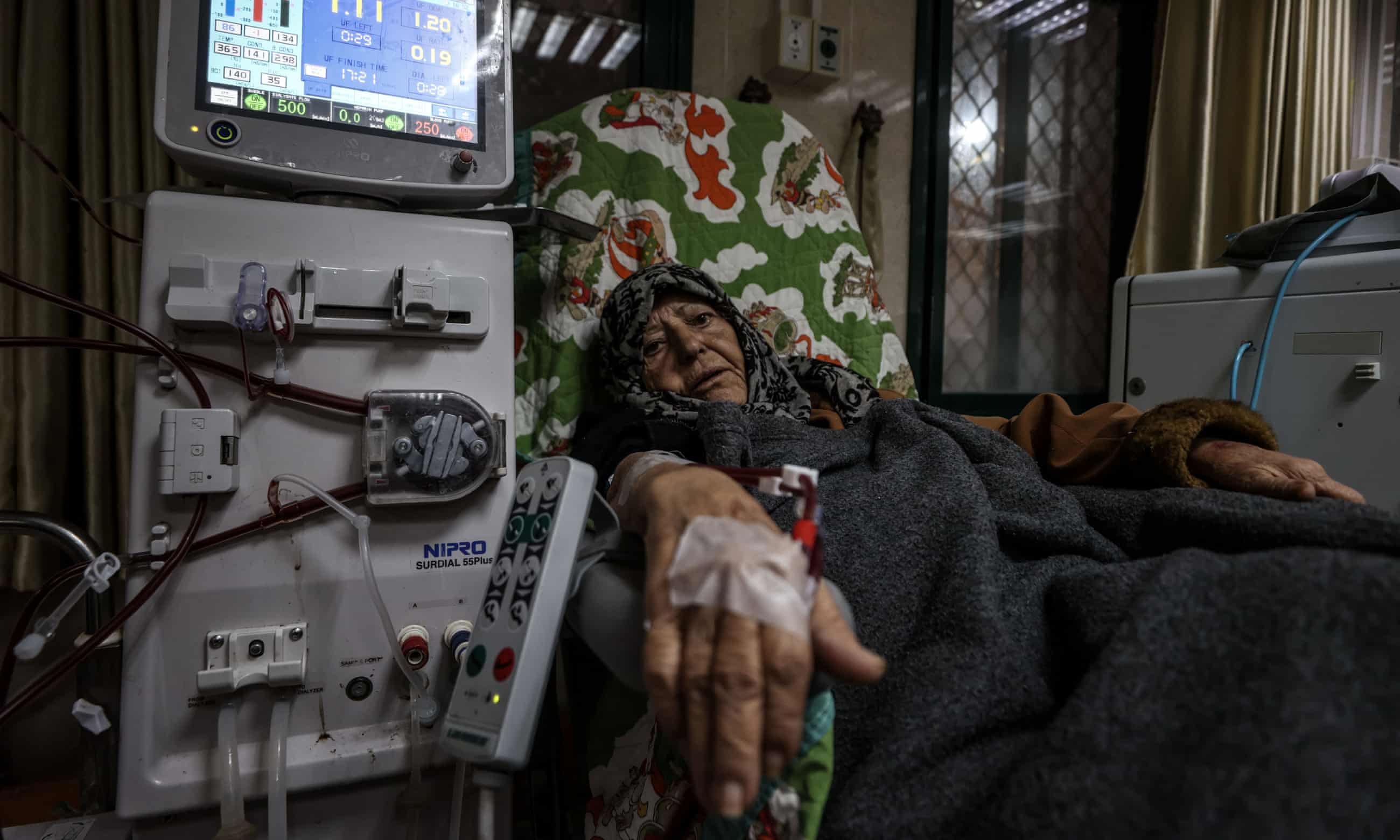
A Palestinian woman receives dialysis treatment at the Al-Aqsa Martyrs Hospital on February 8, 2024. Photograph: Anadolu/Getty Images
The lack of medicine, food and water means thousands of people with asthma, kidney disease or diabetes are unable to treat or control their conditions
Four months of conflict in Gaza is jeopardising the health of thousands of people with chronic illnesses such as kidney disease, diabetes and asthma, doctors have warned.
The chronically ill are the hidden casualties of the war, as access to water, food and medicine is severely restricted, said Guillemette Thomas, the Médecins Sans Frontières (MSF) medical coordinator for Palestine.
“Hospitals that are still functioning are overwhelmed with injured people, they are not able to deal with chronic illness at all,” she said. “Before the war there were 3,500 hospital beds in Gaza, now there are fewer than 1,000, and hundreds and hundreds of injured. We don’t know how many people are dying because they can’t access healthcare.”
When medication is allowed into the territory there are no safe ways of distributing it, Thomas said. “We have some insulin coming in aid trucks, but patients can’t get to the places where it is stocked because of the airstrikes. People are bombed on their way to the hospital.”
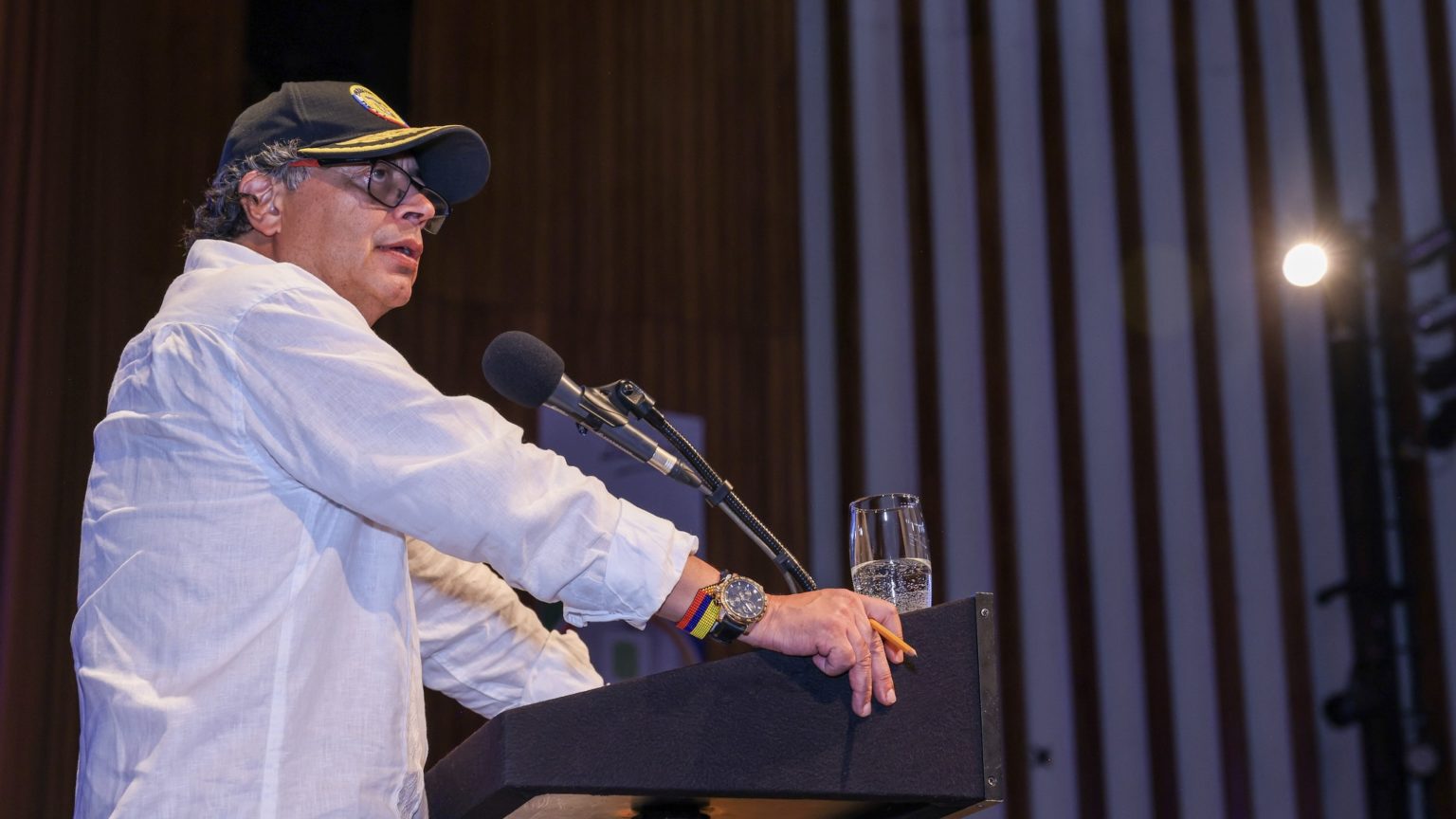
Colombian President Gustavo Petro speaking on February 13 from the Industrial University of Santander in Bucaramanga. Photo: Presidencia Colombia
The delay in the election of the Attorney General at the center of the ongoing tensions with the right, was highlighted by the United Nations Human Rights office and IACHR
Colombia’s Supreme Court will convene on February 22 to elect the country’s Attorney General (AG). The Supreme Court had already convened on two occasions, January 25 and February 8, for the same purpose but was unable, or as some allege, unwilling, to elect one of the three candidates proposed by President Gustavo Petro for the post back in August. The court’s refusal to elect one of Petro’s candidates for the post, has been at the center of what some have termed a “soft coup” or a destabilization campaign against the left-wing president’s government.
Petro himself said on February 2 that the court’s refusal to move forward was “institutional rupture that has reached its most desperate point, because the mafia does not want to control the entire sections of the Attorney General’s office that I have put in danger for having presented a shortlist of decent women.”
The Attorney General in Colombia is part of the judicial branch of power and has the role of investigating and accusing those who are alleged to be responsible for committing crimes.
On Monday February 12, the mandate of former AG Francisco Barbosa expired. Barbosa was appointed by former far-right president Iván Duque who is also his close friend from university. The AG has had open conflict with the current president, telling Blu Radio in May 2023 “I think Gustavo Petro is irresponsible” when Petro had warned of possible foul play in the AG’s investigation of members of Petro’s Historic Pact party.
On January 25, the same day that the Supreme Court was first set to elect his replacement, Barbosa ordered a raid of the Bogotá office of the Federation of Colombian Educators (FECODE) over allegations of improper contributions to Gustavo Petro’s presidential campaign. The move was widely condemned by social movements and trade unions in the country as being politically motivated.
With his term up, Barbosa’s deputy prosecutor and close ally, Martha Mancera, has taken up the post in the interim – until the Court makes its decision. Mancera has been named in different scandals, including an alleged cover up of an agent from the Attorney General’s investigative body who was involved in drug trafficking and arms trafficking.
On Wednesday February 14 at an event in the Industrial University of Santander in Bucaramanga, Petro said, “The government doesn’t agree that the Attorney General should be handed over to people with dubious reputation, that could have links, it seems and according to media investigations, with organized crime.”
International bodies such as the Inter-American Commission on Human Rights (IACHR) also expressed concern over the delay in the Supreme Court’s deliberations. In a statement published on February 13, the body said that a further delay in the selection of an AG, “could weaken the Colombian justice system” and that the Supreme Court must “fulfill its constitutional duty”.
On February 14, the UN Office of Human Rights in Colombia also declared that it was closely following the AG election process. In its statement, it highlighted the role the AG plays in “guaranteeing access to justice, democratic consolidation, and Rule of Law”, and as such, it “encourages the Supreme Court to conclude the process of selection of the AG in the shortest time possible”.
Both statements by the IACHR and the UN alluded to allegations by the right-wing that the citizen protests in dozens of cities across Colombia on February 8 to demand that the Court carry out its constitutional obligation, were an attempt by Petro to subvert rule of law and disrupt the Supreme Court’s process. The allegations are based on a video from a protest in Bogotá which depicts a couple of demonstrators attempting to rush the barricade at the gates of the Court while other protesters are leaving the site. Many analysts have stated that those depicted in the video were seemingly right-wing infiltrators.
Nevertheless, right-wing media has launched full scale attacks on protesters and Petro, and the Attorney General’s office claimed “possible crimes were committed” and opened up a special investigation.
Added to the growing pressure on Petro’s administration, is the direct attack on his foreign minister, Álvaro Leyva, who is under investigation by the Ombudsman and suspended from his position for three months over allegations of irregularities in the bidding process for passport processing. In reality, Leyva had taken steps to confront a private firm, Thomas Gregs and Sons, that had a major contract with the state for processing passports and had control over a significant amount of the population data in the country.
Petro had said that renowned jurists called the suspension of the foreign minister unprecedented and he termed it “institutional rupture”.
With growing pressure on the court to fulfill its constitutional mandate, the Supreme Court’s session on February 22 is set to be an important date, while the movements and social organizations that mobilized and campaigned to put Petro’s government of change in office have vowed to defend it at all costs.
U.S. President Joe Biden speaks during a campaign event at Mother Emanuel AME Church on January 8, 2024 in Charleston, South Carolina. (Photo: Sean Rayford/Getty Images)
The electoral base that Biden is going to need for re-election is heavily against his support for Israel’s war on Gaza. There is no way to hide from that fact.
For more than four months, President Biden has been the main enabler for Israel’s mass murder of Palestinian people in Gaza. Every day, hundreds of civilians are killed by U.S. weaponry and, increasingly, by hunger and disease. The cruelty and magnitude of the slaughter are repugnant to anyone who isn’t somehow numb to the human agony.
Such numbing is widespread in the United States. Some factors include ethnocentric, racial, and religious biases against Arabs and Muslims. The steep pro-Israel tilt of news media runs parallel to the slant of U.S. government officials, with language that routinely conveys much lower regard for Palestinian lives than Israeli lives.
And while the credibility of the Israeli government has tumbled, the brawny arms of the Israel lobby—notably AIPAC and Democratic Majority for Israel—still exert enormous leverage over the vast majority of Congress. Few legislators are willing to vote against massive military aid that makes the carnage in Gaza possible.
Instead of candor, the routine choices have been euphemisms and silence. But—morally and politically—that’s a big mistake.
A chilling example is Sen. Chris Van Hollen of Maryland. On Monday night, he took to the Senate floor and condemned Israel in no uncertain terms. “Kids in Gaza are now dying from the deliberate withholding of food,” he said. “In addition to the horror of that news, one other thing is true. That is a war crime. It is a textbook war crime. And that makes those who orchestrate it war criminals.”
Watching video from Van Hollen’s impassioned speech, you might assume that he would vote against sending $14 billion in further military aid to those “war criminals.” But hours later, he did just the opposite. As journalist Ryan Grim noted, “the senator’s speech pulsed with moral clarity—until it petered out into a stumbling rationale for his forthcoming yes vote.”
In contrast, three senators in the Democratic caucus—Jeff Merkley, Peter Welch, and Bernie Sanders—voted no. Sanders delivered a powerful speech calling for decency instead of further moral collapse from the top of the U.S. government.
While the Senate deliberated, the White House again made clear that it wasn’t serious about getting in the way of Israel’s planned assault on the city of Rafah. That’s where most of Gaza’s 2.2 million surviving residents have taken unsafe refuge from the Orwellian-named Israel Defense Forces.
An exchange at a White House news conference on Monday underscored that Biden is determined to keep enabling Israel’s continuous war crimes in Gaza:
Reporter: “Has the president ever threatened to strip military assistance from Israel if they move ahead with a Rafah operation that does not take into consequence what happens with civilians?”
Spokesman John Kirby: “We’re going to continue to support Israel. They have a right to defend themselves against Hamas and we’re going to continue to make sure they have the tools and the capabilities to do that.”
Later this week, Politico summed up: “The Biden administration is not planning to punish Israel if it launches a military campaign in Rafah without ensuring civilian safety.” Citing interviews with three U.S. officials, the article reported that “no reprimand plans are in the works, meaning Israeli forces could enter the city and harm civilians without facing American consequences.”
Biden continues to serve as an accomplice while mouthing platitudes of concern about the lives of civilians in Gaza. Month after month, he has done all he can to supply the Israeli military to the max.
With just eight months until the voting starts that could propel Donald Trump back into the presidency, the prospect of his return to power is all too real.
Under an apt headline—“Biden Is Mad at Netanyahu? Spare Me.”—The Nation senior editor Jack Mirkinson wrote this week: “In the real world, Biden and his legislative partners have continued to arm Israel; the Democratic leadership in the Senate actually brought people in on Super Bowl Sunday to take a vote on a bill that would, along with rearming Ukraine, send Israel another $14.1 billion for what is euphemistically dubbed ‘security assistance.’”
Ever since October, inspiring protests and activism in the United States have challenged U.S. support for Israel’s military assault on Gaza. However, boosted by revulsion at the atrocities that Hamas committed against Israeli civilians on October 7, the usual rationales for supporting Israel’s violence against Palestinians have been hard at work.
In this election year, an additional factor looms large. With just eight months until the voting starts that could propel Donald Trump back into the presidency, the prospect of his return to power is all too real. And with Biden set to be the Democratic Party’s nominee, countless individuals and groups are careful to avoid saying much that’s critical of the president they want to see re-elected.
Instead of candor, the routine choices have been euphemisms and silence. But—morally and politically—that’s a big mistake.
The electoral base that Biden is going to need for re-election is heavily against his support for Israel’s war on Gaza. Polling shows that young people in particular are overwhelmingly opposed. Most have seen through the thin veneer of his weak pleas for Israel to not kill so many civilians.
No amount of evasions, silences or doubletalk can make Biden’s policies morally acceptable. But—while the administration combines its PR hand-wringing with military arms-supplying—Biden apologists go on and on with evasion and verbal gymnastics to defend the indefensible.
A far better course of action would be actual candor about current realities: Joe Biden’s moral collapse is enabling the Israeli government to continue, with impunity, its large-scale massacre of Palestinian people. In the process, Biden is increasing the chances that the Republican Party, led by fascistic Donald Trump, will gain control of the White House in January.
Demonstrators blockade the entrance of the BAE Systems site in Govan, Glasgow in solidarity with Palestinians and call for an immediate ceasefire, February 15, 2024
by Matt Kerr Scotland reporter
MORE than 100 demonstrators blockaded Scotland’s largest industrial site today to call for a halt of arms to Israel. Amid the ongoing slaughter in Gaza, more than 100 Glaswegian activists answered the call from Palestine trade unionists to disrupt Israeli arms supplies, descending on Govan at 5am to blockade BAE Systems during a shift change.
The controversial company is Britain’s biggest supplier of military hardware and maintains extensive long-term links with Israel, supplying high-tech weaponry.
Demonstrators did not limit their aims to disrupting BAE systems and called both the Westminster and Scottish governments to account for their actions.
Protesters not only demanded that the Tory government immediately stop the bombing of Yemen, but also challenged the Scottish government. One demonstrator, Aisha, a 37-year-old school teacher, said: “The Scottish government funds weapons manufacturers like BAE through Scottish Enterprise.
“This is absolutely disgusting and directly contradicts any lip-service the Scottish Parliament and First Minister pays towards backing a ceasefire or supporting Palestinians.
Sellafield is Europe’s most toxic nuclear site. Photograph: David Levene/The Guardian
Britain’s public spending watchdog has launched an investigation into risks and costs at Sellafield, the UK’s biggest nuclear waste dump.
The National Audit Office (NAO), which scrutinises the use of public funds, has announced it will examine whether the Cumbria site is managing and prioritising the risks and hazards of the site effectively as well as deploying resources appropriately and continuing to improve its project management.
The findings of its investigation are expected to be published this autumn.
Sellafield is Europe’s most toxic nuclear site and also one of the UK’s most expensive infrastructure projects, with the NAO estimating it could cost £84bn to maintain the site into the next century.
Predictions of the ultimate bill for the site, which holds about 85% of the UK’s nuclear waste, vary. It cost £2.5bn to run the site last year, and the government estimates it could ultimately take £263bn to manage the country’s ageing nuclear sites, of which Sellafield accounts for the largest portion.