Firefighters demand emergency funding as thousands evacuated across Britain
FIREFIGHTERS have demanded emergency funding to tackle widespread flooding after thousands of residents were evacuated from their homes and transport links ground to a halt in the wake of Storm Henk.
…
Since 2010 funding for the Environment Agency has been axed by two-thirds, including funding for flood defences and resilience. More than 2,000 jobs have been axed.
In the call for emergency funding, Fire Brigades Union (FBU) general secretary Matt Wrack said: “When floods threaten people’s homes, lives and livelihoods, it’s firefighters who step in to protect communities.
“Storm Henk follows a winter of storm after devastating storm and more is to come.
“It’s high time that the government woke up to the realities of the climate emergency.
…
Greenpeace UK climate campaigner Georgia Whitaker said: “While the prime minister is on a tour to kick off the election year, thousands of people are seeing their homes, businesses and fields wrecked by rising water.
“We’ve known for decades that the climate crisis would bring more rainfall and flooding and yet the government completely failed to prepare for it.
“Thousands of flood defences are in a state of disrepair and ministers are still allowing developers to build in high-risk areas, while also pushing for more oil and gas drilling that will only make the problem worse. It’s a double failure.
“(Prime Minister Rishi) Sunak should take a break from his glad-handing tour and see for himself what the real consequences of climate inaction look like.
“He might learn how voters waist-deep in flood water feel about his plans to slow down climate action ahead of the election.”
A Tory MP has launched a spectacular attack on Rishi Sunak’s climate record as he announced he was quitting.
Former energy minister Chris Kingswood, who led a Government review of net zero, warned: “I can no longer stand by.”
His decision creates another by-election nightmare for the Prime Minister. Mr Kingswood has resigned with immediate effect from the Conservative Party and will formally stand down as an MP when Parliament returns after the Christmas break on Monday.
…
In a statement posted on X, the Tory who signed the UK’s net zero commitment by 2050 into law said he was resigning as he could not support proposed new legislation that “clearly promotes the production of new oil and gas” by handing out more North Sea drilling licence.
He said the “future will judge harshly” anyone who backs the Offshore Petroleum Licensing Bill, which is due to be voted on by MPs on Monday.
“I can… no longer condone nor continue to support a government that is committed to a course of action that I know is wrong and will cause future harm,” he wrote in the excoriating statement. “To fail to act, rather than merely speak out, is to tolerate a status quo that cannot be sustained. I am therefore resigning my party whip and instead intend to be free from any party-political allegiance.”
He added: “I can no longer stand by. The climate crisis that we face is too important to politicise or to ignore.”
Mr Skidmore said the Bill that will be debated next week “achieves nothing apart from to send a global signal that the UK is rowing ever further back from its climate commitments”
… In September 2022, he was appointed by the Truss government to chair the Independent Government Review on Net Zero.[5] On 5 January 2024, Skidmore announced that he would resign his party whip and his Parliamentary seat in protest at the introduction of the Offshore Petroleum Licensing Bill.[6]
…
On 27 June 2019, as Interim Minister for Energy and Clean Growth, Skidmore signed the UK’s Net Zero Pledge into law, becoming the first major economy to do so.
…
Net zero
On 26 September 2022 Skidmore launched the Net Zero Review, pledging to use the review to focus on the UK’s fight against climate change while maximising economic growth to ensure energy security and affordability for consumers and businesses.[28]
On 19 October 2022, Skidmore put out a statement on Twitter, in advance of a debate on fracking, saying that “[a]s the former Energy Minister who signed Net Zero into law”, he could not vote “to support fracking and undermine the pledges I made at the 2019 General Election”. The government was reportedly treating this vote as a confidence vote, putting Skidmore at risk of losing the Conservative Party whip.[29][30]
On 16 January 2023, Skidmore published “Mission Zero”,[31] the final report of the Net Zero Review. The 340 page report, containing 129 recommendations on how to deliver the UK’s net zero commitments, has been widely welcomed by the energy and climate sector.[32][33]
In June 2023, it was announced that Skidmore had been appointed to a professorship at the University of Bath to undertake research on sustainability and climate change.[34][35]
Although in November 2022 he had declared he would not stand again, in January 2024 Skidmore stated he would leave Parliament “as soon as possible”, stating that the relaxation of net zero targets was “the greatest mistake of [Rishi Sunak’s] premiership”.[36]
Resignation
On 26 November 2022, Skidmore announced that he would be standing down at the next general election, later stating in Parliament that ‘my constituency of Kingswood is being formally abolished in the boundary changes and there is nowhere for me to go.’[37][38][39]
However, on 5 January 2024 Skidmore announced that he would resign his party whip and his Parliamentary seat in protest at the introduction of the Offshore Petroleum Licensing Bill.[40]
dizzy: From the Resignation section immediately above, by resigning Skidmore is forcing a by-election in a seat that will cease to exist at the next general election expected this year. From his statement and the rest of the Wikipedia entry, it’s clear that he’s doing it because he’s opposed to Rishi Sunak’s energy policy. Part of his resignation statement reads “I cannot vote for a bill that clearly promotes the production of new oil and gas. While no one is denying that there is a role for existing oil and gas in the transition to net zero, the International Energy Agency, the UNCCC and the Committee on Climate Change have all stated that there must be no new additional oil and gas production on top of what has already been committed, if we are to both reach net area carbon dioxide emissions by 2050 and keep the chance of limiting temperature rises to 1.5 degrees.”
He ends his statement “I can no longer stand by. The climate crisis that we face is too important to politicise or to ignore. We all have a responsibility to act when and where we can to protect the future: I look forward to devoting my time in 2024 and beyond to making the future a better place, in whatever capacity I can.”
The COP 28 UN climate conference concluded with countries agreeing to a plan to transition away from fossil fuels, using language that fell short of calling for an explicit phaseout. In the debates over whether countries need to phase fossil fuels “out” or merely “down,” carbon capture and storage (CCS), a form of so-called fossil fuel “abatement,” played a central role.
Rather than exposing CCS as the greenwashing ploy it essentially is, some reporting placed disproportionate significance on the technology, adding to the confusion and misunderstandings about climate change that fossil fuel companies have been funding for decades.
An excuse to not eliminate
“Don’t be fooled,” writes Jonathan Foley in Scientific American (12/4/23): Carbon capture is “mostly a distraction from what we really need to do right now: phase out fossil fuels and deploy more effective climate solutions.”
Before COP 28 even began, climate activists were not hopeful. The conference, held in Dubai, capital of the oil-dependent United Arab Emirates, reeked of almost comedic irony. The conference’s president, Sultan Al Jaber, is the head of the petrostate’s national oil company.
During a November livestream event, Al Jaber falsely claimed there was “no science” indicating a phaseout of fossil fuels was necessary to keep warming levels below the 1.5°C threshold set by the Paris Agreement. He added that phasing out fossil fuels would “take the world back to the caves” (Guardian, 12/3/23).
CCS technology—which involves capturing carbon from sources like power plants and steel mills, and storing it underground—has become a key part of the fossil fuel industry’s arguments against the elimination of its environmentally devastating product. Instead of rapidly ending the extraction and burning of fossil fuels, the claim goes, we can simply “abate” the emissions with CCS.
The reality is that even optimistic estimates see CCS (also known as carbon capture and sequestration) as playing only a limited role in mitigating emissions from difficult-to-decarbonize sectors. But polluters aggrandize its potential contributions in order to keep expanding fossil fuel extraction while at the same time claiming to take action on climate (Scientific American, 12/4/23). In fact, most successful CCS projects are actually used to force more oil out from underground, in a process called “enhanced oil recovery” (Washington Post, 10/25/23).
Given the chokehold the fossil fuel industry had on this COP and subsequent conversations about climate change mitigation, journalists must be clear and realistic in their reporting about the capabilities of carbon capture, and its role in both climate crisis solutions and fossil fuel industry greenwashing.
‘A valuable role’
To back up the idea that carbon capture is a “valuable tool,” the New York Times (12/6/23) links to a study whose headline calls it “Too Little, Too Late, Too Slow.”
The New York Times’ headline, “Can Carbon Capture Live Up to the Hype?” (12/6/23), could have been most easily and accurately answered by a short “no.” Instead, the subheading misled about CCS’s plausibility as a climate change solution, claiming that “experts say it could play a valuable role.”
But what’s the evidence on offer? The article mostly described the failures of expensive carbon capture projects to even get off the ground. The only reference to that supposedly “valuable role” linked to three studies or reports. The titles of two were “[Carbon Capture]—Too Little, Too Late, Too Slow—It’s No Panacea” (S&P Global, 10/18/23) and “Heavy Dependence on Carbon Capture and Storage ‘Highly Economically Damaging,’ Says Oxford Report” (SSEE, 12/4/23).
A third, seemingly more optimistic, report came from the International Energy Agency (11/27/23). But that agency’s latest report actually offered the opposite message, its executive director explained (Toronto Star, 11/23/23): Oil companies’ plan to achieve “net zero”—removing as much carbon from the atmosphere as they emit—by capturing emissions while increasing production is an “illusion” based on “implausibly large amounts of carbon capture.” Lucky for those companies, New York Times headline writers are here to keep up that illusion.
The Times article itself even noted that “total fossil fuel use will have to fall sharply no matter what to keep global warming at relatively low levels,” and that carbon capture is “no silver bullet.” It cited the IEA’s roadmap to lowering carbon emissions to net zero by mid-century, noting that even in this ideal plan, CCS would account for just 8% of the world’s total emissions cuts, and that “the vast majority of reductions would come from countries shifting away from fossil fuels entirely.”
While CCS could play a part in mitigating emissions from industries like cement, steel and fertilizers, the benefit can only be realized if the technology’s logistical and financial limitations are addressed, explained Jonathan Foley in a piece for Scientific American (12/4/23). Food and Water Watch (7/20/21) characterizes CCS as an “expensive failure” that’s energy intensive and actually increases emissions.
Even while outlining CCS’s “limitations,” the Times managed to both-sides the issue:
One big dispute is over how big a role this technology, known as carbon capture and storage, should play in the fight against global warming. Some oil and gas producers say it should be central in planning for the future. Others, including many activists and world leaders, dismiss carbon capture as too unproven and too risky.
In a “dispute” about how to cut carbon emissions, oil and gas producers’ arguments should certainly not be taken at face value. And, while “activists and world leaders” are among those who “dismiss carbon capture,”crucially, soarescientists.
The Times piece played down the many economic and logistical failures of CCS as “limitations.” While removing carbon will likely play a necessary—albeit small—role in meeting climate goals, CCS’s success hinges on our abilities to phase out fossil fuels. The tone of the piece’s headline is overly optimistic, offering a false sense of hope—and “hype”—for a technology that’s used more as a fossil fuel fig leaf than a climate change solution.
‘Vital…but falling short’
Bloomberg (12/6/23) notes without rebuttal that “CCS has been discussed as a way to limit the damage caused by fossil fuels without having to abandon them.”
An explanatory Bloomberg piece (12/6/23) about carbon capture, headlined, “Why Carbon Capture Is Seen as Vital in Climate Fight but Falling Short,” used similarly weak language.
In addition to CCS, the piece highlighted direct air capture (DAC), another carbon capture technology that removes carbon that is already in the atmosphere, rather than at the site of emission, and also performs at a tiny fraction of the scale that would be necessary for it to be an actual solution. According to the article, the largest DAC hub in the world, found in Iceland, only removes the equivalent of the annual emissions of 250 average US citizens.
For more context, the Regional Direct Air Capture Hubs that Biden’s Department of Energy is supporting are anticipated to suck only about 1 million metric tons of CO2 from the atmosphere annually. In 2022, global emissions of CO2 were 40.5 billion metric tons (Scientific American, 12/4/23)–adding more than 40,000 times as much carbon as the hubs are supposed to take out.
To say these technologies are “falling short” is quite the understatement.
To say they’re “vital” requires context. The Bloomberg piece explained:
Even if solar and wind energy largely supplant fossil fuels, holding temperatures down will require capturing large amounts of emissions produced by activities that are hard to decarbonize, such as making cement.
That much is true. However, it leaves out the most important part: Carbon capture can only make a difference in a world that drastically cuts emissions. Without that priority being met, its impacts are marginal at best—and, at worst, a distraction that permits fossil fuel companies to increase emissions and worsen the crisis.
In a press briefing with Covering Climate Now (11/9/23) regarding CCS and carbon dioxide removal, David King, former chief science adviser to the British government, emphasized that reducing greenhouse gas emissions was still the No. 1 priority, as human activity continues to emit the equivalent of about 50 billion tons of carbon dioxide into the atmosphere each year.
‘Some environmentalists’
Washington Post (12/11/23) attributes the idea that carbon capture is a “false climate solution” to “some environmentalists.”
A Washington Post report (12/11/23), leading with the tearful remarks of Mona Ainuu, a climate activist from Niue, a small island nation, described the ultimate, disappointing outcome of the COP: The draft agreement to come out of the conference called not for the phaseout of fossil fuels, but for the mealy-mouthed “reducing both consumption and production of fossil fuels, in a just, orderly and equitable manner.”
The agreement also called for the rapid phase-down of “unabated coal.” The Post explained carbon capture and sequestration:
Some environmentalists view CCS as a false climate solution, saying it could prolong the life of polluting facilities for decades to come. They note that the International Energy Agency has warned that humanity cannot build any new fossil fuel infrastructure if it hopes to limit warming to 1.5°C.
Like the Times report, the Post framing failed to give readers the unvarnished truth they need, that CCS is only seen as a key climate solution by industries whose profitability depends upon the further burning of fossil fuels. No further information on the IEA report was given, or any information about the other litany of scientific studies, reports and information on the failures of CCS, allowing the specific concerns of “some environmentalists” to go unmentioned.
All of these pieces fail to mention why the fossil fuel industry is so gung ho about this dubious technology: While oil companies’ greenwashed PR campaigns tout CCS, corporations and governments continue to ramp up extraction.
Carbon capture and removal will likely play a small role in avoiding the most devastating effects of climate change, but it’s spitting in the ocean without a fossil fuel phaseout. It is journalists’ job to explain this accurately, while reminding audiences to not forget the No. 1 priority: eliminating fossil fuels.
Addition by dizzy: When Rishi Sunak says that every last drop of oil should be taken from the North Sea, he is showing his full support to the oil industry and it’s CCS misdirection. CCS or it’s original name ‘enhanced oil recovery’ is needed to get every last drop.
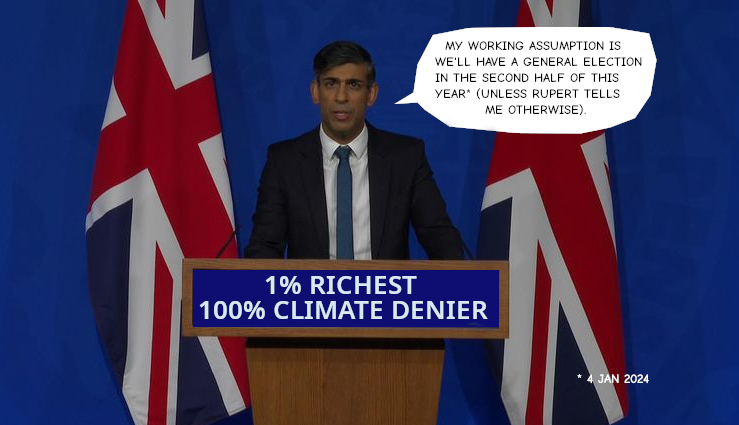
“My working assumption is we’ll have a general election in the second half of this year and in the meantime I’ve got lots that I want to get on with,” he said during a visit to Nottinghamshire.
While he refused to rule out calling a May election, as has been predicted by senior Labour figures, Sunak repeated his intention to hold it in the second part of the year.
A man holds both Palestinian and Turkish flags at a rally in Istanbul on January 1, 2024. (Photo: Ilker Eray/Middle East Images/AFP via Getty Images)
“Israel’s murder of more than 22,000 Palestinian civilians, the majority of whom were women and children, in Gaza for nearly three months should not go unpunished in any way,” said a Turkish spokesperson.
South Africa is no longer alone in bringing its claim of genocide by the Israeli government to the International Court of Justice, following announcements from the Turkish Foreign Ministry and the Malaysian Ministry of Foreign Affairs that they support the case.
Turkish Foreign Ministry spokesperson Oncu Keceli said Wednesday that those responsible for the killing of tens of thousands of Palestinians in Gaza since October 7 “must be held accountable before international law.”
“Israel’s murder of more than 22,000 Palestinian civilians, the majority of whom were women and children, in Gaza for nearly three months should not go unpunished in any way,” Keceli said. “We hope that the process will be completed as soon as possible.”
Turkey has officially backed South Africa’s case at the International Court of Justice, which rightly accuses the israeli enemy of genocide https://t.co/TBBTzBfgh2
The ICJ is scheduled to hear the case on January 11-12. Israeli representatives are expected to appear at the hearing.
International rights groups issued a call on Wednesday for other countries to file Declarations of Intervention at the court, whose authority Israel recognizes, to bolster South Africa’s case.
The Turkish Foreign Ministry said it expects “that within the framework of this application, the ICJ will decide on provisional measures involving those to stop Israel’s attacks on Gaza.”
The Malaysia Ministry of Foreign Affairs said late Tuesday that it “welcomes the application by South Africa instituting proceedings against Israel… concerning the violations by Israel of its obligations under the 1948 Convention on the Prevention and Punishment of the Crime of Genocide in relation to Palestinians in the Gaza Strip.”
A spokesperson for the South African Foreign Ministry told The Jerusalem Post that it expects other countries to soon follow Turkey and Malaysia’s lead and back its case.
In its 84-page complaint, South Africa detailed the genocidal intent that’s been displayed in numerous public statements by Israeli Prime Minister Benjamin Netanyahu, President Isaac Herzog, and other top officials, as well as Israel’s bombardment of civilian targets and forced displacement of civilians.