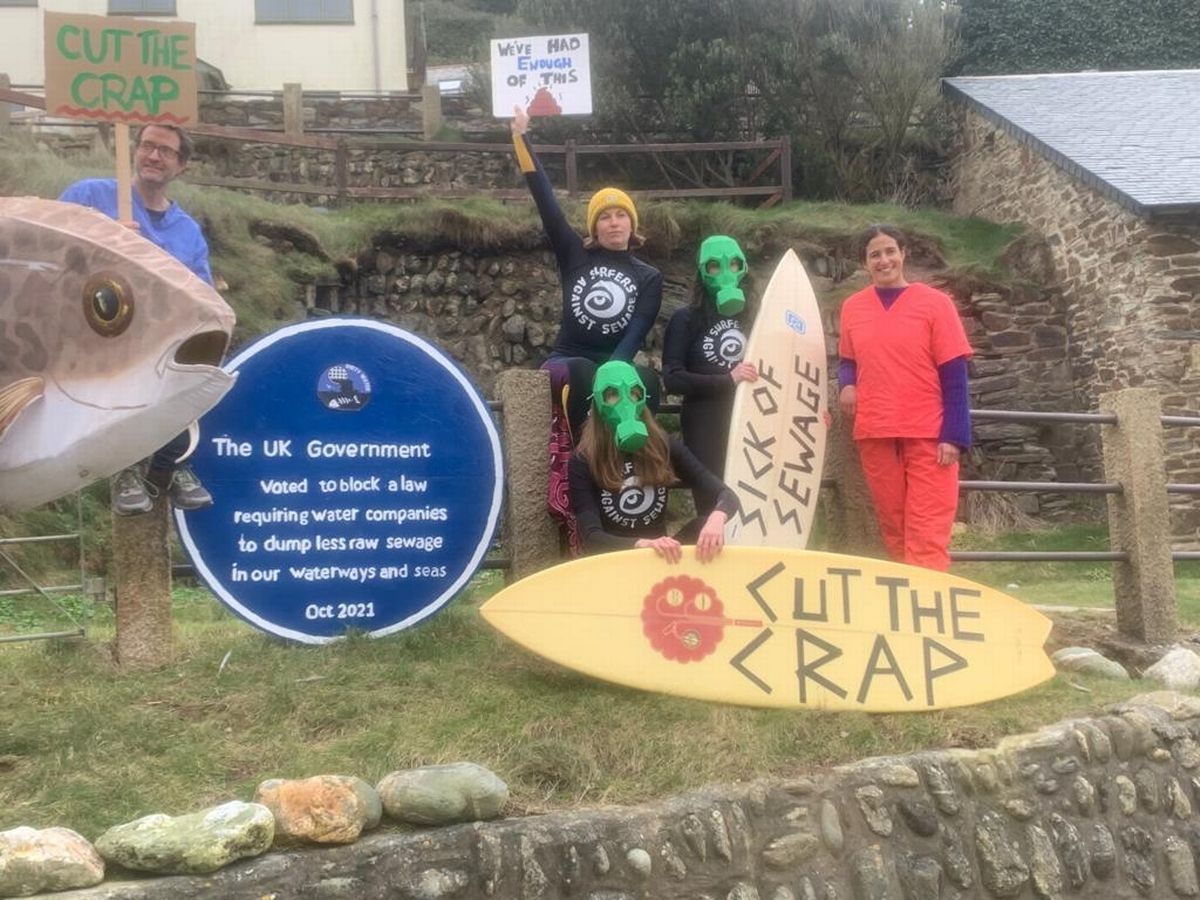
April 2023 Surfers Against Sewage and Extinction Rebellion protests in St Agnes, Perranporth, Truro and Charlestown which unveiled spoof Blue Plaques to the MPs and Conservative Government who allowed raw sewage to be dumped in the sea (Image: Surfers Against Sewage)
The Green Party has reiterated its call for water companies to be brought into public ownership after Water UK apologised for a series of sewage discharges.
The Green Party has reiterated its call for water companies to be brought into public ownership after Water UK apologised for presiding over a rising tide of sewage discharges.
Water UK represents 25 water companies across the UK and said that the public was ‘right to be upset about the current quality of our rivers and beaches’. The companies have also promised to triple funding for sewer system upgrades, cut spilly by up to 25 per cent by 2030, and provide the public with ‘near real-time’ data on sewage spills.
Green Party co-leader Adrian Ramsay said: “Rivers and coastlines up and down the country have faced years of assault at the hands of the water companies and a government that has refused to act.
“Currently water companies can, almost with impunity, dump sewage into our rivers, waterways and coastal waters with an appalling cost to public health and our wildlife. This situation cannot go on.
Energy Monitor talks to leading climate change economist Dimitri Zenghelis about an open letter from 100 economists lamenting UK Prime Minister Rishi Sunak’s recent net-zero U-turns.
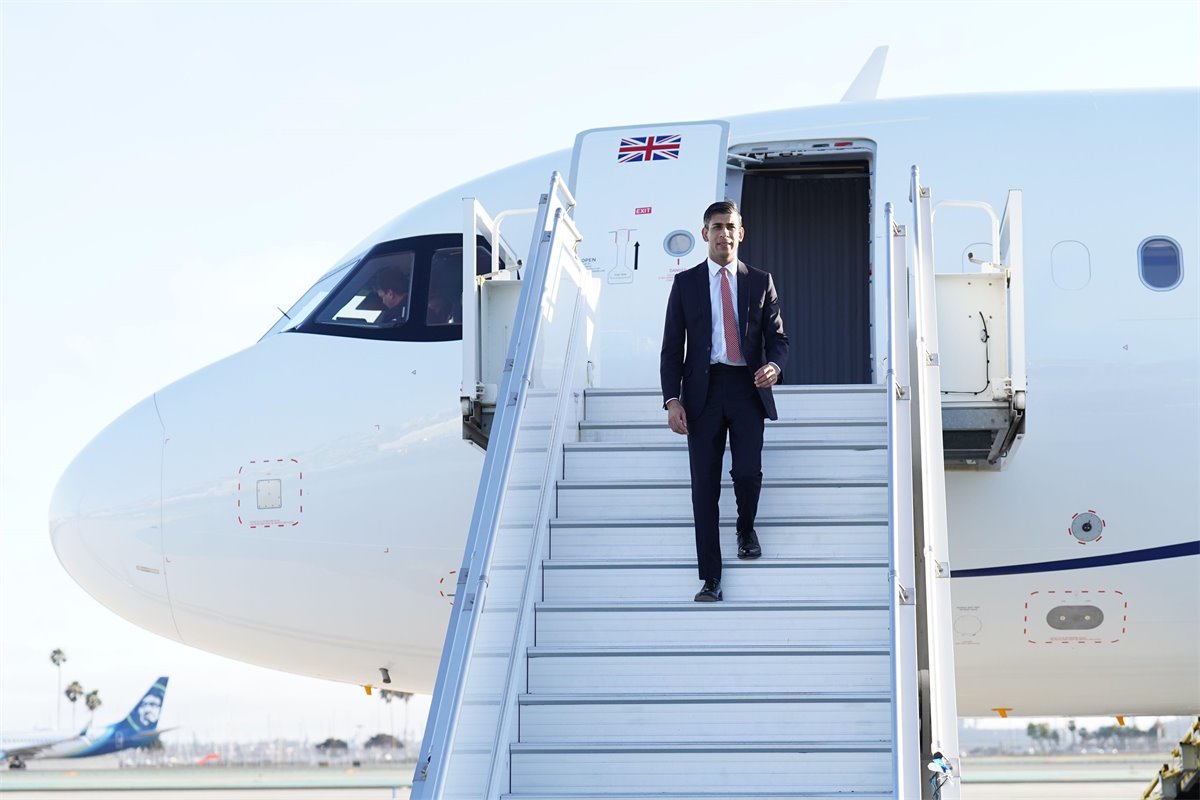
One of the many occasions UK Prime Minister Rishi Sunak uses a private jet.
…
So, what’s behind Sunak’s net-zero moves then?
It’s got nothing to do with cost; it’s pure politics. It’s dog-whistle stuff. He thinks he can turn this issue into an identity politics story. Hence, the “seven bins”. He’s talking about these cosmopolitan elite liberals with their fetishistic recycling (hence the seven bins) and how they’re wanting to take away our cars – from hard-working people who don’t have access to transport. It’s another “us against them” story.
It is true that if you live next to public transport in central London, you can afford to legislate against dirty vehicles, but if you live in a suburb with a terrible bus line, and you can’t afford the latest electric vehicle, yes, it is potentially quite punitive. So, this has to be done in a very careful and fair way. But just removing legislation that doesn’t impose costs sends a signal to the electorate that you’re taking a position, but to businesses that you absolutely haven’t a clue what you’re doing. Because on the one hand, you’re saying you’re committed to net zero by 2050; and on the other hand, you’re providing absolutely zero policy certainty because even when you do apply policies, you then rescind them. It’s economic short-termism.
Sunak’s playing politics with people’s livelihoods, and he’s selling it as if he’s actually trying to help people’s livelihoods instead of actually grappling with the issues of net-zero disruption and figure how we make it easier for people to adjust, how we support people in making their house as energy efficient as possible and transition to heat pumps, how we support people with bad public transport who at the moment can’t afford electric vehicles. But he’s thinking of what happened with ULEZ [Ultra Low Emission Zone] in the Uxbridge vote and what those culture wars can do to turn around his chances in the upcoming election. And if the economy suffers, well that won’t be his problem, because he probably won’t be in government by then. It’s just so cynical.
It’s hard for him to argue this is what economists are saying when both the OBR [Office for Budget Responsibility] and the Treasury have provided numbers that show the cost of delaying this transition is more expensive than the cost of pursuing it, as has the independent Climate Change Committee (CCC).
At the Saudi-Indian Investment Forum held following the G20 meeting in India, Saudi Crown Prince, Mohammad Bin Salman, said that the creation of the Economic Corridor had been announced by New Delhi, which will connect India, Middle East and Europe together, would achieve the common interests of “our countries by enhancing economic connectivity”.
Knowing that this Corridor includes Israel, Bin Salman reiterated that it would contribute to the development of infrastructure, including railways, port connections, improved flow of goods and services and enhanced trade exchange between the involved parties.
Regardless of all controversy related to the Saudi conditions to sign a deal to normalise ties with Israel, this proves that the Kingdom is going ahead very fast with the matter. The remarks made by Bin Salman about the Economic Corridor removed all ambiguities about the real relationship between Saudi Arabia and Israel. He clearly spoke about common interests and trade exchange among the countries involved in the project.
Emirati political analyst, Salem AlKetbi, made it clearer as he said that this “ambitious project is a common ground for cooperation and integration”, pointing out that “economics serves as the gateway to politics” and said “it can effectively chart a new geopolitical map for alliances, as the interests of these parties are more intertwined than ever before which, in turn, reflects on their regional and international policies and orientations.”
Liberty is taking the home secretary to court for ‘unlawfully’ passing legislation Parliament had already rejected
Image of Home Secretary Suella ‘Sue-Ellen’ Braverman
A human rights campaign group is taking Suella Braverman to court for “unlawfully” forcing draconian anti-protest legislation through Parliament, openDemocracy can reveal.
In June, Braverman used secondary legislation – which is subject to less parliamentary scrutiny – to allow police to restrict or shut down any protest that they believe could cause “more than minor disruption to the life of the community”.
A cross-party parliamentary committee said this is the first time secondary legislation has been used to make changes to the law that have already been rejected by Parliament. Akiko Hart, interim director of Liberty, which launched initial legal action in June, described the move as “the latest power grab from this government”.
The government previously tried to insert the new powers into the Public Order Act 2023 in January, but was blocked by the Lords. Liberty’s lawyer, Katy Watts, accused Braverman of “sneak[ing] in new legislation via the back door, despite not having the power to do so”.
Hart said: “We all want to live in a society where our government respects the rules – but the home secretary has deliberately done the opposite. The home secretary’s actions have enabled the government to circumvent the will of Parliament.”
She continued: “This is just the latest power grab from this government, which has shown it is determined to erode the ways people can hold it to account, whether that’s in Parliament or on the streets. The home secretary’s actions give the police almost unlimited powers to stop any protest the government doesn’t agree with – and the way she has done it is unlawful.”
The home secretary has long called for more police powers to tackle peaceful methods of protests by climate activists, such as road blocking, ‘locking on’, and slow marching, which she said “bring misery and chaos to the law-abiding majority”.
One supporter of Insulate Britain previously told openDemocracy that protest is “our only legitimate means to achieve the changes needed within the time frame we have”.
Another of the group’s supporters said that the criminalisation of protest – in particular, of environmental protest – “is an example of attempting to shoot the messenger” and that elected politicians “obviously don’t really care about protecting people’s democratic rights”.
Watts, Liberty’s lawyer leading the case, said Braverman’s circumventing of the Lords’ rejection is “a flagrant breach of the separation of powers that exist in our constitution”.
She added: “The wording of the government’s new law is so vague that anything deemed by police to cause ‘more than a minor’ disturbance could have restrictions imposed upon it. This same rule was democratically rejected earlier this year, yet the home secretary has gone ahead and introduced it through other means regardless.
“It’s really important the government respects the law and that the home secretary’s decision is reversed immediately.”
Liberty has also claimed the new legislation was not consulted on fairly. It has accused the government of only consulting parties it knew would support the amendments, such as the police.
Rishi Sunak used the word change 30 times in his conference speech. His party has been in power for 13 years
Listening to the PM in Manchester, you’d be forgiven for thinking a different party has been running the country
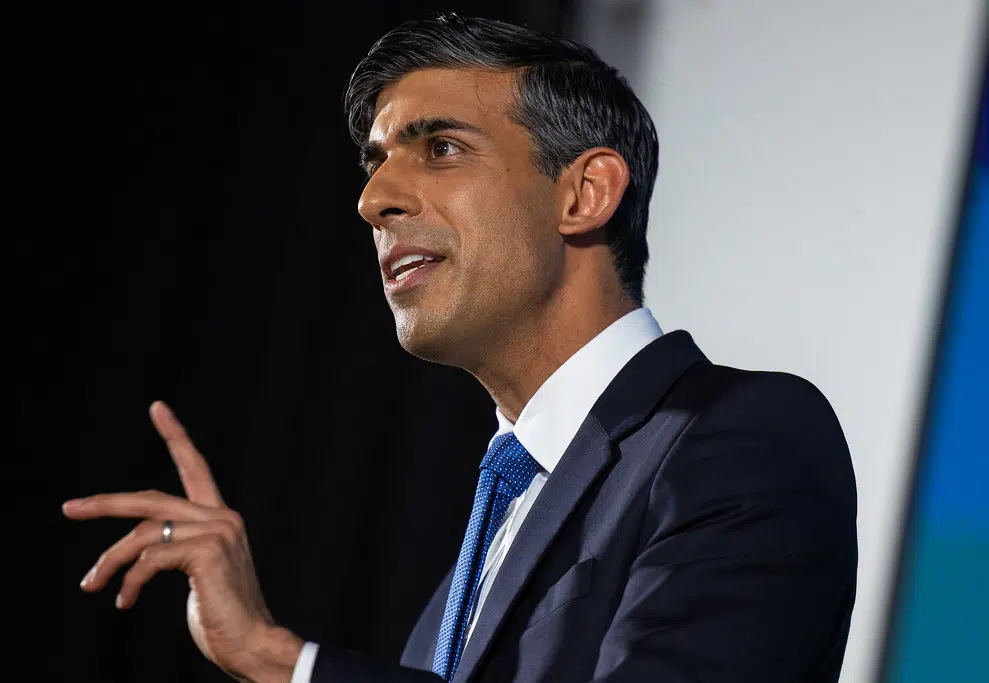
Moments before Rishi Sunak took to the stage at the Conservative Party Conference, a video flashed on a screen. Images of fields, children, roads and vaccines appeared above the heads of the hundreds waiting for the PM’s speech. “Change is…” the words read. “Change is…the Conservatives.”
In his address in Manchester, the prime minister told his party: “It is time for a change.” He confirmed his intention to scrap HS2, Europe’s largest infrastructure project, claiming “the right thing to do when the facts change, is to have the courage to change.” And speaking about his decision to U-turn on manifesto net zero pledges, he added: “Change is difficult, particularly for those who disagree.”
Altogether, Sunak used the word change 30 times. You would be forgiven for thinking another party has been in power for the last 13 years.
The PM, who also served as chancellor for two and a half years, and before that was a senior minister in the Treasury, seems to be running a re-election strategy on the potential amnesia of the country.
This is someone who governs a party focused on conserving, asking voters to believe that another term of Conservative rule will change what has been a reality for the last 13: rising homelessness, a cost of living crisis, crippling rents, spiralling mortgage rates, attacks on minority communities, months of waiting for essential NHS treatment, and a system that puts corporate interest over workers.
While hoping you’ll forget his impact, the speech also hit some key Tory attack lines. Sunak demonised trans people, in an attempt to curry favour through division, and to outsource blame from those in power to those with none. He attempted to rewrite his own history, painting himself as someone with humble beginnings, rather than as someone who attended a £60,000 a year private school. He also bashed striking workers, pretending to care about a National Health Service he’s admitted to not using.
And then there’s everything that was left out. Housing, arguably one of the most important long-term strategies any government needs to form, was mostly absent from the speech. Sunak briefly mentioned housebuilding, which would have been helpful if he hadn’t ditched housebuilding targets in April. Otherwise, the biggest issue facing most young voters was ignored. Rents are rising at their fastest rate since records began, and no-fault evictions, which were meant to be banned under the delayed Renters Reform Bill, are still a leading cause of homelessness. The absence was deafening.
Ultimately, these contradictory threads of Sunak’s speech could cause his downfall. He offers no solution, just buzzwords. It speaks to an underestimation of the British people, to think that you can tell them you care about long-term decisions while scrapping long-term projects. He even deployed his wife, Akshata Murthy, to introduce him with a gushing speech, but refuses to speak about his family when challenged on things like their non-dom status.
Without a coherent pledge, voters may well feel unsure. Sitting in the hall and listening to him deliver his speech, there was a quiet sense of confusion.
It’s easy for Sunak to forget that we’re in a cost of living crisis. He is, after all, the richest Prime Minister we’ve ever had and is wealthy enough to buy himself out of problems. He sends his children to private schools, uses private healthcare to avoid waiting lists, and flies in a helicopter to avoid train cancellations.
Unfortunately for him, most of the country can’t forget.