Category: politics

  • Summer 2023 was the hottest on record – yes, it’s climate change, but don’t call it ‘the new normal’

    Spread the love

    Kansas City’s baseball stadium ran misters to cool people off in heat near 100 degrees on June 28, 2023.
    AP Photo/Charlie Riedel

    Scott Denning, Colorado State University

    Summer 2023 has been the hottest on record by a huge margin. Hundreds of millions of people suffered as heat waves cooked Europe, Japan, Texas and the Southwestern U.S. Phoenix hit 110 degrees Fahrenheit (43 degrees Celsius) for a record 54 days, including a 31-day streak in July. Large parts of Canada were on fire. Lahaina, Hawaii, burned to the ground.

    As an atmospheric scientist, I get asked at least once a week if the wild weather we’ve been having is “caused” by climate change. This question reflects a misunderstanding of the difference between weather and climate.

    Consider this analogy from the world of sports: Suppose a baseball player is having a great season, and his batting average is twice what it was last year. If he hits a ball out of the park on Tuesday, we don’t ask whether he got that hit because his batting average has risen. His average has gone up because of the hits, not the other way around. Perhaps the Tuesday homer resulted from a fat pitch, or the wind breaking just right, or because he was well rested that day. But if his batting average has doubled since last season, we might reasonably ask if he’s on steroids.

    Unprecedented heat and downpours and drought and wildfires aren’t “caused by climate change” – they are climate change.

    The rise in frequency and intensity of extreme events is by definition a change in the climate, just as an increase in the frequency of base hits causes a better’s average to rise.

    And as in the baseball analogy, we should ask tough questions about the underlying cause. While El Niño is a contributor to the extreme heat this year, that warm event has only just begun. The steroids fueling extreme weather are the heat-trapping gases from burning coal, oil and gas for energy around the world.

    Nothing ‘normal’ about it

    A lot of commentary uses the framing of a “new normal,” as if our climate has undergone a step change to a new state. This is deeply misleading and downplays the danger. The unspoken implication of “new normal” is that the change is past and we can adjust to it as we did to the “old normal.”

    Unfortunately, warming won’t stop this year or next. The changes will get worse until we stop putting more carbon dioxide and other greenhouse gases into the atmosphere than the planet can remove.

    The excess carbon dioxide humans have put into the atmosphere raises the temperature – permanently, as far as human history is concerned. Carbon dioxide lingers in the atmosphere for a long time, so long that the carbon dioxide from a gallon of gasoline I burn today will still be warming the climate in thousands of years.

    That warming increases evaporation from the planet’s surface, putting more moisture into the atmosphere to fall as rain and snow. Locally intense rainfall has more water vapor to work with in a warmer world, so big storms drop more rain, causing dangerous floods and mudslides like the ones we saw in Vermont, California, India and other places around the world this year.

    By the same token, anybody who’s ever watered the lawn or a garden knows that in hot weather, plants and soils need more water. A hotter world also has more droughts and drying that can lead to wildfires.

    So, what can we do about it?

    Not every kind of bad weather is associated with burning carbon. There’s scant evidence that hailstorms or tornadoes or blizzards are on the increase, for example. But if summer 2023 shows us anything, it’s that the extremes that are caused by fossil fuels are uncomfortable at best and often dangerous.

    Without drastic emission cuts, the direct cost of flooding has been projected to rise to more than US$14 trillion per year by the end of the century and sea-level rise to produce billions of refugees. By one estimate, unmitigated climate change could reduce per capita income by nearly a quarter by the end of the century globally and even more in the Global South if future adaptation is similar to what it’s been in the past. The potential social and political consequences of economic collapse on such a scale are incalculable.

    Fortunately, it’s quite clear how to stop making the problem worse: Re-engineer the world economy so that it no longer runs on carbon combustion. This is a big ask, for sure, but there are affordable alternatives.

    Clean energy is already cheaper than old-fashioned combustion in most of the world. Solar and wind power are now about half the price of coal- and gas-fired power. New methods for transmitting and storing power and balancing supply and demand to eliminate the need for fossil fuel electricity generation are coming online around the world.

    In 2022, taxpayers spent about $7 trillion subsidizing oil and gas purchases and paying for damage they caused. All that money can go to better uses. For example, the International Energy Agency has estimated the world would need to spend about $4 trillion a year by 2030 on clean energy to cut global emissions to net zero by midcentury, considered necessary to keep global warming in check.

    Just as the summer of 2023 was among the hottest in thousands of years, 2024 will likely be hotter still. El Niño is strengthening, and this weather phenomenon has a history of heating up the planet. We will probably look back at recent years as among the coolest of the 21st century. The Conversation

    Scott Denning, Professor of Atmospheric Science, Colorado State University

    This article is republished from The Conversation under a Creative Commons license. Read the original article.
  • World Bank Pumping Billions More Into Fossil Fuels Than Publicly Known: Study

    Spread the love

    Original article by JAKE JOHNSON republished from Common Dreams under Creative Commons (CC BY-NC-ND 3.0). 

    Exploiting a “trade finance” loophole, the bank dumped an estimated $3.7 billion into oil and gas projects in 2022.

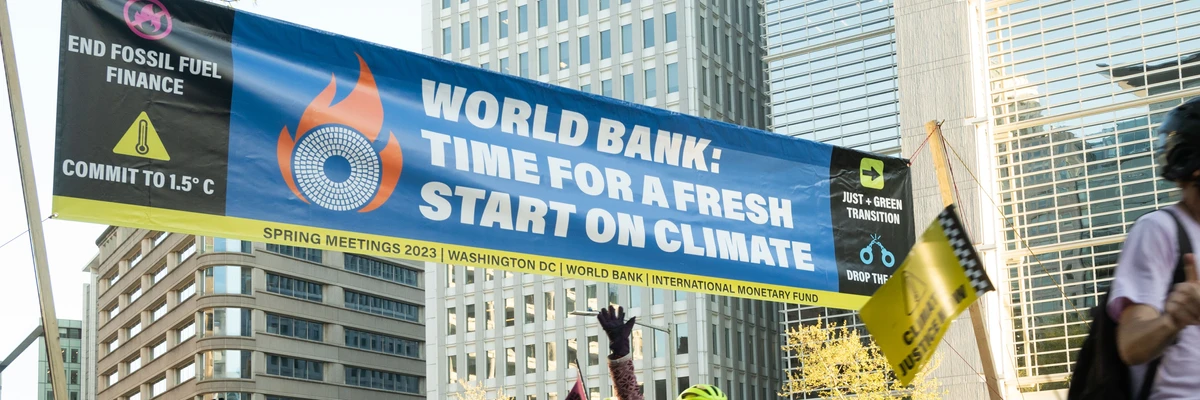
    Cyclists take over rush hour traffic outside World Bank headquarters and urge the bank's president to end funding for fossil fuels on April 10, 2023 in Washington, D.C. (Photo: Kevin Wolf/AP Images for Glasgow Actions Team)
    Cyclists take over rush hour traffic outside World Bank headquarters and urge the bank’s president to end funding for fossil fuels on April 10, 2023 in Washington, D.C. (Photo: Kevin Wolf/AP Images for Glasgow Actions Team)

    An analysis released Tuesday by the German nonprofit Urgewald estimated that the World Bank spent nearly $4 billion on fossil fuel financing last year, when it was under the leadership of a climate denier nominated by former U.S. President Donald Trump.

    The World Bank pledged in 2017 to end financing for upstream oil and gas—with narrow exceptions—after 2019. But Urgewald observed in its new report that the World Bank’s pledge applied only to direct finance, allowing the powerful institution to funnel cash to oil and gas projects through “trade finance” dished out by its private-sector arm, the (IFC).

    “Despite trade finance’s vast and still-growing share of the IFC’s budget, over 70% of it is given out in secrecy,” Urgewald noted. “The types of goods and businesses it is funding are not even reported to the World Bank’s shareholders, i.e., our governments. The public has a right to know where all this money is going.”

    Citing the IFC’s “severe lack of transparency,” Urgewald stressed that it was only able to “formulate an estimate” for oil and gas transactions. The group calculated that the World Bank spent roughly $3.7 billion on oil and gas trade finance in 2022.

    “This would more than triple the current annual level of fossil fuel finance attributed to the World Bank and cast serious doubts on Bank claims of alignment with the Paris Climate Agreement,” Urgewald’s Heike Meinhardt said in a statement.

    “The easiest way for a big oil company or coal operation to escape attention surrounding public assistance is to cloak it in trade finance.”

    The World Bank has long been accused of reneging on its climate commitments. A report released last year by Big Shift Global estimated that the World Bank has spent nearly $15 billion supporting fossil fuels since the adoption of the Paris Climate Agreement in 2015.

    Late last year, former World Bank President David Malpass sparked global outrage by saying he’s not sure whether he accepts the scientific consensus that climate change is caused by the burning of fossil fuels, further validating climate activists’ longstanding calls for systemic reforms at the bank.

    “I don’t know,” Malpass said in response to a reporter’s question about his views on climate change. “I’m not a scientist.”

    The comments prompted widespread calls for Malpass to step down, which he did in June. Current World Bank President Ajay Banga, who U.S. President Joe Biden nominated to replace Malpass, is a former private equity executive who has worked for Nestlé, PepsiCo, and Citibank.

    Urgewald warned in its report Tuesday that the World Bank will remain a major source of funding for the fossil fuel industry until it enacts reforms that prevent the IFC from bolstering oil and gas under the guise of “trade finance.”

    “The easiest way for a big oil company or coal operation to escape attention surrounding public assistance is to cloak it in trade finance,” the group said. “It is a huge loophole that must be closed and evaluated through public disclosure.”

    Urgewald added that “there is no doubt” the World Bank and IFC “are going to deny” its findings and “claim the figures are inaccurate.”

    That’s exactly what an IFC spokesperson did on Tuesday, tellingThe Guardian that “Urgewald’s report contains serious factual inaccuracies and grossly overstates IFC’s support for fossil fuels.”

    “IFC regularly reports accurate and timely project information through various channels,” the spokesperson added.

    Urgewald disputed that narrative in its report, asserting that the “continued secrecy surrounding trade finance makes it impossible to determine how much fossil fuel business the IFC is ultimately facilitating and whether the World Bank is actually aligned with the goals of the Paris Climate Agreement.”

    “An exorbitant amount of IFC money, i.e., more than half its budget, is streaming through banks without any oversight by the [World Bank Board of Directors], without any opportunity for public scrutiny, without any accountability,” the group said.

    Original article by JAKE JOHNSON republished from Common Dreams under Creative Commons (CC BY-NC-ND 3.0). 

  • Peace campaigners protest against DSEI arms fair in London

    Spread the love

    https://morningstaronline.co.uk/article/peace-campaigners-protest-against-dsei-arms-fair-in-london

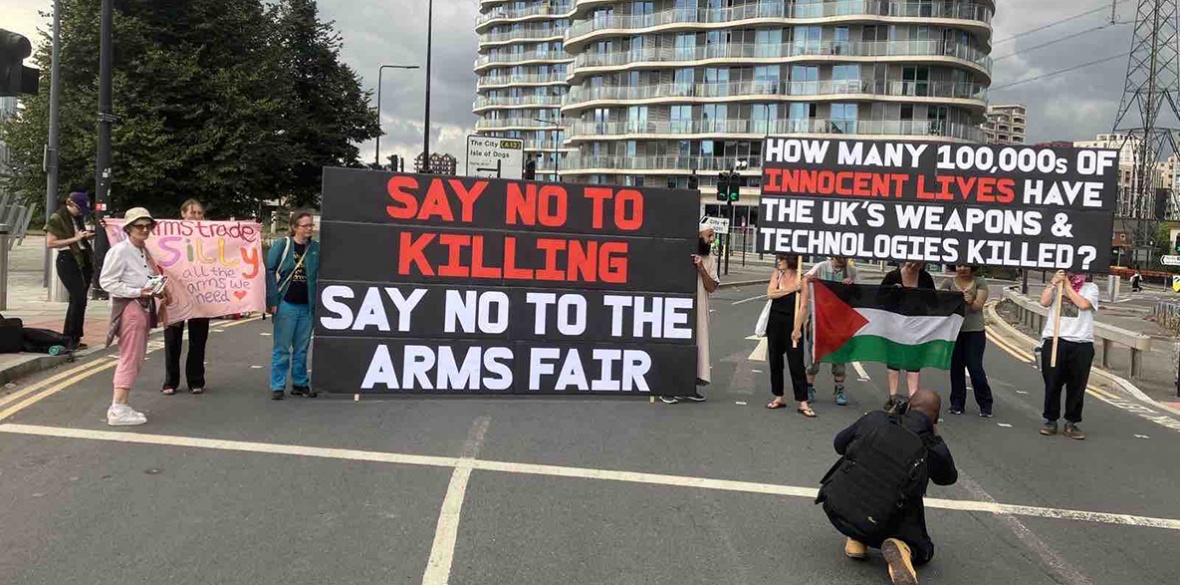
    Campaigners block the road in East London outside the DSEI arms fair Photo: @CAATuk / Twitter
    Campaigners block the road in East London outside the DSEI arms fair Photo: @CAATuk / Twitter

    HUNDREDS of peace campaigners gathered outside of London’s ExCel centre today to tell arms dealers and the world’s worst human rights abusing nations that they are not welcome.

    It came as UK Defence and Security Exports published the list of countries invited to Defence and Security Equipment International (DSEI).

    Eight of the nations are on the British government’s own list of countries of concern, such as Saudi Arabia.

    Protests, co-ordinated by the Stop The Arms Fair (Staf), have been targeting the event since it began preparations last week, leading to at least 12 arrests.

    …

    https://morningstaronline.co.uk/article/peace-campaigners-protest-against-dsei-arms-fair-in-london

  • More than a fifth of UK shoppers’ favourite grocery items at climate breakdown risk

    Spread the love

    https://www.theguardian.com/food/2023/sep/13/uk-grocery-items-climate-breakdown-risk

    Report finds consumers could also face shortages of bananas, avocados, peas and tea in the coming years owing to carbon dioxide emissions

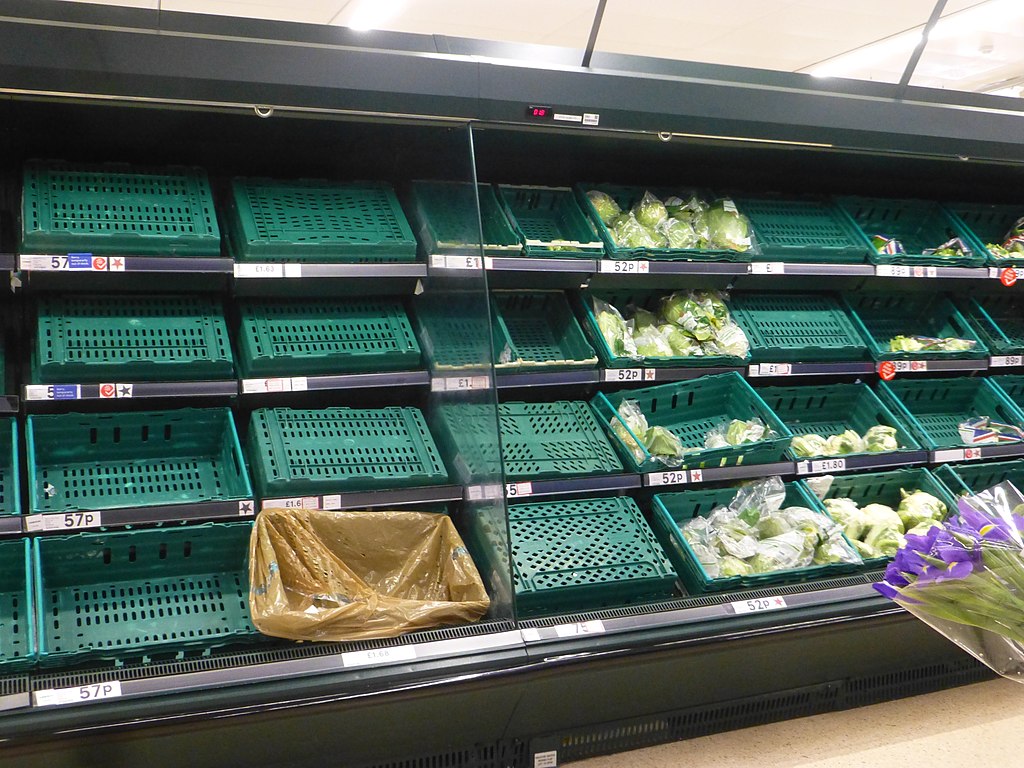
    Empty supermarket shelves. Image: citytransportinfo  Creative Commons CC0 1.0 Universal Public Domain Dedication. Creative Commons CC0 1.0 Universal Public Domain Dedication.
    Empty supermarket shelves. Image: citytransportinfo Creative Commons CC0 1.0 Universal Public Domain Dedication. Creative Commons CC0 1.0 Universal Public Domain Dedication.

    More than a fifth of UK shoppers’ favourite grocery items are at risk from climate breakdown, a new report has found.

    Consumers could also face shortages of bananas, grapes, avocados, cashews, cocoa, peas, canned tuna and tea in the coming years, as the countries they come from are hit by changing weather patterns because of CO2 emissions, the charity Christian Aid has said.

    Of the 25 biggest food exporters to the UK, eight – Brazil, South Africa, India, Vietnam, Peru, Colombia, Ivory Coast and Kenya – faced high climate vulnerability, according to research by the charity. It found 22% of the items in a typical British grocery shop were at risk.

    Some effects have been seen already. Earlier this year, UK supplies of tomatoes, cucumbers, lettuce, peppers and citrus fruits ground to a halt as drought hit parts of Spain and Morocco.

    …

    https://www.theguardian.com/food/2023/sep/13/uk-grocery-items-climate-breakdown-risk

  • Campaigners file formal complaint to EHRC over Labour’s mistreatment of Jewish members

    Spread the love
    Image features the Labour Party's Keith Starmer, Rachel Reeves, Wes Streeting and Rupert Murdoch. Thanks to the Skwawkbox for the image.
    Image features the Labour Party’s Tories Keith Starmer, Rachel Reeves and Wes Streeting and Red and Blue Tories owner Rupert Murdoch. Thanks to the Skwawkbox for the image.

    https://morningstaronline.co.uk/article/b/campaigners-file-formal-complaint-to-ehrc-over-labour-mistreatment-of-jewish-members

    THE Labour Party has “lost its way,” Jewish Labour campaigners said today as the party faces a formal complaint over its mistreatment of Jews.

    A legal letter on behalf of the Jewish Voice for Labour (JVL), sent to the party and copied to the Equality and Human Rights Commission, sets out evidence that Jews who disagree with the current leadership about Israel, Palestine, zionism and anti-semitism “suffer disproportionately from the party’s harsh disciplinary regime.”

    Jewish members are six times more likely to be investigated and more than nine times more likely to be expelled from the Labour Party for anti-semitism than non-Jewish members, according to recent research by JVL.

    The letter, sent on August 22, says the party has failed to understand the diversity of opinion among British Jews and misconstrued criticism of Israel as anti-semitism, illegitimately restricting the free expression of Jewish views on Israel and zionism.

    It highlights that restrictions are contrary to Article 10 of the European Convention on Human Rights and to the party’s own rules.

    …

    https://morningstaronline.co.uk/article/b/campaigners-file-formal-complaint-to-ehrc-over-labour-mistreatment-of-jewish-members