This work by Middle East Monitor is licensed under a Creative Commons Attribution-NonCommercial-ShareAlike 4.0 International License.
Minister of National Defence of Poland Wladyslaw Kosiniak-Kamysz attends the E5 Group Ministers of Defence meeting in Krakow, Poland, on February 20, 2026. [Jakub Porzycki – Anadolu Agency]
Poland will not send any of its Patriot air-defense batteries to the Middle East, Defense Minister Wladyslaw Kosiniak-Kamysz said on Tuesday, after reports that the United States had informally asked Warsaw to consider doing so, Anadolu reports.
Polish daily Rzeczpospolita reported on Tuesday that Washington had unofficially sounded out Poland about deploying one of its two Patriot batteries amid the escalating conflict with Iran and rising missile attacks on US forces and allies in the region.
Kosiniak-Kamysz quickly rejected the idea, writing on X that Poland’s Patriots “serve to protect Polish skies and NATO’s eastern flank.”
“Nothing is changing in this regard, and we are not planning to relocate them anywhere,” he wrote. “Our allies understand perfectly well how important the tasks we have here are. Poland’s security is an absolute priority.”
The ministry also denied suggestions that the United States had pressured Warsaw. Janusz Sejmej, spokesman for the Defense Ministry, told Rzeczpospolita, “The Americans are not pressuring us in any way on these matters.”
Poland’s chief of the general staff, Wieslaw Kukula, also dismissed the reports, writing on X that “no one is asking for it.”
Poland currently has two operational Patriot batteries, both reaching full operational readiness at the end of 2025 after integration into the Wisla air-defense system and the US-made IBCS command network.
Based with the 37th Air Defense Missile Squadron in Sochaczew, the batteries can intercept aircraft and missiles at distances up to 100 kilometers.
Warsaw has long argued that, as NATO’s main eastern-flank state bordering Russia, Belarus, and Ukraine, it cannot afford to weaken its own air-defense capability.
Kosiniak-Kamysz made a similar point last year when reports emerged that American Patriots protecting the Rzeszow logistics hub could be moved elsewhere, insisting that “Polish Patriots also remain in Poland.”
The issue highlights growing global pressure on Patriot systems as the conflict with Iran intensifies. Poland has ordered six additional batteries, due to be delivered between 2027 and 2029, but there are concerns the Middle East war could delay missile deliveries because of sharply rising demand from the US and Gulf states.
Prime Minister Donald Tusk has also ruled out Polish military involvement in the conflict, saying previously that Poland would not send troops to Iran.
Donald Trump calls for help from NATO allies in securing the Straight of Hormuz despite saying on 7 March 2026 that they don’t need people to join wars after they’ve already won. He’s challenged with the claim that he lies as much as the IDF.Keir Starmer explains that UK is actively supporting Israel’s genocidal expansion and repeats his previous quotation that he supports Zionism “without qualification”. Keir Starmer said “I said it loud and clear – and meant it – that I support Zionism without qualification.” here: https://www.jewishnews.co.uk/keir-starmer-interview-i-will-work-to-eradicate-antisemitism-from-day-one/
Donald Trump warns against following the https://onaquietday.org blog, says that it’s easy atm, she only needs to report war crimes supporting Israel’s genocidal expansion.
Keir Starmer picks up Donald Trump’s papers at the G7 summit in Alberta, Canada, June 2025. Stefan Rousseau/PA
Now that’s what I call the art of the deal.
Ahead of what is predicted to be a bruising set of local and devolved parliamentary elections in May, we’re already getting a taste of the economic consequences of Starmer’s inability to keep Britain out of Trump and Netanyahu’s latest Middle East misadventure.
Of all the G20 nations, Britain’s economy will be worst hit by the war on Iran. That’s according to analysis by the Organisation of Economic Cooperation and Development (OECD) released yesterday. The OECD’s assessment also has the UK economy growing by just 0.7% this year, downgraded from the 1.2% it predicted in December, before the war began. By contrast, Italy, France and Germany’s growth will only shrink by 0.2% as a result of the war.
Meanwhile – get this – the US actually had its growth forecast upgraded by the OECD due to an increased demand for US oil, all thanks to its illegal war. Now that’s what I call the art of the deal.
How have we ended up with the worst of all worlds? Well, the UK is heavily overreliant on overseas fuel imports and international trade, and fears of higher inflation mean consumer confidence has collapsed – a fancy way of saying that when things feel uncertain, people are less likely to spend.
Keir Starmer explains that UK is actively supporting Israel’s genocidal expansion and repeats his previous quotation that he supports Zionism “without qualification”. Keir Starmer said “I said it loud and clear – and meant it – that I support Zionism without qualification.” here: https://www.jewishnews.co.uk/keir-starmer-interview-i-will-work-to-eradicate-antisemitism-from-day-one/Climate science denier Donald Trump confirms that he knows nothing about democracy and that more liquid gold is being secured according to his policy of global privateering.Orcas discuss Genocide-supporting and complicit Zionists. Donald Trump, Keith Starmer, David Lammy, Rachel Reeves, Angela Rayner and Wes Streeting are acknowledged as evil genocide-complicit and supporting cnuts.
Zack Polanski has said he wants the Green party to replace Labour and is already building links with trade unions. Photograph: Gareth Fuller/PA
Leader understood to have spoken to 10 trade unions after party claimed working class voters are turning to them
Zack Polanski has kicked off a charm offensive designed to convince trade unions to stop funding Labour and throw their weight behind the Green party, as he delivered the first in a series of speeches to union conferences.
The Green leader has had “good conversations” with 10 trade unions, including some affiliated to Labour, according to party sources, and is due to address the University and College Union and the Bakers, Food and Allied Workers Union, not affiliated with Labour, in the coming months.
The UK’s largest unions – Unite and Unison – were among those that denied negotiating with Polanski and said they remained affiliated to the Labour party. However, Unite is holding internal discussions about its future relationship with Labour before a special conference in 2027 at which it could potentially decide to disaffiliate.
…
The Greens have enjoyed a huge boost in polling since their first national byelection victory in Gorton and Denton, and the party’s membership has tripled in England and Wales since last September to about 200,000.
A Green party source said: “When Zack became Green party leader he said his goal was to replace Labour – and building strong links with trade unions is a central part of that plan.
“Working class people are increasingly looking to the Greens as the only party which will tackle the cost of living crisis and stand up for their rights. Zack’s first priority is to push unions to stop funding the Labour party – a party which in opposition made huge promises to workers and is now watering down and U-turning on those promises.”
Emissions from the new data centres set to drive the UK’s AI “revolution” could be hundreds of times higher than government estimates, according to analysis by Carbon Brief.
There are dozens of data centres being developed across the country, potentially driving a surge in electricity demand.
Amid uncertainty about the scale and pace of this expansion, there are mounting concerns that new data centres could pose a threat to the nation’s climate goals.
UK government analysis concluded that the emissions from data centres would be negligible, even if they expand rapidly – a finding one campaigner tells Carbon Brief is “nonsense”.
In contrast, Carbon Brief analysis finds that emissions from powering data centres could be far higher than the government figures suggest, if at least a small amount of the electricity they need is generated by burning gas.
Data centres could run entirely on low-carbon electricity, but some in the sector have argued that the government’s AI ambitions require the UK to use more gas power.
If new data centres source a large amount of their power from gas, it could cause carbon dioxide (CO2) emissions equivalent to at least Denmark’s annual total.
‘AI superpower’
Data centres are energy-intensive computing facilities that are required to train and run complex AI models, among many other things.
The UK is one of the top-ranking nations for data-centre capacity, with roughly 1.8 gigawatts (GW) of facilities consuming more than 2% of national electricity. This could grow rapidly in the coming years as the government aims to make the UK an “AI superpower”.
Companies have already “achieved financial commitment” to invest in 71 new data centres that, if built, would require around 20GW of electricity, according to energy regulator Ofgem.
(For reference, the UK’s average electricity demand in 2025 stood at around 37GW.)
This potential increase in electricity demand has raised concerns from campaigners and some MPs about the impact of data centres on the UK’s climate targets.
Last year, the government’s plan for meeting its 2035 climate target noted that AI growth was “not factored into” emissions projections, although energy secretary Ed Miliband has said new data centres are captured in modelling of “overall electricity demand growth”.
The government is targeting a “clean power system” by 2030, with just a small amount of gas generation remaining. Extra demand from new data centres could require a rollout of clean power that is even faster than the growth already underway.
If clean-power growth does not keep pace, data centres could, therefore, prolong the use of gas power, either by requiring more gas to remain on the grid or by facilities building their own on-site gas generation.
There is significant uncertainty around future emissions from UK data centres, which will depend on the number of centres built, how clean their power is and when they come online.
The government published an analysis of its AI strategy’s climate impact last year, alongside a data-centre “roadmap”.
The analysis, released by the Department for Science, Innovation and Technology (DSIT) suggests emissions from future data centres will be minimal – reaching a maximum of 0.142m tonnes of CO2 (MtCO2) from 11.2GW of AI-related computing power by 2035.
(There is an additional 2.4GW of data-centre demand in this scenario that is not associated with AI, for which emissions are not calculated.)
This figure is based on what DSIT describes as a high-emissions, high-AI growth scenario. Yet it implies that each unit (kilowatt hour, kWh) of electricity supplied to the 11.2GW of AI data centres would be associated with less than 2g of CO2. In other words, their electricity supply would need to be almost completely decarbonised. The government aim is for 50gCO2/kWh by 2030.
In addition, the DSIT figure – for emissions associated with the entire UK data centre fleet in 2035 – is much lower than the emissions estimates reported in planning applications for individual UK data centres made by Google and other companies.
Gas power
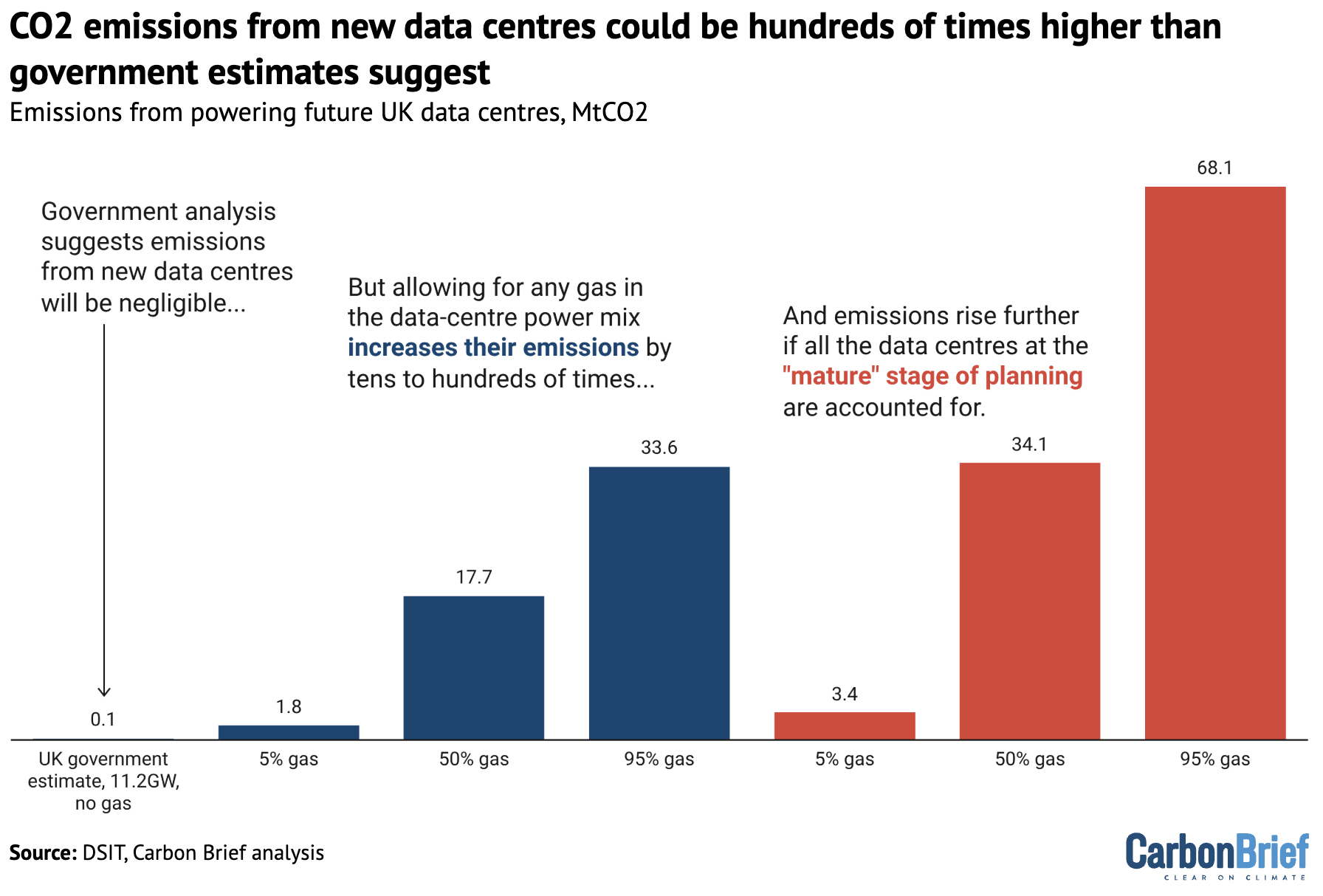
The chart below, based on Carbon Brief analysis, shows how data-centre emissions could be far higher than the government’s figures suggest.
Even if gas-fired electricity only accounts for 5% of their supply – indicated by the smallest blue column below – emissions from 11.2GW of data centres would be around 2MtCO2. This is more than 10 times higher than the government’s top estimate for 2035.
If the same data centres rely more heavily on gas, emissions could be hundreds of times higher, exceeding 30MtCO2. This is roughly equivalent to the annual emissions of Denmark. Emissions could rise even higher if capacity increases in line with the extra 20GW of data-centre demand that Ofgem says is in the pipeline, as indicated by the red columns
Emissions from powering future UK data centres, MtCO2, under different scenarios. The UK government figure is based on a modelled estimate for total AI-related data-centre computing power in 2035. The blue bars combine the government capacity figure of 11.2GW with increasing shares of gas power. The red bars use the Ofgem estimate of 20GW of “mature” projects that may be built in the future, combined with existing capacity of 1.8GW, to reach a figure of 21.8GW. Source: DSIT, Carbon Brief analysis.
If data-centre expansion reaches 20GW and those centres rely heavily on gas power, then the figure could be as high as 70MtCO2, the annual emissions of Sweden. This would also be nearly 500 times higher than the government’s upper estimate, which it says is based on a “pessimistic decarbonisation” scenario.
(The numbers are not directly comparable as, unlike the AI-specific 11.2GW figure, it is unclear how much of this 20GW would be for AI, specifically.)
The government’s modelling states that AI emissions in 2035 would be “equivalent to below 0.05% of the UK’s projected total emissions”. It also says “this could be equivalent to the annual emissions of approximately 5,000 to 23,600 UK households”.
On the contrary, Carbon Brief’s analysis suggests data centres could, in fact, be equivalent to as much as 20% of the UK’s projected total emissions in 2035.
As for the number of households, Carbon Brief estimates that future data centres could result in emissions equivalent to as many as 11.4m homes, roughly a third of all UK households.
Dr Tim Squirrel, head of strategy at Foxglove – part of an NGO group calling for more government scrutiny of data-centre emissions – tells Carbon Brief the DSIT figures are “nonsense and threaten to derail our carbon budgets”. He says:
“The figures that DSIT projects here wildly downplay data-centre emissions, even by the standards of the most optimistic energy transition scenario. There is no way that the amount of compute they anticipate can be built and produce the miniscule emissions they’re calculating.”
In its analysis, the government attributes the low emissions figures to “more efficient models and hardware” and “the UK’s ambitious targets for electricity grid decarbonisation”.
When asked by Carbon Brief, DSIT declined to provide any more information about its analysis.
Clean growth
While the UK is prioritising data centres for AI, there is mounting industry pressure to allow gas-power expansion for this “critical” infrastructure, as is happening in, for example, the US and Ireland.
Developers in the UK have reportedly already “turned to gas” via private electricity supplies, due to struggles securing a connection to the public network.
Yet, new data centres could be completely emissions-free if they are powered entirely with on-site clean energy or using electricity from a decarbonised grid.
As it stands, most data centres are connected to the electricity grid. Some enter power purchase agreements (PPAs) in which they financially support renewable-energy operators, allowing them to describe their electricity as clean.
Katie Davies, head of energy and infrastructure policy at techUK, a trade association representing the technology sector, highlights this expansion of PPAs as important for driving the growth of wind and solar power:
“In doing so, data centres actively contribute to additionality by unlocking extra carbon-free capacity that might not otherwise come online.”
A report last year by Aurora Energy Research found that data centres could provide a “route-to-market” worth up to £35bn for 19GW of UK renewables. However, it added:
“If renewables capacity and networks don’t keep pace, additional data centre demand will likely be met by carbon-intensive sources of generation.”
The UK’s “AI opportunities action plan” includes the establishment of “AI growth zones“, which the government says will be in areas with “available clean energy”. It is also overhauling the grid connection queue, which Davies says is important:
“Reducing this queue through strategic alignment and the removal of speculative applications will be vital to ensuring [data-centre] operators do not have to turn to higher-carbon energy sources as a last resort.”
Responding to Carbon Brief’s analysis, a government spokesperson said:
“We want the UK to be at the forefront of AI, but we are clear this must be done sustainably. That is why our AI growth zones are supporting development in areas with access to clean power, while the AI Energy Council is exploring how AI can be powered by responsible, clean-energy sources.”
Update: After Carbon Brief contacted DSIT about this analysis, it deleted its emissions assessment and replaced it with text stating: “We keep analysis under routine review, and are updating this modelling to ensure it reflects the most up to date assumptions and analysis.”
Methodology
There is considerable uncertainty around data-centre power demand and emissions, with much of the relevant information not in the public domain. Carbon Brief has performed some rough calculations based on available data.
The government figure comes from an annex to DSIT’s UK compute roadmap. DSIT analyses the emissions impact of expanding the UK’s data-centre capacity to between 7.4GW in a “low compute-demand scenario” and 13.6GW in a “high compute-demand scenario” by 2035. (The majority of the demand in each scenario is from AI.)
DSIT also uses an “AI environmental impacts model” to estimate the greenhouse gas emissions from AI compute, only covering the 11.2GW AI component of data-centre capacity. It concludes that AI emissions in 2035 could range from 0.025MtCO2 to 0.142MtCO2. This includes both “direct” and “indirect” emissions, indicating that it covers more than just emissions from the electricity used to power the data centres.
A widelyreportedconsultation by the energy regulator, Ofgem, found that there are proposals for around 140 new data centres in the UK, which would require 50GW of electricity if they were all built.
In reality, it is highly unlikely that all of these data centres will be completed, with a “significant number” expected to fail when trying to secure funding or planning permission.
The 20GW figure used in this analysis is based on the 71 “mature” projects that have “achieved financial commitment with final investment decision”, according to Ofgem.
Carbon Brief used the top government figure of 0.142MtCO2, even though it represents a “pessimistic grid decarbonisation” and “high compute demand” scenario.
To calculate the emissions from powering data centres in the future, Carbon Brief assumes a data-centre “load factor” of 90%, which is in line with otheranalyses. The analysis uses different shares of gas in the centres’ power supplies to indicate a range of future possibilities, assuming emissions from gas power are 0.4MtCO2 per terawatt hour.
Keir Starmer explains that UK is actively supporting Israel’s genocidal expansion and repeats his previous quotation that he supports Zionism “without qualification”. Keir Starmer said “I said it loud and clear – and meant it – that I support Zionism without qualification.” here: https://www.jewishnews.co.uk/keir-starmer-interview-i-will-work-to-eradicate-antisemitism-from-day-one/Donald Trump calls for help from NATO allies in securing the Straight of Hormuz despite saying on 7 March 2026 that they don’t need people to join wars after they’ve already won. He’s challenged with the claim that he lies as much as the IDF.Orcas discuss Donald Trump and the killer apes’ concept of democracy. Front Orca warns that Trump is crashing his country’s economy and that everything he does he does for the fantastically wealthy.