Category: politics

  • Posties like me are working ourselves to death. Enough is enough

    Spread the love

    OPINION: I’ve been a Royal Mail worker for 30 years. Here’s why I’m going on strike

    Original article republished from Open Democracy under a  Creative Commons Attribution-NonCommercial 4.0 International licence.
    Anonymous .

    21 December 2022, 6.00am

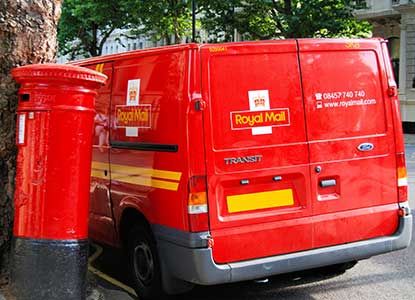
    Image of post office van next to postbox

    On National Postal Workers Day 2022, a Royal Mail worker of more than 30 years’ service reflects on what 115,000 of his striking colleagues are fighting for – fair conditions, decent pay, dignity in the workplace and community spirit.

    I’ve worked for the Royal Mail for more than three decades, and I can remember thousands of special moments.

    You’re working with a special type of person, I’ve come to believe. My colleagues are people willing to go the extra mile. They’re funny and kind, thoughtful and creative. They know that the role they play – and the bond they have with the communities they serve – is unique. I couldn’t count the number of charity runs, fundraising concerts and special events that have been organised by my colleagues.

    I remember the wartime stories the older boys could tell when I first started; more recently, I can remember the sacrifices we all made during the pandemic, when many of us died keeping the country connected.

    Such proud moments can be reeled off by heart, but so can our problems. During festive periods, we are under serious pressure – but other types of stress are creating an incoming catastrophe. Under-recruitment has meant older workers do more while the next generation isn’t coming through to replenish the ranks, at least not where it matters.

    Anecdotally, it’s not uncommon to hear of posties having heart attacks, sometimes fatal, on the job – the price of cutting corners. Ask any postal worker and they can tell you stories about ridiculously outdated toilet facilities, broken doors and seatbelts on delivery vans, and serious complaints getting ignored by managers who seem to think they know better.

    Bosses and shareholders come first

    The money is there to change all this, but it’s not going where it’s needed. In the last year, Royal Mail made £758m in profit and was able to hand out £400m to shareholders. Royal Mail CEO Simon Thompson even gave himself an advance bonus of more than £140,000. But when it came to the workers who created that profit – and during a historic cost-of-living crisis – Royal Mail’s leadership pleaded poverty then offered us a pay rise of just 2%.

    Through the Communication Workers Union (CWU), we voted by nearly 100% on nearly 80% turnout, twice, to strike. Instead of recognising the anger we almost unanimously felt, bosses announced they would withdraw from all existing legal agreements with the union and make moves that many fear could mean the derecognition of the union.

    The CWU was even told by members that managers were threatening to dock pay if strikers called in sick. Bosses have been trying to humiliate us online, and have offered bonuses worth up to £30,000 to managers overseeing job cuts. After one strike day, the company said it was going to cut 10,000 jobs unless we packed it in.

    Postal workers believe that, for Royal Mail bosses, the wrecking of your Christmas and my wellbeing is a worthwhile sacrifice to turn the company into a bog-standard, Uber-style delivery courier. There, old-fashioned things such as good conditions, decent pay and self-respect on the job can be easily binned, and casualised workers can work harder for less.

    This country deserves better, as does its posties

    These bosses aren’t people with roots in the industry, and they aren’t sympathetic to the connection it has to our communities: there’s no profit to be made in knocking on your nana’s door when it’s icy, to check on her.

    I do my job because I love it. There are things that money can’t buy – like the laughs we gave kids and elderly people with the (frankly bizarre) costumes we tried on during the dark days of the pandemic – and knowing that you serve a wider community and play a useful role in people’s lives.

    This is also why we’re on strike. In this country, a tiny number of well-connected people have been making astonishing wealth out of royally stuffing the rest of us for far too long. It feels like everything just gets worse day by day: our bills are sky high, our trains are wrecked, our rivers are filled with sewage, and rent for many is now becoming an existential crisis – and all because a tiny number of people have never had it better.

    I, and 115,000 of my colleagues, don’t want to add to these problems by accepting the destruction of one of our few reliable national institutions. This country deserves better, as does its posties. I hope you can back us in our dispute this Christmas. 

    Original article republished from Open Democracy under a  Creative Commons Attribution-NonCommercial 4.0 International licence.

  • Big Pharma’s obscene profits, not striking nurses, are killing the NHS

    Spread the love

    Monopoly pricing and corporate greed are destroying healthcare systems in the UK and globally

    Original article republished from Open Democracy under  a Creative Commons Attribution-NonCommercial 4.0 International licence.
    Tarun Gidwani

    21 December 2022, 12.59pm

    NHS sign
    There’s so much hoo-ha about the fiscal consequences of nurses resisting pay cuts, but profiting by corporations isn’t deemed an issue.

    Imagine a disability almost disappearing if you flew out of the Global South. I have severe haemophilia, a genetic condition that interferes with the body’s ability to clot after bleeding. When left untreated, anything – even a bruise or merely sitting down – can trigger a bleed, internally or externally. Anti-clotting injections can stop this.

    However, outside the advanced West, these injections are sold at exorbitantly high prices. When I was a child in India, my parents couldn’t afford such treatment, so they’d bury my bleeding joints under piles of ice to freeze them. Almost all the bleeds I experienced in India were left untreated, resulting in permanent damage to my joints and internal organs. In the UK, the NHS home-delivers me these injections twice a month.

    This global medical apartheid is created and perpetuated by pharmaceutical monopolies. Treatment pricing pursues a single sacrosanct goal: making profits. Trade laws allow corporations to keep most of their recipes secret, so that no one else can sell the same medicines at a cheaper price. Then the very same logic of capital menaces governments into withdrawing welfare nets – leaving families absolutely at the mercy of the market.

    When a friend recently sent me news about a supposedly “miraculous” new treatment for haemophilia, I was pessimistic. The new intervention replaces the need to inject yourself every other day, which would be revolutionary to many lives. And trials to date have been very positive. But our current pricing and trade regime will inevitably ensure it is out of reach for those who most desperately need it – just as it did with the Covid-19 vaccines.

    Profits before patients

    Not all is quiet on the Western front, however. In its search for ever-greater profits, Big Pharma is strangling healthcare in richer countries too. The same monopoly pricing and trading mechanisms that keep those in the Global South from accessing care are eating up access in the Global North too.

    Between 2011 and 2017, the cost of medicines for NHS England grew from £13bn to £17.4bn – a 5% rise every year. In 2020, this reached £20.9bn. Yet the government is currently considering trade arrangements, leaked documents show, that will increase this cost even further by forcing the NHS to buy from pharmaceutical monopolies instead of buying generic medicines.

    By contrast, the US pharmaceutical giant Pfizer recorded profits of $21bn last year. That amount could fund the nurses’ wage demand twice over – while also bringing in more revenue, through tax and spending, than corporate profits do. That should put the nurses’ demands in perspective. It’s not striking health workers who are holding the NHS at gunpoint – it’s the corporate compulsion to squeeze and extract.

    Ending the global medical apartheid necessitates ending pharmaceutical monopolies. Saving the NHS also necessitates this. These monopolies suck up public money for the development of drugs and then suck it up again by selling those same drugs back to the public at high prices.

    Studies have shown that new drugs for rare diseases can be developed at costs up to £1.2bn cheaper than claimed by corporations. Organisations such as Global Justice Now have pointed this out repeatedly.

    Take the development of abiraterone, for instance, which treats advanced prostate cancer. Its development was publicly funded, but once released to the market, the NHS was forced to ration it because it was exorbitantly expensive. Meanwhile, the corporation that sold it, Janssen, made £7.2bn in sales.

    The NHS spends billions buying treatments that were developed using public funding. In 2018, the UK spent around £500m on cancer drugs that were developed through publicly funded institutions. Things have only gotten worse. Prices more than doubled for several drugs between July 2018 and October 2020. A pack of 28 risperidone tablets, a commonly prescribed antipsychotic medicine used for treating mental health disorders, went from £2.68 to £49.21 – an increase of 1,736%. Drug prices in the UK are not subject to controls. They are negotiated behind closed doors.

    There’s so much hoo-ha about the fiscal consequences of nurses resisting pay cuts, but profiting by corporations isn’t deemed an issue. British prime minister Rishi Sunak claims that paying minimally decent wages to nurses is “obviously unaffordable”, while saying nothing about all the extra cash being handed to pharma companies that have a stranglehold on NHS spending.

    Some battles are between forces larger than those visibly involved. The NHS strike against dramatic wage cuts (not for outrageous wage demands, as the government would have it) is one of them. The struggle of NHS workers can strike at the heart of the forces that profit from a segregated global health system.

    This is a system that is only interested in making nauseating profits. Even if the pharmaceutical giants lost 20% of their profits, they’d still outperform 75% of other industries. They are also avoiding billions in taxes, according to a 2018 report by Oxfam – money that could otherwise expand the ever-shrinking pool of public-sector healthcare workers.

    These profits, by the way, are by definition on top of what is spent on research and marketing. Taxing these profits will not only bring their profitability down to less nauseating levels. It’s the only way to curb treatment prices – and bring dignity to NHS workers. The bonanzas to corporations come at the cost of our health. And they come at the cost of decent wages for healthcare workers.

    Big Pharma isn’t patriotic. These corporations don’t love the NHS. They may operate in the UK (and the US), but they suck the life out of working people around them.

    But working people in the Global North, especially workers in the NHS and in the pharmaceutical industry, hold legitimate power over Big Pharma because they foot the bill for its profiteering. They can demand price controls and transparency. Therefore they play an important role in taming the beast that has come back West to stalk Frankenstein. The NHS strikes should be seen as a manifestation of this larger struggle.

    There is a Himalayan distance between the healthcare that people receive in the Global South and in the Global North. I know – I have lived this distance first-hand. But we are united in being subjected to the same systemic forces. Everywhere, the same corporations are hollowing out people’s ability to exercise their right to health; a right that is foundational to the meaningful exercise of any other right.

    What the nurses are up against when they go on strike should unite us all.

    Original article republished from Open Democracy under  a Creative Commons Attribution-NonCommercial 4.0 International licence.
  • Ambulance strikes show government must come to the table on pay, GMB warns Parliament’s health committee

    Spread the love

    https://morningstaronline.co.uk/article/ambulance-strikes-show-government-must-come-table-pay-gmb-warns-parliaments-health-committee

    Image of Accident and emergency

    “LIFE-and-limb cover” will be provided across the ambulance service in England and Wales today to ensure patients are not put at risk during strikes, a union leader told MPs today.

    GMB national secretary Rachel Harrison said that unions had been working “round the clock” to ensure there were enough strike exemptions to keep critical services running.

    …

    “Life-and-limb cover will be provided,” Ms Harrison told MPs. “The last thing that our members want to do is put patients in harm’s way.

    “We will do everything within our power to ensure that communities are safe during this action.

    “The government has to play their part, they have to come to the table and talk to us.”

    She told MPs that ambulance workers have been forced to take strike action after raising concerns for years about ambulance delays and unsafe conditions for patients.

    …

  • Government treating NHS staff with contempt, say nurses on picket lines on second national strike day

    Spread the love

    https://morningstaronline.co.uk/article/government-treating-nhs-staff-contempt-say-nurses-picket-lines-second-national-strike-day

    NHS sign

    STRIKING nurses outside St Thomas’s hospital in London said today that they felt the government has treated NHS staff with “contempt” and “does not care” about them or their patients.

    Jane, who was on the picket line outside the busy London hospital, condemned ministers for failing to engage in talks with nurses’ union RCN.

    “I just feel like they seem so distant from us, from what we’re going through, that they are contemptuous of us and that they don’t care … and by extension they don’t care about our patients either,” she told the Star.

    The London-based nurse, who has worked in the NHS for three years and did not want to give her surname, said that she had joined the picket because chronic staff shortages mean “we can’t look after our patients safely.”

    …

  • What Big Oil knew about climate change, in its own words

    Spread the love


    The oil industry was aware of the risks of climate change decades ago.
    Barry Lewis/InPictures via Getty Images

    Benjamin Franta, Stanford University

    Leer en español.

    Four years ago, I traveled around America, visiting historical archives. I was looking for documents that might reveal the hidden history of climate change – and in particular, when the major coal, oil and gas companies became aware of the problem, and what they knew about it.

    I pored over boxes of papers, thousands of pages. I began to recognize typewriter fonts from the 1960s and ‘70s and marveled at the legibility of past penmanship, and got used to squinting when it wasn’t so clear.

    What those papers revealed is now changing our understanding of how climate change became a crisis. The industry’s own words, as my research found, show companies knew about the risk long before most of the rest of the world.

    Surprising discoveries

    At an old gunpowder factory in Delaware – now a museum and archive – I found a transcript of a petroleum conference from 1959 called the “Energy and Man” symposium, held at Columbia University in New York. As I flipped through, I saw a speech from a famous scientist, Edward Teller (who helped invent the hydrogen bomb), warning the industry executives and others assembled of global warming.

    “Whenever you burn conventional fuel,” Teller explained, “you create carbon dioxide. … Its presence in the atmosphere causes a greenhouse effect.” If the world kept using fossil fuels, the ice caps would begin to melt, raising sea levels. Eventually, “all the coastal cities would be covered,” he warned.

    1959 was before the moon landing, before the Beatles’ first single, before Martin Luther King’s “I Have a Dream” speech, before the first modern aluminum can was ever made. It was decades before I was born. What else was out there?

    In Wyoming, I found another speech at the university archives in Laramie – this one from 1965, and from an oil executive himself. That year, at the annual meeting of the American Petroleum Institute, the main organization for the U.S. oil industry, the group’s president, Frank Ikard, mentioning a report called “Restoring the Quality of Our Environment” that had been published just a few days before by President Lyndon Johnson’s team of scientific advisers.

    “The substance of the report,” Ikard told the industry audience, “is that there is still time to save the world’s peoples from the catastrophic consequences of pollution, but time is running out.” He continued that “One of the most important predictions of the report is that carbon dioxide is being added to the earth’s atmosphere by the burning of coal, oil, and natural gas at such a rate that by the year 2000 the heat balance will be so modified as possibly to cause marked changes in climate.”

    Ikard noted that the report had found that a “nonpolluting means of powering automobiles, buses, and trucks is likely to become a national necessity.”

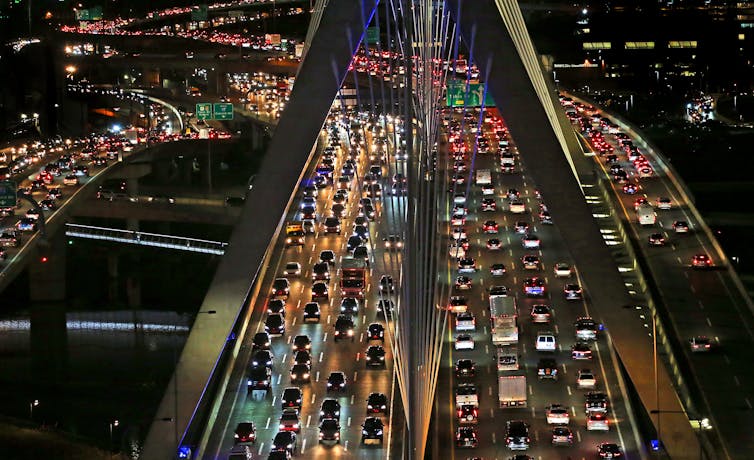
    Traffic lights up the evening on a Boston bridge

    Transportation is now the leading source of carbon dioxide emissions in the U.S., followed by electricity.
    David L. Ryan/The Boston Globe via Getty Images

    As I reviewed my findings back in California, I realized that before San Francisco’s Summer of Love, before Woodstock, the peak of the ’60s counterculture and all that stuff that seemed ancient history to me, the heads of the oil industry had been privately informed by their own leaders that their products would eventually alter the climate of the entire planet, with dangerous consequences.

    Secret research revealed the risks ahead

    While I traveled the country, other researchers were hard at work too. And the documents they found were in some ways even more shocking.

    By the late 1970s, the American Petroleum Institute had formed a secret committee called the “CO2 and Climate Task Force,” which included representatives of many of the major oil companies, to privately monitor and discuss the latest developments in climate science.

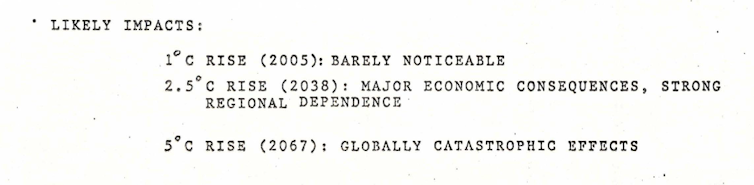
    In 1980, the task force invited a scientist from Stanford University, John Laurmann, to brief them on the state of climate science. Today, we have a copy of Laurmann’s presentation, which warned that if fossil fuels continued to be used, global warming would be “barely noticeable” by 2005, but by the 2060s would have “globally catastrophic effects.” That same year, the American Petroleum Institute called on governments to triple coal production worldwide, insisting there would be no negative consequences despite what it knew internally.

    A slide from John Laurmann’s presentation to the American Petroleum Institute’s climate change task force in 1980, warning of globally catastrophic effects from continued fossil fuel use.

    Exxon had a secretive research program too. In 1981, one of its managers, Roger Cohen, sent an internal memo observing that the company’s long-term business plans could “produce effects which will indeed be catastrophic (at least for a substantial fraction of the earth’s population).”

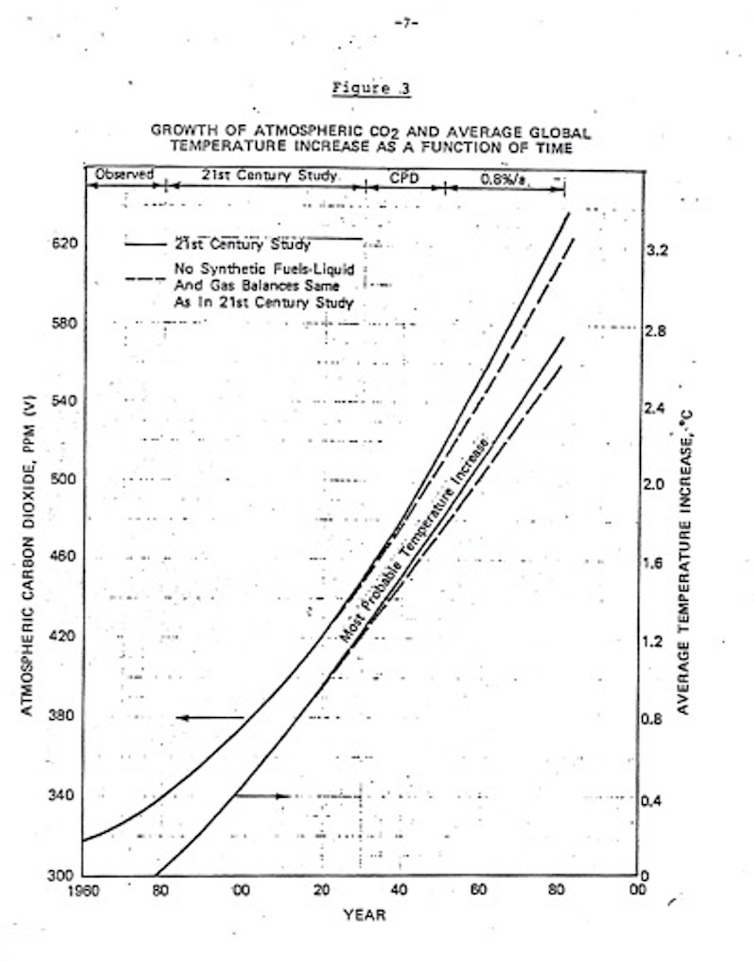
    The next year, Exxon completed a comprehensive, 40-page internal report on climate change, which predicted almost exactly the amount of global warming we’ve seen, as well as sea level rise, drought and more. According to the front page of the report, it was “given wide circulation to Exxon management” but was “not to be distributed externally.”

    And Exxon did keep it secret: We know of the report’s existence only because investigative journalists at Inside Climate News uncovered it in 2015.

    A figure from Exxon’s internal climate change report from 1982, predicting how much carbon dioxide would build up from fossil fuels and how much global warming that would cause through the 21st century unless action was taken. Exxon’s projection has been remarkably accurate.

    Other oil companies knew the effects their products were having on the planet too. In 1986, the Dutch oil company Shell finished an internal report nearly 100 pages long, predicting that global warming from fossil fuels would cause changes that would be “the greatest in recorded history,” including “destructive floods,” abandonment of entire countries and even forced migration around the world. That report was stamped “CONFIDENTIAL” and only brought to light in 2018 by Jelmer Mommers, a Dutch journalist.

    In October 2021, I and two French colleagues published another study showing through company documents and interviews how the Paris-based oil major Total was also aware of global warming’s catastrophic potential as early as the 1970s. Despite this awareness, we found that Total then worked with Exxon to spread doubt about climate change.

    Big Oil’s PR pivot

    These companies had a choice.

    Back in 1979, Exxon had privately studied options for avoiding global warming. It found that with immediate action, if the industry moved away from fossil fuels and instead focused on renewable energy, fossil fuel pollution could start to decline in the 1990s and a major climate crisis could be avoided.

    But the industry didn’t pursue that path. Instead, colleagues and I recently found that in the late 1980s, Exxon and other oil companies coordinated a global effort to dispute climate science, block fossil fuel controls and keep their products flowing.

    We know about it through internal documents and the words of industry insiders, who are now beginning to share what they saw with the public. We also know that in 1989, the fossil fuel industry created something called the Global Climate Coalition – but it wasn’t an environmental group like the name suggests; instead, it worked to sow doubt about climate change and lobbied lawmakers to block clean energy legislation and climate treaties throughout the 1990s.

    For example, in 1997, the Global Climate Coalition’s chairman, William O’Keefe, who was also an executive vice president for the American Petroleum Institute, wrote in the Washington Post that “Climate scientists don’t say that burning oil, gas and coal is steadily warming the earth,” contradicting what the industry had known for decades. The fossil fuel industry also funded think tanks and biased studies that helped slow progress to a crawl.

    Today, most oil companies shy away from denying climate science outright, but they continue to fight fossil fuel controls and promote themselves as clean energy leaders even though they still put the vast majority of their investments into fossil fuels.

    A Congressional subcommittee on Oct. 28, 2021, questioned executives from Exxon, BP, Chevron, Shell and the American Petroleum Institute about industry efforts to downplay the role of fossil fuels in climate change. Exxon CEO Darren Woods told lawmakers that his company’s public statements “are and have always been truthful” and that the company “does not spread disinformation regarding climate change.”

    As I write this, climate legislation is again being blocked in Congress by a lawmaker with close ties to the fossil fuel industry.

    People around the world, meanwhile, are experiencing the effects of global warming: weird weather, shifting seasons, extreme heat waves and even wildfires like they’ve never seen before.

    Will the world experience the global catastrophe that the oil companies predicted years before I was born? That depends on what we do now, with our slice of history.

    This article was updated Oct. 28, 2021, with details from a Congressional hearing.

    Benjamin Franta, Ph.D. Candidate in History, Stanford University

    This article is republished from The Conversation under a Creative Commons license. Read the original article.

    Related video