Category: politics

  • Iain Duncan Smith and the Tories F*Up again: Training people to use universal credit ‘could cost hundreds of millions’

    Spread the love

    http://www.theguardian.com/society/2013/nov/21/universal-credit-benefit-training-cost-millions

    Research shows many benefit claimants will need extensive help to get online, open bank accounts and manage budgets
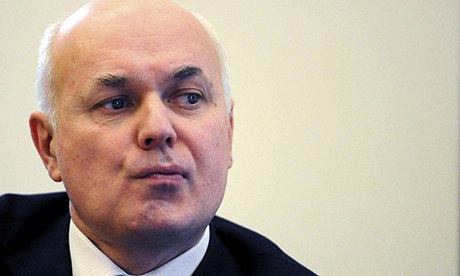
    Image of Iain Duncan SmithEquipping benefit claimants with the digital and financial skills to use the government’s new universal credit welfare system is likely to cost hundreds of millions of pounds, unpublished research commissioned by the Department for Work and Pensions (DWP) has found.

    The study, carried out by three London councils using DWP data and a methodology agreed with Whitehall officials, found they would each need to spend about £6m over a two-year period to support vulnerable claimants to get online, help them open bank accounts and manage monthly budgets.

    The research, seen by the Guardian, , reveals the extent to which socially excluded claimants will struggle with the huge cultural and behavioural changes demanded by universal credit, and warns that without help, those who fail to get to grips with the new welfare system will face debts, arrears and eviction, leading to a rise in homelessness.

    It suggests councils, charities and private companies will be required to deliver millions of hours of specialist training and support face-to face and over the telephone to ensure claimants are confident and technically proficient enough to use the system.

    Around one in 10 users of the system are likely to need intensive or ongoing support, it finds.

    The scale and cost will unnerve ministers, who are struggling to roll out the beleaguered £2.4bn universal credit system, and have admitted that they have already written off at least £140m on failed IT systems for the project. Ministers are expected to decide by Christmas whether to write off universal credit altogether and start again, or reduce it in size and complexity to make it more manageable.

    Those behind universal credit see it as an opportunity to tackle digital and financial exclusion for up to 8m households. Iain Duncan Smith, the work and pensions secretary, has called it a chance for claimants to “get back in to the 21st century“.

    But while they anticipated that this would require some investment, they are understood to be taken aback by the potential size of the support bill – which could reach £100m for London alone – and have ordered departmental analysts to see if it can be reduced.

    Under universal credit, six existing benefits will be rolled into a single monthly payment, out of which claimants will be expected to pay rent, spread living costs over a four-week period, and provide regular online updates marking changes in their income and job status. Unemployed claimants will also have to search for jobs online.

    …

  • Blair’s government allowed USA to spy on UK citizens

    Spread the love
    Traitor Tony Blair receives the Congressional Gold Medal of Honour from George 'Dubya' Bush
    Traitor Tony Blair receives the Congressional Gold Medal of Honour from George ‘Dubya’ Bush

    The Guardian and Channel4 – in a joint investigation – have released documents sourced by whistleblower Edward Snowden. The documents reveal that US intelligence agencies were given far greater powers to spy on UK citizens by UK intelligence agency GCHQ in 2004. It is extremely unlikely that this move would be taken without treasonous ministerial approval by Tony Blair’s government.

    GCHQ and the cabinet office are not commenting.

    Image of GCHQ donught buildingUS and UK struck secret deal to allow NSA to ‘unmask’ Britons’ personal data

    Documents show Blair government let US spy on Britons

    1pm update: The important issue about these revelations is that UK allowed US authorities to spy on UK subjects who are not guilty or even suspected of any crime. Further, the scale of those subjected to such spying without any legal oversight is astonishingly wide. While it is reported as contacts-of-contacts or friends-of-friends of suspects it may be more practical to just consider it as being all UK subjects. [2.20pm Most news sources are reporting contacts-of-contacts. The Guardian say that it’s ‘”three hops” from its targets — who could be people who talk to people who talk to people who talk to you.’ That does look like all UK subjects. ]

    This post subject to change

  • Labour: We’ll scrap benefits for under 25s [unless they agree to be subjected to forced labour or some useless training course]

    Spread the love

    http://www.telegraph.co.uk/news/politics/labour/10461175/Labour-Well-scrap-benefits-for-under-25s.html

    Only those in “purposeful” training or carrying out an “intensive” job search would be eligible for the allowance, under proposals being considered by the party

    People under the age of 25 would be barred from claiming unemployment benefits under proposals being considered by the Labour Party.

    The Institute for Public Policy Research will publish a paper later this week proposing a new means-tested “youth allowance” for 18 to 24-year olds who are not in work or education.

    Only those who prove they are in “purposeful” training or carrying out an “intensive” job search would be eligible for the allowance, the group will say.

    The allowance would be dependent on family income, with the children of parents earning more than £25,000 a year unable to claim it, the IPPR will suggest.

    The youth allowance would be set at £56.80, the same level as Job Seekers’ Allowance.

    Under-25s would be banned from claiming additional benefits including Employment Support Allowance and Income Support. Paying those two benefits to under-25s costs taxpayers almost £1.3 billion a year.

    It is understood that Rachel Reeves, the Labour shadow work and pensions secretary, is considering adopting the policy, though is undecided about applying a means test.

    Ed Miliband, the Labour leader, has also hinted at taking young people out of the benefits system.

    The Conservatives have also suggested stripping benefits from under-25s. David Cameron said last month that if he was re-elected in 2015, he would insist that young people would either “earn or learn”, without the option of claiming welfare.

    …

    George Eaton claims that Labour isn’t planning to scrap benefits for under-25s. That’s exactly what they’re planning.

    I find the continuous attacks on the young difficult to understand. Is it simply that they are relatively powerless and can’t fight back? It may have something to do with low voting rates.

    1.30pm update

    Shadow work and pensions secretary Rachel Reeves has denied that Labour is planning to strip young unemployed people of unemployment benefits.

    Previously: Labour will be tougher than Tories on benefits, promises new welfare chief

    “Nobody should be under any illusions that they are going to be able to live a life on benefits under a Labour government,” she said. “If you can work you should be working, and under our compulsory jobs guarantee if you refuse that job you forgo your benefits, and that is really important.”

    She added: “It is not an either/or question. We would be tougher [than the Conservatives]. If they don’t take it [the offer of a job] they will forfeit their benefit. But there will also be the opportunities there under a Labour government.

    “We have got some really great policies – particularly around the jobs guarantee and cancelling the bedroom tax – that show that we are tough and will not allow people to linger on benefits, but also that we are fair. Where there are pernicious policies like the bedroom tax, we will repeal them.”

  • Archbishop attacks UK food poverty

    Spread the love

    http://www.theguardian.com/society/2013/nov/19/food-poverty-archbishop-york-john-sentamu

    Image of Archbishop of York, John SentamuJohn Sentamu calls for ‘more equitable, more caring world’ and questions effects of government’s welfare reforms

    The archbishop of York has attacked the “new and terrible” blight of food poverty and increasing malnutrition in Britain, questioned the effects of the government’s welfare reforms and called for a renewal of the postwar spirit that hungered for “a more equitable, more caring world”.

    In a long and often angry address to the Church of England general synod on Tuesday, John Sentamu said static salaries and rising prices had left nine million people living below the breadline at a time when the chief executives of the UK’s 100 biggest companies were earning on average £4.3m – 160 times the average national wage.

    “We are an advanced economy, a first-world country, and we have been one for longer than most,” said the archbishop. “But we suffer from blight – increasing poverty in a land of plenty.”

    Sentamu, who chairs the Living Wage Commission, said politicians needed to stop referring to “hard-working” families and recognise that they were instead “hard-pressed” families struggling to survive despite their best efforts.

    “Once upon a time you couldn’t really be living in poverty if you had a regular income,” he said. “You could find yourself on a low income, yes. But that is not longer so. You can be in work and still live in poverty.”

    Reports of malnutrition and food poverty in Yorkshire “disgrace us all, leaving a dark stain on our consciences”, he said. “How can it be that last year more than 27,000 people were diagnosed as suffering from malnutrition in Leeds – not Lesotho, not Liberia, not Lusaka but Leeds?”

    The effects of the government’s welfare reforms, Sentamu said, were “beginning to bite – with reductions in housing benefit for so-called under-occupation of social housing, the cap on benefits for workless householders and single parents, and the gradual replacement of the disability living allowance with a personal independence payment”.

    He questioned whether the bedroom tax made economic sense, as those leaving accommodation to avoid the under-occupancy charge were being rehoused in private lodgings at a greater cost. He expressed incredulity that the statutory minimum wage had been raised by just 12p last month.

    …

  • U-turn over energy efficiency rules could risk 30,000 jobs

    Spread the love

    http://www.theguardian.com/environment/2013/nov/19/energy-efficiency-jobs

    Scrapping programme will result in massive job losses and huge costs in lost savings, green association warns

    Scrapping the government’s commitment to key measures to bring energy efficiency improvements to homes would cost tens of thousands of future UK jobs, research obtained by the Guardian has shown.

    The energy companies obligation (Eco) is likely to provide 46,000 jobs within the next two years, according to the Association for the Conservation of Energy, in an analysis using the government’s own estimates of employment.

    Most of those jobs – the majority of which are “blue collar” jobs in installing insulation, new boilers and construction projects – are now potentially at risk following government backtracking.

    If the scheme were abandoned, as some have called for, at least 30,000 of these jobs would be at risk.

    Scaling back the scheme, rather than abandoning it, would also result in significant job losses: halving the main requirements would cut employment by 10,000 people in the next year and an additional potential 7,500 future jobs would be foregone. Removing one of the main components of the scheme, which is aimed at people on low incomes, would see 28,000 jobs lost.

    Andrew Warren, director of the Association for the Conservation of Energy, said: “The vast majority of these jobs would be blue collared, and often semi-skilled. They would frequently be not even in SMEs, but in micro-businesses, precisely the companies that the government is relying upon to ensure economic recovery. Hammering these home improvement schemes makes no sense.”

    The future of the Eco scheme – which is designed to help people on low-incomes and those with hard-to-treat homes requiring expensive measures such as solid wall insulation – has been thrown into doubt after David Cameron pledged to “roll back” the green measures that are added to consumer energy bills.

    Eco was targeted after government legal experts pointed out that the UK has obligations under EU law to generate about 15% of energy from renewable sources by 2020, and that any moves to scrap the current subsidy regime could lead to the coalition being sued by renewable energy companies. Eco is currently paid for out of additions to energy bills, and one of the options that some energy company bosses have espoused is to move it into general taxation.

    EDF came under fire for “blackmailing” the government over the scheme when it announced it would raise its prices by 3.9% – significantly less than rivals – but saying that the rise would be increased unless Eco was scrapped.

    But Eco could help hundreds of thousands of people out of fuel poverty, according to the Local Government Association. It calculates that Eco could deliver £2.5bn in savings on energy bills for low-income and vulnerable households, but at present only about £1bn is being realised, because of foot-dragging by the energy companies in carrying out Eco installations in homes.

    The estimates of likely job losses follow the revelation that energy companies have netted £1bn from consumer bills to pay for Eco, while spending only about £400m on the scheme. On one of the three key components of the scheme, designed to help the most vulnerable people, Ofgem has said energy companies have delivered only 3% of what needs to be achieved by March 2015.

    …