Prime Minister Andy Burnham departs 10 Downing Street, London, to attend his first Prime Minister’s Questions at the Houses of Parliament, September 9, 2026
BRITAIN is proud to be leading the way in challenging the Israeli occupation of Palestine, Prime Minister Andy Burnham told MPs today.
Speaking in the Commons a day after Foreign Secretary Ed Miliband had announced sweeping sanctions against Israeli settlements and denounced terrorist “ethnic cleansing” in Palestine, Mr Burnham said: “Britain is showing leadership.
“Words from any politician about a two-state solution will be only words if it’s not backed with action. And leadership is about taking action.
“Britain has to stand for something. Britain has to show leadership. Britain has to stand for fairness against injustice.
“Where people are being bullied out of their homes, intimidated, we will always stand with the underdog and take what action we can to support them.
“That is leadership on the world stage, Britain being true to what it’s always been about.”
Mr Miliband himself, basking in broad approval for his measures from Labour MPs for both his commitment to the new policy and for assembling support from France, Canada and elsewhere for it, brushed aside overwrought criticism of the sanctions from chief rabbi Ephraim Mirvis, who had claimed they were “a dark day for British Jews.”
The Foreign Secretary said: “I’m a proud British Jew, and I don’t agree with the chief rabbi.
“I believe that it must be possible to do what we did, which is to stand up for British values of the rule of law, of dignity for people, of the prevention of injustice, and do so in a way, as I did yesterday, to say to anyone in our country who holds British Jews responsible for the actions of the Israeli government, that is antisemitism, pure and simple.”
He made it clear that British firms and potentially Israeli banks involved in the construction or financing of illegal West Bank settlements would be hit by the sanctions.
“We are seeking to cut off the supply of the supply lines of British finance, British construction, for settlement expansion,” Mr Miliband said.
“This is about a clear purpose, which is to draw a line in the sand and to stop this infinite, ever-expanding settlement expansion.”
He also shrugged off as “regrettable” counter-measures announced by the Netanyahu government, including the closing of the British consulate in Jerusalem and the banning of 11 MPs from visiting Israel.
“I would prefer that Israel hadn’t announced what it did, but overall, I strongly believe that what we did, along with other international allies, was absolutely the right thing to do,” the Foreign Secretary said.
The MPs sanctioned stressed it would change nothing in their attitudes and actions.
Your Party parliamentary leader Jeremy Corbyn said in a statement: “I have visited all parts of Palestine on several occasions, where I have witnessed the horrors of occupation, as well as the resilience and humanity of the Palestinian people.
“They are the ones who suffer from Israel’s apartheid.
“Israel doesn’t want the world to see what it is doing — but we can never give up in our attempts to expose the truth.
“That is the real scandal. Israel’s genocide cannot go unpunished — and I will keep speaking up for peace, freedom and justice for the Palestinian people.”
Fellow Your Party MP Zarah Sultana said: “Israel has just banned me from entering.
“Given that this is a fascist government presiding over genocide, apartheid and an illegal occupation, I’ll wear it as a badge of honour.
“I will not be intimidated into silence. I will continue to speak out against Israel’s genocide and against the UK’s complicity. If anything, this ban only strengthens my resolve to keep speaking out.”
She added: “One day, I look forward to visiting Jerusalem not as an occupied city, but as part of a free and liberated Palestine.”
Bradford West MP Naz Shah called the list “rather random and, frankly, bizarre” and said she was “proud of the UK government’s actions today, taken in line with our international legal obligations.”
She pledged to continue to campaign for a two-state solution in Palestine.
Labour MPs John McDonnell, Diane Abbott and Richard Burgon were also on the list and all five Green MPs were sanctioned by Israel.
The Green Party said: “We will not be bullied into silence by the Israeli government.
“We are proud of our MPs for standing up for Palestinian rights and demanding an end to British complicity in genocide and illegal occupation.
“Banning our representatives only strengthens our resolve. The British government must stand firm and follow these overdue restrictions with a full arms embargo and wide-ranging sanctions.”
This work by Middle East Monitor is licensed under a Creative Commons Attribution-NonCommercial-ShareAlike 4.0 International License.
Israeli authorities continue construction activities for settlement projects in the Maale Arugot area, expanding the broader land policy agenda across the territory following recent administrative decisions in West Bank on September 3, 2026. [Wisam Hashlamoun – Anadolu Agency]
Eleven European countries plus Canada announced plans on Tuesday to introduce national restrictions on trade in goods with Israeli settlements that are illegal under international law, French Foreign Minister Jean-Noel Barrot announced, Anadolu reports.
“Today, France, the United Kingdom, Canada, Denmark, Spain, Finland, Ireland, Iceland, Norway, Poland, Portugal and Sweden confirm their intention to impose national restrictions on trade in goods with settlements that are illegal under international law and/or to support European restrictions to this effect,” said a joint declaration issued by Barrot.
The statement reaffirmed that the 12 countries are “seriously considering” adopting such restrictions or other measures in accordance with their national procedures.
“In this regard, France, the United Kingdom and Canada welcome the significant measures already taken by Ireland, Spain, the Netherlands, Norway and Belgium, and will propose national measures to prohibit trade in goods originating from settlements,” it added.
The declaration decried actions taken by the Israeli government in the West Bank that undermine the possibility of a two-state solution.
“The situation is rapidly deteriorating as settler violence and settlement expansion have reached unprecedented levels, including the unacceptable decision to issue tenders for the E1 settlement project,” it underscored.
They also stressed the need for protecting the possibility of a two-state solution and vowed their determination to work for a just and lasting peace.
“We firmly oppose any action resulting in the annexation of Palestinian land and the forced displacement of Palestinian populations,” the declaration said.
It further urged Israel to immediately halt the expansion of illegal settlements and civilian administrative powers while ensuring that settlers responsible for violence are held accountable for their actions and investigating allegations involving Israeli forces.
Donald Trump calls for help from NATO allies in securing the Strait of Hormuz despite saying on 7 March 2026 that they don’t need people to join wars after they’ve already won. He’s challenged with the claim that he lies as much as the IDF.Climate science denier Donald Trump confirms that he knows nothing about democracy and that more liquid gold is being secured according to his policy of policy of global privateering.
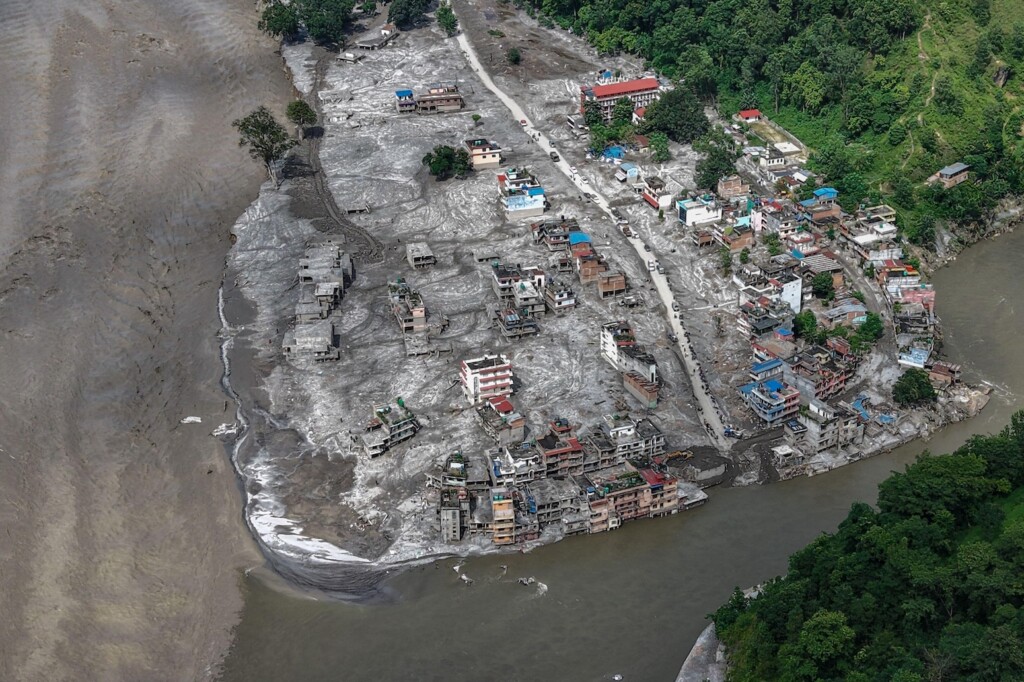
An aerial view of Devighat Bazaar in Nuwakot, Nepal, following the floods of 26 August 2026. Credit: ZUMA Press / Alamy Stock Photo
Can the event be attributed to climate change?
On the morning of 26 August, flash floods surged through a Himalayan border region of Nepal and the Chinese region of Tibet, killing more than 1,300 people, with thousands still missing.
In the days since the floods, scientists have examined satellite imagery, drone footage and seismic data in order to understand and explain the forces behind the event.
While initial theories pinned the flood on a glacial collapse, scientists now understand the event as a “multi-hazard cascade”, which began with a bedrock collapse.
Some climate sceptics have tried to use this to falsely claim that human-caused climate change had no impact on the event.
Yet, scientists havenoted that, while no formal attribution study has been carried out thus far, warming is making such ice-rock avalanches in the region more likely.
Researchers have highlighted how rapid warming is dramatically reshaping Asia’s high-mountain region – and identified rising temperatures, glacier retreat and permafrost thaw as factors that may have all contributed to the disaster.
Balendra Shah, Nepal’s prime minister, has called the floods a “serious signal that…the risks we must bear in the Himalayan region are increasing” due to climate change.
Here, Carbon Brief unpacks what scientists currently know about the causes of the catastrophic event and what they can – and cannot – say about the role of climate change.
A report published on 28 August by the HiRisk scientific consortium of high mountain experts detailed the events that led to the flash floods.
It said that events were set in motion on 26 August when a mass of bedrock, as well as the glacier ice on top of it, broke off a slope of Langtang-Lirung mountain in the Nepalese Himalaya, plunging from approximately 5,200 metres above sea level to the valley floor at 3,000 metres.
The landslide shook the ground hard enough that, at 8:37am Nepal local time, the US Geological Survey (USGS) initially reported a magnitude 4.4 earthquake. Later that day, it clarified the shaking was caused by glacier collapse and debris flow, equivalent to a magnitude 5.2 earthquake.
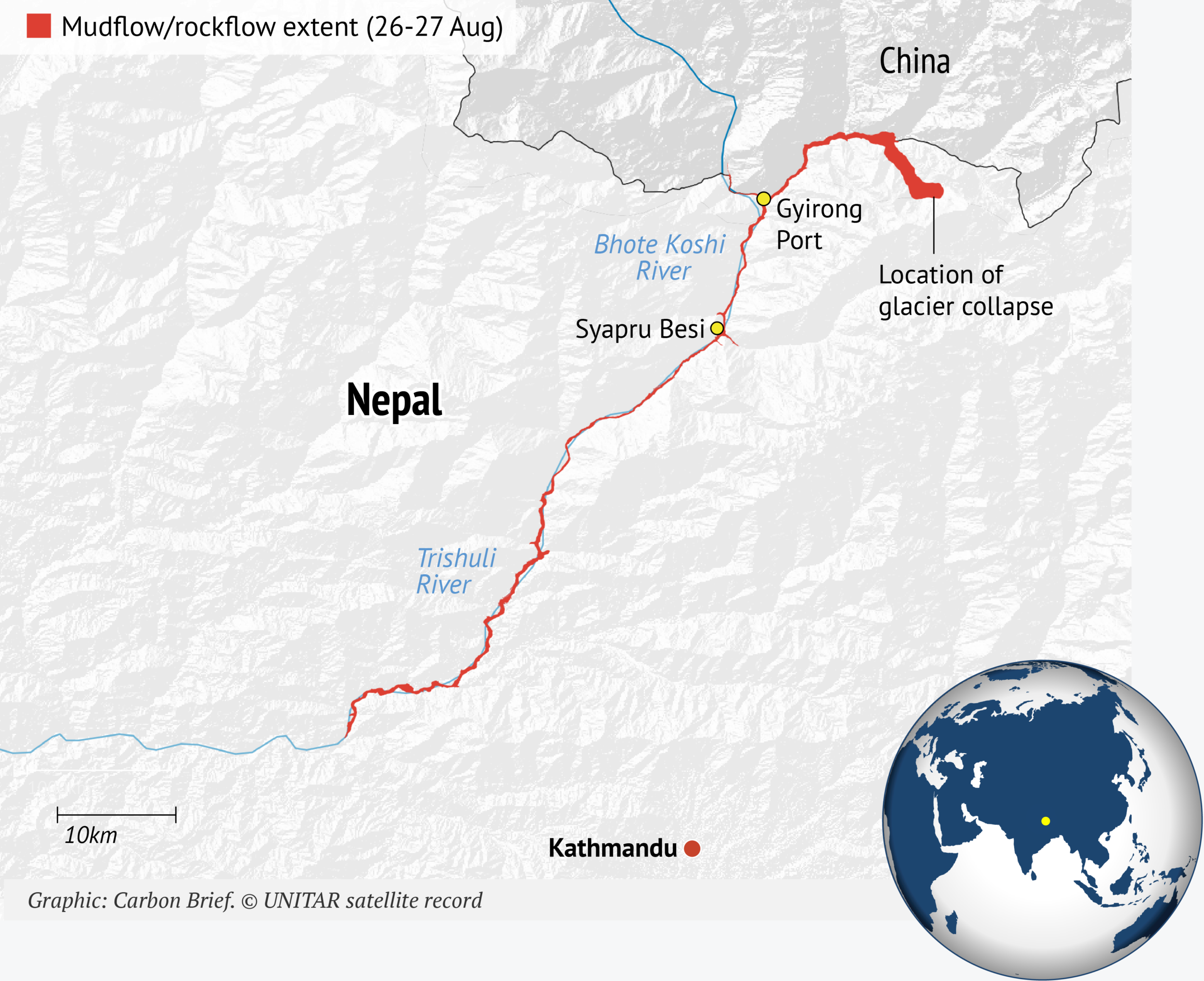
On the valley floor, the melting ice, water and debris slammed into the Lhende Khola river, a high-altitude river that runs along Nepal’s border with China.
Known downstream as the Bhote Koshi river in Nepal and the Poiqu or Poqu in China, the Lhende Khole feeds a network of rivers across Nepal and the Chinese region of Tibet, including the Trishuli river. (In China, the Lhende Khola is known as the Donglin Tsangpo.)
The designations employed and the presentation of the material on this map do not imply the expression of any opinion whatsoever on the part of Carbon Brief concerning the legal status of any country, territory, city or area or of its authorities, or concerning the delimitation of its frontiers or boundaries. Credit: Carbon Brief.
A large “debris” lake was briefly formed on the valley floor. When this lake burst, a wall of water and rock travelled downstream, killing more than a thousand people and destroying settlements, roads, bridges, hydropower plants and border posts across Nepal and Tibet.
HiRisk said that the floodwave travelled down rivers as fast as 30km an hour (around 19 miles per hour) and reached Mugling – a Nepalese town more than 130km downstream – at around 1pm local time.
A separate report from the Center for Land Surface Hazards in the US noted that the flood moved “exceptionally fast, was sediment-laden and extreme in scale”. For example, in the Nepalese municipality of Galchhi, the Trishuli river rose by nine metres in 30 minutes, it said.
He continued that a new “barrier lake” – estimated to hold a few million cubic metres of water – had developed in a location where two rivers meet in Tibet before crossing into Nepal. This lake burst on 28 August and the river rose again, he said.
On 4 September, the chief of Nepal’s National Disaster Risk Reduction and Management Authority, told Reuters that property and infrastructure worth “at least” $2.5bn (£1.9bn) had been lost. Dharma Raj Upreti estimated the cost to build roads and temporary shelters, provide drinking water and restore power would be around $53m (£39m).
How did bedrock collapse trigger the flash floods?
In the immediate aftermath of the floods, initial reports suggested that the trigger was a collapsing glacier or earthquake in the high mountains of Nepal.
After confirming that a seismic tremor was as a result of falling rock and ice, the USGS said the trigger was likely a “glacial collapse and debris flow”. This was widelypickedupby the media.
Subsequently, satellite imagery revealed that an “enormous chunk of the mountainous bedrock” beneath the glacier had also given way, reported the New York Times.
“It was not a glacier that collapsed. It was the mountain below the glacier that collapsed and the glacier had no other chance but to go with it because it was sitting on top of it.
“The trigger for that is something that we are not 100% certain about, but, in the end, it very much looks like simply a mechanical failure of the rock material because of stressors that have built up over a long period of time.”
Failures of “bedrock” – the hard, solid rock that sits below looser rocks and soil – are an “increasingly common occurrence”, says Prof Bethan Davies, a professor of glaciology at Newcastle University. She tells Carbon Brief:
“These massive landslides occur in mountain regions, commonly following rapid deglacierisation [the melting away of a glacier]. Similar events happened in the Chamoli event in 2021 [in the Indian Himalaya] and in the Blatten landslide last year in Switzerland. They’ve also occurredrecently in Alaska.”
With a shift in focus from the failure of a glacier to the bedrock underneath, some climatescepticsseized on the development to falsely claim that climate change had not played any role in the disaster.
However, scientists have highlighted the likely contribution of rapid warming in the region. These factors include the thawing of permafrost and glacier retreat. (For more, seesectionsbelow).
Fundamentally, “this would have been a much less significant tragedy if it had been just a rock-slope failure”, notes Davies.
The initial landslide took a mixture of rock and ice into a valley that “contains buried ice” as well, she says, providing the water that “resulted in the hyperconcentrated flow, which took so many lives”.
How have temperatures risen in the affected region?
Global temperatures have risen by roughly 1.4C since the pre-industrial period. However, this increase is not uniform across the planet, with some regions warming faster than others.
A study published in Global and Planetary Change in June 2026 investigated changes in the Langtang catchment – a river basin in central Nepal, in which the Langtang-Lirung mountain is located, which eventually drains into the Ganges. Around one-quarter of the area is made up of glaciers.
The paper found that glacial areas of the catchment – found at 4,000 metres above sea level – warmed at 0.31C per decade over 1960-2023. This was “more than three times” the rate observed at a lower elevation weather station, the authors said.
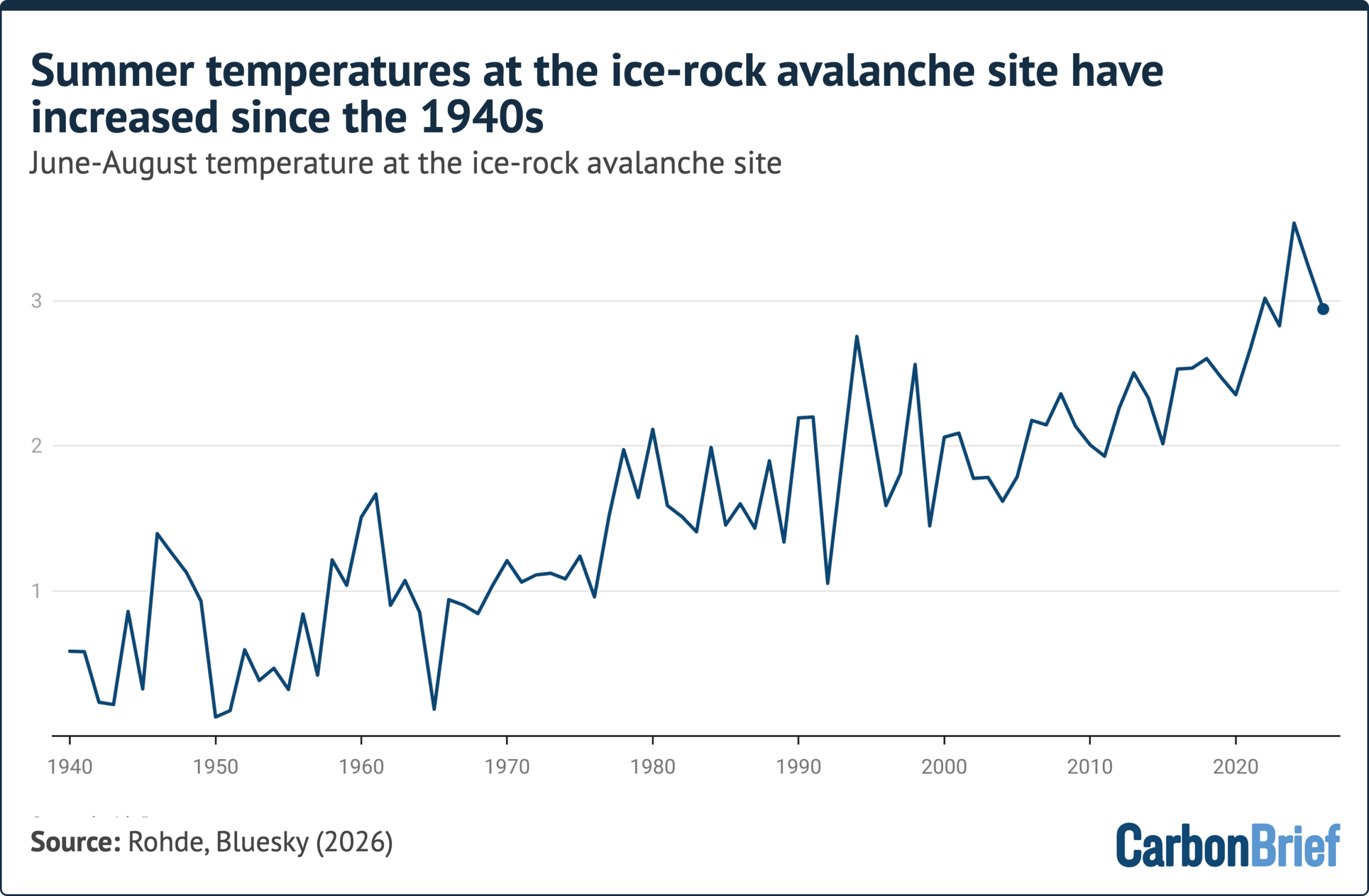
Looking in more detail at the site of the glacial collapse, Dr Robert Rohde, chief scientist for Berkeley Earth, used ERA5 reanalysis data to show how temperature has changed at the 5,200-metre elevation site where the mass of ice and rock broke loose.
Rohde’s analysis found that June-to-August temperatures have been rising at the site of the glacier collapse since the year 1940, with 2026’s summer the fourth warmest on record, behind 2024, 2025 and 2022. This is shown in the graph below.
Average summer (June-August) temperature at the ice-rock avalanche site over 1940-2026. Data source: Rohde, Bluesky (2026)
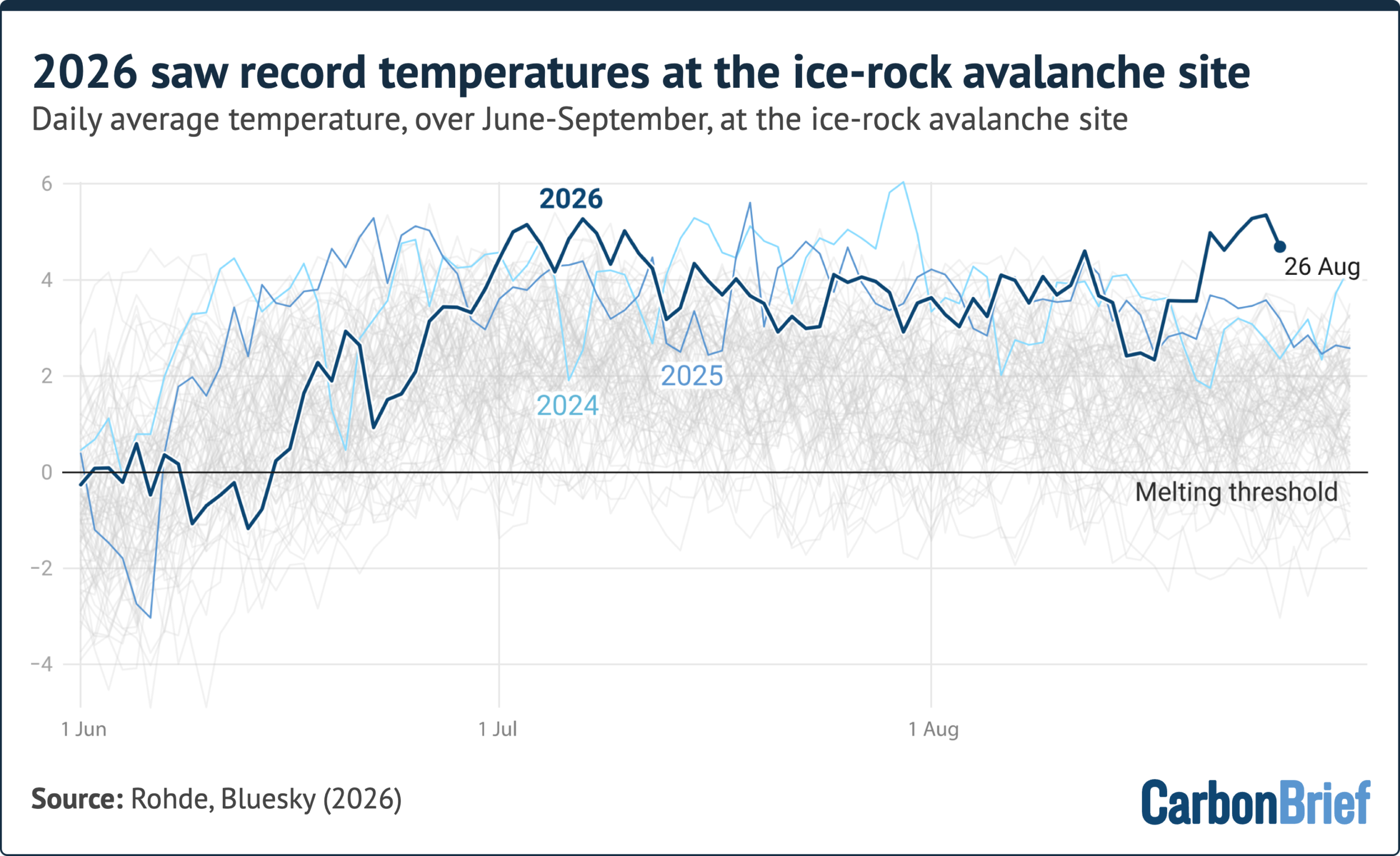
Rohde also found that the days leading up to the disaster recorded the hottest August temperatures ever experienced at the site. This is shown in the graph below.
Daily average temperature, from 1 June-1 September, at the ice-rock avalanche site. 2026, 2025 and 2024 are shown in dark, mid and light blue. All other years from 1940-2023 are shown in grey. Source: Rohde, Bluesky (2026)
“Given the warming trend, this Nepali glacier had probably been thinning and weakening for years, or even decades. But it ultimately failed during the warmest week in one of its warmest years on record. It would be a hell of a coincidence if global warming wasn’t at least partially to blame.”
How have rising temperatures affected mountain stability?
Many experts have linked warming temperatures in the region to thawing permafrost – ground that has been frozen for at least two consecutive years, whose thickness ranges from less than one metre to more than a kilometre.
Steiner is part of a research team that has been using sensors to monitor permafrost in the region since 2014. He tells Carbon Brief that it is “pretty clear” the permafrost has been thawing “very actively” at elevations as high as 5,200 metres above sea level “for many years”. He adds:
“This means that the ground has, over the last decades, moved from being in a solid state into – at least, periodically during the warm season – patchy ground where some is frozen and some isn’t…
“If you have frozen ground next to non-frozen ground, you have dynamics happening between that because there are different densities and there’s movement happening, which is conducive to interventional failure – and that we know from many other cases.”
Davies also points to the “degradation” of perennially frozen ground as a factor in the disaster:
“This permafrost acts as a glue to hold together the rocks and, as it melts, the rock can become weakened.”
Permafrost thaw can also result in saturated ground, says Davies, which adds “pressure in the joints” of rock and can “facilitate” failure. She continues:
“Sources of the water include melting permafrost and meltwater from the overlying glacier. We know that this event happened during a period of warmth, but in the absence of heavy precipitation, pointing to ice melt as the source of water.”
A 2025 study of rock and ice avalanches in High Mountain Asia found that more than two-thirds started in areas “where permafrost is probable”.
How have glaciers retreated in the affected region?
Glaciers – frozen rivers of ice holding three-quarters of the global freshwater supply – are extremely vulnerable to climate change.
In the Himalaya, the rate of glacier retreat has doubled since the late 20th century, according to a 2019 study in Science Advances.
The Global and Planetary Change study found that glacier area loss rates in the Langtang catchment increased more than fourfold from 1964 to 2023 – with melting accelerating after 2000.
It added that glaciers in the region also experienced “fragmentation” and “widespread thinning” over this period.
The study noted that this loss “coincided with elevation dependent warming”.
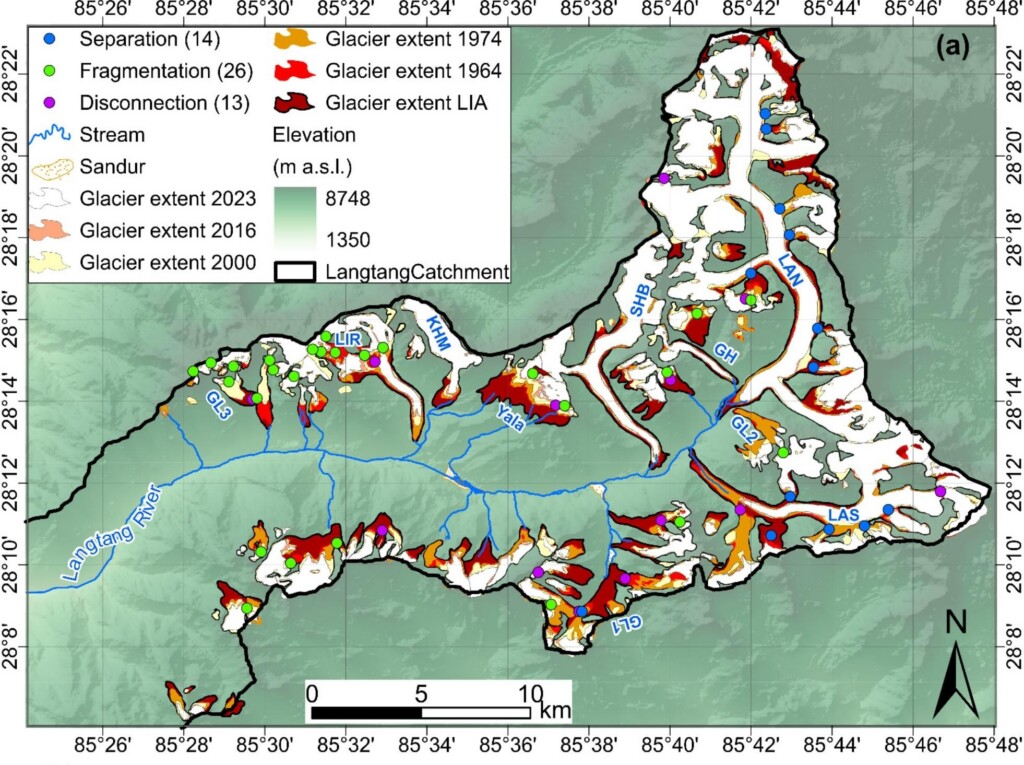
The figure below provides an overview of glacier loss in the Langtang catchment over 1964-2023, with orange, red and dark red indicating areas of retreat.
In addition, green dots note points of glacier fragmentation, while blue dots show separation and pink show disconnection.
Glacier loss in the Langtang catchment over 1964-2023. Orange, red and dark red indicate areas of retreat. Green dots note points of glacier fragmentation, while blue dots show separation and pink show disconnection. Credit: Silwal et al. (2026)
In comments released by the University of Reading, Prof Maria Shahgedanova, a climate scientist researching climate impacts on mountain glaciers, said that the glacier involved in the floods had “retreated by approximately 450 metres between 1990 and 2020”.
She adds that this “potentially reduce[d] the mechanical support provided by the glacier to the underlying rock slope”.
Speaking to Carbon Brief, Davies reiterates that the retreat of the glacier is “potentially a contributing factor” to the bedrock collapse and subsequent disaster.
This is because the removal of the glacier from the lower slopes leaves the “upper rock slopes less stable”, she says.
The most recent assessment by the International Centre for Integrated Mountain Development said that glaciers in the Hindu Kush Himalaya region are “rapidly shrinking” as a result of climate change. (This region extends 3,500km over Afghanistan, Bangladesh, Bhutan, China, India, Myanmar, Nepal and Pakistan.)
It said this loss is threatening the safety of the nearly two billion people, including by increasing the risk of “glacial lake outburst floods” (GLOFs). A GLOF is a sudden and catastrophic release of meltwater from a glacial lake.
Although this disaster was not caused by a GLOF, it is known that climate change is making such events more likely.
However, many climate scientists have cautioned that it is too early to say precisely how climate change impacted the disaster.
Davies tells Carbon Brief:
“These events happen so quickly that the exact causes and drivers can take a little time to uncover, especially if the event was a surprise and there had been no monitoring system in place.”
When trying to determine the role human-caused climate change played in the intensity or likelihood of extreme weather, scientists turn to the field of “attribution science”.
To date, no formal rapid attribution study has been produced that attempts to quantify whether – and how – climate change contributed to the event.
Scientists have noted that climate attribution of ice-rock avalanches – which are typically driven by a variety of factors – remains limited, in part because of the lack of a long-term observational record of previous collapses in high mountain areas.
Meanwhile, the studies that do exist stop short of directly linking such disasters to climate change. For example, the authors of a 2021 study into the Chamoli ice-rock avalanche concluded that “we cannot attribute this individual disaster specifically to climate change”.
However, they added, the “possibly increasing frequency of high-mountain slope instabilities can likely be related to observed atmospheric warming and corresponding long-term changes in cryospheric conditions (glaciers and permafrost)”.
In the aftermath of the disaster, many researchers have similarly highlighted that climate change could not be singled out as the cause of the disaster, even if warming likely increased the probability of its occurrence.
On the Climate Brink substack, Carbon Brief’s climate science contributor Dr Zeke Hausfather noted that a “definitive single-event attribution” of the more recent disaster “may never be possible” due to the “messy causality of rock-ice avalanches”.
However, he added that both the existing scientific literature and “essentially every scientist working on these hazards point in the same direction” – namely, that warming is making such events more likely in the Himalaya.
Steiner tells Carbon Brief it might be possible to attribute different factors that played a role in the disasters to climate change – for instance, the recession of the glacier – but it would be more difficult to do so for the event as a whole.
Part of the reason for this, he says, is that rock failures in this region of the Himalaya have occurred for millennia, well before humans started altering the climate.
However, he continues:
“The physics of it is not something that has been made possible by climate change. This could have happened without it. But the chance of it happening – and the likelihood of it happening five years after a previous, similar event [in Chamoli] – we, as the scientific community, can be pretty confident about that [being increased because of a changing climate].
“This is because so many of the changes that we know are related to climate change can potentially drive the build-up to eventual failure.”
Ultimately, says Davies, a “careful attribution study is needed, but it is hard to argue that the rapidly warming climate is not having an effect in these regions”. She adds:
“A single event may have multiple drivers, but we are seeing an increase in these events and are likely to see more as the permafrost and glacier melt continues.”
Israel has been building settlements in the occupied West Bank for decades. But Britain’s new ban on the import of settlement goods comes in a response to a major escalation in construction over the past four years, which an International Court of Justice advisory opinion in 2024 concluded is illegal and must stop.
Most striking are recent steps to build a new settlement bloc known as E1 on the outskirts of Jerusalem. First planned as long ago as 1999, but progressing significantly over the past year or so, the E1 bloc would mark a major change to the geography of the West Bank.
Current plans allow for thousands of housing units in the settlement, as well as commercial properties and regional services. The project would establish a new urban area that would connect the large settlement of Maale Adumim with East Jerusalem.
The international community has long seen the construction of E1 as a red line for three main reasons. First, it would isolate East Jerusalem from the rest of the West Bank, including major Palestinian cities like Ramallah and Bethlehem. This matters because East Jerusalem is the proposed capital of a Palestinian state in any future two-state agreement to end the conflict.
Second, because E1 reaches across the West Bank at its narrowest point, it would also disrupt the connections between the north and south of the territory. Fragmenting the West Bank in this way would again undermine efforts to develop a future Palestine state.
And third, the construction of E1 would involve the displacement of Palestinians. This includes people in the community of Khan al-Ahmar, which Israeli authorities ordered should be evacuated in May 2026 ahead of the new settlement construction.
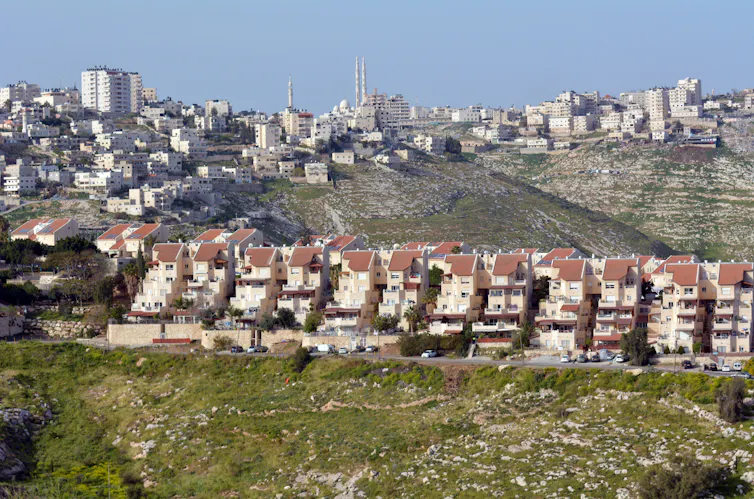
The Maale Adumim settlement next to the Palestinian town of al-Eizariya, pictured in 2015. ChameleonsEye / Shutterstock
Israeli government ministers have been explicit that E1 would suffocate any future Palestinian state. In September 2025, when announcing new progress on E1, Prime Minister Benjamin Netanyahu said: “We are going to fulfil our promise that there will be no Palestinian state.” His finance minister, Bezalel Smotrich, has also said E1 would “bury the idea of a Palestinian state”.
The E1 project has advanced considerably in recent times, after years of delay. In August 2025, final planning approval was given for more than 3,400 housing units on the site. Then, in August 2026, the first call for construction tenders was issued to build 1,200 residential units in the southern part of E1. The closing date for bidding is on October 19, just before Israeli elections on October 27.
The UK’s import ban, which seems intended to deter companies from taking part in building E1, has been backed by similar measures announced by countries including Canada, France, Ireland and Spain.
Mounting international concern
The ban on settlement goods demonstrates mounting international concern about Israel’s actions. More than 700,000 Israeli settlers now live on land captured in the 1967 six-day war, even though settlements on occupied land are illegal under international law.
Israeli rights group, Peace Now, reports that more than 102 new settlements have been approved since 2022, most deep inside the West Bank. The Israeli military often supports settlers building new outposts, and the Israeli government provides substantial financial backing to establish settlements.
The UN says that more than 6,400 Palestinians have been displaced in the West Bank due to settler attacks and access restrictions since January 2023, of which at least 2,500 were displaced in 2026 alone.
In addition, more than 30,000 Palestinians have been displaced from refugee camps during Israeli military operations in the northern West Bank since late 2024.
Israel’s expanded control over the West Bank is one element in a broader revisionist policy to push its borders outwards, which marks a step change from a previous strategy of conflict management.
The new moves come in the wake of the October 2023 attacks, when Hamas gunmen killed more than 1,200 Israelis and captured 250 hostages, and Israel’s subsequent war in Gaza, which has killed more than 70,000 Palestinians and devastated the strip.
Since the war began, Israel has seized territory as a buffer zone in southern Lebanon against Hezbollah. It has also advanced into Syria, following the fall of the Bashar al-Assad regime in late 2024. In Gaza, Israel has now taken control of at least 60% of the strip and is considering building three new military settlements there.
Israel’s far-right national security minister, Itamar Ben-Gvir, recently again raised the prospect that Israel may seek to expel the 2 million Palestinians in Gaza. Egypt, which has a border with Gaza, and Jordan, which shares a border with the West Bank, are gravely concerned about the risk of mass deportation of Palestinians across their borders.
The UK government’s action against settlement expansion, accompanied by similar measures introduced by countries elsewhere, signals a new effort to curb these expansionist ambitions.
Andy Burnham and Ed Miliband outside 10 Downing Street in 2024 (Photo: Alamy)
Andy Burnham’s decision to impose trade sanctions with Israel’s illegal settlements stands in sharp contrast to this week last year when Keir Starmer welcomed Israel’s president to Downing Street.
Speaking in parliament today, UK foreign secretary Ed Miliband also announced a ban on arms exports that would “materially contribute” to the occupation of Palestine and the advertising of illegal settlement properties in Britain.
Burnham may hope he has now done enough to see off the threat to his left flank from Green party leader Zack Polanski, especially with a tight inner London by-election coming up.
The measures have received a furious reaction from Tel Aviv, with Israeli foreign minister Gideon Sa’ar announcing the closure of the UK consulate in Jerusalem.
Washington’s ambassador in Jerusalem Mike Huckabee, meanwhile, suggested British firms could now be “banned” from doing business in a number of US states.
But do Burnham’s new sanctions go far enough?
Bloomberg has already reported that British diplomats briefed US counterparts that the move is “largely symbolic” and will have “no material impact on the UK’s wider relationship with Israel on trade or security”.
Genocide denier and Current UK Prime Minister Keir Starmer is quoted that he supports Zionism without qualification. He also confirms that UK air force support has been essential in Israel’s mass-murdering genocide. Includes URLs https://www.declassifieduk.org/keir-starmers-100-spy-flights-over-gaza-in-support-of-israel/ and https://youtu.be/O74hZCKKdpAKeir Starmer objects to criticism of the IDF. He asks how could anyone object to them starving people to death, forced marches like the Nazis did, bombing Gaza’s hospitals and universities, mass-murdering journalists, healthworkers and starving people queuing for food, killing and raping prisoners and murdering children. He calls for people to stop obstructing his genocide for Israel. New Labour UK Prime Minister Andy Burnham continues Labour party policy of active support and complicity in Israel’s genocide.

 Prime Minister Andy Burnham departs 10 Downing Street, London, to attend his first Prime Minister’s Questions at the Houses of Parliament, September 9, 2026