Francesca Albanese, UN special rapporteur on the occupied Palestinian territories, said she would not join people dismissing policy as ‘theatre’ before details announced. Photograph: Jordi Ruiz Cirera/The Guardian
Exclusive: UN special rapporteur on occupied territories says ban on goods from settlements ‘important’ but must go further if it is to amount to more than a ‘press release’
The UK’s planned ban on trade with unlawful Israeli settlements is a welcome, if overdue, first step and must be judged according to its practical impact, a UN expert has told the Guardian.
…
Palestinian groups in the UK are holding judgment until they see the fine detail of Miliband’s policy, due to be announced on Tuesday, but are expecting the most significant shift since a previous foreign secretary, David Lammy, withdrew most arms export licences in September 2024.
Speaking to the Guardian, Francesca Albanese, the UN’s special rapporteur on the occupied territories, said a “ban on settlement goods was a change in UK government stance and absolutely important”. She added she would “not join those dismissing it as theatre before the details had been announced”.
She said a settlement trade ban would have to be part of “a true paradigm shift to Israel-Palestine that ultimately seeks to implement the international court of justice advisory opinion in 2024”, which stated that Israel’s presence in the occupied territories was “unlawful in its entirety”. The opinion, she added, said that “all states carry an obligation – not a preference of an obligation – not to recognise the situation as legal, and not render aid and assistance in maintaining it”.
Genocide denier and Current UK Prime Minister Keir Starmer is quoted that he supports Zionism without qualification. He also confirms that UK air force support has been essential in Israel’s mass-murdering genocide. Includes URLs https://www.declassifieduk.org/keir-starmers-100-spy-flights-over-gaza-in-support-of-israel/ and https://youtu.be/O74hZCKKdpAUK Prime Minister Andy Burnham admits to blatently lying and engaging in deception to become leader of the UK Labour Party and Prime Minister.UK Foreign Secretary David Lammy says that UK is suspeding 30 of 350 arms licences to Israel. He also confirms the UK government’s support for Israel’s Gaza genocide.
As the latest UNEP reports we will blow past 1.5°C, we must prioritise solutions that work, rather than focusing on complex, unproven technologies
For anyone who’s been paying attention, it’s no surprise that the United Nations Environment Program (UNEP) reports that we will now inevitably blow past the global average temperature threshold of 1.5°C above pre-industrial levels.
Climate scientists like myself have been warning for years that we are about to cross this invisible red line, while quietly worrying that global average temperatures will end up being double that. Personally, I said goodbye to 1.5°C several years ago, but it still feels momentous to see it written in print, and that too by the UN.
The target to keep warming to 1.5°C above pre-industrial temperatures isn’t some hard red line in the sand, because all warming carries some risk, but it’s relevant because limiting warming to 1.5°C gives us a good chance of avoiding some of the worst impacts of climate heating. We’ve already had a glimpse of what this looks like in the myriad heatwaves, wildfires, floods, droughts and storms that have made headlines this year.
Every tenth of a degree of heating means real-terms impacts for peoples’ lives, livelihoods and property, and increases the risk of the extreme events that we’ve already seen tragically claim so many lives. It also increases the likelihood of exceeding critical tipping points such as the collapse of the West Antarctic Ice Sheet, beyond which there’s no return.
We’ve already had single years that have exceeded the 1.5°C limit, but the widely discussed Paris Agreement target is a multi-year average. That means we won’t know we’ve reached it until it’s in the rearview mirror, but it’s also possible to “overshoot” 1.5°C, temporarily peak at higher temperatures, and then bring them back down – and that’s now the best-case scenario outlined by UNEP.
This would mean we would have to take drastic action to bring temperatures back down again rather than continuing to drive them ever upwards. Which, in the current political climate, feels like a bit of a stretch.
Temperatures won’t stabilise until we reach net zero emissions, where we remove as much carbon from the atmosphere as we add to it. Until then, we will still be increasing greenhouse gas concentrations in the atmosphere and turning up the dial on the thermostat. Net zero isn’t a nice to have, despite what certain parts of the political spectrum would have you believe, it’s an essential if we want to have a liveable planet.
In fact, UNEP’s latest report points to the need to take action beyond net zero:
Once we have limited heating to 2°C or below — which currently feels optimistic — we will have to roll out carbon dioxide removal (CDR) to reduce temperatures on an enormous scale.
CDR often connotes high-tech solutions to suck carbon dioxide out of the atmosphere, but it can also mean one of the oldest technologies in the world: trees. That’s why restoring nature and preventing deforestation is so important for climate action.
But UNEP reports that CDR only works if we limit heating to 2C or below. As the stakes of climate heating continue to rise, another idea is moving from the sidelines to centre-stage: geoengineering, or deliberate technological interventions to alter the Earth’s climate.
Geoengineering is a spectrum, ranging from the comparatively reasonable and well-researched (injecting particles into the stratosphere to reflect incoming sunlight and cool the surface, much like major volcanic eruptions have done) to downright barmy (launching mirrors into space – you can imagine which silicon valley billionaires love that idea). And while there are sensible (if heated) scientific discussions about how to actually do it, there are also some very serious ethical and governance hurdles to overcome.
The tech bros will tell you that geoengineering will save us and allow us to keep doing what we’re doing while still ‘fixing’ climate change. But beware any arguments that downplay the importance of emissions cuts. We can’t simply geoengineer our way out of this crisis.
For example: who decides when to deploy? What happens if an intervention makes things better for some and worse for others? How do we safeguard against bad actors acting unilaterally? These questions are largely unanswered, and that’s before we get to the scientific questions around unintended consequences, like disrupting the Arctic food chain while trying to refreeze ice, or what happens if we stop the intervention, resulting in a so-called termination shock, where temperatures would shoot back up with devastating effect.
In some senses the climate crisis is relatively simple: we’re pumping planet-heating carbon dioxide into the atmosphere, and it’s heating the planet. To reverse it, we need first to stop adding planet-heating carbon dioxide to the atmosphere, and then to start removing it.
The good news is that we do know what we need to do to achieve that. Climate action is less a knowledge problem, and more an implementation one.
Proponents of geoengineering argue that it’s not an either/or between emissions cuts and major interventions. But in a world with finite resources, expensive and unproven geoengineering solutions should not be a priority, rather, we should prioritise the simple stuff we know works: decarbonising energy production, improving public transport, retrofitting and building greener housing, reducing meat and dairy consumption, restoring natural ecosystems.
That said, we are now committed to some level of change, and we need to behave as such. That means we need to prepare for the sea level rise that’s to come, and adapt societies, behaviours and infrastructure to a less predictable and more extreme climate.
If the summer of 2026 has taught us anything in the UK, it’s that our houses, schools, offices, railways, emergency services, power networks and public transport are simply not fit for purpose in the heat. Nor are they built to withstand the wet, stormy, flood-prone autumn and winter that is on its way. We’re not equipped to deal with the rapidly extremifying climate or the weather whiplash it brings. Simply put: our infrastructure was built for a climate that no longer exists.
If we are to survive the coming decades, we need to build preparedness and climate resilience into our society. Extreme events are already exposing our vulnerabilities, and if we thought 2026 was bad, count my words: we ain’t seen nothing yet.
In the wake of our hottest summer on record, it’s abundantly clear that we need to slash emissions to save lives, and at the same time prepare for the changes that are now committed.
The geoengineers are right about one thing: It’s not an either/or. We have to reduce emissions to net zero and remove carbon from the atmosphere and adapt to what’s in store. There’s no other safe option.
Dr. Ella Gilbert is a climate scientist and multi-award-winning presenter with a PhD in Antarctic climate change.
Donald Trump urges you to be a Climate Science denier like him. He says that he makes millions and millions for destroying the planet, Burn, Baby, Burn and Flood, Baby, Flood.Nigel Farage urges you to ignore facts and reality and be a climate science denier like him and his Deputy Richard Tice. He says that Reform UK has received £Millions and £Millions from the fossil fuel industry to promote climate denial and destroy the planet.Elon Musk urges you to be a Fascist like him, says that you can ignore facts and reality then.
Ministers promised last year to set up new water boards for consumers that would allow them to air complaints. Photograph: Catherine Falls Commercial/Getty Images
[Guardian] Exclusive: Documents reveal water firms have been allowed to advise on how they wish to be held to account
Labour’s new powers for customers to hold water companies to account are a “stitch-up”, campaigners have said, as utilities firms have been advising on how to implement it.
…
Documents released under freedom of information laws reveal the CCW has been consulting water companies on how to set up the new consumer boards that would hold them to account. It said it had “set up an industry advisory group to get ideas, feedback and advice from water companies”.
Feargal Sharkey, the former Undertones frontman turned water campaigner, said: “This is a stitch-up. If water companies are involved in setting this up customers will not get any redress. The people who are important in all of this are the customers who have been extorted by these companies. The CCW is asking the extorters what should be happening to the victims, this is an outrage and a scandal.”
He added: “It sounds like this scheme will be equally inept and dysfunctional.”
Coventry South MP Zarah Sultana branded Andy Burnham a ‘boring nice guy’
…
Ms Sultana, who represents Coventry South, was first elected in 2019 as a Labour MP. But shortly after the 2024 General Election she was suspended from the Labour Party for rebelling against the party line on the two-child benefit cap.
She later left the party and went on to set up Your Party with former Labour leader Jeremy Corbyn.
In a debate this [last] week, she said: “The Prime Minister has reeled off a list of policies since coming into office. Interestingly, he has failed to mention one major Intervention: his Government have continued his predecessor’s policy of arming Israel—an apartheid state that has committed and continues to commit genocide in Gaza.
“Instead of deflection and the boring nice-guy act, will he finally admit to the House that he has chosen to continue arming Israel and is therefore complicit in the genocide of the Palestinian people?”
UK Prime Minister Andy Burnham admits to blatently lying and engaging in deception to become leader of the UK Labour Party and Prime Minister.Genocide denier and Current [former] UK Prime Minister Keir Starmer is quoted that he supports Zionism without qualification. He also confirms that UK air force support has been essential in Israel’s mass-murdering genocide. Includes URLs https://www.declassifieduk.org/keir-starmers-100-spy-flights-over-gaza-in-support-of-israel/ and https://youtu.be/O74hZCKKdpA
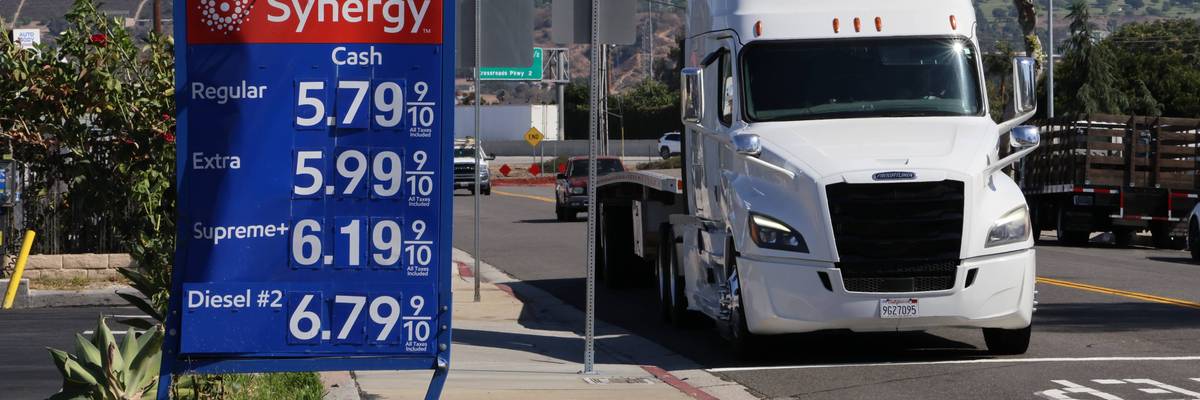
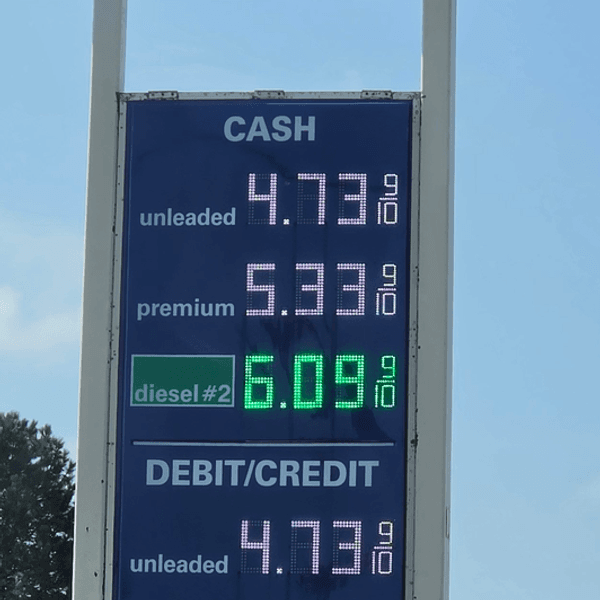
Gasoline and diesel prices are displayed at a gas station in El Monte, California on August 26, 2026. (Photo by Zeng Hui/Xinhua via Getty Images)
“Labor Day weekend travelers are facing the highest gas prices ever for this time of year,” said the American Automobile Association.
The average price for a gallon of diesel fuel in the United States hit an all-time high average price of $5.85 on Friday as the Trump administration’s war on Iran and its resulting disruptions to the global energy market showed no signs of ending.
The Associated Press noted that “because diesel is used for many freight and delivery networks, higher diesel prices mean higher transportation costs for a long list of everyday goods.”
According to the American Automobile Association (AAA), the national average price for a gallon of regular gasoline was just under $4.15 on Friday—up from $3.20 a year ago and an increase of nearly 40% since the US and Israel started bombing Iran in late February, prompting the Middle East country to retaliate by closing the Strait of Hormuz, a critical waterway for the global oiltrade.
“Labor Day weekend travelers are facing the highest gas prices ever for this time of year,” AAA said on Thursday. “The national average has never been above $4 per gallon on Labor Day. The current Labor Day record is $3.82, set on September 3, 2012. Even though gasoline demand decreases this time of year, typically bringing down gas prices, this year is different due to the high cost of crude oil.”
Kendall Witmer, rapid response director for the Democratic National Committee, said in a statement Friday that “working families deserve to enjoy their hard-earned holiday weekends, but Trump and Republicans’ agenda has made everything from gas to groceries more expensive and left families with no breathing room.”
“It’s no wonder Americans are rejecting Trump and Republicans,” Witmer added, “forcing Trump’s approval ratings to fall to embarrassing lows.”
President Donald Trump’s White House has thus far responded dismissively to concerns about surging gas prices, even as they appear to pose a significant threat to the Republican Party’s chances of retaining control of Congress in the upcoming midterm elections.
At a rally in New York last month, Trump told Americans that paying “a tiny little bit more for your gasoline” is worth the price for waging the Iran war, which is historically unpopular with the US public.
During a press conference on Thursday, US Vice President JD Vance suggested Americans should be grateful that gas prices aren’t even higher.
“Gas, frankly, could’ve been much, much higher were it not for our efforts,” said Vance, referring to the administration’s attempts to reopen the Strait of Hormuz.
The New Republic’s Hafiz Rashid observed that Vance’s remarks “belie the fact that the Iran war was arbitrarily and unnecessarily started by the Trump administration.”
“There was no threat to the flow of oil and gas or other maritime traffic traversing through the Strait of Hormuz prior to the war,” Rashid wrote. “If not for the efforts of President Trump, gas would in fact be much, much, lower.”
While the administration claims the Strait is now open and that dozens of vessels carrying millions of barrels of oil are transiting the critical waterway daily, analysts have cast doubt on the assertion. Al Jazeera noted Thursday that “according to marine analytics firm Kpler, just six vessels crossed the Strait on Wednesday, 11 on Tuesday, and five on Monday. It put the 10-day average at 13 vessels per day.”