Trump and Netanyahu have a problem of their own making in Iran | Joe Raedle/Getty Images
The US president’s claim that the war is ‘very complete’ was little more than wishful thinking
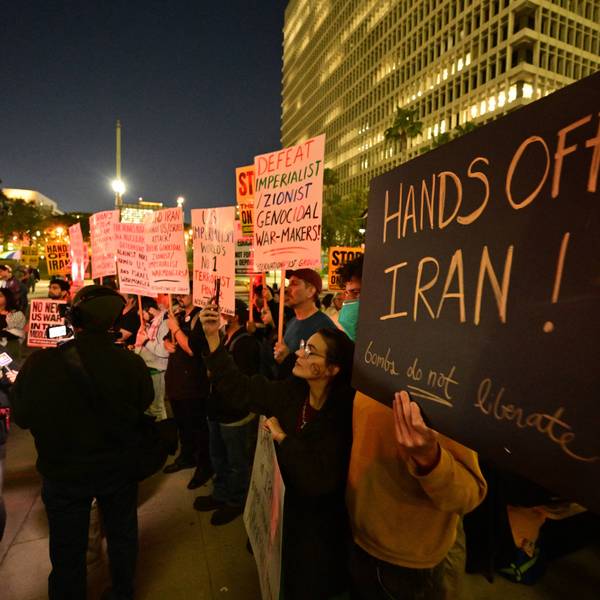
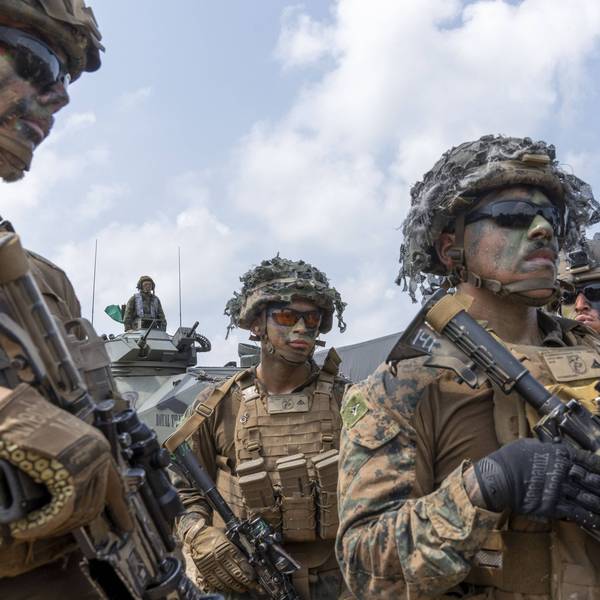
“I think the war is very complete, pretty much,” was Donald Trump’s assessment of the Israeli-American war in Iran earlier this week, after nearly a fortnight of death and destruction.
“[Iran has] no navy, no communications, they’ve got no air force,” the US president continued. “Their missiles are down to a scatter. Their drones are being blown up all over the place, including their manufacturing of drones.”
Iran thinks otherwise: it struck three merchant ships near the Strait of Hormuz days later.
The US military’s recent actions are also in contradiction with Trump’s boasts of success. Having depleted its stocks of missiles and anti-drone weapons, the Pentagon is making plans to move reserves from South Korea, to the evident concern of the government in Seoul. In a further unexpected twist, the US is even turning to Ukraine to supply it with cheap anti-drone defences made locally and costing a tiny fraction of the commercial systems.
For Israel and the US, which began the war with surprise airstrikes on Iran on 28 February, Tehran’s ability to survive is proving far greater than expected. More than 1,000 Iranians have been killed, including the former supreme leader, but the regime is still able to respond to attacks.
As the war intensifies with no end in sight, two key elements are emerging.
The first is that Binyamin Netanyahu, in particular, has fallen into a trap of his own making.
Israel’s prime minister likely imagined Israel and the US would be able to quickly declare victory after assassinating Iran’s supreme leader, bolstering his approval ratings ahead of this year’s Israeli general election.
But with the supreme leader’s son now appointed as his successor, a victory for Israel can only involve completely destroying Iran’s ability to resurrect a nuclear weapon programme. Anything short of this, and its resurrection will be the first aim of any surviving regime – leaving Israel in an even less secure position than before it attacked Tehran.
This total destruction is proving harder than expected, not least because of Iran’s extensive network of tunnels, which I noted in openDemocracy last week. Footage released by Iran’s Islamic Revolutionary Guard Corps last year, which purportedly shows a tunnel full of naval drones, anti-ship missiles, and sea mines, resurfaced this week after the attacks on the merchant ships.
The second issue is more surprising and has emerged only in the past few days.
Having failed to terminate the Iranian regime in the first leadership assassination, Israel and the US are falling back on the Dahiya Doctrine, an Israeli military tactic rooted in wrecking a neighbourhood, a city or even a country to undermine public support for a recalcitrant leadership. In theory, it forces the enemy leadership to give up and thereby lose the war.
The two nations have embarked on an expanded bombing campaign that increasingly targets Iran’s civilian population. As well as the spiralling death toll, thousands of residential properties have been destroyed, displacing more than a million people from their homes.
Civil infrastructure has also been targeted, including banks needed to pay wages. There are numerous reports of hospitals and health centres being hit.
Israel and the US’s use of the Dahiya Doctrine is unsurprising; Israel first used the tactic to attack Hezbollah’s stronghold district of Dahiya in southern Beirut in 2006, and it has since become a valuable tool in its arsenal. Despite Hezbollah’s survival – indeed, 20 years on, Israel is again pummelling Dahiya – Israel used the same approach in four assaults on Hamas in Gaza between 2007 and 2021, and it has been its main policy in the devastating war in Gaza since 2023.
In Iran, expect many more attacks from Israel and the US, killing or maiming many thousands more. Yet a remarkable sting in the tail is emerging that is already changing everything.
Put bluntly, Iran is using Israel’s Dahiya Doctrine against Israel itself.
Iran cannot defeat the combined military power of the US and Israel, but what it can do, and is already doing, is engage in economic warfare on a global scale by targeting the 20% of the world’s oil and gas that originates in the Persian Gulf and passes through the Strait of Hormuz.
Its aim is simple: cause such problems in world energy markets that, in a matter of weeks, there will be huge pressure on Trump and his people to force a pause in the fighting, whatever Netanyahu says.
And the International Energy Agency has already described the situation as one of “dire straits’, warning that “the war in the Middle East is creating the largest supply disruption in the history of the global oil market”.
It continued: “With crude and oil product flows through the Strait of Hormuz plunging from around 20 mb/d before the war to a trickle currently, limited capacity available to bypass the crucial waterway, and storage filling up, Gulf countries have cut total oil production by at least 10 mb/d. In the absence of a rapid resumption of shipping flows, supply losses are set to increase.”
The implication is that a very difficult time of global energy shortages lies ahead.
So while Trump may say the war is “very complete”, it’s far from it.
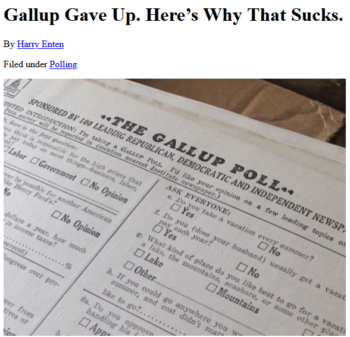
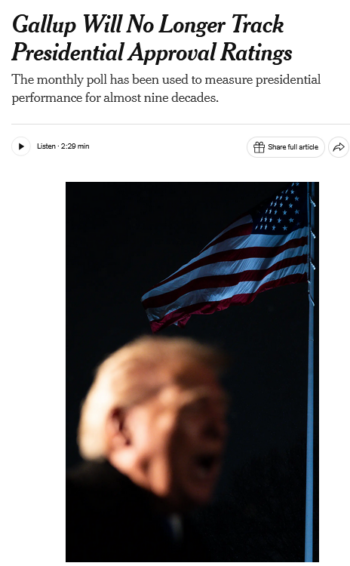
The Gallup Poll announced this month it would no longer measure presidential approval or other national leadership ratings. It was a surprise to pollsters and journalists who report on public opinion, because George Gallup was the pollster who initiated presidential approval ratings in the 1930s. Over the past nine decades, the organization has developed the most extensive database available, allowing journalists to compare approval ratings among all presidents since Franklin D. Roosevelt at various stages of their tenure.
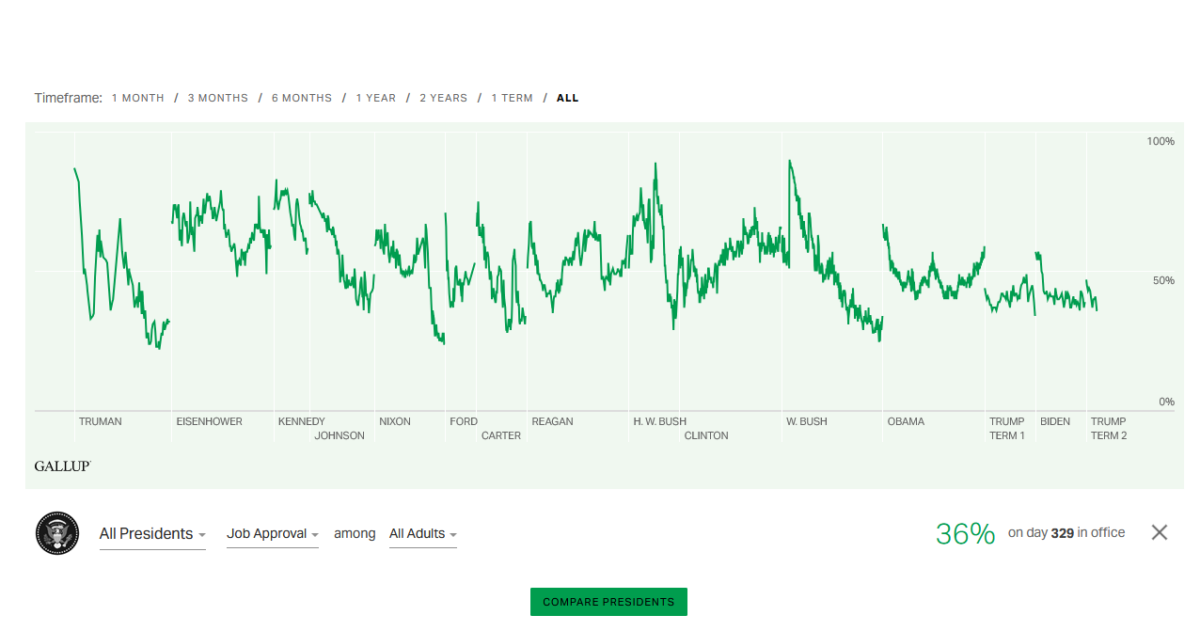
In fact, that very ability may have been the catalyst for Gallup dropping the ratings. Last November, Gallup (11/28/25) reported President Donald Trump’s approval rating as the lowest in his second term (36%), just barely above his lowest rating ever in January 2021, after he fomented the insurrection in an effort to avoid leaving office. His average approval rating in his first term was the lowest of any president since such polling began.
The November report also noted that Trump’s net approval ratings had dropped significantly on several items since the previous February/March: immigration (-9 points), situation in the Middle East (-7), economy (-6), federal budget (-12) and the situation in Ukraine (-10).
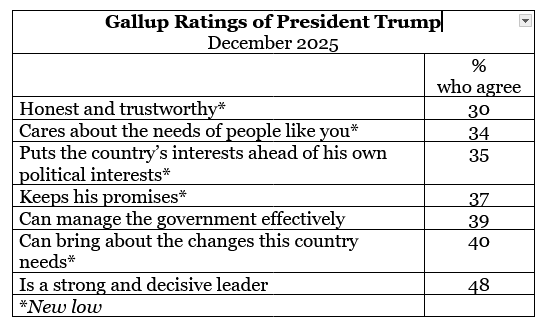
The December report (12/22/25) was not any better. Trump’s approval rating remained at 36%, while ratings on seven other personal characteristics were at a new low or near a new low:
Also problematic for Gallup was that its approval ratings consistently showed numbers below the average of other polls. Across ten approval ratings Gallup published in 2025, the net rating averaged 8.7 points lower than the average that Nate Silver (formerly of 538 and now of Silver Bulletin) compiled from other polls.
These are especially bad numbers. Trump doesn’t like bad numbers. He still has a lawsuit against an Iowa pollster whose pre-election numbers he didn’t like. And Gallup has extensive contracts with the federal government. It’s a no-brainer to infer that Gallup’s polling results may have caused the Gallup organization to re-evaluate the utility of continuing to report numbers that Trump hates.
No one knows if the White House let its dissatisfaction be known, or if the leaders at Gallup evaluated the zeitgeist on their own and took steps to mitigate possible financial problems with the US government. When asked by the Hill (2/11/26) “if Gallup had received any feedback from the White House or anyone in the current administration before making the decision,” the organization’s spokesperson apparently did not deny such an intervention, but said, “this is a strategic shift solely based on Gallup’s research goals and priorities.” Sounds like a yes to me.
The decision feels like the exclamation point marking the end of the Gallup Poll as envisioned by its founder.
The rise of Gallup
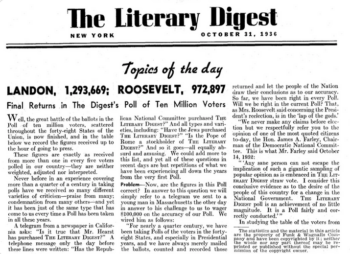
The Literary Digest (10/31/1936) predicted that Alf Landon would get 370 electoral votes and defeat Franklin Roosevelt in the 1936 election. He won eight, and did not.
On October 20, 1935, the Washington Post published a new column, “America Speaks!” by Dr. George Gallup, who had recently founded the American Institute for Public Opinion. (See Chapter 2, “America Speaks,” in David W. Moore, The Superpollsters, 1995.) It would report on the first “scientific” measurement of the voters’ minds. And, Gallup guaranteed, he would predict the outcome of the 1936 election between Alf Landon and President Franklin Roosevelt closer than the famed, and highly respected, Literary Digest poll.
While the latter poll based its results on responses from 10 to 20 million ballots it had sent to voters across the country, those voters had been targeted because their names were on a “tel-auto” list—a marketing list of people who owned cars and telephones. Gallup surmised that those voters would be disproportionately of the upper socioeconomic strata, potentially biasing the results in favor of Republicans. The “scientific” sampling he used was intended to identify voters all across the socioeconomic spectrum, to obtain a truly representative sample of the whole population. Based on his knowledge of statistics, he recognized that such a sample need not be as gargantuan as the Literary Digest sample.
As it turned out, Gallup’s prediction was indeed closer than that of the Literary Digest poll. As were the results of two other “scientific” pollsters—Elmo “Bud” Roper and Archibald Crossley. The Literary Digest poll predicted a landslide victory for Alf Landon, while the three upstarts all correctly predicted a landslide victory for Roosevelt. The “scientific” method of sampling had shown that relatively small samples of voters, chosen carefully to include all varieties of voters, could accurately represent the larger population.
All three pollsters had their own organizations, but Gallup was the most aggressive advocate for this new way of polling. More so than the others, he engaged in frequent polling on policy matters, and thus became the leader of the new public opinion polling industry. Newspapers subscribed to his columns, and for four decades, his polling results were the most significant influences in defining what the public was thinking on major issues.
Of course, he continued his election polling as well, because he believed that accurate election predictions were essential to developing public confidence that polls could represent public opinion more generally. And he developed ratings of political leaders, initiated in 1938 with his presidential approval rating question: “Do you approve or disapprove today of Franklin Roosevelt’s job as president?”
Election polling, public policy polling and leadership ratings were the three signature aspects of the Gallup Poll.
New owner, new strategy
In the mid-1970s, the three major broadcast networks began to develop their own polls, each partnering with a major newspaper—ABC with the Washington Post, CBS with the New York Times and NBC with the Wall Street Journal. In the ensuing decade, other national polls emerged as well, such as the Los Angeles Times poll, and occasional polls by Time and Newsweek.
By the late 1980s, the Gallup Poll had all but disappeared from national news stories. Few major newspapers continued to subscribe to Gallup’s polling service, because most newspapers got their poll results for free, recycled from the newspapers and television networks that conducted their own polls. George Gallup had died in 1984, and his two sons—Alec and George, Jr.—did not have the charisma or business acumen of their father. They waited until their mother had passed, in 1987, and then put the Gallup Poll up for sale.
The company that eventually bought Gallup was founded by Donald O. Clifton, a psychology professor at the University of Nebraska in Lincoln, who designed questions that would help match people with specific types of jobs. Based on his research, he eventually founded Selection Research Inc. (SRI) to help companies hire employees. (See pp. 19-21, David W. Moore, The Opinion Makers, 2008.)
Among Clifton’s four children there was one son, Jim, who became president and CEO of the new Gallup Organization. One of his most brilliant moves came shortly after he assumed his new position. He was able to persuade Ted Turner, owner of CNN, to have the network join in a one-year polling partnership with Gallup for the 1992 election. The agreement included USA Today, which had been an occasional CNN partner.
It was an ideal arrangement for all three organizations. Gallup was finally back in the news, because its poll results were immediately published by both partners. And the two media organizations benefited from the credibility of the Gallup Poll. The arrangement worked well during the campaign, and subsequently was renewed in a multi-year contract.
(It was at this point, March 1993, that I joined Gallup as a vice president and managing editor of the Gallup Poll. My immediate supervisor was Frank Newport, editor-in-chief of the Gallup Poll. I remained with Gallup until April 2006.)
With Gallup back in the news, the company’s marketing business took off. When SRI acquired Gallup, it was like one guppy eating another—the annual revenues from SRI were only slightly larger than the annual revenues from Gallup (in the $12–15 million range). A decade later, SRI-Gallup’s revenues were estimated to exceed $200 million.
The strategy was clear: The “Gallup Poll” part of the company—the part that conducted opinion polls, as opposed to the marketing business of the new Gallup Organization—was the advertising that helped bring in clients. If the “Poll” were to lose credibility, that could hurt the business. And, slowly, the “Poll” did begin to lose credibility.
‘Gallup vs. the World’
Harry Enten (538, 10/17/15) noted that when Gallup stopped doing electoral polling in 2015, it took away the best tool for judging the accuracy of its opinion polling.
Despite the extensive public policy polling and widespread dissemination of Gallup’s results, its election polling was often controversial. In 2012, Nate Silver wrote an analysis, “Gallup vs. the World” (New York Times, 10/18/12), describing numerous times when CNN/USA Today/Gallup’s results significantly diverged from the average of other polls, and even from final election results. From the beginning of the partnership, the election polling was erratic, he noted, with results showing “implausibly large swings in the race.” As he wrote, “In 1996, Gallup had Bill Clinton’s margin over Bob Dole increasing to 25 points from nine points over the course of four days.”
Then in 2000, it found “a 26-point swing toward Mr. Gore over the course of a month and a half. No other polling firm showed a swing remotely that large.” Silver pointed out that Gallup’s polling swung again, back toward Bush, putting him 13 points ahead on October 27―”just 10 days before an election that ended in a virtual tie.”
The problems continued. In 2015, 538‘s Harry Enten (10/7/15) wrote that Gallup had suffered
two consecutive elections in which its results were way off. Gallup’s final generic congressional ballot in 2010 had Republicans winning by 15 percentage points; they won by 7 points.
He also noted that in 2012, Gallup’s final poll showed Romney winning by one point. Obama won by four.
The partnership had begun to break apart in 2006, when Gallup dropped CNN. USA Today and Gallup continued working together, but in 2008, 2010 and 2012, the final elections polls on Real Clear Politics list results under Gallup’s name alone, despite earlier polls in those years when the results were listed as USA Today/Gallup. The official breakup came in early 2013, when Politico (1/18/13) announced that “USA Today and Gallup, the polling organization, have announced a mutual decision to end their 20-year partnership.”
Gallup’s decline
“We believe to put our time and money and brainpower into understanding the issues and priorities is where we can most have an impact,” Gallup editor-in-chief Frank Newport told Politico (10/7/15) in 2015.
That wasn’t the only bad news. In 2012, the Gallup Organization was sued by the federal government for bilking it out of millions of dollars, and for violating the Procurement Integrity Act by agreeing to hire a federal employee only if he could first increase the size of a government contract for Gallup.
In July 2013, the suit resulted in Gallup having to pay a $10.5 million fine for its transgressions, and—according to the Omaha World Herald (8/17/13)—removed Clifton from “authority over the company’s government division” as part of an agreement that allowed the company to “continue to compete for federal contracts.” It’s ironic that after such success in reviving the Gallup brand, Clifton was the one to tarnish it so profoundly.
After a bad election year in polling and the overbilling and procurement scandal, Gallup ultimately decided to give up election polling altogether. As Politico (10/7/15) wrote:
After a bruising 2012 cycle, in which its polls were farther off than most of its competitors, Gallup told Politico it isn’t planning any polls for the presidential primary horse race this cycle. And, even following an internal probe into what went wrong last time around, Gallup won’t commit to tracking the general election next year.
And it didn’t.
With no media partner, Gallup’s public policy polling also declined. It’s rare these days when Gallup conducts a poll that gets cited about some current national issue.
But Gallup did continue with regular polls on presidential approval and favorability ratings of political leaders. Until now. With the recent announcement, it no longer does regular election polling, public policy polling or leadership ratings—the three signature characteristics of George Gallup’s original vision of “American Speaks.” America continues to speak, but with respect to voter preferences, citizens’ views on controversial public policy issues, and how they view their leaders—Gallup is no longer listening.
The Gallup Poll still functions, of course. Its extensive data base is still available to journalists. It continues to conduct polls of Americans related to its Social Series, started in 2000. The surveys track attitudes in a variety of areas over time, but they do not focus on current controversial public policy issues.
No questions, for example, about Epstein, tariffs, immigration enforcement and ICE, war with Iran, the capture of Venezuela’s president, vaccine mandates, housing policy, the war in Gaza, ways to address “affordability,” the use of presidential pardons, healthcare subsidies, Ukraine, crypto currency, and other policies that ask respondents to take a position in favor or opposed. Gallup apparently doesn’t want to offend, so virtually all of its questions are general in nature. It has become a shadow of its former self.
‘A big deal’?
“Gallup’s…88 years of data give historical context to what amounts to a monthly snapshot of Americans’ views,” wrote the New York Times (2/11/26). “Political and news media analysts have come to rely on the poll to understand shifting trends in the country over time.”
Does it matter?
Some media observers think so. The Washington Post (2/11/26) called it “a big deal,” with the paper’s polling director saying Gallup is “leaving Americans with a dimmer view into our politics.” Ruth Igielnik of the New York Times (2/11/26) bemoaned the loss of Gallup’s “high-quality surveys” and “record of accuracy.” Both cite Gallup’s long history and its use of telephone, rather than online, surveys.
But telephone surveys’ primacy is no longer undisputed (Data for Progress, 3/11/21; Pew, 4/19/23). Indeed, while the Gallup Poll is still a high-quality polling organization, it is not the leader in the industry. Nate Silver rates polls by comparing their predictions with actual election results; Gallup gets a B+, better than average, but Silver finds at least 25 pollsters to be more accurate.
Despite their disappointment with the Gallup announcement, both Clement and Igielnik note that the New York Times tracked 51 polls measuring Trump’s approval rating in January—so many, Clement concludes, “that poll watchers may not have noticed the absence of Gallup’s monthly figures.”
When Gallup announced it would no longer conduct pre-election polls in 2015, Harry Enten (538,10/7/15) gave a similar reaction:
There are still plenty of good polls, and Gallup’s decision, by itself, doesn’t change the overall polling landscape that much…. ABC News, CBS News, CNN, Fox News and NBC News have all published live-interview primary polls in the past couple of months. (They all have a better track record than Gallup, according to our ratings.)
The Gallup Organization is a highly successful business, with an estimated annual revenue of $500 million, employing over 2,000 employees. The Gallup Poll was always, as Silver notes, a “loss-leader,” essentially the organization’s advertising for its business. After SRI bought the Gallup name and its reputation, the Poll—focusing on George Gallup’s vision of election polls, public policy polls, and leadership ratings—was instrumental in stimulating business. Over the years, the controversies surrounding the Poll’s performance and results seemed to have hurt the business more than help it. Abandoning Gallup’s vision of “American Speaks” was a logical business decision.
The truth is, with all the other polls that exist today, hardly anyone seems to notice. Except, perhaps, the president of the United States. The “big deal” about Gallup’s announcement, then, has much less to do with the loss of one poll than with the pressure a US president is apparently exerting on the polling industry.
Orcas discuss how Trump was re-elected and him being an obviously insane, xenophobic Fascist.Climate science denier Donald Trump says that more liquid gold is being secured according to his policy of global privateeringDonald Trump warns against following the https://onaquietday.org blog, says that it’s easy atm, she only needs to report war crimes supporting Israel’s genocidal expansion.
General Secretary of the Communist Party Marxist – Kenya (CPM-K) Booker Ngesa Omole. Photo: BookerBiro/X
Withdrawing from the case, the complainant and the key witness named in the chargesheet has accused the police of fabricating charges and weaponizing the criminal justice system.
The chargesheet against Booker Omole, the general secretary of the Communist Party Marxist – Kenya (CPM-K), began to unravel in the very first pre-trial hearing on March 9. Abducted on February 24 without a warrant by men in plainclothes, tortured in custody, and imprisoned, Omole was released on bail on March 3.
At his pre-trial hearing on Monday, the complainant and the main witness named by the police in the chargesheet submitted an affidavit in the court, saying that he was “unequivocally” withdrawing his “complaint and all statements recorded” pertaining to the case.
Stating that “these proceedings are a weaponization of the criminal justice system aimed at … harassing and intimidating” Omole, he added that the police had fabricated the charges.
“It is clear that the complainant was forced into this by the police,” Omole told Peoples Dispatch. “The Registrar of Firearms Bureau also presented a report to confirm that I am a legally registered owner of the firearm,” he was accused of possessing illegally.
Surviving an assassination attempt
It was the same firearm he had used to survive an assassination attempt last year during the Gen Z protests between June and July, sparked by police brutality amid a worsening cost-of-living crisis under the austerity regime instituted by President William Ruto.
“Many activists suspected of being involved in the protests were being abducted without warrants and tortured,” Omole recalled. “Six gunmen broke into my house. I shot one dead at my bedroom door.”
After a gun fight, “one more was found dead outside on the road, probably from a bullet wound. Others who fled were arrested, but the judicial enquiry never concluded.” The case went dark “because they were intelligence officers,” he maintains.
“It was an ambush.”
“But I did not have this gun with me in the car when I was stopped” on February 24 at a roadblock set up at the bypass to turn to Nairobi on his way back from Isiolo, where he was travelling with a party comrade and a foreign delegate for political work and to raise funds.
“It was an ambush. Some 20 men, without uniforms, surrounded our car and started to grab us. We did not know who they were. So we resisted and fought back,” he recalled. It was only when the public gathered, demanding to know who the men were, that they identified themselves as police.
“The accusation that I threatened to kill them during this scuffle is ridiculous. There were 20 of them – armed – how could I have threatened to kill them?”
They took all three into custody, along with their two cars, and drove them to the apartment the party had rented to host its international delegates. The police named the owner of this apartment, Andrew Amoth, as the main complainant and witness in the chargesheet.
A chargesheet riddled with contradictions
The police maintain they swung into action after Amoth allegedly made a noise complaint against the guests who had rented his apartment. “But his apartment is in Nairobi. I was abducted on my way from Isiolo. How could I be making noise in Isiolo and Nairobi at the same time? When the police write a cooked story,” Omole remarked, “such contradictions appear.”
Upon their arrival at the apartment, the police allege that Omole drew his gun on the landlord. But Omole maintains he was already detained and brought there in police custody. “At no point did … Omole point a firearm at me,” the landlord insisted in his affidavit.
Upon raiding the apartment, the police found 320,000 Kenyan shillings, equivalent to about USD 2,500, which they insisted was a fund to sponsor an insurgency against the government. They then drove Omole to the Mlolongo police station, where, according to Amoth’s affidavit, they tried to extort this amount from Omole.
“A well-known criminal within the police”
The Officer Commanding Station (OCS) at Mlolongo is Peter Mugambi, whom Omole described as “a well-known criminal within the police. He is also a sworn anti-communist, Evangelical Christian.” Omole had already had a run-in with him back when he was the OCS of Bamburi. At the time, “he had accused me of organizing a terrorist cell to overthrow the government.”
Now under his wing again at the Mlolongo police station, the police tortured Omole, dislocating his arm, already injured in the scuffle during his abduction. “They even strangled me”, demanding to know who was financing him for leading the protest outside the US embassy against the abduction of Venezuela’s president, Nicholas Maduro.
“They insisted I must also be a member of a drug cartel,” like Maduro, echoing the allegation the US had concocted before his abduction. Just as this allegation was dropped by the US prosecution when Maduro was produced in a court, the Kenyan police also dropped this from the chargesheet.
They instead claimed to have found narcotics in the apartment. “Contrary to what is stated in the Charge Sheet, I confirm that no narcotics, drugs, or illegal substances were found in the apartment,” its owner and complainant said in his affidavit. “As the lawful owner and occupant of the premises, I find any suggestion to the contrary to be false and did not originate from any evidence recovered from my home.”
The chargesheet was made available to Omole only when he was produced in the Mavoko Law Court in Machakos on February 26, well past the 24 hours since detention as mandated by law. His injured arm was crudely bandaged as he was rushed into the courtroom by more than half a dozen policemen who kept out all his comrades and journalists. Denied bail on the technical grounds that the police had not provided the pre-trial document to the court, Omole was sent to Kitengela Remand Prison.
“A prison within a prison where they send you to break your spirit”
On the night he was brought to this prison, he was held in isolation, in what he estimates to be a 2-by-1 meter cell, where his tall and athletic frame could barely move about. “There is no toilet,” added Omole. “You are given a bucket to defecate in. It is a prison within a prison where they send you to break your spirit.”
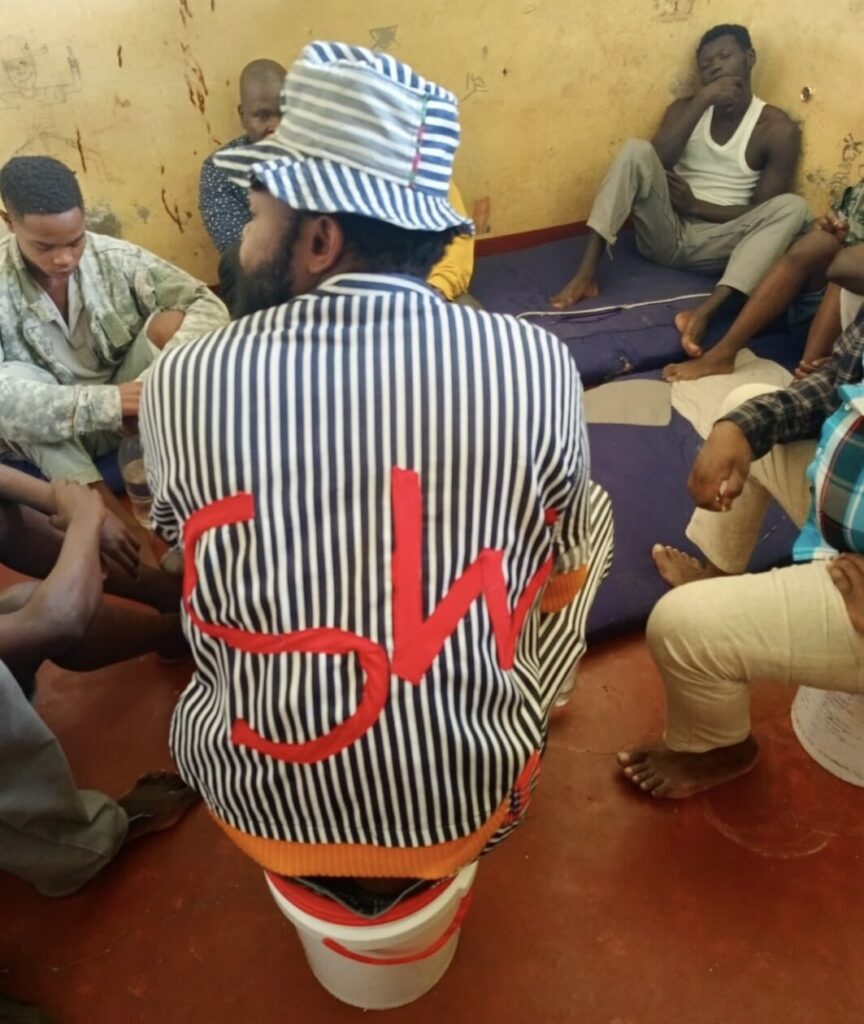
The following day, he was transferred to the “capital remand prison”, in a uniform, scrawled with the red letters “SW”, standing for Special Watch, assigned to those deemed dangerous. His inmates here were charged or convicted with the death penalty, carrying crimes like murder, robbery with violence, etc.
Booker Omole in prison. Photo: CPM-K
“We were about 400” held on a floor consisting of what he estimates to be an 8 by 20 meters hall, with rows of 3 by 4 meter cells on either side – 27 prisoners packed in each. Several human rights reports have also documented the overcrowding in Kenyan prisons, requiring inmates to sleep on their sides, facing the same direction to fit in, “packed close to one another like sardines.”
“If a privileged prisoner who could pay the police was brought in, a cell would be emptied for him,” which would further overcrowd other cells, added Omole. “So inmates spend most of their time in the hall.”
Holding political education sessions for prisoners and wardens
Sitting on the lid over a dustbin in this hall, shuffling between books, Omole can be seen in a video snuck out of prison lecturing the inmates gathered around him about the commonalities between the guerrilla warfare led by Mao in China and the Mau Mau uprising led by Dedan Kimati in Kenya.
“We had three such sessions at night,” he recalled, observing that the prisoners were readily receptive “to our ideas”. All of them were poor and strongly insisted that it was their instincts to survive poverty that got them into crime.
“None of them had any regrets for their crimes,” he said, adding that they only swore that if given a second chance, they would not get caught. “This goes to show that the idea of prison as a place to reform criminals and rehabilitate them back into society is a myth.”
Wealthy criminals, rarely imprisoned, have a relatively comfortable living space and are not crammed in like the rest. They get to “take walks and have a smoke.” Prison authorities, bribed, allow them wholesome meals brought in from outside. The rest, who cannot pay, have to make do with “some soup and corn bread,” perceptible in their bony frames seen in the video. The prisoners were therefore acutely aware of the class contradictions, Omole said.
This, he said, was “already a firm basis to start the discussion about the capitalist system.” The inmates did not need much explanation to grasp why Kimati, who fought for land, remained criminalized as a terrorist for the most part since independence by the “neo-colonial state”, while the representatives of the wealthier classes were hailed as the heroes of Kenya’s freedom struggle.
Outside of this floor where the violent criminals were held, there was also the so-called “prison school”, where inmates gather for sort of group therapy sessions, recollecting “what got them into prison” and reiterating “why they must change. I exploited that platform to deliver an agitational lecture.”
Prison wardens live like prisoners themselves
The junior prison wardens took an interest, initially out of simple curiosity about a political prisoner. As it grew, “I also held a session with them,” Omole said. “They needed a public figure to engage with their issues.” Their condition was little better than the prisoners themselves. Their homes were essentially four walls and a roof made of iron sheets, emanating a chilling cold in winters and blistering heat in summers.
”There are seven gates” between the rows of jails, with two junior prison wardens placed as guards between each. “They are also locked in. They don’t have the keys. If there is a fire outbreak, they can’t escape either. They have to die with the rest of the prisoners. These work conditions,” Omole explained, naturally gravitated them toward the left-wing ideas he was espousing. “We became good friends. They helped us smuggle in political literature.”
But the political literature was later discovered by the higher authorities. “I was handed another 8 hours in the isolation cell.”
In the meantime, the police finally provided the court with the pre-bail hearing document, whereupon he was granted bail on March 3 for an amount of 500,000 Kenyan shillings, more than the 320,000 the police had allegedly tried to extort from him.
The judge also ordered the police to return all the possessions they had seized from Omole and his co-accused. It included “two cars, an iPhone, a laptop, and the 320,000 Kenyan shillings” they found in the apartment. When Omole went with his lawyer to collect them, he said that Mugambi let loose his police to expel him from the station, leading to a scuffle.
Chargesheet unravels
On March 9, the court issued another order to return them. At the pre-trial hearing that day, Amoth, the complainant and main witness, submitted an affidavit to withdraw from the case, while the Registrar of Firearms also confirmed his gun was legally owned.
The Department of Public Prosecution then sought leave to amend the chargesheet, to change the accusation of illegal possession of a firearm to misuse of a firearm. However, Amoth said in his affidavit, “At the time the police arrived, the firearm was secured in a safe in the upper bedroom, and the magazine was separated from it.”
So the charge of misusing a firearm will not hold either, Omole said, adding the chargesheet will likely be dropped as “defective and untenable. If that happens, we will file a case for wrongful detention and prosecution, and demand compensation.”
While confident that the case against him will fall apart, Omole is certain that the “crackdown against our party will only intensify as we grow in strength. The task we face today is to build a revolutionary organization, capable of fighting back.”
A video shared by the White House combines footage from Wii golf with video of US strikes on Iran. (Photo: The White House/X/Screengrab)
By saying the quiet part out loud, Trump is revealing that war is based on the least of who we are, the least mature aspect of human nature.
Boys will be boys. Just ask the president.
At a gathering of Republicans a few days ago, Donald Trump talked nonchalantly about the recent sinking of an apparently unarmed Iranian frigate by the US Navy—in the Indian Ocean, more than 2,000 miles from the Persian Gulf. A total of 104 crew members were killed and 32 more were injured.
The president proceeded to make this more than merely another brutal, pointless act of war. He turned it into a glaring—shocking—revelation of truth… about the American-Israeli war on Iran and, quite possibly about all wars: about war itself. He was upset at first, he told the crowd, that the Navy sank the frigate rather than capturing it. But when he expressed this to the military officials, one of them responded, “It’s more fun to sink them.”
And the crowd laughed. Uh… are we “playing” war or waging it, with that trillion-dollar annual military budget America has? No doubt we’re doing both, but normally the “fun” part of war—the dehumanization of the enemy, the abstraction of people’s deaths (including those of children)—is airbrushed from public discussion by politically correct strategic and political blather. But this is Trump, spouting the quiet part out loud—in the process, causing the global infrastructure of nation-states, borders, and militarism to tremble. Could it be that war is based on the least of who we are, the least mature aspect of human nature?
A “global structure of nonviolence” is emerging—pushing, pushing against the deeply embedded infrastructure of war and us-vs.-them consciousness.
Well, guess what. There are other forces alive in today’s world. Decades of resistance to domination and colonialism, the learnings of movements across the Global South, the freedom that Western hegemony for a few decades inadvertently released on its majority population, and access through social media to some of the reality of the actual horrors perpetrated in our names have together led to a worldwide awakening to fundamental injustices, and a worldwide longing for a livable, connected, survivable future.
She calls this worldwide awakening “Radical Empathy,” a term in widespread use, which means a deeply rooted sense of connection among people, well beyond merely sympathy and shared feelings. We are one planet, one people, and we will survive together or not at all.
“Radical Empathy must be fierce, stubborn, creative, persistent,” she continues. “We must hold on to each other, build community, be willing to take risks and accept consequences. Seek alternatives. Stand in solidarity with all who resist oppression and the violence of power and greed…
“And we artists must nurture artistic bravery, using the power of the arts to tell truth, to build community, to turn our capacity for radical empathy into a force for good.”
In other words, Radical Empathy isn’t simply emotional. You can say it’s spiritual, but it’s also political. It’s a movement: ever changing, ever manifesting in the moment, ever addressing conflict by reaching for connection and understanding. Yes, global nationalism still maintains the power to wage war. And war is everywhere these days. As Jeffrey Sachs noted in a recent interview, “World War III is here…” from Ukraine and Gaza and Iran to Asia to the Western Hemisphere. And the fighting across the world is linked.
But at the same time the world is changing. A “global structure of nonviolence” is emerging—pushing, pushing against the deeply embedded infrastructure of war and us-vs.-them consciousness. Finding understanding with your enemy—connecting with “the other”—can be incredibly difficult, especially in the midst of conflict, but Radical Empathy is making it a reality across the planet.
Laura Hassler’s organization, Musicians Without Borders, exemplifies this movement. The organization was founded in 1999, in Alkamaar, a city in the Netherlands. Laura, who was a choir director and organized music events, had put together a concert for the town’s annual honoring of the dead of World War II.
The bloody war in Kosovo was then raging: Thousands had died; nearly a million refugees were streaming across Europe. Its horror dominated the daily news, and Laura couldn’t ignore it. She couldn’t simply focus on the war dead of half a century ago, not when the hell of war was alive in the present moment, pulling at her soul.
She decided, “We’ll perform music from the people suffering from war now—folk songs from Eastern Europe,” she told me. Her impulse was to reach out, to connect, somehow, with those suffering right now, on the other side of Europe. And something happened the night of the concert. When it ended, there was a moment of profound silence… and then, as the audience stood, applause so thunderous that the rafters shook. It went on for 20 minutes.
One of the musicians, a political refugee from Turkey, said to her afterwards: “This concert was special. We should put it on a train, send it to Kosovo and stop the war!”
And they went to Kosovo. Gradually, Musicians Without Borders became global, working with local people in war-torn regions all over the world—people on both sides of the divide—to create music that transcends the war of the moment. The organization currently has long-term projects in the Balkans, West Asia, Eastern Africa, and Europe.
This is Radical Empathy, or at least one example of it—our complex force of hope even as the world’s leaders continue bleeding away the planet’s resources in order to play war. Radical Empathy transcends war. It’s who we are—when we find ourselves.
Climate science denier Donald Trump says that more liquid gold is being secured according to his policy of global privateeringDonald Trump explains why he established his Bored of PeaceOrcas discuss how Trump was re-elected and him being an obviously insane, xenophobic Fascist.
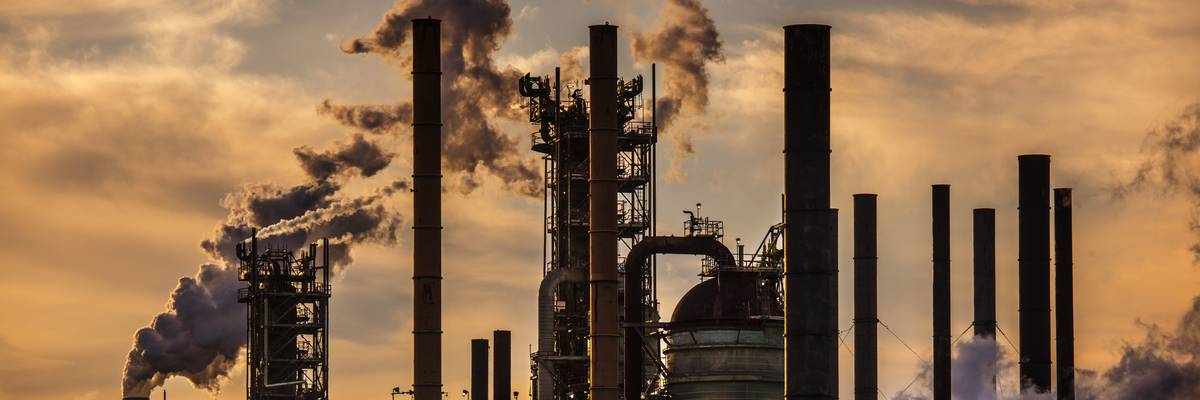
The pictured oil refinery, owned by Exxon Mobil, is the second largest in the country on 28th February 2020 in Baton Rouge, Louisiana, United States. (Photo by Barry Lewis/InPictures via Getty Images)
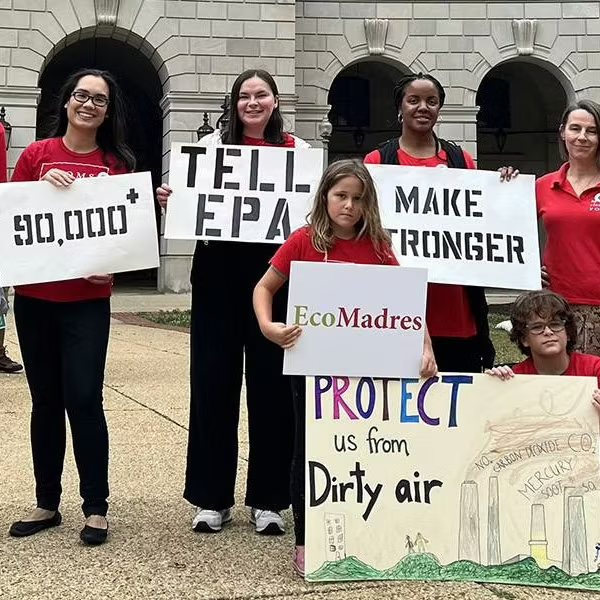
The EPA’s decision to erase the value of lives lost or saved by regulations is a horror beyond the pale. It opens the door for government-sanctioned death with a baked-in cover-up.
Last March, I interviewed staffers at the Environmental Protection Agency’s Region 5 headquarters in Chicago who were horrified by the Trump administration’s staff and funding cuts, which notably included eliminating environmental justice and diversity, equity, and inclusion programs.
The threat of those cuts was so severe that Brian Kelly, an on-site emergency coordinator based in Michigan, predicted: “People will die. There will be additional deaths if we roll back these protections.”
How many additional deaths? The Trump EPA will not say. As part of President Donald Trump’s crusade to destroy federal science and roll back environmental safeguards, his EPA announced recently that it will no longer consider the monetary value of saving lives by regulating fine particulate matter, commonly called soot, smaller than 2.5 micrometers in diameter (PM 2.5) and ozone smog from vehicles, fossil-fuel-burning power plants, and other polluting industries.
In other words, the agency intends to conduct cost-benefit analyses by only considering the cost.
We Need Stronger Pollution Regs
The data documenting soot’s deadly damage even with environmental rules in place is voluminous, much coming from the federal government itself, suggesting that we need stronger regulations, not weaker ones.
A 1997 EPA report found the first 20 years of the 1970 Clean Air Act were so effective that 205,000 premature deaths were avoided from all air pollution sources in 1990. The same report concluded that the 1990 amendments to the law would save more than 230,000 lives a year by 2020 and prevent 2.4 million asthma attacks.
By disbanding DEI and environmental justice programs, the Trump administration is ensuring that communities of color are collateral damage in sucking the Earth dry of oil and gas and mining for the last lump of coal.
Even so, air pollution remains mortally high in a nation that is now the world’s biggest producer of oil and gas and stubbornly prioritizes individually owned vehicles over public transportation. A 2021 study funded by the EPA and published in the journal Science Advances found that PM 2.5 alone still accounts for 85,000 to 200,000 excess deaths a year.
The conclusions of nongovernmental studies echo the EPA’s own findings. A 2022 University of Wisconsinstudy, for example, estimated that if the United States eliminated all fine particulate, sulfur dioxide, and nitrogen oxide emissions from electricity generation, vehicles, factories, and buildings, 53,200 premature deaths a year could be prevented, providing $600 billion in health benefits from avoided illness and mortality.
Drill Baby Drill’s Collateral Damage
The Trump EPA’s recent announcement is just another of a string of nonsensical—and dangerous—moves by the agency. They include abandoning the Paris Climate Accord and killing the agency’s 2009 “endangerment finding” determining that carbon pollution threatens human health, which the Environmental Defense Fund (EDF) estimates will cut short the lives of as many as 58,000 people over the next 30 years due to additional pollution.
Taken together, the Trump administration’s assault on public health has the potential of triggering an environmental massacre, particularly among the most vulnerable Americans.
Because of our nation’s history of housing discrimination, communities of color, regardless of income, face more than twice the risk of exposure to PM 2.5 than white communities. According to the 2021 Sciences Advances study, this “phenomenon is systemic, holding for nearly all major sectors, as well as across states and urban and rural areas, income levels, and exposure levels…. Targeting locally important sources for mitigation could be one way to counter this persistence.”
By disbanding DEI and environmental justice programs, the Trump administration is ensuring that communities of color are collateral damage in sucking the Earth dry of oil and gas and mining for the last lump of coal. An August 2025 Science Advances study found that the life cycle of oil and gas extraction, storage, transporting, refining, and combustion results in 91,000 annual premature deaths due to exposure to PM 2.5, nitrogen dioxide, and ozone. It found that, with rare exception, “Asian, Black, Hispanic, and Native American groups experience the worst exposures and burdens for all life-cycle stages and pollutants.” A 2023 New England Journal of Medicine study, meanwhile, concluded that reducing PM 2.5 pollution alone would disproportionately benefit Blacks at all income levels as well as low-income whites.
EPA Now Stands for Every Polluter’s Ally
Without a single fact to back up its claim, the Trump EPA—led by the fossil fuel industry-friendly Lee Zeldin—stated it did away with calculating lives saved because prior estimates were done with “false precision and confidence.” In fact, the agency is now simply repeating the talking points of the oil and gas industry and the US Chamber of Commerce, which has a long history of lobbying Congress to resist climate legislation and filing endless amicus briefs on behalf of polluters to counter environmental lawsuits.
In 2018, during the first the Trump administration, the chamber asserted—also with no evidence—that previous to the Trump EPA, the agency “historically misinformed and misled the public by using inconsistent and opaque analytical and communication methods regarding costs and benefits.”
That same year, the Trump EPA offered a revealing nugget of information that was hardly opaque. It admitted that its effort to kill the Obama administration’s Clean Power Plan, which would have reined in power plant carbon pollution, would result in in as many as 1,400 premature deaths a year by 2030, and thousands more annual cases of respiratory diseases. At the time, Trump was also trying to roll back Obama-era clean air vehicle standards that were projected to save nearly 40,000 lives a year by 2030.
In its last year in office, the Biden administrationproposed tightening PM 2.5 standards, estimating that it could prevent as many as 4,500 premature deaths in 2032 and lead to $46 billion in health benefits in 2032.
There is not a single word about protecting lives or lowering healthcare costs in the EPA’s February 12 press release announcing its repeal of the endangerment finding nor in its February 20 press release hailing the repeal of tighter mercury and air toxics standards enacted by the Biden administration. Instead, Zeldin claimed—without proof—that the air pollution rules would have “destroyed reliable American energy” and revoking the endangerment finding would save Americans more than $1.3 trillion, including an average cost savings of more than $2,400 on a new vehicle.
While Zeldin is trying to use the greater availability of cheaper, gas-guzzling cars as a lure to seduce the public to look the other way on environmental regulations, the pollution they emit will smoke the nation. EDF estimates that higher-polluting vehicles could, by 2055:
Cost US drivers as much as $1.4 trillion in increased fuel costs;
Emit carbon pollution that will intensify climate change-related extreme weather events, costing $1.5 trillion to $4.2 trillion; and
Increase respiratory and heart disease, as well as the number of premature deaths, costing $170 billion to $500 billion.
None of that mattered to the first Trump administration, which admitted its regulatory rollbacks could kill people. When the second Trump administration barreled into office with its cutbacks and deep-sixing of environmental justice and DEI programs, staffers in the EPA Chicago Region 5 office feared the worst. They included Kayla Butler, a Superfund community involvement coordinator. The stories her team collects in the field of people living with toxic horrors are precisely the stories she said the Trump administration is “trying to erase.”
The EPA’s decision to erase the value of lives lost or saved by regulations is a horror beyond the pale. It opens the door for government-sanctioned death with a baked-in cover-up. With the death toll from air pollution still so high, the Trump EPA is burying the data with the bodies, so we will never know the cause.
This article first appeared at the Money Trail blog and is reposted here at Common Dreams with permission.
Donald Trump urges you to be a Climate Science denier like him. He says that he makes millions and millions for destroying the planet, Burn, Baby, Burn and Flood, Baby, Flood.Orcas discuss how Trump was re-elected and him being an obviously insane, xenophobic Fascist.Elon Musk urges you to be a Fascist like him, says that you can ignore facts and reality then.