This work by Middle East Monitor is licensed under a Creative Commons Attribution-NonCommercial-ShareAlike 4.0 International License.
Fanatical Jewish settlers continue to raid on the Al-Aqsa Mosque, located in East Jerusalem, within the “Sukkot Holiday” (Feast of Tabernacles) in Jerusalem on October 12, 2025. [Gazi Samad – Anadolu Agency]
Pakistan on Tuesday strongly condemned the raid carried out by Israeli settlers at Al-Aqsa Mosque on Monday in occupied East Jerusalem.
In a statement, the Pakistani Foreign Ministry said the settlers’ entry into Al-Aqsa Mosque was a “clear violation” of international law and relevant UN resolutions.
The statement stressed the need to protect holy sites in line with international law and the current historical status.
Pakistan called on the international community to take urgent and effective steps to ensure the protection of holy sites, prevent further violence and attacks by settlers, and uphold UN resolutions.
According to an official statement, 198 Israeli settlers entered Al-Aqsa Mosque on Monday, while 974 tourists also entered the site.
Data from the Palestinian government’s Wall and Settlement Resistance Commission, updated to 5 October, indicates that settlers carried out 7,154 attacks in the West Bank during the two years of the Israeli war on Gaza. These attacks led to the killing of 33 Palestinians and the displacement of 33 communities.
This work by Middle East Monitor is licensed under a Creative Commons Attribution-NonCommercial-ShareAlike 4.0 International License.
Genocide denying UK Foreign Secretary David Lammy says that UK is suspending 30 of 350 arms licences to Israel. He also confirms the UK government’s support for Israel’s Gaza genocide and the UK government and military’s active participation in genocide.Orcas discuss Genocide-supporting and complicit Zionists. Donald Trump, Keith Starmer, David Lammy, Rachel Reeves, Angela Rayner and Wes Streeting are acknowledged as evil genocide-complicit and supporting cnuts.Keir Starmer objects to criticism of the IDF. He asks how could anyone object to them starving people to death, forced marches like the Nazis did, bombing Gaza’s hospitals and universities, mass-murdering journalists, healthworkers and starving people queuing for food, killing and raping prisoners and murdering children. He calls for people to stop obstructing his genocide for Israel.
US Ambassador to the United Nations Mike Waltz raises his hand to vote in favor of a draft resolution to authorize a so-called international stabilization force in Gaza, on November 17, 2025 in New York City. (Photo by Adam Gray/Getty Images)
CodePink said the plan “will leave Palestine in the hands of a puppet administration, assigning the United States, which shares complicity in the genocide, as the new manager of the open-air prison.”
Palestine defenders decried Monday’s approval by the United Nations Security Council of a US plan authorizing a so-called international stabilization force for Gaza—a plan decried by one peace group as a denial of Palestinian self-determination.
While US Ambassador to the UN Mike Waltz hailed the approval of what he called a “historic and constructive resolution,” Hamas, which has ruled Gaza since 2007, rejected what it said “imposes an international guardianship mechanism on the Gaza Strip, which our people and their factions reject.”
“Assigning the international force with tasks and roles inside the Gaza Strip, including disarming the resistance, strips it of its neutrality, and turns it into a party to the conflict in favor of the occupation,” added Hamas, which the US labels a terrorist organization.
After waging war on Gaza for over two years, Israeli officials also rejected the resolution for opening the door to Palestinian statehood—which is officially recognized by around 150 nations but is vehemently opposed by Israel—with Prime Minister Benjamin Netanyahu calling such an outcome “unacceptable.”
The approved stabilization force will be tasked with securing Gaza’s borders, protecting civilians, facilitating humanitarian assistance, supporting a redeployed Palestinian police force, and supervising disarmament of Hamas and other militant resistance groups. Under the plan, Israeli occupation forces would fully withdraw from Gaza after the stabilization force achieves security and operational control of the Palestinian exclave.
Then, a transitional governing body—the so-called Board of Peace led by US President Donald Trump—would be established to coordinate security, humanitarian aid, and reconstruction. The plan, which builds on Trump’s 20-point peace proposal adopted in last month’s tenuous ceasefire, dangles the carrot of a pathway toward Palestinian self-determination and statehood under a reformed Palestinian governing authority.
Human Rights Watch criticized the vote in an X post stating that “the fact that the words ‘human rights’ don’t appear in the resolution adopted by the Security Council today speaks volumes.”
The US-based peace group CodePink said in a statement that “the resolution, while disguised as a peaceful and humanitarian proposal, is in reality a blueprint for the internationalization of the Israeli occupation and a complete denial of Palestinian self-determination.”
CodePink continued:
The resolution imposes a two-year mandate to “secure borders,” “protect civilians,” and “decommission weapons,” with the stated goal of disarming Palestinian resistance. However, it does nothing to address and end the root cause of the violence: Israel’s ongoing siege, occupation, and ethnic cleansing. The United States, which armed and shielded the Israeli government unconditionally as it killed and displaced hundreds of thousands of Palestinians, should not be considered a neutral actor of good faith. A military force that answers to a “Board of Peace” chaired by the US president is an extension of US and Israeli interests, plain and simple.
“The establishment of a ‘technocratic Palestinian administration’ that answers to a US-led board will strip the Palestinian people of political agency,” CodePink added. “Essentially, it will leave Palestine in the hands of a puppet administration, assigning the United States, which shares complicity in the genocide, as the new manager of the open-air prison that Israel has already established.”
Members of the New York branch of the Palestine Youth Movement led a demonstration outside the US mission to the UN in Manhattan to protest the resolution.
“We see through this thinly veiled attempt to strip the Palestinian people of their sovereignty, self-determination, and right of return,” the group said on Instagram. “The people reject any and all occupation plans for Gaza. Our movement will continue to struggle against Zionism and imperialism until Palestine is free, from the river to the sea.”
Genocide denier and Current UK Prime Minister Keir Starmer is quoted that he supports Zionism without qualification. He also confirms that UK air force support has been essential in Israel’s mass-murdering genocide. Includes URLs https://www.declassifieduk.org/keir-starmers-100-spy-flights-over-gaza-in-support-of-israel/ and https://youtu.be/O74hZCKKdpAKeir Starmer objects to criticism of the IDF. He asks how could anyone object to them starving people to death, forced marches like the Nazis did, bombing Gaza’s hospitals and universities, mass-murdering journalists, healthworkers and starving people queuing for food, killing and raping prisoners and murdering children. He calls for people to stop obstructing his genocide for Israel.Orcas discuss Genocide-supporting and complicit Zionists. Donald Trump, Keith Starmer, David Lammy, Rachel Reeves, Angela Rayner and Wes Streeting are acknowledged as evil genocide-complicit and supporting cnuts.
More than 160 governments are nominally signed up to the global methane pledge. Photograph: Orjan F Ellingvag/Corbis/Getty Images
Analysis published at Cop30 summit shows adhering to pledges offer world hope of avoiding climate breakdown
Sticking to three key climate promises – on renewables, energy efficiency and methane – would avoid nearly 1C of global heating and give the world hope of avoiding climate breakdown, analysis published at the Cop30 climate summit suggests.
Governments have already agreed to triple the amount of renewable energy generated by 2030, double global energy efficiency by then, and make substantial cuts to methane emissions.
If they follow through on these promises – still a big if, even though countries are meeting for climate crisis talks in Brazil this week – it would be a “gamechanger”, shaving 0.9C from projected temperature rises this century, according to the Climate Action Tracker coalition.
Achieving all of these measures, among G20 countries alone, would reduce global greenhouse gas emissions by 18bn tonnes in 2035 – enough to cut the rate of global heating by a third in the next decade, and halve it by 2040.
Bill Hare, chief executive of Climate Analytics, one of the organisations behind the report, said: “If [governments] achieve this by 2035, it would be a gamechanger, quickly slowing the rate of warming in the next decade and lowering global warming this century from 2.6C to about 1.7C.”
Orcas comment on killer apes destroying the planet by continuing to burn fossil fuels.Donald Trump urges you to be a Climate Science denier like him. He says that he makes millions and millions for destroying the planet, Burn, Baby, Burn and Flood, Baby, Flood.Nigel Farage urges you to ignore facts and reality and be a climate science denier like him and his Deputy Richard Tice. He says that Reform UK has received £Millions and £Millions from the fossil fuel industry to promote climate denial and destroy the planet.
The proportion of patients who said there were always enough nurses on duty improved from 55.7% in 2023 to 57.9% in 2024. Photograph: Jeff Moore/PA
Findings of CQC survey from November 2024 lead experts to say waiting in such settings has become normalised
Corridor care has become the new normal in England, experts have said, as a national survey found that one in five patients admitted to hospital had to wait in such settings.
The report by the Care Quality Commission also found that nearly 10% of patients waited more than 24 hours to be admitted to hospital and 17.5% waited 12 to 24 hours.More than half of all patients waited more than six hours.
Nearly half waited in a treatment bay, but 18% had to wait in a corridor, 31% in a waiting room and 1%, or 361 patients, said they had to wait in a storage room or cupboard in November last year.
The CQC’s chief inspector of hospitals, Dr Toli Onon, said trolley waits were regrettable and must not become the norm. She said it was great to see improvements since but that reports of lengthy waits and patients whose health had deteriorated was a real concern.
Keir Starmer says that the Labour Party under his leadership is intensely relaxed about assaulting those least able to defend themselves – the very poorest and most vulnerable.
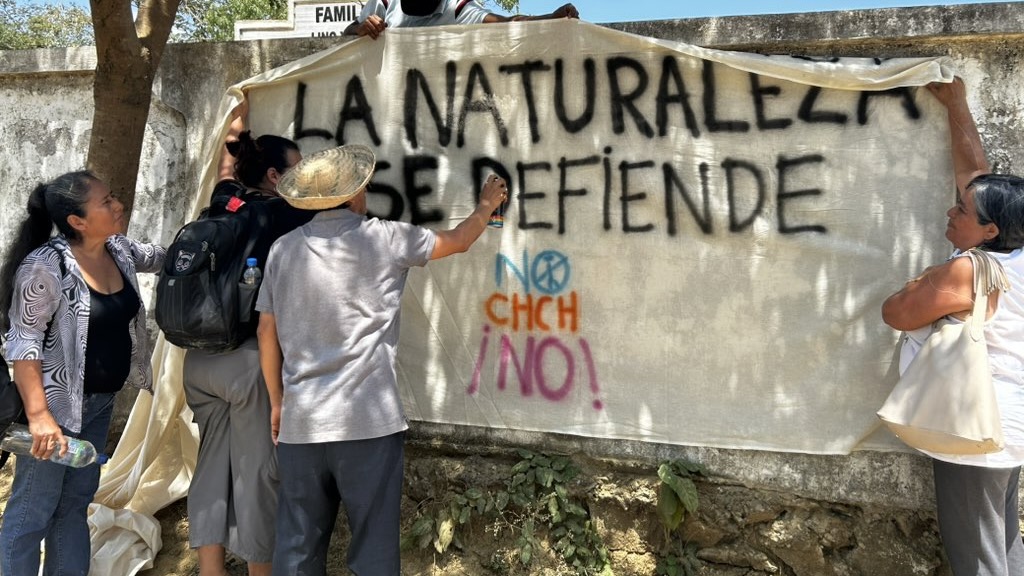
Community members in Santa Elena, Ecuador, painting a banner reading “Defend nature, VOTE NO”. The grassroots nature of the “NO” campaign appears to have given it greater success. Photo: NOchchNO / X
The government has suffered a harsh and resounding defeat to its political and economic plans. In this article, we present the results and offer some explanations for the outcome of November 16.
In a massive defeat for President Daniel Noboa’s neoliberal program, Ecuador overwhelmingly voted “No” on all four questions in the national referendum held on November 16. The result is a crushing blow for the government, who had hoped a victory would help pave the way for a structural transformation of the Ecuadorian state.
The election was organized at the request of right-wing President Noboa who called for a referendum in September of this year, hoping to achieve the economic elites’ long-awaited dream of converting Ecuador’s legal framework into a neoliberal one.
What were the referendum’s four questions?
The first question asked Ecuadorians whether foreign military bases should be allowed in Ecuador, something that is prohibited by the current constitution. Noboa appealed to the deep sense of insecurity felt by people in the country as a result of the historic crisis of violent crime, in which drug trafficking gangs are fighting over territory.
The government claimed that the installment of foreign military personnel would help reduce insecurity, although the opposition argued that it was an excuse to align the country with Washington’s geopolitical interests.
The next two questions were called “bait questions” by the opposition. They argued that the questions were less overtly ideological and employed a kind of electoral populism to exploit the widespread dissatisfaction with the political class, with the hope of garnering support for the more extreme parts of the referendum. The “bait questions” had to do with reducing the number of legislators and eliminating state funding for political parties.
The opposition, however, claimed that both measures would have benefited the ruling party, as they would have reduced the representation of small provinces and prevented political parties without wealthy contributors from running election campaigns.
Finally, the most important question had to do with the creation of a constituent assembly to draft a new neoliberal constitution, which is the great desire of the country’s economic elites.
Though the government was not particularly vocal about this, its silence about its intentions only provoked anxiety among voters, who saw this obscurity as a sign that the new constitution would reduce rights won in past decades.
The results
After the initial results were announced, several media outlets repeated the phrase “No one expected these numbers.” The latest polls had predicted that Noboa would win on all four questions, although it was known that the gap between the YES and NO votes had narrowed on the questions about military bases and the convening of a constituent assembly.
However, the president’s defeat was crushing. Not even on the so-called “bait questions” did Noboa manage to win over the majority of Ecuadorians, who clearly said “No” to the executive branch’s neoliberal project.
The government had prepared celebrations in Quito and Guayaquil, but the YES campaign headquarters were empty and the few Noboa supporters present were clearly shocked. Many expected the president to make statements to the press and his supporters, but Noboa did not appear.
He left only a brief message on X: “We consulted the Ecuadorian people, and they have spoken. We fulfilled our promise: to ask them directly. We respect the will of the Ecuadorian people. Our commitment remains unchanged; it is strengthened. We will continue to fight tirelessly for the country you deserve, with the tools we have.”
Thus, some analysts have claimed that Noboa is announcing his refusal to back down from his plan to neoliberalize the economy and the state, although he’s been forced to do so by other means. Currently, the ruling party has a majority in the National Assembly, but it will now be more difficult for it to carry out the reforms it proposes due to the votes of the independents who support it and who may hesitate to give their support to the government, as well as a Constitutional Court that has already put a stop to several of the president’s laws that undermine the legal structure of the state.
However, it is important to consider that if all the votes had been against the government, the results between one question and another would not have fluctuated so much. This is because there was a difference in voting, especially between questions 1 and 4, compared to questions 2 and 3. In this regard, some analysts have highlighted a flawed political communication strategy and the ruling party’s election campaign.
Questions loomed regarding, which foreign armed troops would come to the country to go where (there was much speculation that it would be in the Galapagos, one of the natural treasures most cherished by Ecuadorians). Also murky was the content of the constitution that the government wanted (Noboa literally said that the day after winning the referendum he would reveal the structure of the new constitution, not before).
However, attributing the government’s defeat solely to its communication failures is insufficient and dangerous, as it overshadows the enormous efforts of various political groups, social movements, and citizen collectives that campaigned for the NO vote.
Thus, the NO campaign had to be carried out in an almost artisanal manner. No political party (not even Correísmo) took the lead in the NO campaign, so funding was almost non-existent. The various videos on social media, discussions, interviews, etc., were produced by civil society, which did what it could with the little it had.
However, this accidental strategy proved to be fundamental, because, as it was “ordinary people” who ran the campaign, many undecided Ecuadorians felt that their “peers” were speaking directly to them, and not on behalf of a political party that would probably have been stigmatized by the ruling party.
Several government spokespeople began to suggest possible constitutional changes if the yes vote won, such as labor flexibility, the elimination of some rights of Indigenous peoples’ (such as Indigenous justice), the elimination of the rights of nature (something in which the country is a pioneer), and the elimination of free tuition for university students, among others. This, coupled with Noboa’s silence, allowed the opposition to organize a successful political campaign that appealed to an anti-neoliberal spirit that remains in the country.
Ecuador does not yield to neoliberalism: a historic struggle
Similarly, national workers’ strikes in the 1980s, Indigenous mobilizations in the 1990s, and in the last six years have stopped attempts to neoliberalize the country in the streets, a historical trend that continues to be confirmed today.
Faced with enormous popular rejection, the 1998 Constitution, with its clear neoliberal slant, was drafted in a military barracks, behind closed doors, with the almost exclusive participation of the Ecuadorian right.
That constitution, which opened the door to the dollarization of the country and the infamous bank holiday (in which thousands of Ecuadorians lost their savings to save the banks in crisis) was replaced by the 2008 Constitution, in which more than 150 social and political organizations went to the Assembly to demand that their claims be included.
Thus, this constitution, now clearly endorsed with full popular legitimacy, brought together a series of rights that had been demanded and won over decades by various groups of citizens. Perhaps this is why the government’s strategy of calling the current constitution “Correísta,” “Castro-Chavista,” etc., did not have the expected impact. People recognized that the country’s poor administration does not mean that the constitution is negative.
On the contrary, they saw in the ruling party’s plans something more dangerous than political antipathy toward Correísmo, which is why several people on the right and left who oppose the return of Correísmo voted NO in the 2025 referendum, which the government did not expect.
What will happen now?
For now, it remains to be seen how this sharp defeat will impact the country’s governability. Several right-wing intellectuals have called on the government to change its strategy, namely to start delivering clear results to Ecuadorians beyond advertising spots and smokescreens.
For now, changes are expected in the ministries and spokespersons of a government that, despite having been elected twice to govern, has lost in the referendums it has called and which have sought to introduce neoliberal changes.
This was the case in the 2024 referendum, also called by Noboa, in which he won on several questions to increase his power over security, but lost on the two economic questions, which sought to approve hourly work and subject Ecuador to international arbitration by international courts.
However, the defeat in 2025 is much deeper, as it implies a widespread rejection of a government that has lost much of the support of voters who trusted its administration but do not see results, which has increased mistrust. Today, the government has come to better understand sociologist Max Weber’s famous phrase: “Politics is a matter of faith and responsibility.”