Category: politics

  • Ecuador: When legitimate protest becomes ‘terrorism’

    Spread the love

    Original article by Rose Barboza republished from Open Democracy under a Creative Commons Attribution-NonCommercial 4.0 International licence. 

    Indigenous demonstrators shout slogans during a demonstration at Parque Central Cayambe, Ecuador, as part of the national strike on October 1, 2025
     | Felipe Stanley/Agencia Press South/Getty Images

    Taking from Trump’s playbook and reviving colonial trope, President Noboa labelled Indigenous protesters ‘terrorists’

    Recent years have seen Western governments extoll their democratic values while leading increasingly harsh crackdowns on dissent, with activists arrested and accused of terrorism.

    Now, Ecuador has gone even further. President Daniel Noboa’s far-right government met recent nationwide anti-austerity protests with a brutality that has left two protesters dead, 473 injured, 12 missing, and 206 detained, according to the Alliance of Human Rights Organisations of Ecuador.

    A 31-day national strike erupted on 22 September, nine days after Noboa removed fuel subsidies, raising the price of diesel by 55% from $1.80 to $2.80 per gallon. The demonstrations, which disrupted the movement of goods and people across the country as protesters blocked main roads, were led by Ecuador’s largest Indigenous organisation, the Confederation of Indigenous Nationalities, which represents many of the people who will be the hardest hit by the price hikes.

    The government responded by imposing a state of emergency and deploying troops to break up protesters, leading to state-inflicted violence that drew criticism from civil rights groups in Ecuador and across the world.

    Human Rights Watch reported it had “verified 15 videos” of “soldiers or police officers forcibly dispersing peaceful demonstrations and using tear gas and other ‘less lethal’ weapons recklessly and indiscriminately”, while Amnesty International warned of “excessive use of force against protesters by the security forces, possible arbitrary arrests, as well as the opening of abusive criminal proceedings and freezing of bank accounts belonging to social leaders and protesters”.

    The unrest came as Ecuadorian voters prepare to vote on a series of referendums on 16 November. Perhaps the most controversial question they will answer is over whether to accept foreign military bases on Ecuador’s territory.

    The ballot does not explicitly refer to the United States, but it may as well do; this week, US homeland security secretary Kristi Noem made her second visit to the Latin American country in four months to scout out locations for new US military bases.

    Noboa’s government has long pushed for greater alignment with the US. While Ecuadorian opposition leaders warn that US military bases would threaten Ecuador’s sovereignty, both Noboa and Donald Trump’s administrations argue that they would help to stop transnational crime gangs from using the country to smuggle drugs from South America into the US.

    Although polls suggest a slight majority of voters are against the bases, many are still undecided. Regardless of how they vote, Trump’s influence over Noboa’s government is already clear from the reaction to the recent Indigenous-led demonstrations. Taking from the US president’s playbook, ministers accused protesters of carrying out “terrorist acts” – directly echoing language used against activists in the US – and at least 13 people have been charged with terrorism after allegedly attacking the offices of police in Otavalo, a city in northern Ecuador.

    This decision to cry terrorism is part of a strategy to turn social discontent into a security threat. Rather than answering the demands of protesters – the majority of whom were the poor people, transport workers and Indigenous peoples who will be hardest hit by fuel price increases – the government has chosen to criminalise dissent and militarise social conflict to protect its austerity measures from popular resistance.

    But protest is not terrorism. It is the democratic voice of those who suffer most from inequality.

    Unequal sacrifices

    In Ecuador, an oil-producing country, the dispute over fuel subsidies is a recurring issue.

    The subsidies have kept prices for petrol and diesel artificially low since the 1970s, but consecutive governments have argued they put too much strain on the national budget, costing the state billions, while international financial institutions have criticised them for “distorting” the economy. In 2022, the subsidies were equivalent to around 2% of Ecuador’s GDP, according to a report by the Ministry of Economy and Finance.

    But for farmers, truck drivers and informal workers, the subsidies provide indispensable respite from low incomes and rising living costs. Therein lies the clash: what governments see as an easy way to make savings on their balance sheet will mean hunger for many ordinary people.

    One key measure of the cost of living in Ecuador is the monthly price of the ‘basic family basket’, a government-defined set of goods needed to sustain a family of four, including food, clothing, medicine, household items and transport costs. In May this year, the price of that basic family basket reached $812, while the monthly minimum wage remained at $470. This disparity will only worsen with the removal of the diesel subsidy, which will make transport, food and the production of goods more expensive.

    Previous attempts to scrap the fuel subsidies have caused the social unrest that has marked Ecuadorian politics in recent years. Two previous governments tried to do so in 2019 and 2022. Both instances sparked huge demonstrations that forced ministers into U-turns.

    This time, Noboa’s government, which was elected in 2023, does not appear to be backing down. The Confederation of Indigenous Nationalities eventually called off their strike on 23 October in the wake of the state’s brutal repression, having been unable to secure any concessions.

    If the government does succeed in removing the subsidies, it will lead to rising costs that will not be borne equally across Ecuador, a plurinational and multi-ethnic country where wealth is concentrated in certain areas and among certain racial groups.

    The most recent data finds that 72% of the population self-identifies as mestizo, a term that refers to a person of mixed European and Indigenous American ancestry. The next largest demographic group is the Montubio people (7.4%), a rural ethnic group from coastal Ecuador; followed by Afro-Ecuadorians (7.2%), who also primarily live in the coastal provinces; then Indigenous people (7%) who largely live in the highlands and Amazon; and white people (6.1%), who have historically been based in larger cities.

    The Afro-Ecuadorians and Indigenous populations in the country’s Amazon and rural coastal provinces will suffer most from the increases in transport and labour costs. Many of the families who will be affected are already impoverished, with a 40% poverty rate in these areas, far above the national rate of 28%.

    Ecuador’s coast is dominated by export-oriented agribusiness and ports; the Andean highlands by public administration, services and manufacturing; while the oil extraction in the Amazonian east accounts for a large part of the country’s national income, without translating into local well-being.

    The paradox is evident: the territories that produce wealth also face the greatest inequalities and deficits in health, education and basic services.

    Women will also be hit harder by the removal of the fuel subsidies than men. The country’s 3.6% unemployment rate masks key gender inequalities; among women the rate is 4.6%, compared to 2.8% among men. Similarly, only 27% of women have access to adequate employment, with sufficient income and stability, compared to 41% of men, according to official figures.

    The greater job insecurity created by rising food and household goods prices will disproportionately affect women. They will be forced to work longer hours to survive, particularly where they are responsible for the care of children or elderly relatives – another burden that disproportionately falls on women.

    There is no neutrality in austerity: there is a regressive redistribution that privileges fiscal balance at the expense of the country’s most impoverished.

    ‘Terrorism’ and state coercion

    While protests started in the immediate aftermath of the announcement on 13 September that the subsidies would be scrapped, the coordinated national strike began on 22 September.

    Over the following 31 days, news broadcasts were full of images of this resistance across Ecuador: closed roads in Cuenca, pots and pans banging in Quito, women and children fleeing tear gas in San Rafael de la Laguna.

    President Noboa imposed a state of emergency in many provinces, a measure that suspends constitutional guarantees such as the freedom of assembly, the inviolability of the home and correspondence, and the freedom of movement due to curfews. Last year, the Constitutional Court issued a warning to the president over the repeated use of this tool, which it said should be applied only in “extraordinary” circumstances.

    By also condemning the protesters as “terrorists”, the government aims to delegitimise collective action, depoliticise the dispute over income and enable repression. Labelling Indigenous people as ‘offenders’ revives an old colonial trope of ‘internal enemies’, where racialised bodies are seen as a threat to order.

    Noboa’s discourse is also part of a well-known Latin American genealogy: during the years of counterinsurgency, the labels of ‘subversion’ and ‘terrorism’ justified massacres, states of siege and arbitrary detentions. Today, that same language is being revived to shield a neoliberal model that is based not on consensus but on coercion.

    For now, the question is not whether Ecuador can sustain fuel subsidies in the long term, but who gets to decide this. Removing subsidies without dialogue or progressive compensation mechanisms is governing against the majority.

    A truly democratic policy would require real dialogue with Indigenous, Afro-Ecuadorian and peasant organisations, and including their voices in defining policies on the prices of utilities, including fuel, water and energy.

    Wage and labour reform is also needed to link the minimum wage to the cost of the basic basket of goods and reduce gender and ethnic gaps, as well as territorial investment in the Amazon and rural areas to provide health, education and basic services. Finally, the demilitarisation of social conflict and the repeal of laws that criminalise protest.

    The Noboa government seems to be choosing another path: shielding austerity with repression. But labelling those who defend life and bread for their families as terrorists does not resolve the conflict: it deepens it.

    Protest is the language of those who refuse to be expelled from history by a model that promises order in exchange for inequality and silence.

    *Rose Barboza is a Brazilian researcher and doctoral candidate in Social Sciences at the Centre for Social Studies, University of Coimbra, Portugal. She specialises in transitional justice, feminist epistemologies and critical race theory. Her current work explores comparative cases of state repression and social movements across Latin America.

    Open Democracy free Daily Email

    Get one whole story, direct to your inbox every weekday. Sign up now

    Original article by Rose Barboza republished from Open Democracy under a Creative Commons Attribution-NonCommercial 4.0 International licence. 

    Crisis in Ecuador: Days of Mourning and Rage

    Ecuador has no winners – both sides will pay for peace

    The most dangerous ‘school’ in the UK: Army must end child recruitment

    Inside British Army’s child training college where violent abuse is the norm

  • Zarah Sultana: Keir Starmer and Wes Streeting are like the Kray twins

    Spread the love

    https://www.facebook.com/reel/859307746435909

    Keir Starmer says that the Labour Party under his leadership is intensely relaxed about assaulting those least able to defend themselves - the very poorest and most vulnerable.
    Keir Starmer says that the Labour Party under his leadership is intensely relaxed about assaulting those least able to defend themselves – the very poorest and most vulnerable.
    Keir Starmer objects to criticism of the IDF. He asks how could anyone object to them starving people to death, forced marches like the Nazis did, bombing Gaza's hospitals and universities, mass-murdering journalists, healthworkers and starving people queuing for food, killing and raping prisoners and murdering children. He calls for people to stop obstructing his genocide for Israel.
    Keir Starmer objects to criticism of the IDF. He asks how could anyone object to them starving people to death, forced marches like the Nazis did, bombing Gaza’s hospitals and universities, mass-murdering journalists, healthworkers and starving people queuing for food, killing and raping prisoners and murdering children. He calls for people to stop obstructing his genocide for Israel.
    Orcas discuss Genocide-supporting and complicit Zionists. Donald Trump, Keith Starmer, David Lammy, Rachel Reeves, Angela Rayner and Wes Streeting are acknowledged as evil genocide-complicit and supporting cnuts.
    Orcas discuss Genocide-supporting and complicit Zionists. Donald Trump, Keith Starmer, David Lammy, Rachel Reeves, Angela Rayner and Wes Streeting are acknowledged as evil genocide-complicit and supporting cnuts.
  • A new face of ethnic cleansing: From siege to demographic engineering

    Spread the love


    by Dr Oroub El-Abed

    This work by Middle East Monitor is licensed under a Creative Commons Attribution-NonCommercial-ShareAlike 4.0 International License.

    Protesters hold a banner accusing Israel of ethnic cleansing in Gaza at the Nakba 76 March for Palestine against Israeli attacks on Gaza in central London, UK on 18 May 2024 [Soloman/UCG/Universal Images Group via Getty Images)

    When a chartered flight carrying more than 150 Palestinians from Gaza landed in Johannesburg last week, confusion filled South African airwaves. As reported by The Guardian (15 Nov 2025), the passengers — weary, hungry, and bewildered — were held on board for hours, unable to explain where they had come from or who had organised their journey. Most had no exit stamps or official travel documents. To many observers, it looked like a logistical mishap amid the chaos of war. Yet behind the scenes, a far more disturbing pattern appears to be emerging: the quiet transformation of forced displacement into a new, bureaucratic face of ethnic cleansing.

    For decades, Zionist Israel has pursued systematic methods to dispossess Palestinians. The open violence — bombardment, blockade, and home demolitions — is merely the most visible. Yet the subtler machinery of displacement has never ceased. It operates quietly, through psychological exhaustion, bureaucratic restriction, and controlled mobility.

    Palestinians released from Israeli prisons are often expelled directly from their homeland or denied permits to return to their cities and villages. Others are subjected to constant harassment and surveillance, confined by administrative orders that make normal life impossible. Many former detainees describe being pushed to the conclusion that leaving Palestine is their only viable escape from unending humiliation and control.

    The same logic extends to the younger generation. Students and youth activists live under perpetual monitoring — their academic lives, social gatherings, and even online presence are tracked, creating a climate of fear that narrows both their physical and intellectual space. The goal is not only to punish resistance but to suffocate hope, turning departure into a coerced choice.

    The latest events merely reveal another layer of this long continuum: expulsion through paperwork, or more precisely, through the deliberate absence of it. Multiple investigations show that passengers were escorted through the Karam Salem crossing and transferred to Israel’s Ramon Airport without their passports being stamped. Bureaucratically, this erases their legal identity; without proof of exit, their right of return dissolves. Politically, it signals a chilling shift from siege to disappearance — the continuation of ethnic cleansing by administrative means.

    The organisation behind these “humanitarian” flights calls itself Al-Majd Europe. On its own website, the group describes itself as a humanitarian organisation “founded in 2010 in Germany” and “specialising in providing aid and rescue efforts to Muslim communities in conflict and war zones.” Its self-presentation is steeped in religious language — “Our roots are rooted in the values and heritage of Islam, and our headquarters are located in Jerusalem” — projecting an image of benevolent rescue and offering “evacuation services” to Gazans. Yet the site also includes a disclaimer warning against “hidden smugglers using our name and asking for money.”

    Red ribbons in London: A silent uprising bringing Palestinian hostages back into view

    Investigative journalists from AP and Al Jazeera  have since uncovered a digital mirage: a domain registered abroad, cryptocurrency payment options, AI-generated staff photos, and no verifiable headquarters. Families in Gaza reportedly paid thousands of dollars to secure passage, only for the organisation to vanish once the flights landed. Is this the latest form of smuggling — not into, but away from the homeland? What masquerades as rescue thus becomes complicity, a humanitarian mask concealing the machinery of erasure.

    The spectacle is disturbingly familiar. In 1933, Nazi Germany signed the Haavara (“Transfer”) Agreement with Zionist agencies — a plan enabling German Jews to emigrate to Palestine by exporting their assets as German industrial and agricultural equipment. At the time, the scheme was advertised as humanitarian relief; in retrospect, it functioned as a logistical mechanism for demographic engineering. The parallel is unsettling: ninety years later, Palestinians are again being moved through networks that speak the language of rescue while erasing their legal and territorial claims. Al-Majd Europe, like Haavara before it, turns displacement into a business of reconfiguration — transforming a colonised population into mobile labour, and dispossession into managed mobility.

    That the first of these flights ended up in South Africa is profoundly symbolic. The country that dismantled apartheid recognised, almost instinctively, the echo of its own past. When the passengers were finally released, President Cyril Ramaphosa intervened personally — welcoming them on humanitarian grounds but warning that South Africa would not become a corridor for disguised deportations. His statement cut through global indifference: this was not migration; it was the outsourcing of displacement.

    The pattern is neither isolated nor accidental. Reports suggest earlier flights organised through similar channels and an expanding number of “relocation” offers targeting Palestinians trapped between war and economic despair. The Israeli role in facilitating undocumented departures cannot be dismissed as bureaucratic oversight. It aligns with a long-standing objective to depopulate Gaza without the spectacle of expulsion. By transforming refugees into “migrants,” Israel reframes dispossession as voluntary mobility and absolves itself of legal responsibility.

    As AP reported, the operation remains shadowy. Rights groups fear it signals an attempt by Israel to push Palestinians from Gaza under the pretext of humanitarian coordination. The Washington Post reported that Israel’s Foreign Ministry referred questions to the Coordinator of Government Activities in the Territories (COGAT), which confirmed that Palestinians left Gaza “after approval from a third country” under a government policy permitting exits. It declined to name that third country. Since the start of the war, some 40,000 people have reportedly left Gaza under this arrangement as reported by AP.

    The roots of this policy reach back to the Trump administration, when Washington briefly endorsed a plan to “empty Gaza permanently” of its population which international lawyers described as ethnic cleansing. Though President Trump later abandoned that rhetoric while brokering a ceasefire, the underlying ambition in order to reduce Gaza’s demographic weight has quietly persisted through administrative means.

    Testimonies from Jerusalem and Jordan reveal that this machinery of quiet transfer extends well beyond Gaza. Each week, buses reportedly depart through neighbouring countries or via Ramon Airport, carrying Palestinians enticed by online campaigns promising “legal migration opportunities” — framed as educational scholarships, job offers, medical treatment, or family reunification. Applicants fill out forms, pay fees, and are told they have “won” relocation — an illusion of luck masking financial exploitation. Locals point to a web of intermediaries linked to international entities and private offices such as Al-Majd, believed to have ties in Jerusalem and Countries in the West. One of its figures allegedly sought to run for municipal elections in Israel years ago.

    READ: Reframing the terminology of war

    Economic predation is only one layer of harm. Beneath it lies a deeper political design: demographic re-engineering. While select groups are quietly granted Israeli citizenship or residency through new administrative channels, restrictions on Palestinians holding temporary or permanent Jordanian passports intensify. Bureaucratic obstacles such as delays at bridge crossings, arbitrary “security reviews,” the rising cost of renewals , create pressure to leave or to seek new documents abroad. The cumulative effect is to blur identity, exhaust mobility rights, and fracture the continuity of Palestinian belonging.

    This is ethnic cleansing by other means: the slow unmaking of a people through procedures, incentives, and silence. The humanitarian façade only deepens the crime, for it invites the world to mistake coercion for compassion. International law has yet to catch up with these invisible forms of transfer with no gunfire, no camps, no headlines.

    Equally troubling is the regional silence. No Arab government has demanded clarification on how Palestinians, still under siege, were escorted through Israeli territory to foreign airports. No official has questioned who authorised their passage or why their identities were left deliberately undocumented. The international community, meanwhile, treats the case as a “migration anomaly,” reducing a political crime to a bureaucratic curiosity. In an age obsessed with migration management, the border has become both weapon and excuse.

    What emerges is a new humanitarian economy ; one that profits from despair while serving geopolitical agendas. Each “evacuation” flight reduces the demographic pressure Israel seeks to erase; each visa issued elsewhere shifts responsibility from the occupier to the host. Even well-meaning aid actors risk becoming instruments of this design when oversight fails.

    South Africa’s stance offers a rare moment of moral clarity. Its refusal to participate reminds us that apartheid , whether in the form of walls or airports ,  can only persist through global complicity. Yet moral clarity alone is not enough. The Palestinian displacement project has entered officially a new phase that is quieter, procedural, almost invisible. Unless states, journalists, and civil society expose the networks behind these operations, the world may soon awaken to find an emptied Gaza and a scattered people — all with paperwork, but without rights.

    The image of Palestinians stepping onto unmarked planes with no flag and no stamp may seem benign beside the devastation of Gaza’s ruins. But it captures the next chapter of erasure. The weapon is no longer the bomb but the boarding pass; the target no longer the body, but the legal trace that ties it to home. When the architecture of expulsion is rebuilt in the language of humanitarianism, silence becomes complicity.

    History will not forgive the world for ignoring these silent flights. They are not anomalies. They are the future blueprint of ethnic cleansing — refined, digital, and deniable.

    The views expressed in this article belong to the author and do not necessarily reflect the editorial policy of Middle East Monitor.

    Keir Starmer objects to criticism of the IDF. He asks how could anyone object to them starving people to death, forced marches like the Nazis did, bombing Gaza's hospitals and universities, mass-murdering journalists, healthworkers and starving people queuing for food, killing and raping prisoners and murdering children. He calls for people to stop obstructing his genocide for Israel.
    Keir Starmer objects to criticism of the IDF. He asks how could anyone object to them starving people to death, forced marches like the Nazis did, bombing Gaza’s hospitals and universities, mass-murdering journalists, healthworkers and starving people queuing for food, killing and raping prisoners and murdering children. He calls for people to stop obstructing his genocide for Israel.
    Orcas discuss Genocide-supporting and complicit Zionists. Donald Trump, Keith Starmer, David Lammy, Rachel Reeves, Angela Rayner and Wes Streeting are acknowledged as evil genocide-complicit and supporting cnuts.
    Orcas discuss Genocide-supporting and complicit Zionists. Donald Trump, Keith Starmer, David Lammy, Rachel Reeves, Angela Rayner and Wes Streeting are acknowledged as evil genocide-complicit and supporting cnuts.
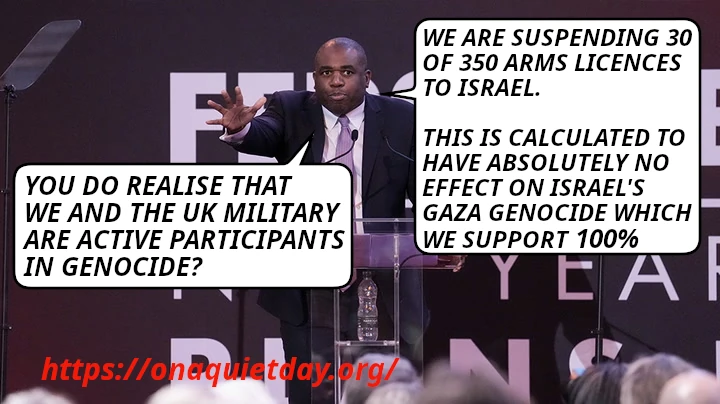
    Genocide denying UK Foreign Secretary David Lammy says that UK is suspending 30 of 350 arms licences to Israel. He also confirms the UK government's support for Israel's Gaza genocide and the UK government and military's active participation in genocide.
    Genocide denying UK Foreign Secretary David Lammy says that UK is suspending 30 of 350 arms licences to Israel. He also confirms the UK government’s support for Israel’s Gaza genocide and the UK government and military’s active participation in genocide.

  • Heavy rains flood tents sheltering displaced Gazans for 3rd day

    Spread the love

    This work by Middle East Monitor is licensed under a Creative Commons Attribution-NonCommercial-ShareAlike 4.0 International License.

    Displaced Palestinians try to protect their belongings from damage after heavy rain in the Austrian Quarter of Khan Yunis, Gaza on November 16, 2025. [Abed Rahim Khatib – Anadolu Agency]

    Dozens of tents sheltering displaced families have been flooded by rainwater in the Al-Mawasi area of Khan Younis in the southern Gaza Strip, the Civil Defence said Sunday, Anadolu reports.

    For the third consecutive day, Gaza has been affected by a weather depression accompanied by cold air, rain, and strong winds, with meteorological forecasts expecting it to subside by Sunday evening.

    Stormy winds have caused thousands of tents to collapse or be blown away, leaving families staying on the streets and forcing many to seek shelter inside destroyed buildings that pose serious safety risks.

    In a statement, the Gaza Civil Defence renewed warnings about the “risk of destroyed, structurally unstable buildings collapsing on their occupants” due to heavy rain and winds.

    “We have recorded a large-scale disaster caused by the storm that hit Gaza amid the massive destruction inflicted by Israel during two years of genocide,” spokesman Mahmoud Basal said.

    READ: Israel returns remains of 15 more Gazans under ceasefire deal, Health Ministry

    He appealed to the international community to assume its responsibilities and provide urgent relief to Palestinians in Gaza.

    “Every passing second brings more harm and pain to the Palestinian people.”

    According to the Gaza Media Office, 1.5 million Palestinians are displaced in Gaza, living in catastrophic conditions with little access to basic necessities and severely limited essential services due to Israel’s ongoing blockade.

    Israel has killed more than 69,000 people, mostly women and children, in attacks in Gaza since October 2023 and reduced it to rubble.

    This work by Middle East Monitor is licensed under a Creative Commons Attribution-NonCommercial-ShareAlike 4.0 International License.

    Keir Starmer objects to criticism of the IDF. He asks how could anyone object to them starving people to death, forced marches like the Nazis did, bombing Gaza's hospitals and universities, mass-murdering journalists, healthworkers and starving people queuing for food, killing and raping prisoners and murdering children. He calls for people to stop obstructing his genocide for Israel.
    Keir Starmer objects to criticism of the IDF. He asks how could anyone object to them starving people to death, forced marches like the Nazis did, bombing Gaza’s hospitals and universities, mass-murdering journalists, healthworkers and starving people queuing for food, killing and raping prisoners and murdering children. He calls for people to stop obstructing his genocide for Israel.
    Orcas discuss Genocide-supporting and complicit Zionists. Donald Trump, Keith Starmer, David Lammy, Rachel Reeves, Angela Rayner and Wes Streeting are acknowledged as evil genocide-complicit and supporting cnuts.
    Orcas discuss Genocide-supporting and complicit Zionists. Donald Trump, Keith Starmer, David Lammy, Rachel Reeves, Angela Rayner and Wes Streeting are acknowledged as evil genocide-complicit and supporting cnuts.
    Genocide denying UK Foreign Secretary David Lammy says that UK is suspending 30 of 350 arms licences to Israel. He also confirms the UK government's support for Israel's Gaza genocide and the UK government and military's active participation in genocide.
    Genocide denying UK Foreign Secretary David Lammy says that UK is suspending 30 of 350 arms licences to Israel. He also confirms the UK government’s support for Israel’s Gaza genocide and the UK government and military’s active participation in genocide.

  • Israel presses US to soften UN draft that references Palestinian self-determination, statehood

    Spread the love

    This work by Middle East Monitor is licensed under a Creative Commons Attribution-NonCommercial-ShareAlike 4.0 International License.

    UN Security Council (UNSC) on September 23, 2025, in New York City, USA. [Selçuk Acar – Anadolu Agency]

    Israel presses the US to soften the wording of an American draft resolution that the UN Security Council is set to vote on Monday, which mentions “self-determination and the establishment of a Palestinian state,” Israeli media reported Sunday, Anadolu reports.

    Tel Aviv is making “last-minute efforts to change the wording of the proposal that will be approved tomorrow in the Security Council regarding the multinational force that will deploy in the Gaza Strip,” Israel’s public broadcaster KAN said.

    Aides to Prime Minister Benjamin Netanyahu and senior officials at the Foreign Ministry have been holding discussions with the team of US President Donald Trump and Arab leaders “to ease the language of the expected resolution,” it added.

    According to the broadcaster, Israeli officials believe the Palestinian Authority will not meet the terms of Trump’s plan for establishing a Palestinian state, which requires “comprehensive reform.” Even so, they describe the draft as “dangerous” and warn that it could lead to unpredictable outcomes.

    The report did not specify the format Israel seeks to see adopted.

    Washington is promoting the draft resolution, which calls for deploying a multinational force in Gaza under a ceasefire between Israel and Hamas that has been in effect since Oct. 10.

    The text says that “conditions may finally be in place for a credible pathway to Palestinian self-determination and statehood” after the Palestinian Authority undergoes reforms.

    It also says the US will initiate dialogue between Israel and the Palestinians to reach a political horizon for peaceful coexistence, according to KAN.

    The outlet said the draft specifies that the multinational force would work with Israel and Egypt to stabilize Gaza and replace Hamas governance and the presence of the Israeli army in the area.

    It also envisions a trained Palestinian police force operating in Gaza to help secure the borders.

    On Sunday, Israeli Defense Minister Israel Katz and Foreign Minister Gideon Saar joined Finance Minister Bezalel Smotrich and National Security Minister Itamar Ben-Gvir in rejecting the establishment of a Palestinian state.

    READ: US Rep. Greene questions Israeli ties to Epstein, says feud with Trump stems from files push

    – Netanyahu rejects statehood

    Hours before the scheduled vote, Netanyahu doubled down on his opposition to any form of Palestinian statehood.

    “My opposition to the establishment of a State of Palestine has not changed. It stands and remains,” Netanyahu said at the start of Sunday’s weekly Cabinet meeting, as cited by a statement from his office.

    He said Gaza “will be demilitarized, and Hamas will be dismantled.”

    “I have confronted these attempts for many years, and I am doing so now against pressure from outside and from within,” he said.

    Against the backdrop of the Israeli war on Gaza, several countries recognized Palestinian statehood during UN meetings in September, bringing the total to 160 of the UN’s 193 member states, according to the Palestinian Foreign Ministry.

    Israel has killed more than 69,000 people, mostly women and children, in attacks in Gaza since October 2023 and reduced it to rubble.

    Israel continues to occupy Palestinian territory, as well as land in Syria and Lebanon, and opposes the creation of a sovereign Palestinian state on lands occupied in 1967.

    This work by Middle East Monitor is licensed under a Creative Commons Attribution-NonCommercial-ShareAlike 4.0 International License.

    Keir Starmer objects to criticism of the IDF. He asks how could anyone object to them starving people to death, forced marches like the Nazis did, bombing Gaza's hospitals and universities, mass-murdering journalists, healthworkers and starving people queuing for food, killing and raping prisoners and murdering children. He calls for people to stop obstructing his genocide for Israel.
    Keir Starmer objects to criticism of the IDF. He asks how could anyone object to them starving people to death, forced marches like the Nazis did, bombing Gaza’s hospitals and universities, mass-murdering journalists, healthworkers and starving people queuing for food, killing and raping prisoners and murdering children. He calls for people to stop obstructing his genocide for Israel.
    Orcas discuss Genocide-supporting and complicit Zionists. Donald Trump, Keith Starmer, David Lammy, Rachel Reeves, Angela Rayner and Wes Streeting are acknowledged as evil genocide-complicit and supporting cnuts.
    Orcas discuss Genocide-supporting and complicit Zionists. Donald Trump, Keith Starmer, David Lammy, Rachel Reeves, Angela Rayner and Wes Streeting are acknowledged as evil genocide-complicit and supporting cnuts.
    Genocide denying UK Foreign Secretary David Lammy says that UK is suspending 30 of 350 arms licences to Israel. He also confirms the UK government's support for Israel's Gaza genocide and the UK government and military's active participation in genocide.
    Genocide denying UK Foreign Secretary David Lammy says that UK is suspending 30 of 350 arms licences to Israel. He also confirms the UK government’s support for Israel’s Gaza genocide and the UK government and military’s active participation in genocide.