This work by Middle East Monitor is licensed under a Creative Commons Attribution-NonCommercial-ShareAlike 4.0 International License.
Al-Qassam Brigades hand over 3 female Israeli hostages to Red Cross at al-Saraya as part of 1st phase of ceasefire and prisoner swap deal between Israel and Hamas, in Gaza City, Gaza on January 19, 2025 [Dawoud Abo Alkas – Anadolu Agency]
A senior official in the Hamas movement, Taher Al-Nounou, has confirmed that the group has agreed to release 10 Israeli captives currently held in Gaza in order to guarantee the delivery of humanitarian aid and bring an end to the ongoing war on the Strip.
In remarks made to the press on Wednesday, Al-Nounou said that Hamas is showing a high degree of flexibility during the current negotiations taking place in the Qatari capital, Doha, and is responding positively to mediators.
He noted that this round of talks faces serious challenges, but stressed that the movement remains committed to its core demands, foremost among them the full withdrawal of Israeli forces from Gaza and a comprehensive end to the aggression.
He emphasised that Hamas’s primary goal in any negotiations is to safeguard the interests of the Palestinian people and stop what he described as “the crime of genocide”, while also ensuring that humanitarian aid can enter Gaza freely and with dignity.
Al-Nounou pointed out that the flexibility Hamas has demonstrated in dealing with proposals from mediators has been one of the main reasons for progress in the talks. He confirmed that the decision to release the Israeli prisoners falls within this humanitarian and political context.
Stressing the importance of international guarantees, Al-Nounou noted that the United States holds real leverage over Israel to end the war, and could compel it to adhere to any agreement reached—if it exercises the political will to do so.
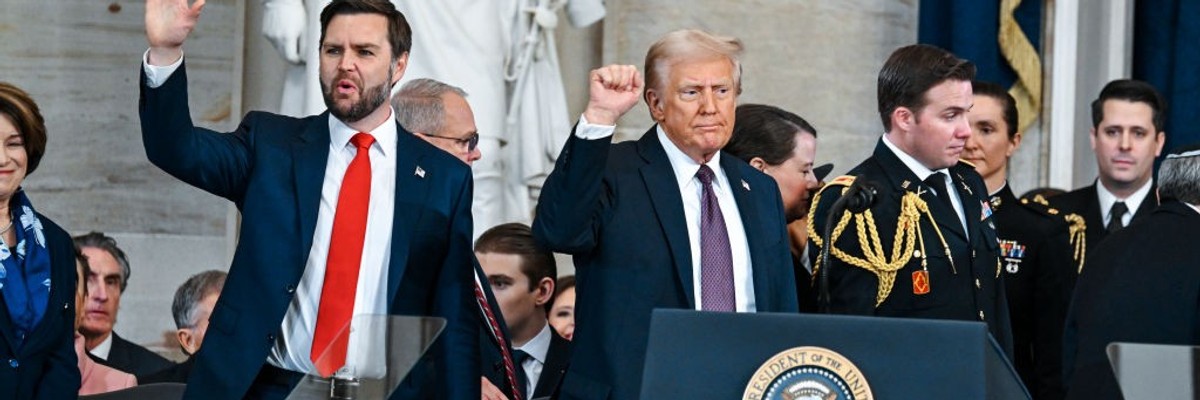
U.S. President Donald Trump and Vice President JD Vance acknowledge the crowd after Trump’s second inauguration in the U.S. Capitol Rotunda on January 20, 2025 in Washington, D.C. (Photo: Kenny Holston/Pool/Getty Images)
“Every month that Donald Trump has been in power, we’ve seen a raft of anti-climate measures come out which are music to the fossil fuel industry’s ears,” said one investigator.
Oil, gas, and coal companies and individuals linked to the climate-wrecking fossil fuel industry contributed more than $19 million to U.S. President Donald Trump’s second inaugural fund, an analysis by a leading international environmental and human rights group revealed Wednesday.
Scouring itemized U.S Federal Election Commission data, Global Witness identified 47 individual donations to the Trump-Vance Inaugural Committee between November 2024 and January 2025 totaling $19,151,933. Using an artificial intelligence tool developed by Global Witness to identify corporate lobbyists, the group’s researchers were able to automatically determine each donor’s ties to the fossil fuel industry.
SUBSCRIBE TO OUR FREE NEWSLETTER
Quality journalism. Progressive values. Direct to your inbox.
Global Witness said the $19.15 million figure “is likely an underestimate, as we did not count donations from diversified investors and businesses who couldn’t be said to primarily represent the fossil fuel industry,” and individuals with common names that couldn’t be identified were not included in the final report.
According to the analysis:
The list of donors includes individuals who were given ambassadorships or key positions in the Trump Cabinet.
For example, billionaire Warren Stephens donated $4 million on December 2, 2024, the same day Trump nominated him to be U.S. ambassador to the U.K. Stephens has extensive links to the oil and gas industry but also invests in other sectors and wasn’t included in our calculations of fossil fuel industry donors.
Trump also nominated Melinda Hildebrand—who donated $500,000 to the president’s inaugural fund—to be U.S. ambassador to Costa Rica.
Hildebrand is the vice president of Hilcorp Ventures, which claims to be of the largest privately owned oil and gas producers in the U.S. Her husband, founder and chairman of Hilcorp, donated another $500,000.
Among fossil fuel corporations, Chevron was by far the largest contributor to Trump’s inauguration fund, giving $2 million. Other companies including ExxonMobil, ConocoPhillips, and Occidental Petroleum each donated $1 million.
Overall, Big Oil gave $445 million to Trump and other Republican candidates during the 2024 election cycle.
Trump accepted over $23 million from Fossil Fuel Lobby & Big Oil independently spent $445 million in 2024 elections.
In return Trump eroded our environmental regulations, hired a Fossil Fuel Executive as his Energy Secretary & let Musk defund FEMA. He is responsible for this ⤵️ https://t.co/wZuqUUbf9hpic.twitter.com/rKoRPTnive
Trump, who ran on a “drill, baby, drill” energy policy, has signed a series of executive orders aimed at boosting fossil fuel production, including by declaring a fake “energy emergency” in a push to fast-track permit approvals. He also tapped former fossil fuel executives to head the Department of Energy and Interior Department, which have pursued a policy of opening up more public lands and waters for fossil fuel development.
At the same time, the Trump administration dropped out of the Paris climate agreement for the second time and moved to roll back the modest climate progress achieved under former President Joe Biden.
“It’s no surprise the oil and gas industry handed millions to Donald Trump for his inauguration, and they seem to have reaped a huge return on their investment,” Global Witness senior data investigator Nicu Calcea said in a statement Wednesday.
“Every month that Donald Trump has been in power, we’ve seen a raft of anti-climate measures come out which are music to the fossil fuel industry’s ears,” Calcea continued. “From plans to steamroll through dirty new coal plants, to the attempted quashing of ‘polluter pays’ laws that would hold oil giants accountable, it’s clear where his political priorities lie.”
“While Trump sides with his friends in oil and gas, we must keep up the fight for a fair, green future—that means pushing for wind and solar where we live, backing polluters pay bills, and resisting the development of oil, gas and coal projects across the country,” he added.
Donald Trump urges you to be a Climate Science denier like him. He says that he makes millions and millions for destroying the planet, Burn, Baby, Burn and Flood, Baby, Flood.Nigel Farage urges you to ignore facts and reality and be a climate science denier like him. He says that Reform UK has received millions and millions from the fossil fuel industry to promote climate denial and destroy the planet.Neo-Fascist Climate Science Denier Donald Trump says Burn, Baby, Burn.
COP30 President André Corrêa do Lago speaks to journalists at a press conference to launch an open letter on work towards the COP30 climate summit in Belem, Brazil. (Photo: Rafa Neddermeyer/ COP30 Amazônia/PR)
In an exclusive interview, André Corrêa do Lago says negotiators can work out rules or a timeline for the energy transition, but it’s up to countries to act on what they agreed
When it comes to the most important thing to curb climate change – moving away from planet-heating fossil fuels – governments have done enough negotiating, and their focus now should be on putting what they already agreed into practice, Brazil’s COP30 president told Climate Home News.
That does not require repeating language in new UN texts or even consensus among countries about how to transition from coal, oil and gas, although they could choose to design a roadmap for that energy shift at this year’s climate summit in the Amazon, André Aranha Corrêa do Lago said in an exclusive interview.
…
Brazil’s environment minister Marina Silva at a press conference in London. (Photo: Credit: Isabela Castilho / COP30 presidency)
The COP30 president emphasised that while this is up to governments, “we can’t keep the world waiting for negotiations to move forward” before acting to transition away from fossil fuels in energy systems.
“It’s not true that it depends on that. There’s already enough approval from countries. Individual countries can do it because implementation isn’t by consensus. Implementation is that each country does what it thinks it can do,” he explained.
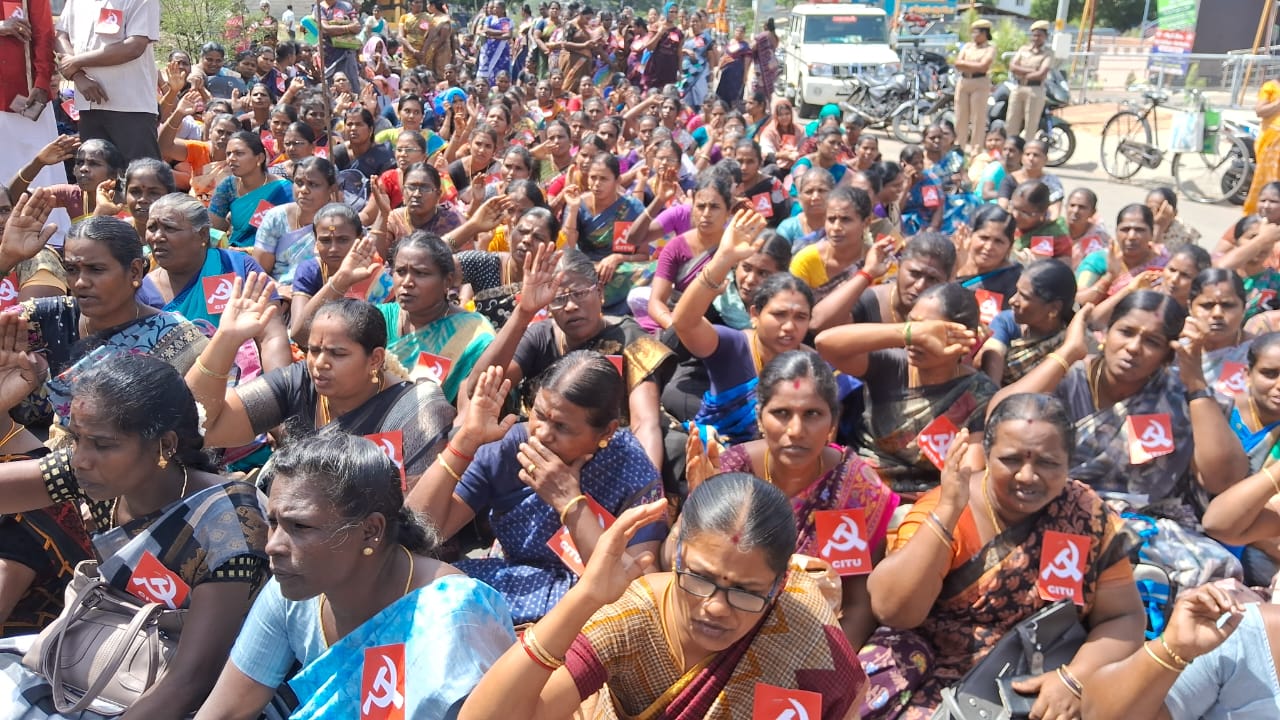
The strike was called by the trade unions and farmers groups against anti-workers labor codes and failures of the government to enact a legal support price for farm products.July 09, 2025 by Abdul Rahman
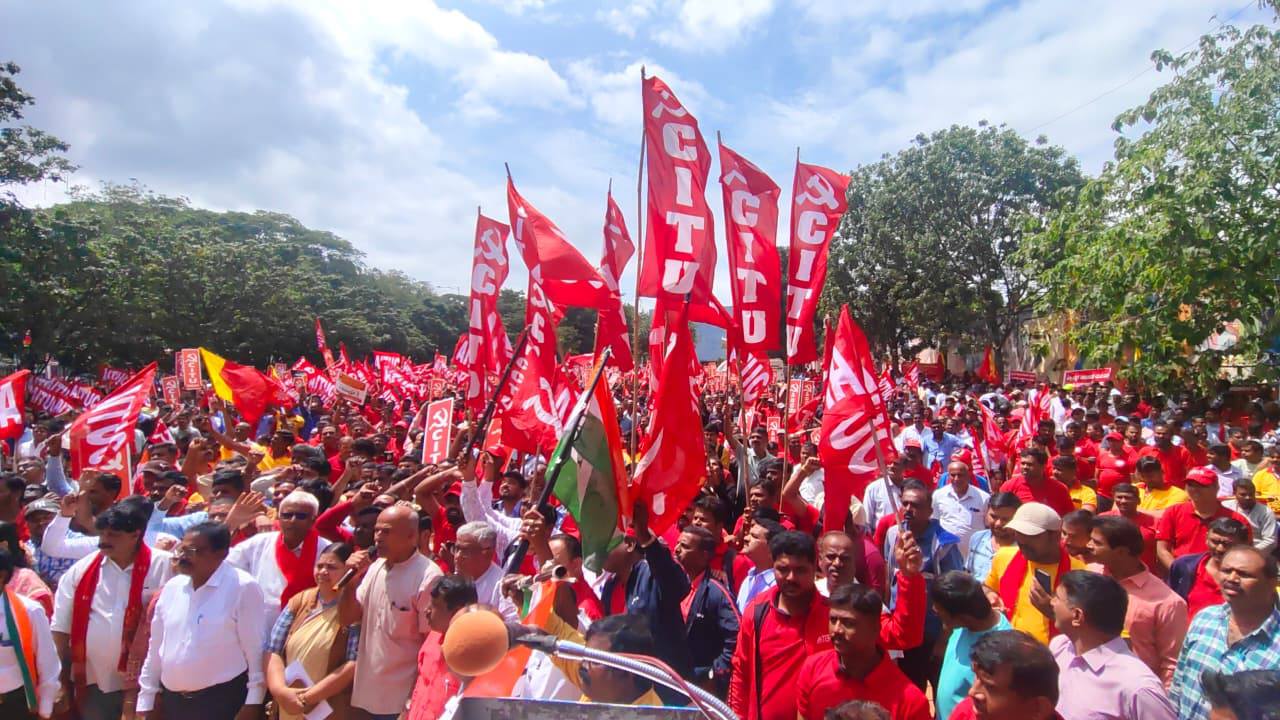
National strike against the “anti-worker” labor codes of the Modi government on July 9. Photo: CPI(M)
Millions took to the streets all over India on Wednesday, July 9, to observe a national strike call made by Central Trade Unions (CTU). They are striking against the anti-worker policies adopted by the ultra-right-wing government in the country.
CTU is a platform of all the major trade union federations in the country, spanning the ideological and political spectrum. It includes the Center for Indian Trade Unions (CITU), the All India Trade Union Congress (AITUC), the Indian National Trade Union Congress (INTUC) and several others.
The strike was also supported by all the major groups of farmers, students, women, and various professional unions such as teachers, journalists, and IT employees in the country.
According to various estimates, more than 250 million workers and farmers – both in organized and unorganized sectors – directly participated in the strike and protests across the country.
Workers in other organized sectors such as ports, airports, and banking also participated alongside those in various public sectors.
The strike affected most of the industrial activities in the country, particularly industries related to mining.
In several places, workers blocked the movement of trains, blocked highways, and picketed factory gates to mobilize greater support. In some cases, such as the Kochi refinery in the southern state of Kerala, workers defied court orders and observed the strike.
A total shut down of all major business was observed in various states in the country such as Kerala, Tripura, Bihar, Jharkhand, and others.
Anti-worker labor codes must be withdrawn
The workers were demanding immediate withdrawal of the new labor codes enacted by the ultra-right-wing government led by Narendra Modi at the center in 2020. CTU claims the four new labor codes are anti-worker, depriving them of their basic rights, including the right to collective bargaining, which was won through a historic and painful worker’s struggle.
The other major demands include:
The end of the privatization and contractualization of jobs
A national minimum wage of Rs. 26,000 (USD 303)
Improvements in working conditions across all sectors for all kinds of workers
The strike also supported the demands raised by the country’s major farmers groups, led by the Samyukta Kisan Morcha (SKM), for a legal minimum support price for all farm produce, the waiving of loans for farmers, an end to all forced land acquisition, and better employment opportunities.
The strike was originally scheduled for May 19. It had to be postponed following the war-like situation in the region created after India attacked several locations inside neighboring Pakistan, accusing it of supporting armed groups who carried out attacks on tourists in Pahalgam.
Popular action defeats government lies
A central protest rally was held in the national capital Delhi. The protest was attended by all the constituents of CTU and SKM, the farmers collective which has extended support to the strike.
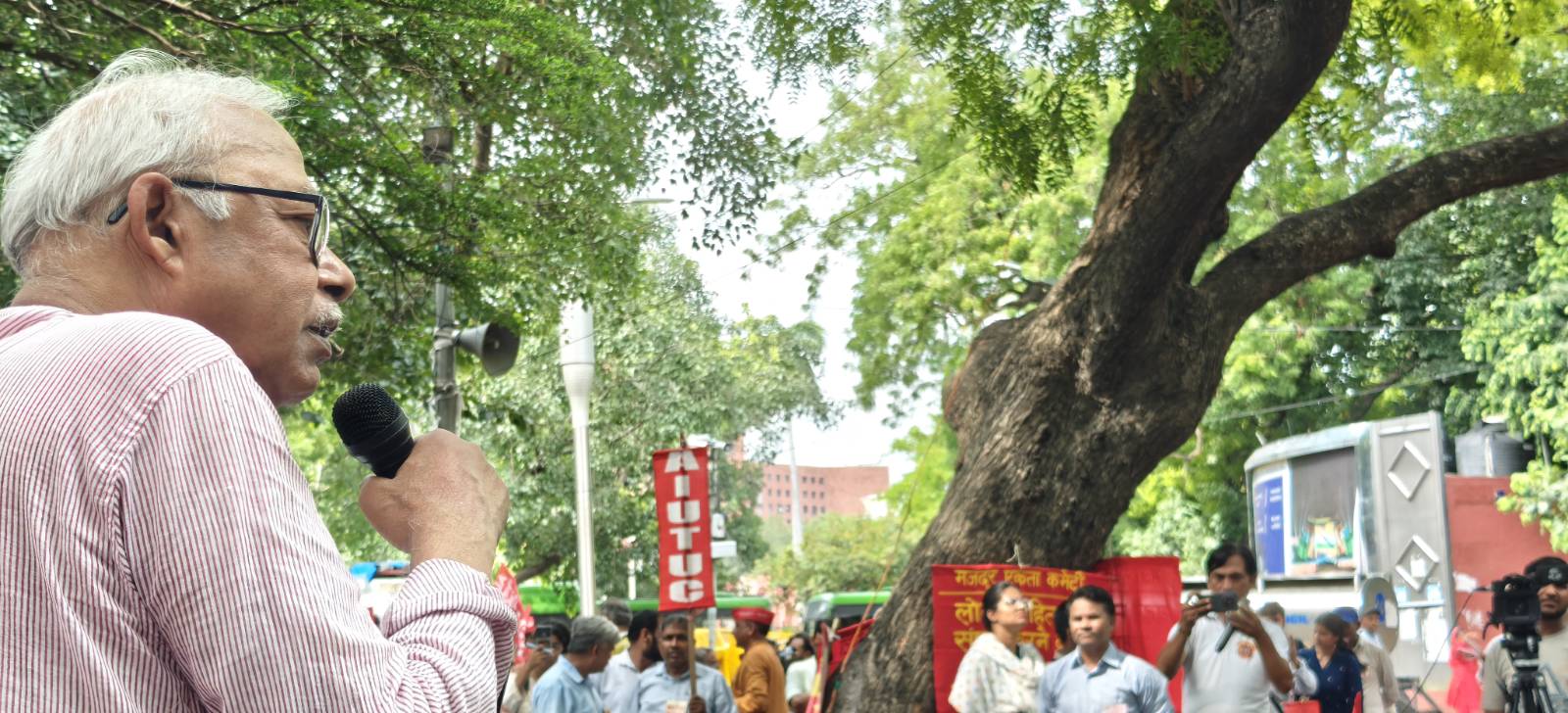
CPI(M) Politburo Member and CITU General Secretary Tapan Sen addresses a strike demonstration in Jantar Mantar, New Delhi. Photo: CPI (M)
Addressing the rally, Tapan Sen, general secretary of CITU and a member of the Communist Party of India (Marxist) polit bureau, claimed that the success of the strike demolishes the myths created by the Modi government about the so-called economic prosperity his government’s policies have created.
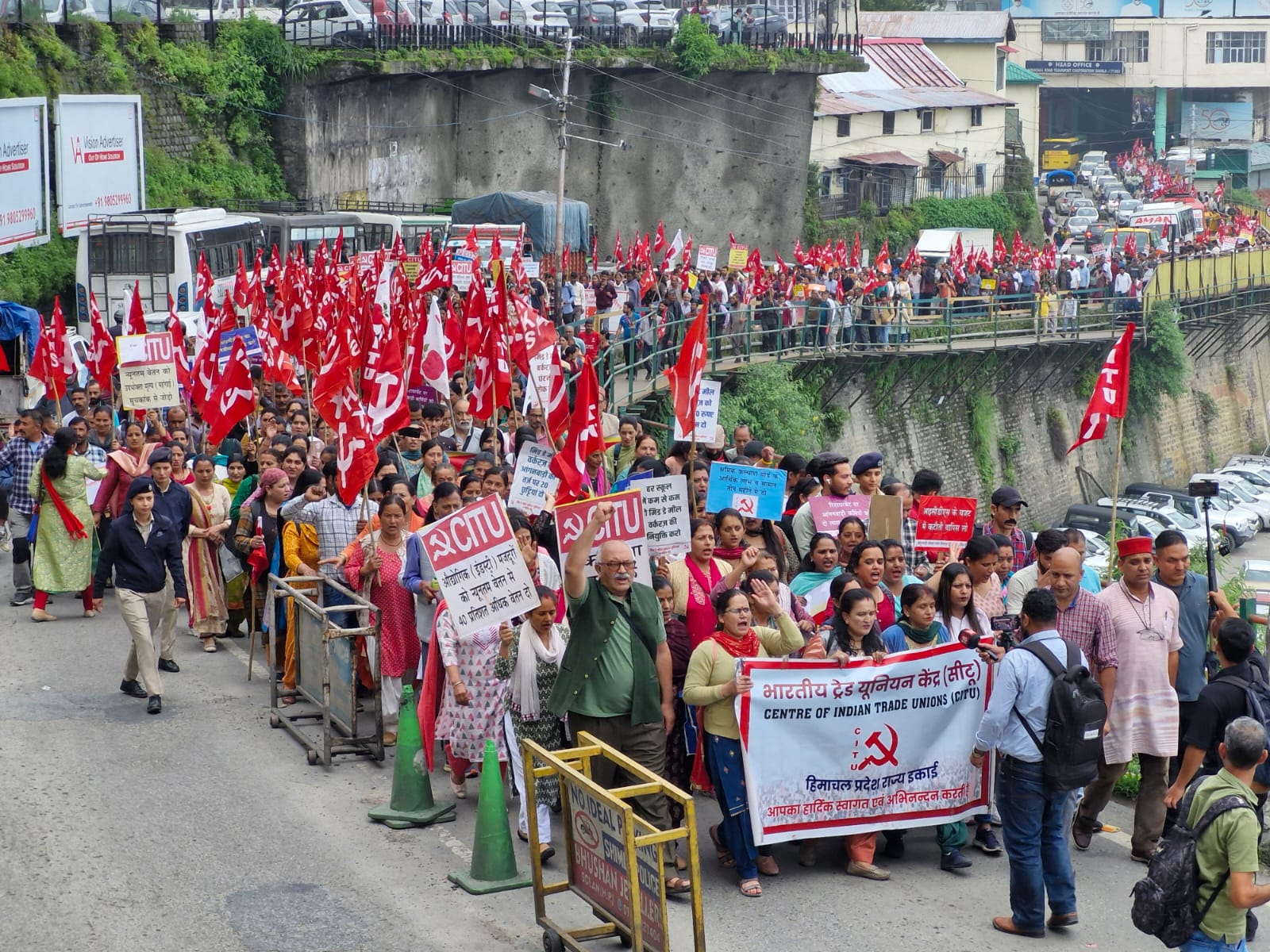
Strike demonstration in Shimla, Himachal Pradesh. Photo: CPI (M)
Most Indians today are struggling to find a decent source of livelihood and those who have one are struggling to protect it from the effects of the various wrongful and pro-corporate policies of the Bharatiya Janata Party (BJP)-led government, Sen underlined.
The lies about India being the third or fourth largest economy in the world, propagated by the present government in the country and magnified by the complicit media, have been exposed by the sheer number of people who participated in today’s strike. It establishes the fact that under Modi’s decade-long rule the condition of the working classes in India has gone from bad to worse, Sen told the protesters gathered at the rally.
Photo: CPI(M)
Sen also warned the government against going ahead with the proposed trade deal with the US, claiming that would further compromise the interest of workers and farmers in India.
Amarjeet Kaur, general secretary of the AITUC, claimed that the BJP used pro-government unions to divide the working classes in the country and falsely called the strike “illegal”.
“The attempts to divide the working class, so that the interest of its corporate bosses are protected, was defeated by the successful strike” Kaur declared. She noted that this was the fourth such strike since 2020 and more such strikes will happen in the future, with more intensity, if the government fails to correct its ways and take back the four draconian labor codes, and enact laws which really benefit the working classes of this country.
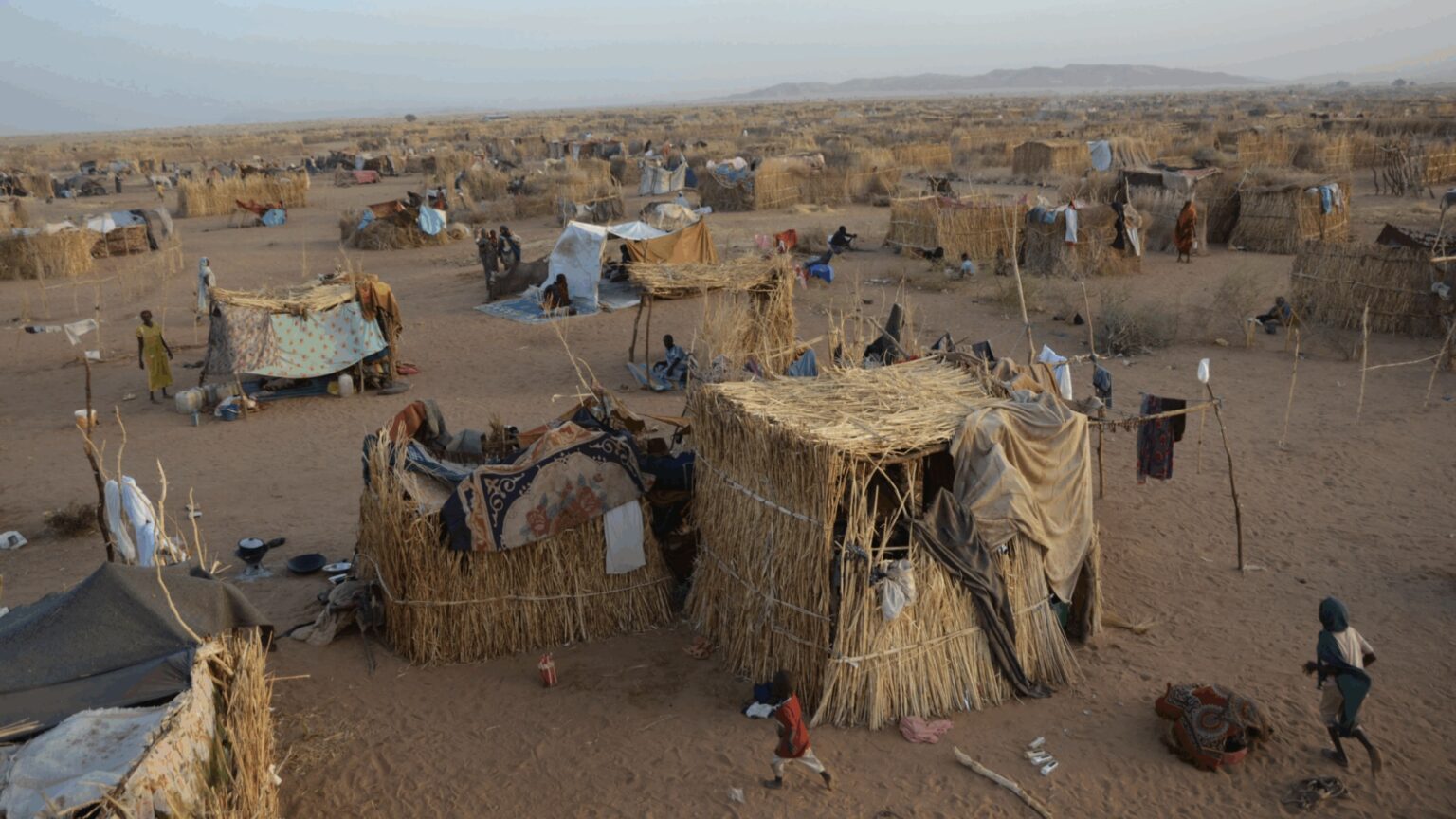
Over 400,000 people were forced to flee to El Fasher from the Zamzam refugee camp due to RSF ground operations. Photo: Doctors Without Borders
The specter of ethnic cleansing looms over hundreds of thousands trapped without food, water, or medicines in the North Darfur state’s besieged capital, El Fasher.
Nearly half a million people were forced to flee from North Darfur state’s capital, El Fasher, and the nearby Zamzam camp for displaced people in just the two months of April and May, the UN Secretary-General’s spokesperson, Stéphane Dujarric, said in a press briefing on Monday, July 7.
North Darfur is the only one of the five states where the Sudanese Armed Forces (SAF) have retained a foothold in the war-torn Sudan’s vast western region of Darfur, overrun by its rival, the paramilitary Rapid Support Force (RSF), within six months of the war’s start in April 2023.
Moving against this last holdout, the RSF laid siege in May 2024 on El Fasher, where the SAF has a base, and the Zamzam camp on its outskirts, where some of the local self-defense units allied with the SAF are positioned.
“People are not only caught in indiscriminate heavy fighting between” the two warring forces, but are also being “actively targeted by the RSF and its allies, notably on the basis of their ethnicity,” Michel Olivier Lacharité, MSF head of emergencies, said on July 3.
SAF created the RSF in Darfur
The RSF was coalesced in 2013 from the militias the SAF had spawned from Arabic-speaking nomadic communities to perpetrate mass atrocities on the regional-language-speaking groups of sedentary farmers that supported the rebel groups during the Darfur civil war in the 2000s.
The partnership between SAF and the RSF lasted a decade, during which they seized power together to form a military junta in 2019, when mass pro-democracy protests forced the ouster of Omar al-Bashir after a 30-year-long dictatorship.
The duo deployed its troops to jointly repress the militant protests that continued until April 15, 2023, when the intensifying power struggle within the junta between the two forces crossed the Rubicon, mobilizing their forces against each other and hurling the country into a civil war.
IDPs under attack
Now continuing into its third year, the civil war has claimed an estimated 150,000 lives and displaced nearly 13 million people, unleashing in this poor North African country the world’s worst displacement crisis.
Over three million of the displaced have fled to other countries as refugees. An estimated 8.6 million have remained as Internally Displaced People (IDPs). Darfur, which already had almost 3.1 million IDPs from the regional civil war in the 2000s, was among the worst-affected regions by this new war.
The RSF maneuvered quickly to take control over this region, starting with West Darfur, where it committed ethnically targeted massacres in June 2023 against the Masalit community, most of whom were displaced in the Darfur civil war. Ethnic cleansing of this community from West Darfur was nearly complete by November that year.
By then, the RSF had taken over most of the region, with North Darfur as the SAF’s only holdout. Members of the state’s Zaghawa community, which had until then remained neutral, volunteered in large numbers to form self-defense units that aligned themselves with the SAF.
“In light of the ethnically motivated mass atrocities committed on the Masalit in West Darfur… MSF fears such a scenario will be repeated in El Fasher – notably because witnesses report that RSF soldiers spoke of plans to ‘clean El Fasher’ of its non-Arab, and especially Zaghawa, community,” MSF said in a report released on July 3.
Titled “Besieged, attacked, starved: Mass atrocities in El Fasher“, the report added: “Aside from the direct violence exerted on civilians, residents from El Fasher and surrounding areas [also] have been prevented from meeting their basic needs.”
Famine
The RSF’s siege since last May has cut off the city and its surrounding localities from supplies. Its markets have been repeatedly bombed by both sides. At the Zamzam camp located seventeen kilometers south of El Fasher, a famine was declared in August 2024.
Among the largest IDP camps in the country, it was already sheltering about 350,000 displaced people from the Darfur civil war. With new displacements from this intra-junta civil war, IDPs nearly doubled in Zamzam. Its meagre resources in the form of aid were already stretched when its supply was cut off by the RSF’s siege in May 2024.
“When fighting erupted in Zamzam in December 2024 and then intensified at the end of January and in February 2025, the camp was hosting … up to 700,000,” MSF’s report added.
Most of them had to flee again, for the second, even third time, after the RSF’s large-scale ground offensive this April, displacing over 400,000 in three weeks, according to the International Organization for Migration (IOM).
“A large proportion of the population fled to El Fasher, where they remained trapped, out of reach of humanitarian aid and exposed to attacks and further mass violence,” the report warns.
No escape for the Zaghawa community
Over 68,000 others have fled across the western border to Chad, according to the UN Refugee Agency (UNHCR). No one identified as Zaghawa was let through the RSF checkpoints, multiple survivors told the MSF. “They would only let mothers with small children under the age of five through,” said one of the refugees interviewed in Chad.
“Other children and adult men didn’t go through. Males over fifteen can hardly cross the border [into Chad]. They take them, they push them aside, and then we only hear a noise, gunshots … Fifty families came along with me. Not even one boy of 15 years old or above.. [is] among us” in Chad.
“The number of people killed and injured” in the RSF’s offensive on Zamzam is “unknown”, the report said, adding “with no functional hospital within the camp, most of the wounded had no access to life-saving medical assistance.”
“Access to healthcare has been rendered near impossible, as most healthcare infrastructure has been partially or completely damaged.” MSF’s own medical facilities have been attacked over a dozen times since last May.