Category: politics

  • What public-private-partnership scandals can tell us about wrongdoing in the water industry

    Spread the love
    Jory Mundy/Shutterstock.com

    Daniel Fisher, University of Sussex

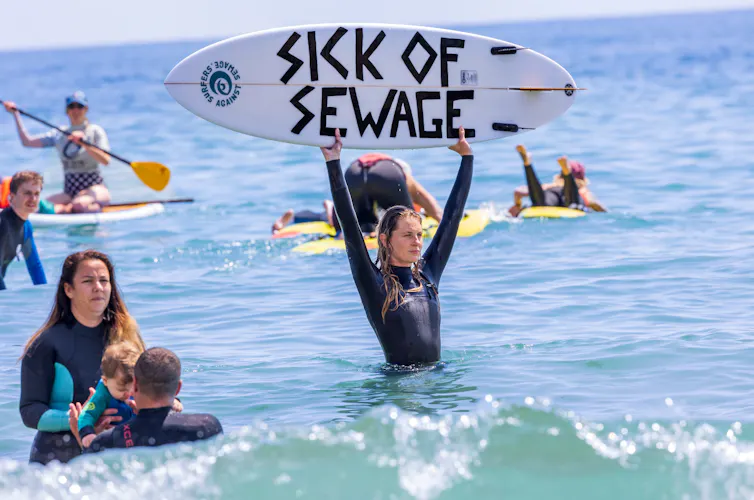
    Water bills are going up in England and Wales, even after the series of scandals around water companies. Last year water firms paid £158 million in fines following a record-breaking number of sewage dumps in rivers and seas.

    Severn Trent Water and United Utilities alone reportedly made 1,374 illegal sewage spills over two years. (Both companies took issue with the analysis that led to this figure but acknowledged concerns about sewage discharges.)

    There have been other notable incidents. Whistleblowers have told of water companies that fail to treat legally required amounts of sewage and divert that sewage to public waterways. To add to the disgrace, water companies have generally failed to invest enough in the UK’s water infrastructure.

    Research suggests that governments have been pressured to become more “business-like”. This has given rise to the use of public-private partnerships (PPPs) to run important public services, such as water, transport and even prisons. Water companies in England and Wales are private companies that bid for their contracts, while in Scotland, the water provider is a public organisation.

    While other findings show that PPPs can support important public service needs, such as public health, research by my colleagues and I examines a consistent pattern in UK PPP scandals and wrongdoing. Over the past decade and a half, billions of pounds of taxpayers’ funds are unaccounted for. This appears to be largely because private interests have been prioritised over public needs.

    As a researcher of PPP wrongdoing, the reasons for many of the scandals seem obvious. My colleagues and I studied parliamentary inquiries and reports that have scrutinised PPP wrongdoing. This research can tell us a great deal about the UK’s predicament with regard to the failings in the water industry.

    The first lesson is that, in general, many PPPs are motivated actually to reduce the quality of the services they deliver. One parliamentary inquiry found that contracting services out from the public to the private sector had become a “transactional process” where cost-cutting is favoured and the “knock-on cost” to users results in a lower-quality public service.

    Other findings showed that companies regularly reduced the quality of a service to maximise profits. One way was to bid for a public service at a low price. A Public Accounts Committee member observed that companies coming in with low quotes for contracts can end up damaging services by under-investing in them.

    Another example is Sodexo – a private prison management provider. It cut employee numbers by around 200 and a subsequent BBC Panorama documentary detailed escapes and widespread drug use in the prisons they managed and also criticised a lack of safety for both prisoners and prison officers. Sodexo acknowledged the programme had highlighted problems and said it would investigate, but added that there had been “positive actions and improvements” already.

    Similar practices were observed at a children’s prison run by security firm G4S, where an officer was left with brain damage after an attack by inmates. G4S admitted liability for the officer’s injuries and agreed a settlement with him.

    Pay the fine, it’s cheaper

    The second lesson is it can be cost-effective to breach contracts and pay fines. Companies sometimes breach the terms of their public-private contracts because it’s in their economic interest. This even has a name – economists call it “efficiency breach”.

    For instance, a parliamentary report found that between 2010 and 2016 G4S was fined 100 times for breaching contracts – paying out roughly £3 million. As one MP suggested, these fines compared to its profits are a “slap on the wrist”. The same has been said of water companies.

    When observing the fines in comparison to the profitable contracts, it’s easy to posit what the motivations of many in the UK’s public service system are. In 2017, despite previous indictments of wrongdoing, G4S won £25 million of government contracts.

    In 2020 the firm won another £300 million contract to run Wellingborough “mega-prison” in England. Despite some raised eyebrows, G4S said at the time it aimed to make the site a blueprint for “innovation, rehabilitation and modernisation” in the prison service.

    Pay the shareholders, invest later

    The third lesson is that shareholders are more important than long-term investments in a service. This is perhaps the most notable feature of the UK’s public service system, where a vast array of shareholders benefit from the profits made by PPPs. In one of the parliamentary reports we analysed, which details the collapse of the facilities management firm Carillion, it was clear that shareholders’ interests trumped good management and long-term investment.

    As was noted in the report, despite Carillion’s collapse, the firm paid out £333 million more to shareholders than it generated in cash between 2012 and 2017. Often, this shareholder primacy can even go against a firm’s own employees rather than just the state and taxpayers. One MP noted that despite its pension scheme being in deficit, shareholders were still receiving dividends.

    Often, shareholders are prioritised because of short-term thinking. These processes can lead to firms passing these bad practices down their supply chains.

    The behaviour of water companies is suggestive of these dynamics. Since water companies have been privatised, they have loaded themselves up with debt (£64 billion) but paid out £78 billion to shareholders. Some 70% of these shareholders are “foreign investment firms, private equity, pension funds and businesses lodged in tax havens”.

    aerial shot of Bantham beach and estuary, Devon
    Water companies could give the UK’s rivers, estuaries and seas representation at board level. jimcatlinphotography.com/Shutterstock

    So what should be done? There are plenty of ways to enhance and improve the UK’s PPP problems. The most obvious may be to renationalise public services and renew the quality of public services through New Deal-style investments. After all, this is what what most of the UK electorate wants.

    There are other options. An innovative and exciting frontier is opening for businesses to recognise their environmental responsibilities – initiatives in New Zealand, India and Ecuador are giving the status of personhood to rivers and ecosystems, for example.

    Outdoor fashion brand Patagonia has “the Earth” as its only shareholder, and hair and skincare brand Faith in Nature has appointed nature to its board. Imagine if the UK’s water companies had the rivers and seas represented.

    In the end, only time will tell how water companies will be held accountable. But for the moment it’s the UK taxpayer and consumer paying the price.

    G4S was approached about this article but declined to comment.

    Daniel Fisher, Assistant Professor in Management, University of Sussex

    This article is republished from The Conversation under a Creative Commons license. Read the original article.
  • Greens say Labour are “plumbing new depths” with filmed immigration raids

    Spread the love
    Image of the Green Party's Carla Denyer on BBC Question Time.
    Image of the Green Party’s Carla Denyer on BBC Question Time.

    Responding to the news that Labour are now publishing videos of police immigration raids, Green Party Co-Leader, Carla Denyer MP, said:

    “This Labour government are plumbing new depths with their plan to broadcast footage of people being detained and deported. Those involved should be searching their consciences to ask if such breath-taking cruelty is really worth it all for the sake of aping the rhetoric of Reform. The bitter irony is that following Reform to the right on migration won’t win Labour any support – it will only lend legitimacy to Reform’s extreme views. It’s time this government showed a bit of backbone and told the truth – that migration is good for this country.”

  • ‘He’s Building a Concentration Camp’: Fears Grow as Images Emerge of Offshore Prison at Gitmo

    Spread the love

    Original article by Jon Queally republished from Common Dreams under Creative Commons (CC BY-NC-ND 3.0).

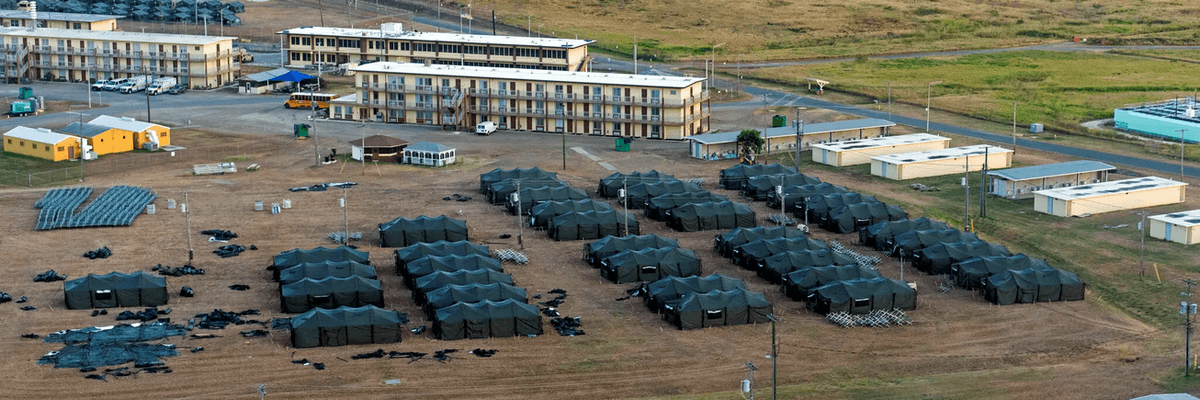
    “An open-air tent facility was rising on a field near the base’s Marine barracks,” reads the NYT caption, “housing for foreign laborers and crude sanitary stations. The edge of the base’s airfield can be seen in the distance.” (Image: Screenshot via NYTimes of photo taken by Doug Mills, embedded with Secretary of Homeland Security Kristi Noem)

    “There’s no reason to build this in Guantánamo unless you want to do things you don’t think you could get away with on the U.S. mainland. It’s easy to put tents in Florida. But they’re putting them in Cuba. Ask yourself why.”

    Fears are growing that the offshore U.S. detention facilities at Guantánamo Bay, Cuba are an ominous sign for what President Donald Trump has in store as he further disregards the rule of law and normalizes actions that previously would have been unthinkable or faced immediate, bipartisan opposition in Congress.

    After the first pictures emerged Saturday of still unidentified persons transferred to the island from the U.S. mainland by immigration officials, progressive journalist Nathan Robinson was among those raising the alarm, accusing Trump of “building a concentration camp and deliberately putting it where it is hardest to monitor or enforce the law.”

    The New York Times, alongside pictures of newly-erected tents taken by photojournalist Doug Mills, reported Saturday that the administration had already “moved more than 30 people described as Venezuelan gang members to the U.S. Navy base at Guantánamo Bay, as U.S. forces and homeland security staff prepare a tent city for potentially thousands of migrants.” Mills was traveling Friday with Kristi Noem, the secretary of homeland security, as she made her first visit to the offshore site.

    According to the outlet:

    Ms. Noem visited the nascent tent camp, where the administration has suggested that thousands, perhaps tens of thousands, of migrants who pose lesser threats could be housed. She watched Marines rehearse how to move migrants to the future tent city, and she was shown a tent with cots and a display of basic items to be provided each new arrival — T-shirt, shorts, underwear and a towel — and then got an aerial view of the mission from a Chinook helicopter.

    “The Trump administration,” the Times reported, “has not released any of their identities, though they are believed to all be men, nor has it said how long they might be held at the island outpost.”

    According to critics like Robinson, “There’s no reason to build this in Guantánamo unless you want to do things you don’t think you could get away with on the U.S. mainland. It’s easy to put tents in Florida. But they’re putting them in Cuba. Ask yourself why.”

    https://twitter.com/QasimRashid/status/1888463370275135859?ref_src=twsrc%5Etfw%7Ctwcamp%5Etweetembed%7Ctwterm%5E1888463370275135859%7Ctwgr%5Ea0ee0b8f317b71061500e60ff8c1f6048600bd0e%7Ctwcon%5Es1_c10&ref_url=https%3A%2F%2Fwww.commondreams.org%2Fnews%2Fgitmo-concentration-camp

    Sorry, this content could not be embedded.
    X

    On Friday, a coalition of more than a dozen rights groups—including the ACLU, National Immigration Law Center, and others—sent a letter today to the Department of Homeland Security (DHS), Department of Defense (DoD), and the U.S. State Department demanding Trump officials provide immediate access to those who have been transferred out of the country to the offshore facility.

    In addition, the groups demanded to know:

    • The immigration status of the ten noncitizens detained there
    • Who the government intends to transfer to and detain at Guantánamo, including what criteria, legal or otherwise, the administration is or will be using to decide who to transfer and detain at Guantánamo
    • Which government agency has custody of the transferred noncitizens at Guantánamo
    • What authority is the government invoking to transfer noncitizens from the United States to Guantánamo and what authority the government is invoking to hold them at Guantánamo
    • The length of time that the government will be holding these noncitizens at Guantánamo and plans for them after

    “Sending immigrants from the U.S. to Guantánamo and holding them incommunicado without access to counsel or the outside world opens a new shameful chapter in the history of this notorious prison,” said ACLU deputy director of immigrant rights Lee Gelernt. “It is unlawful for our government to use Guantánamo as a legal black hole, yet that is exactly what the Trump administration is doing.”

    Setareh Ghandehari, advocacy director of Detention Watch Network, said Friday that expansion of operations at Guantánamo “is especially alarming given its remote location and the decades-long documented history of abuse and torture there, which will only be exacerbated by the well-documented abuse inherent to the ICE detention system, including abuse, unsanitary conditions, and medical neglect. In no uncertain terms—lives are in jeopardy.”

    While previous administrations have exploited the land seized by the U.S. in Cuba to detain and process asylum seekers and migrants in the past, those were individuals interdicted at sea or prior to having ever set foot on American soil. The facilities have not been used to hold noncitizens deported from the U.S. mainland.

    Last week, Slate’s Mary Harris interviewed journalist Andrea Pitzer, author of “One Long Night: A Global History of Concentration Camps,” who acknowledged that while many immediately think of Nazi Germany’s death camps under Adolf Hitler when they hear the term “concentration camp,” it is not wrong to describe the U.S. prison facilities at Guantánamo that way and for important reasons.

    In her questioning, Harris posed to Pitzer how the existence of Guantánamo “doesn’t mean it’s going to become Auschwitz” necessarily, but that it does make “the road to Auschwitz more possible.”

    And Pitzer responded:

    That’s exactly right. And so what it means is even to do the most horrible things that humans have done takes time. It takes sort of a space and imagination and tools and resources. And the more of those kinds of tools and resources we line up in one place, the more room there is for the obscene or the perverted imagination to work. And even Auschwitz—keep in mind that it was 1933 when Hitler came to power and they started with concentration camps right out of the gate. So within the first weeks, Dakau is opened, though not quite in its final form, but it is already a camp and it takes almost a decade to get to even this final solution. And so, yes, absolutely, the Holocaust as we know it, as we remember it, has never been repeated. Nothing has come close to that. But you do not get to the death camps without having several years of Auschwitz, of Buchenwalds, of those beforehand.

    “And right now,” Pitzer said of Gitmo’s legacy and the new purpose that Trump is giving it, “we have a place where there has been torture, we have a place where there has been riots, we have a place where there have been people held without trial for more than 20 years. And those are some of the most dangerous seeds that humanity can plant.”

    “The Holocaust as we know it, as we remember it, has never been repeated. Nothing has come close to that. But you do not get to the death camps without having several years of Auschwitz, of Buchenwalds, of those beforehand.”

    In a weekend column, the Philadelphia Inquirer’s Will Bunch warned that even as much of the Trump administration’s targeting of immigrants and refugees thus far should be seen as a “propaganda” exercise designed to titillate his base and antagonize his liberal opponents, the danger present by the Gitmo policy and others are very real.

    “The bigger worry, ” writes Bunch, “is that just because the cruelty of mass deportation is largely performative doesn’t mean these performances won’t scale up dramatically in the months ahead. Trump reportedly is already badgering his border czar, Tom Homan, and ICE to meet ambitious arrest targets, which would probably require crueler and more legally dubious measures that would fill those empty tents at Gitmo. If the president needs his phony war against a nonexistent border invasion to distract the American heartland from the coming evisceration of government services, the cruelty will become a bigger and bigger point.”

    Referencing the great Russian playwright’s famous quote about the introduction of a gun onstage, Bunch opined that Trump’s performative brand of governance does not mean the threat isn’t real.

    “You don’t need Anton Chekhov,” noted Bunch, “to understand that you don’t build empty tents at Gitmo in Act One of your presidency unless you plan to fill them in Act Three.”

    Original article by Jon Queally republished from Common Dreams under Creative Commons (CC BY-NC-ND 3.0).

    Climate Science Denier Donald Trump says Burn, Baby, Burn.
    Climate Science Denier Donald Trump says Burn, Baby, Burn.
    Elon Musk urges you to be a Fascist like him, says that you can ignore facts and reality then.
    Elon Musk urges you to be a Fascist like him, says that you can ignore facts and reality then.
  • Labour’s immigration crackdown plans set a ‘dangerous precedent,’ campaigners warn

    Spread the love

    https://morningstaronline.co.uk/article/labour-immigration-crackdown-plans-set-a-dangerous-precedent-campaigners-warn

    Home Secretary Yvette Cooper on patrol with officers from West Yorkshire Police during a visit to Halifax Police Station, December 20, 202

    LABOUR boasts of an immigration crackdown and plans for sweeping new seize and search powers set a “dangerous precedent” and embolden the far right, campaigners warn.

    Ahead of a crunch parliamentary vote on their Border Security, Asylum and Immigration Bill today, Prime Minister Sir Keir Starmer’s government has gone on the offensive, trumpeting thousands of arrests of exploited “illegal” migrants made since assuming office in July.

    Between polling day and January 31 2025, 5,424 visits were made by immigration officers to workplaces across the country, leading to 3,930 arrests — numbers they proudly proclaim to be 38 per cent higher than a year earlier.

    Hailing a record 609 arrests in January alone — almost twice the tally of 352 a year earlier under ther Tories — Labour Home Secretary Yvette Cooper said the government was boosting enforcement to “record levels.”

    She said: “The immigration rules must be respected and enforced.

    …

    Continues at https://morningstaronline.co.uk/article/labour-immigration-crackdown-plans-set-a-dangerous-precedent-campaigners-warn

  • Following Reform UK’s politics can only lead Labour to disaster

    Spread the love

    https://morningstaronline.co.uk/article/following-reform-uks-politics-can-only-lead-labour-disaster

    MILLSTONE: Parts of the Labour Party see Nigel Farage’s Reform as worthy of emulation

    You only have to look at the dire polling of Labour’s sister parties in Europe to see that aping the hard right on migration leads to spectacularly bad results, argues DIANE ABBOTT MP

    LABOUR is facing calls, both internally and from its enemies, that it should become even more anti-migrant in its policies and rhetoric in order to stave off the growing threat of Reform UK. This is a morally and politically bankrupt approach that will lead Labour to disaster.

    If anyone doubts that, just take a look at some of the traditional left parties in Europe who have trodden that path, they have largely been reduced to a rabble.

    The BBC reports that a group of “around 40 MPs” calling themselves the Red Wall group are calling in the government for a stronger message on immigration to stave off the electoral threat posed by Reform UK.

    At the same time, there has been the proposed revival of the odious Blue Labour group with effectively the same aim. It has received a shot in the arm with the invitation of its ideological leader Maurice Glasman to Donald Trump’s inauguration. This is a direct foreign intervention in British politics and specifically into Labour politics as the Maga reactionaries try to reshape Western politics in their own image.

    Labour has also decided to boost Reform UK’s advertising, by issuing ads which mimic their content and style on deportations.

    …

    Continues at https://morningstaronline.co.uk/article/following-reform-uks-politics-can-only-lead-labour-disaster