Category: politics

  • ‘Far Too Little, Far Too Late,’ Say Critics as Biden Finally Removes Cuba From Terror List

    Spread the love

    Original article by Brett Wilkins republished from Common Dreams under Creative Commons (CC BY-NC-ND 3.0). 
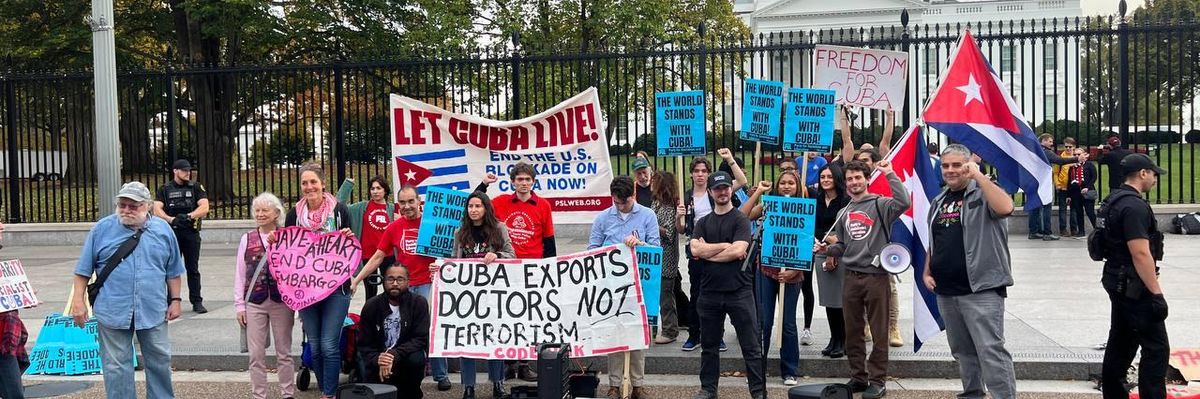
    CodePink led a November 2, 2022 rally against the U.S. economic blockade of Cuba outside the White House in Washington, D.C. (Photo: CodePink)

    “Seriously? You wait until six days before leaving office to do what you promised to do during your 2020 campaign?” said one observer.

    In a move likely to be reversed by the incoming Trump administration, President Joe Biden on Tuesday notified Congress of his intent to remove Cuba from the U.S. State Sponsors of Terrorism list, a designation that critics have long condemned as politically motivated and meritless.

    Noting that “the government of Cuba has not provided any support for international terrorism” and has “provided assurances” that it will not do so in the future, the White House said in a memo that the Biden administration is moving to rescind the first Trump administration’s January 2021 addition of Cuba to the State Sponsors of Terrorism (SSOT) list and take other measures to ease some sanctions on the long-suffering island of 11 million inhabitants.

    Cuba’s SSOT designation was based mostly on the socialist nation’s harboring of leftist Colombian rebels and several U.S. fugitives from justice for alleged crimes committed decades ago, even though no other country has been placed on the SSOT list for such a reason and despite right-wing Cuban exile terrorists enjoying citizenship—and even heroic status—in the United States.

    “Despite its limited nature, it is a decision in the right direction and in line with the sustained and firm demand of the government and people of Cuba, and with the broad, emphatic, and repeated call of many governments, especially Latin America and the Caribbean, of Cubans living abroad, political, religious and social organizations, and numerous political figures from the United States and other countries,” the Cuban Ministry of Foreign Affairs said in a statement.

    “It is important to note that the economic blockade and much of the dozen coercive measures that have been put into effect since 2017 remain in force to strengthen it, with full extraterritorial effect and in violation of international law and human rights of all Cubans,” the ministry added.

    https://twitter.com/cidelson/status/1879273086085939288?ref_src=twsrc%5Etfw%7Ctwcamp%5Etweetembed%7Ctwterm%5E1879273086085939288%7Ctwgr%5Ea895ab5425ec3540961455b263e9b98fa9fd162d%7Ctwcon%5Es1_c10&ref_url=https%3A%2F%2Fwww.commondreams.org%2Fnews%2Fcuba-ssot

    Sorry, this content could not be embedded.

    X

    For 32 straight years, the United Nations General Assembly has overwhelmingly voted for resolutions condemning the U.S. blockade of Cuba. And for 32 years, the United States, usually along with a small handful of countries, has opposed the measures. Last year’s vote was 187-2, with Israel joining the U.S. in voting against the resolution.

    Cuba followed Biden’s move by announcing it would “gradually” release 553 political prisoners following negotiations with the Catholic Church, The New York Timesreported.

    Many progressives welcomed Biden’s shift. Congresswoman Nydia Velázquez (D-N.Y.) said in a statement that Cuba’s SSOT designation “has only worsened life for the Cuban people without advancing U.S. interests” and “has made it harder for Cubans to access humanitarian aid, banking services, and the ability to travel abroad.”

    “It has also deepened food and medicine shortages and worsened the island’s energy crisis, especially after Hurricane Rafael,” she added. “These hardships have driven an unprecedented wave of migration, leading to the largest exodus in Cuba’s history.”

    Rep. Ilhan Omar (D-Minn.) called Biden’s move “a long overdue action that will help normalize relations with our neighbor.”

    “This is a step toward ending decades of failed policy that has only hurt Cuban families and strained diplomatic ties,” Omar added. “Removing this designation will help the people of Cuba and create new opportunities for trade and cooperation between our nations. I look forward to continuing the work to build bridges between our countries and supporting policies that benefit both the American and Cuban people.”

    https://twitter.com/dsa_intl_comm/status/1879288137966641462?ref_src=twsrc%5Etfw%7Ctwcamp%5Etweetembed%7Ctwterm%5E1879288137966641462%7Ctwgr%5E5bb7e50bbcb151d4ef02ea69a12198cf5b1fc9ef%7Ctwcon%5Es1_c10&ref_url=https%3A%2F%2Fwww.commondreams.org%2Fnews%2Fcuba-ssot

    Sorry, this content could not be embedded.

    X

    David Adler, the co-general coordinator at Progressive International, called the delisting “far too little, far too late.”

    “POTUS removing Cuba’s SSOT designation in the final days of his presidency only means one thing: He knew—from day one—that the designation was simply an excuse to punish the Cuban people,” Adler added. “But he maintained it anyway. Sickening.”

    The peace group CodePink released a statement welcoming Biden’s shift, but adding that “it is unacceptable that it took this administration four years to address these injustices.”

    “President Biden made the inhumane decision every single day to not alleviate the suffering of millions of Cubans by keeping this designation in place,” the group added. “As we mark this overdue progress, we can only hope that the Trump administration does not reverse these crucial steps towards justice and diplomacy.”

    Trump’s nominee for secretary of state, Sen. Marco Rubio (R-Fla.) is the son of Cuban immigrants and a fierce critic of Cuba’s socialist government. In 2021, Rubio introduced legislation aimed at blocking Cuba’s removal from the SSOT list. Trump has also tapped Mauricio Claver-Carone—a staunch supporter of sanctioning Cuba—as his special envoy for Latin America.

    Alex Main, director of international policy at the Center for Economic and Policy Research, said Tuesday that “while this decision, which comes years after 80 members of Congress urged Biden to reverse Trump’s ‘total pressure’ approach should have been made long ago, it is better late than never.”

    “Sixty years of failed policy should be more than enough, and hopefully the new administration will have the wisdom and the courage to pursue a new course, one that’s in the best interest of both the U.S. and the Cuban people,” Main added.

    Cuba was first placed on the SSOT list by the Reagan administration in 1982 amid an ongoing, decadeslong campaign of U.S.-backed exile terrorism, attempted subversion, failed assassination attempts, economic warfare, and covert operations large and small in a futile effort to overthrow the revolutionary government of longtime leader Fidel Castro. Cuba says U.S.-backed terrorism has killed or wounded more than 5,000 Cubans and cost its economy billions of dollars.

    In stark contrast, Cuba has not committed any terrorism against the United States.

    Former President Barack Obama removed Cuba from the SSOT in 2015 during a promising but ultimately short-lived rapprochement between the two countries that abruptly ended when Trump took office for the first time in 2017.

    “Cuba will continue to confront and denounce this policy of economic war, the interference programs, and the disinformation and discredit operations financed each year with tens of millions of dollars from the United States federal budget,” the Cuban Foreign Ministry said Tuesday. “It will also remain ready to develop a relationship of respect with that country, based on dialogue and noninterference in the internal affairs of both, despite differences.”

    Original article by Brett Wilkins republished from Common Dreams under Creative Commons (CC BY-NC-ND 3.0). 
  • Lynx in Scotland: why illegal attempts to reintroduce lost species are surprisingly common

    Spread the love
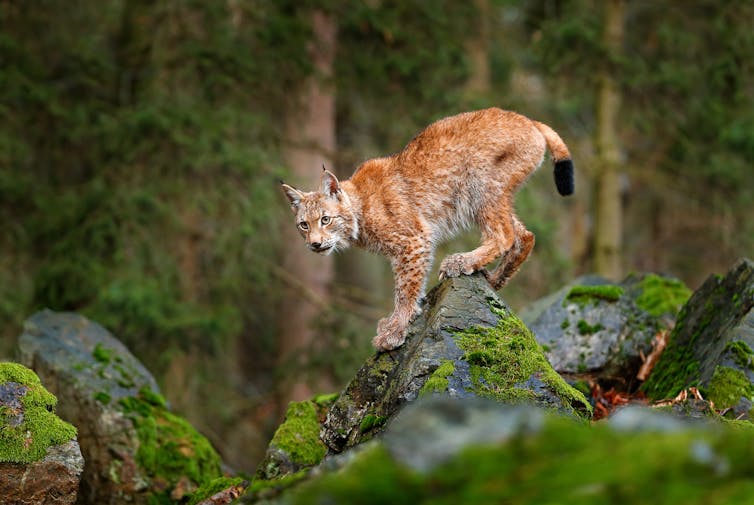
    Four lynx were recently released in the Scottish countryside. Ondrej Prosicky / shutterstock

    George Holmes, University of Leeds; Darragh Hare, University of Oxford, and Hanna Pettersson, University of York

    For more than 500 years, no lynx had roamed the British countryside. That changed with the recent release of four of these large cats in the Cairngorm mountains of Scotland.

    This was an action that is widely assumed to be linked to attempts to reintroduce species that had been wiped out in Britain, as part of a wider rewilding movement. Supporters of these reintroductions typically want to atone for past extinctions, and want to create richer, more dynamic ecosystems.

    The lynx were soon recaptured, with one dying shortly after. For now, foxes and badgers remain Britain’s largest predatory mammals.

    While many conservation organisations are working with the authorities to bring back species, from microscopic fungi to half-tonne bison, some people are reintroducing them without seeking guidance or approval. In fact, such illicit and unregulated reintroductions are surprisingly common.

    Illicit beaver populations have sprung up across Europe, from southern Italy and Spain to Wales, Scotland and England. The phenomenon is so widespread it is referred to as “beaver bombing”, now matched by “boar bombing” in Scotland and across southern England.

    In Britain, there have also been illicit reintroductions of smaller mammals, as well as insects and wildflowers that are much easier and cheaper to obtain, transport and release. Wildflower seeds and butterfly pupae or eggs can be easily bought online and delivered to your door, then let loose during a nice country walk.

    Transforming political debates

    Illicit and unregulated reintroductions matter. They can lead to new populations of previously missing species – there are over a thousand beavers living in the Tayside region of Scotland, for instance, widely thought to descend from beavers deliberately, and illegally, released in the early 2000s. In England, the New Forest population of pine martens are similarly thought to originate from illegal releases in the early 1990s.

    Beaver in river
    Beavers were reintroduced in Scotland deliberately and illegally. Digital Wildlife Scotland / shutterstock

    This can transform political debates. While there were proposals to reintroduce beavers as an experiment before the illicit Tayside reintroduction, self-sustaining populations increased political and public support for more widespread, approved releases. The presence of wild beavers in Scotland changed what was a theoretical notion of having beavers into something more tangible that the public could relate to, and it forced decision makers to address the issue rather than avoid it.

    Illicit and unregulated reintroductions can be controversial. Farmers and other land managers do not always take kindly to new species popping up on their land without warning or consultation. In Tayside, beavers have been killed by farmers who were angry at the damage caused to their properties by dams and burrows.

    All this sheds light on important differences among conservationists. As these reintroductions are illicit, it is difficult to have clear understanding of who is behind them, and why. We are aware of only one case – of beavers in Belgium – where an illicit reintroducer has been publicly identified and prosecuted. But they reflect a frustration with official reintroduction processes and regulations, seen by some as too slow, bureaucratic and risk averse.

    Lynx in snow
    Lynx have been successfully (and officially) reintroduced in many of their original habitats across Europe. Ondrej Prosicky / shutterstock

    Opinions within conservation range from seeing illicit reintroductions as reckless and harmful to lauding them as heroic, game-changing acts. This reflects real disagreements on what species belong in a given country, and how reintroductions should be done. Releasing animals and plant material is considered a major biosecurity risk by some, whereas others see this as overstated.

    There are also concerns about genetic contamination. While regulations and recommendations say that animals and plants for release should be a close genetic match for those which existed in a place previously, to ensure that they are best suited to the conditions, other conservationists say this is a pedantic irrelevance given climate and other environmental changes.

    Many conservationists also worry about whether released animals are able to cope with the shift from life in captivity. Given that lynx in the wild are extremely shy, the ease by which the Cairngorms foursome were captured shows they were too tame to survive in Scottish woods.

    Likewise, the black-veined white butterflies that have appeared in the past few years in south-east England, the first UK sightings in a century, probably came from unlicensed releases, but are thought unlikely to breed and survive. Yet, the thriving beaver and pine marten populations show this is not always an issue.

    Coexistence is difficult

    Predators like lynx are the most contentious reintroductions, because they are big enough to target livestock and scare humans. Coexistence between people and predators is difficult, involving careful strategies to minimise harm and create trusting relationships. Of all the different ways a predator might come back to an area – natural colonisation, a planned reintroduction or an illicit release – the last is most contentious because such relationships and strategies are missing.

    Lynx warning road sign
    In remote hills and forests across Europe, people have learned to live with lynx. Jens Otte / shutterstock

    That’s why existing campaigns to reintroduce lynx to Scotland are strongly condemning the Cairngorms release. They see it as undermining their work to carefully build bridges with farmers. Judging by reactions of land managers to illicit beaver releases in Scotland, it may also generate opposition to any kind of reintroduction. By feeding into narratives of “arrogant” conservationists, it might undermine support, especially in rural communities that may one day have to live with reintroduced lynx.

    If conservationists want to see a free-living, healthy and self-sustaining population of lynx, they’ll need to build careful relationships with local people and other interest groups. They’ll need to put forward a clear idea of how to live successfully alongside lynx, and what to do when either people or lynx overstep the mark. Illicit reintroductions are unlikely to get us there.


    Don’t have time to read about climate change as much as you’d like?
    Get a weekly roundup in your inbox instead. Every Wednesday, The Conversation’s environment editor writes Imagine, a short email that goes a little deeper into just one climate issue. Join the 40,000+ readers who’ve subscribed so far.


    George Holmes, Professor of Conservation and Society, University of Leeds; Darragh Hare, Research Fellow, Department of Biology, Wildlife Conservation Research Unit, University of Oxford, and Hanna Pettersson, Postdoctoral Research Associate, Leverhulme Centre for Anthropocene Biodiversity, University of York

    This article is republished from The Conversation under a Creative Commons license. Read the original article.

    No 10 blocks beaver release plan as officials view it as ’Tory legacy’

  • Trump urges Israel to avoid unnecessary escalation

    Spread the love

    https://www.middleeastmonitor.com/20250114-trump-urges-israel-to-avoid-unnecessary-escalation

    President-elect Donald Trump speaks at the US Capitol Building in Washington, DC on 8 January, 2025 [Nathan Posner/Anadolu Agency]

    An Israeli television channel has revealed that US President-elect Donald Trump sent a message to officials in Tel Aviv, urging Israel to avoid any “unnecessary” escalation and refrain from statements that could lead to regional conflicts, particularly during the transition period before his administration begins.

    Channel 12 reported that Trump’s aides informed Israeli officials that the incoming US administration aims to achieve stability in the Middle East, focusing on fostering “peace” between Israel and Lebanon and maintaining the ongoing ceasefire.

    In his discussions with Israeli officials, Trump emphasised that he had no intention of engaging in new wars during the early days of his presidency, as he intends to prioritise addressing domestic issues in the United States.

    According to the channel, Trump has personally begun intervening in efforts to secure the release of Israeli captives held in the Gaza Strip. He has expressed significant interest in resolving this issue before officially taking office.

    The report also mentioned that Trump’s special envoy to the Middle East, Steven Witkoff, met with Israeli Prime Minister Benjamin Netanyahu to discuss the next steps. Following this meeting, it was decided that the heads of Mossad and the Israeli Security Agency (Shin Bet) would be sent to Qatar to engage in direct negotiations.

    READ: ‘Distinct possibility that we can get’ Gaza deal done this week, says US’ Sullivan

    This work by Middle East Monitor is licensed under a Creative Commons Attribution-NonCommercial-ShareAlike 4.0 International License.

  • The Gaza Genocide: the fall of Israel’s immunity

    Spread the love

    https://www.middleeastmonitor.com/20250113-the-gaza-genocide-the-fall-of-israels-immunity

    People gather for a funeral ceremony of Palestinian journalist Saed Sabri Abu Nabhan after he is fatally shot by an Israeli sniper while on duty in the Nuseirat Refugee Camp in the central Gaza Strip on January 11, 2025 [Ashraf Amra – Anadolu Agency]

    by Dr Ramzy Baroud

    A dramatic escape was cited by Israeli media as the reason that Yuval Vagdani, a soldier in the Israeli army, managed to escape justice in Brazil.

    Vagdani was accused by a Palestinian advocacy legal group, the Hind Rajab Foundation, of carrying out well-documented crimes in Gaza. He is not the only Israeli soldier being pursued for similar crimes.

    According to the Israeli Broadcasting Corporation (KAN), more than 50 Israeli soldiers are being pursued in countries ranging from South Africa to Sri Lanka to Sweden.

    In one case, the Hind Rajab Foundation filed a complaint in a Swedish court against Boaz Ben David, an Israeli sniper from the 932 Battalion of the Israeli Nahal Brigade. He is also accused of committing war crimes in Gaza.

    The Nahal Brigade has been at the heart of numerous war crimes in Gaza. Established in 1982, the brigade is notorious for its unhinged violence against Occupied Palestinians. Their role in the latest genocidal atrocities in the Strip has far exceeded their own dark legacy.

    OPINION: Why context is important in Palestine

    Even if these 50 individuals are apprehended and sentenced, the price exacted from the Israeli army pales in comparison to the crimes carried out.

    Numbers, though helpful, are rarely enough to convey collective pain. The medical journal Lancet’s latest report is still worthy of reflection. Using a new data-collecting method called ‘capture–recapture analysis’, the report indicates that, by the first nine months of the war, between October 2023 and June 2024, 64,260 Palestinians have been killed.

    Still, capturing and trying Israeli war criminals is not just about the fate of these individuals. It is about accountability—an absent term in the history of Israeli human rights violations, war crimes and recurring genocides against Palestinians.

    The Israeli government understands that the issue now goes beyond individuals. It is about the loss of Israel’s historic status as a country that stands above the law.

    As a result, the Israeli army announced that it decided not to publicly reveal the names of soldiers involved in the Gaza war and genocide, fearing prosecution in international courts.

    However, this step is unlikely to make much difference for two reasons. First, numerous pieces of evidence against individual soldiers, whose identities are publicly known, have already been gathered or are available for future investigation. Second, much of the documentation of war crimes has been unwittingly produced by Israeli soldiers themselves.

    Reassured about the lack of accountability, Israeli soldiers have taken countless pieces of footage showing the abuse and torture of Palestinians in Gaza. This self-indictment will likely serve as a major body of evidence in future trials.

    All of this cannot be viewed separately from the ongoing investigation into the Israeli genocide in Gaza by the International Court of Justice (ICJ). Additionally, arrest warrants have been issued by the International Criminal Court (ICC) against top Israeli leaders, including Prime Minister Benjamin Netanyahu.

    OPINION: When it comes to genocide and Palestine, the world is — deliberately — getting its priorities wrong

    Though these cases have moved slowly, they have set a precedent that even Israel is not immune to some measure of international accountability and justice.

    Moreover, these cases have granted countries that are signatories to the ICC and ICJ the authority to investigate individual war crimes cases filed by human rights and legal advocacy groups.

    Though the Hind Rajab Foundation is not the only group pursuing Israeli war criminals globally, the group’s name derives from a five-year-old Palestinian girl from Gaza who was murdered by the Israeli army in January 2024, along with her family. This tragedy and that particular name are a reminder that the innocent blood of Palestinians will not go in vain.

    Though justice may be delayed, as long as there are pursuers, it will someday be attained.

    Pursuing alleged Israeli war criminals in international and national courts is just the start of a process of accountability that will last many years. With every case, Israel will learn that the decades-long US vetoes and blind Western protection and support will no longer suffice.

    It was the West’s shameless shielding of Israel throughout the years that allowed Israeli leaders to behave as they saw fit for Israel’s so-called national security—even if it meant the very extermination of the Palestinian people, as is the case today in Gaza.

    Still, Western governments, including the US and Britain, continue to treat wanted Israelis as sanctified heroes—not war criminals. This goes beyond accusations of double standards. It is the highest immorality and disregard for international law.

    Things need to change; in fact, they are already changing.

    Since the start of the Israeli war on Gaza, Tel Aviv has already learned many difficult lessons. For example, its army is no longer “invincible”, its economy is relatively small and highly dependent, and its political system is fragile. In times of crisis, it is barely operable.

    It is time for Israel to learn yet another lesson: that the age of accountability has begun. Dancing around the corpses of dead Palestinians in Gaza is no longer an amusing social media post, as Israeli soldiers once thought.

    OPINION: The PA wants its repression hidden in plain sight

    The views expressed in this article belong to the author and do not necessarily reflect the editorial policy of Middle East Monitor.

    This work by Middle East Monitor is licensed under a Creative Commons Attribution-NonCommercial-ShareAlike 4.0 International License.

    Experiencing issues with this image not appearing. I suspect because it's so critical of Zionist Keir Starmer's support of and complicity in Israel's genocides.
    Genocide denier and Current UK Prime Minister Keir Starmer is quoted that he supports Zionism without qualification. He also confirms that UK air force support has been essential in Israel’s mass-murdering genocide. Includes URLs https://www.declassifieduk.org/keir-starmers-100-spy-flights-over-gaza-in-support-of-israel/ and https://youtu.be/O74hZCKKdpA
  • We will march against Israel’s genocide and BBC bias

    Spread the love

    https://www.stopwar.org.uk/article/we-will-march-against-israels-genocide-and-bbc-bias/

    Palestine Coalition statement in response to Met Police ban – 13 January 2025

    Last week, the Metropolitan Police publicly confirmed its intention to prevent our planned protest at the BBC on Saturday 18 January, by imposing an exclusion order banning Palestine solidarity protestors from entering the area surrounding the BBC throughout the day. We will not be silenced.

    Since the Police announced their imposing of orders to prevent a protest at the BBC, nearly 200 MPs, trade union and civil society leaders and groups including Amnesty International UK and Akiko Hart, Director of Liberty, Holocaust survivors and their descendants, lawyers, journalists and prominent cultural figures have spoken out in support of the right to protest. Today, they have been joined by over 700 members of the Jewish community.

    In recent weeks, Israel has intensified its genocide against the Palestinian people – including massacres of civilians sheltering in so-called ‘safe zones’ and the destruction of the last remaining medical facilities in the north of Gaza. Our marches reflect the overwhelming outrage felt by those who have witnessed these atrocities for more than a year alongside the ongoing complicity of the British government.

    Recent investigations have exposed widespread anger amongst BBC staff at the skewed nature of its coverage, and its consistent failure to adhere to its own editorial standards, including by dehumanising Palestinians and obscuring the truth of Israel’s crimes against them. It is entirely unacceptable for the Metropolitan Police to abuse public order powers to shield the BBC from democratic scrutiny.

    Contrary to the excuse offered by the police – that they have taken this action to prevent potential disruption to a nearby synagogue – the closest synagogue to the BBC is not even on the route of the march. As the Metropolitan Police have acknowledged, there has never been any threat to a synagogue attached to any of our marches. In fact, every march has been joined by thousands of Jewish people – many in an organised Jewish bloc.

    We are calling on all those who support an immediate ceasefire and an end to Israel’s genocide in Gaza, as well as everyone who believes in the democratic right to protest, to join us in London at 12 noon on Saturday 18 January. We will assemble in Whitehall, which will allow us to form up in massive numbers, and we will march in an orderly fashion towards the BBC. We call on the Metropolitan Police to drop these repressive restrictions and accept our right to demonstrate at the BBC.

    #WeWillMarch

    https://www.stopwar.org.uk/article/we-will-march-against-israels-genocide-and-bbc-bias/

    Experiencing issues with this image not appearing. I suspect because it's so critical of Zionist Keir Starmer's support of and complicity in Israel's genocides.
    Genocide denier and Current UK Prime Minister Keir Starmer is quoted that he supports Zionism without qualification. He also confirms that UK air force support has been essential in Israel’s mass-murdering genocide. Includes URLs https://www.declassifieduk.org/keir-starmers-100-spy-flights-over-gaza-in-support-of-israel/ and https://youtu.be/O74hZCKKdpA