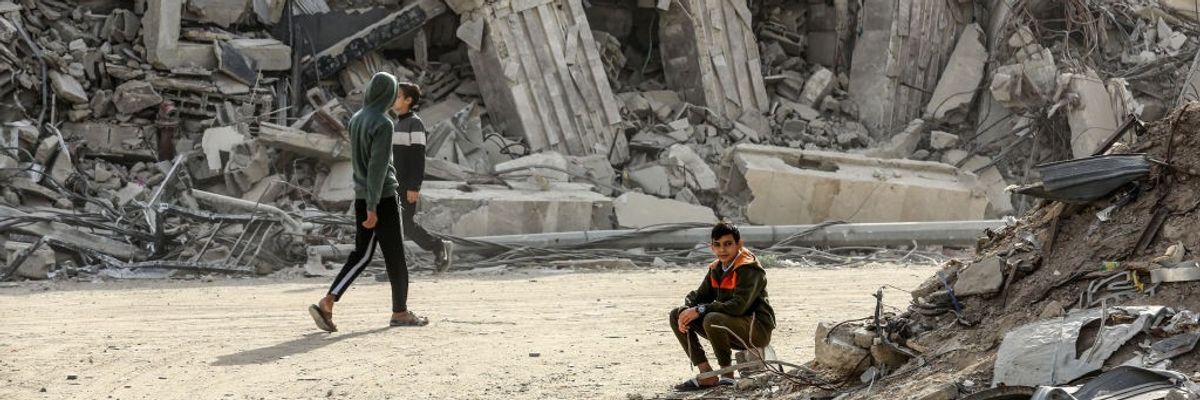
Palestinians are surrounded by buildings destroyed by Israeli attacks in Khan Younis, Gaza on December 10, 2024. (Photo: Abed Rahim Khatib/Anadolu via Getty Images)
“Failure to do so not only risks our leverage in ceasefire negotiations, it undermines our country’s own national security and weakens America’s commitment to human rights as a cornerstone of our foreign policy.”
Twenty progressives in the U.S. House of Representatives on Tuesday wrote to top Biden administration officials arguing that “the United States government must suspend offensive weapons” to Israel over its destruction of the Gaza Strip, citing federal and international law.
Led by Reps. Summer Lee (D-Pa.) and Greg Casar (D-Texas), the incoming Congressional Progressive Caucus chair, the lawmakers began by thanking U.S. Secretary of State Antony Blinken and Secretary of Defense Lloyd Austin for their October 13 letter threatening to cut off weapons to Israeli Prime Minister Benjamin Netanyahu’s government if it did not dramatically improve humanitarian conditions in Gaza.
“However, despite your administration acknowledging that the Netanyahu government did not fully address the United States’ concerns over Gaza and has failed to meet all of the conditions stipulated in this letter, the State Department decided not to take further action, including the suspension of offensive military assistance, to ensure full compliance,” the Democrats wrote.
“We believe continuing to transfer offensive weapons to the Israeli government prolongs the suffering of the Palestinian people and risks our own national security by sending a message to the world that the U.S. will apply its laws, policies, and international law selectively,” they continued. “Furthermore, a failure to act will put Israeli lives in danger by prolonging Netanyahu’s war, isolating Israel on the international stage, and creating further instability in the region.”
The new letter comes just over a month away from President Joe Biden leaving office and follows one from last week signed by 77 House Democrats—including Casar—that demanded “a full assessment of the status of Israel’s compliance with all relevant U.S. policies and laws, including National Security Memorandum 20 (NSM-20) and Section 620I of the Foreign Assistance Act.”
This one goes further, explicitly urging the Biden administration to suspend offensive military transfers and warning that “failure to do so not only risks our leverage in cease-fire negotiations, it undermines our country’s own national security and weakens America’s commitment to human rights as a cornerstone of our foreign policy.”
“We remain committed to saving Palestinian and Israeli lives. This means doing everything possible to prioritize the release of hostages, secure a lasting cease-fire deal, and move toward long-term peace,” the 20 progressives concluded.
In addition to Lee and Casar, Tuesday’s letter was signed by Democratic Reps. Jamaal Bowman (N.Y.), Cori Bush (Mo.), Joaquin Castro (Texas), Lloyd Doggett (Texas), Veronica Escobar (Texas), Jesús “Chuy” García (Ill.), Al Green (Texas), Sara Jacobs (Calif.), Pramila Jayapal (Wash.), Hank Johnson (Ga.), Jim McGovern (Mass.), Alexandria Ocasio-Cortez (N.Y.), Ilhan Omar (Minn.), Mark Pocan (Wis.), Ayanna Pressley (Mass.), Delia C. Ramirez (Ill.), Rashida Tlaib (Mich.), and Bonnie Watson Coleman (N.J.).
It came on the same day as a lawsuit filed by Palestinians and Palestinian Americans accusing the U.S. State Department of creating “unique, insurmountable processes to evade the Leahy Law requirement to sanction abusive Israeli units.”
As of Tuesday, the 14-month Israeli assault on Gaza in retaliation for the Hamas-led October 7, 2023 attack has killed at least 45,059 people and wounded another 107,041, according to local officials. Israel’s slaughter and starvation of Palestinian civilians have led to a genocide case at the International Court of Justice as well as International Criminal Court arrest warrants for Netanyahu and his former defense minister, Yoav Gallant.
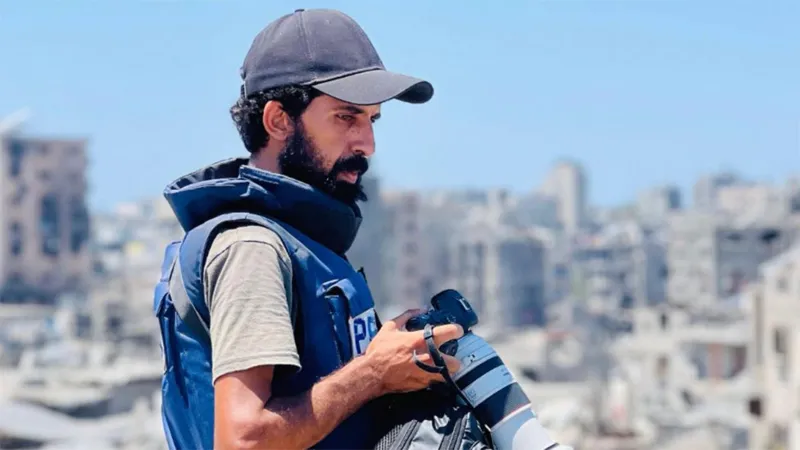
Omar el Qataa is a photojournalist operating out of northern Gaza
Facebook has severely restricted the ability of Palestinian news outlets to reach an audience during the Israel-Gaza war, according to BBC research.
In a comprehensive analysis of Facebook data, we found that newsrooms in the Palestinian territories – in Gaza and the West Bank – had suffered a steep drop in audience engagement since October 2023.
The BBC has also seen leaked documents showing that Instagram – another Meta-owned platform – increased its moderation of Palestinian user comments after October 2023.
Meta – the owner of Facebook – says that any implication that it deliberately suppressed particular voices is “unequivocally false”.
…
During a period of war, audience engagement might be expected to rise. However, the data showed a 77% decline after the Hamas attacks on 7 October 2023.
Palestine TV has 5.8 million followers on Facebook. Journalists at the newsroom shared statistics with us showing a 60% drop in the number of people seeing their posts.
“Interaction was completely restricted, and our posts stopped reaching people,” says Tariq Ziad, a journalist at the channel.
Over the past year, Palestinian journalists have raised fears that their online content is being “shadow-banned” by Meta – in other words, restricted in how many people see it.
To test this, we carried out the same data analysis on the Facebook pages of 20 Israeli news organisations such as Yediot Ahronot, Israel Hayom and Channel 13. These pages also posted a large amount of war-related content, but their audience engagement increased by nearly 37%.
In the immediate wake of the Syrian government’s abrupt collapse, much remains uncertain about the country’s future – including whether it can survive as a unitary state or will splinter into smaller states as did Yugoslavia in the early 1990s, a move that ultimately led to a bloody NATO intervention. Moreover, who or what may take power in Damascus remains an open question. For the time being at least, members of ultra-extremist Hayat Tahrir al-Sham (HTS) appear highly likely to take key positions in whatever administrative structure sprouts from Bashar Assad’s ouster after a decade-and-a-half of grinding Western-sponsored regime change efforts.
As Reuters reported on December 12, HTS is already “stamping its authority on Syria’s state with the same lightning speed that it seized the country, deploying police, installing an interim government and meeting foreign envoys.” Meanwhile, its bureaucrats – “who until last week were running an Islamist administration in a remote corner of Syria’s northwest” – have moved en masse “into government headquarters in Damascus.” Mohammed Bashir, head of HTS’ “regional government” in extremist-occupied Idlib, has been appointed the country’s “caretaker prime minister.”
However, despite the chaos and precariousness of post-Assad Syria, one thing seems assured – the country will be broken open to Western economic exploitation, at long last.
Multiple reports show that HTS has informed local and international business leaders that when in office, it will “adopt a free-market model and integrate the country into the global economy, in a major shift from decades of corrupt state control.”
As Alexander McKay of the Marx Engels Lenin Institute tells MintPress News, state-controlled parts of Syria’s economy may have been under Assad, but corrupt it wasn’t. He believes a striking feature of the ongoing attacks on Syrian infrastructure from forces within and without the country is that economic and industrial sites are a recurrent target. Moreover, the would-be HTS-dominated government has done nothing to counter these broadsides when “securing key economic assets will be vital to societal reconstruction, and therefore a matter of priority”:
We can see clearly what kind of country these ‘moderate rebels’ plan to build. Forces like HTS are allied with U.S. imperialism, and their economic approach will reflect this. Prior to the proxy war, the government pursued an economic approach that mixed public ownership and market elements. State intervention enabled a degree of political independence [that] other nations in the region lack. Assad’s administration understood without an industrial base, being sovereign is impossible. The new ‘free market’ approach will see all of that utterly decimated.”
‘Reconstruction Project’
Syria’s economic independence and strength under Assad’s rule and the benefits reaped by average citizens, as a result, were never acknowledged in the mainstream before or during the decade-long proxy war. Yet, countless reports from major international institutions underline this reality – which has now been brutally vanquished, never to return. For example, an April 2015 World Health Organization document noted how Damascus “had one of the best-developed healthcare systems in the Arab world.”
Per a 2018 U.N. investigation, “universal, free healthcare” was extended to all Syrian citizens, who “enjoyed some of the highest levels of care in the region.” Education was likewise free, and before the conflict, “an estimated 97% of primary school-aged Syrian children were attending class, and Syria’s literacy rates were thought to be at over 90% for both men and women [emphasis added].” By 2016, millions were out of school.
A U.N. Human Rights Council report two years later noted pre-war Syria “was the only country in the Middle East region to be self-sufficient in food production,” its “thriving agricultural sector” contributing “about 21%” to GDP 2006 – 2011. Civilians’ daily caloric intake “was on par with many Western countries,” with prices kept affordable via state subsidy. Meanwhile, the country’s economy was “one of the best performing in the region, with a growth rate averaging 4.6%” annually.
At the time that report was written, Damascus had been reduced to heavy reliance on imports by Western sanctions in many sectors and, even then, was barely able to buy or sell much in the way of anything, as the measures amounted to an effective embargo. Simultaneously, the U.S. military occupation of a resource-rich third of Syria cut off the government’s access to its own oil reserves and wheat. The situation would only worsen with the Caesar Syria Civilian Protection Act’s passing in June 2020.
Under its auspices, a vast volume of goods and services in every conceivable field were and today remain banned from being sold to or traded with any Syrian citizen or entity. The legislation’s terms explicitly state preventing attempts to rebuild Syria was its chief objective. One passage openly outlines “a strategy to deter foreign persons from entering into contracts related to reconstruction.”
Immediately after coming into effect, the Syrian pound’s value collapsed further, sending living costs skyrocketing. In a blink, almost the entire country’s population was left barely able to afford even the bare essentials. Even mainstream sources typically approving of belligerence towards Damascus cautioned of an inevitably impending humanitarian crisis. However, Washington was neither concerned nor deterred by such warnings. James Jeffrey, State Department chief of Syria policy, actively cheered these developments.
Simultaneously, as Jeffrey subsequently admitted to PBS, the U.S. was engaged in frequent, secret communication with HTS and actively assisting the group – albeit “indirectly” due to the faction’s designation as a terrorist entity by the State Department. This followed direct approaches to Washington by its leaders, including Abu Mohammed Jolani, former leader of Al Qaeda affiliate al-Nusra. “We want to be your friend. We’re not terrorists. We’re just fighting Assad,” HTS reportedly said.
Given this contact, it may be no coincidence that in July 2022, Jolani issued a series of communications about HTS’ plans for future Syria, containing multiple passages in which finance and industry loomed large. Directly foreshadowing the group’s recent pledge to “adopt a free-market model,” the extremist mass murderer discussed his desire to “open up local markets to the global economy.” Many passages read as if they were authored by representatives of the International Monetary Fund.
Coincidentally, Syria, since 1984, has refused IMF loans, a key tool by which the U.S. Empire maintains the global capitalist system and dominates the Global South, ensuring ‘poor’ countries remain under its heel. The World Trade Organization, of which Damascus isn’t a member either, plays a similar role. Accession to both would go some way to cementing the “free-market model” advocated by HTS. After over a decade of deliberate, systematic economic ruin, geopolitical risk analyst Firas Modad tells MintPress News:
They have no choice. They need Turkish and Qatari backing, so [they] will need to liberalize. They have no capital whatsoever. The country is in ruins and they desperately need investment. Plus, they hope liberalizing may attract some Saudi, Emirati or Egyptian interest. It’s impossible for Syria to rebuild using its own resources. The civil war might resume. They are acting out of necessity.”
‘Shock Therapy’
In Syria’s protracted political and economic dismantling, there are eerie echoes of the U.S. Empire’s destruction of Yugoslavia throughout the 1990s. During that decade, the multiethnic socialist federation’s breakup produced bitter wars of independence in Bosnia, Croatia and Slovenia – encouraged, financed, armed, and prolonged every step by Western powers. Belgrade’s perceived centrality to these brutal conflicts and purported complicity in and sponsorship of horrendous war crimes led the U.N. Security Council to impose sanctions against what remained of the country in May 1992.
The measures were the harshest ever levied in U.N. history. At one point, producing inflation of 5.578 quintillion percent, drug abuse, alcoholism, preventable deaths and suicides skyrocketed, while shortages of goods – including water – were perpetual. Yugoslavia’s once thriving independent industry was crippled, its ability to manufacture even everyday medicines virtually non-existent. By February 1993, the CIA assessed that the average citizen had “become accustomed to periodical shortages, long lines in stores, cold homes in the winter and restrictions on electricity.”
Surveying the wreckage years later, Foreign Affairs noted that sanctions against Yugoslavia demonstrated how “in a matter of months or years whole economies can be devastated,” and such measures can serve as uniquely lethal “weapons of mass destruction” against civilian populations of target countries. Yet, despite such desolation and misery, throughout this period, Belgrade remained resistant to privatization and foreign ownership of its industry or to the pillaging of its vast resources. The overwhelming majority of Yugoslavia’s economy was state- or worker-owned.
Yugoslavia was not a member of the IMF, World Bank, or WTO, which went some way to insulate the country from economic predation. In 1998, though, authorities began waging a heavy-handed counterinsurgency against the Kosovo Liberation Army, a CIA and MI6-funded and armed al-Qaeda-linked extremist militia. This provided the U.S. Empire with a pretext to, at last, finish the job of neutralizing what remained of the country’s socialist system. As a Clinton administration official later admitted:
It was Yugoslavia’s resistance to the broader trends of political and economic reform [in Eastern Europe] – not the plight of Kosovar Albanians – that best explains NATO’s war.”
From March – June 1999, the military alliance bombed Yugoslavia for 78 straight days. Yet, Belgrade’s army was barely in the firing line at any stage. In all, officially, just 14 Yugoslav tanks were destroyed by NATO, but 372 separate industrial facilities got smashed to smithereens, leaving hundreds of thousands jobless. Markedly, the alliance took guidance from U.S. corporations on which sites to target, and not a single foreign- or privately-owned factory was hit.
NATO’s bombing laid the foundations for Yugoslav leader Slobodan Milosevic’s removal via a C.I.A.- and National Endowment for Democracy-sponsored color revolution in October of the following year. In his place, a doggedly pro-Western government advised by a collective of U.S.-sponsored economists took power. Their explicit mission was to “make an economic environment favorable for private and other investments” in Belgrade. Ravaging “shock therapy” measures were deployed the moment they assumed office, to the further detriment of an already immiserated and impoverished population.
In the decades since successive Western-backed governments across the former Yugoslavia have enforced an endless array of neoliberal “reforms” to ensure an “investor-friendly” environment locally for wealthy Western oligarchs and corporations. In lockstep, low wages and a lack of employment opportunities stubbornly endure or worsen while living costs rise, producing mass depopulation, among other destructive effects. All along, U.S. officials intimately implicated in the country’s breakup have brazenly sought to enrich themselves from the privatization of former state industries.
‘Internal Repression’
Does such a fate await Damascus? For Pawel Wargan, founder of the Green New Deal for Europe, the answer is a resounding “yes.” He believes the country’s story is familiar “to those who study the mechanisms of imperialist expansion.” Once its defenses are fully neutralized, he foresees the country’s industries being “bought-up at bargain sale prices as part of market ‘reforms,’ which transfer yet another chunk of humanity’s wealth to Western corporations”:
We’ve witnessed the well-rehearsed choreography of imperialist regime change: a ‘tyrant’ is overthrown; backers of national sovereignty are systematically and viciously repressed; with tremendous, but hidden, violence, the country’s assets are chopped and diced and sold to the lowest bidder; labor protections are discarded; human lives are cut short. The most predatory forms of capitalism take root in every crevice and pore that emerges in the collapse of the state. This is the agenda of structural adjustment policies enforced by the World Bank and IMF.”
Alexander McKay echoes Wargan’s analysis. Now “free,” Syria will be forcedly made “dependent upon imports from the West” evermore. This not only fattens the Empire’s bottom line but “also severely restricts the freedom of any Syrian government to act with any degree of independence.” He notes similar efforts have been undertaken throughout the post-1989 era of U.S. unipolarity. It was well underway in Russia during the 1990s “until the slow turn around in policy started in the early 2000s under Putin”:
The aim is to reduce Syria to the same status as Lebanon, with an economy controlled by imperial forces, an army used primarily for internal repression, and an economy no longer able to produce anything but merely serve as a market for commodities produced elsewhere, and site of resource extraction. The U.S. and its allies do not want independent development of any nation’s economy. We must hope the Syrian people can resist this latest act of neo-colonialism.”
Kit Klarenberg is an investigative journalist and MintPress News contributor exploring the role of intelligence services in shaping politics and perceptions. His work has previously appeared in The Cradle, Declassified UK, and Grayzone. Follow him on Twitter @KitKlarenberg.
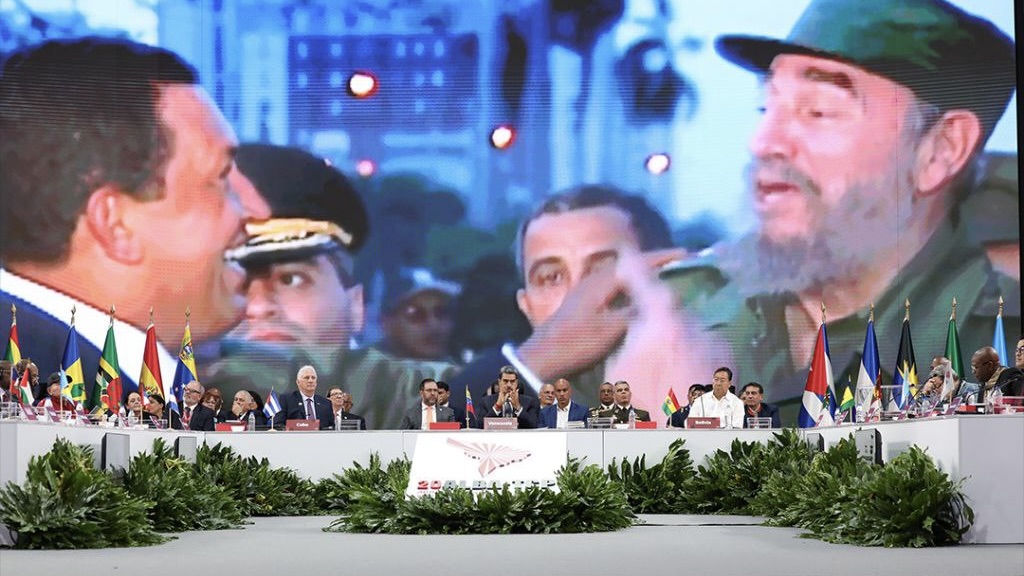
Heads of State Summit of ALBA-TCP in Caracas, Venezuela. Photo: ALBA-TCP
ALBA-TCP was founded in 2004 in an attempt to counter the US proposal of creating a “free trade zone of the Americas
December 14 marked the 20th anniversary of the creation of the Bolivarian Alliance for the Peoples of Our America-People’s-Trade Agreement (ALBA-TCP). ALBA-TCP was created in 2004 as a geopolitical alternative to the devastating advance of neoliberalism in the region.
The project was founded on December 14, 2004, in Havana by Cuban President Fidel Castro and Venezuelan President Hugo Chávez. Currently, the organization has 10 member countries and four countries considered “special guests.” In 2006, Bolivia signed its membership; in 2007, Nicaragua; in 2008, Dominica; in 2009, Antigua and Barbuda and St. Vincent and the Grenadines; in 2014, St. Kitts and Nevis and Grenada; and in 2021, St. Lucia. The special invited countries are Syria, Haiti, Suriname, and now Palestine.
To commemorate the 20 years, social movements, political parties, and heads of state gathered in Caracas, Venezuela for the 24th Heads of State Summit as well as parallel meetings. The event was attended by the host, Venezuelan President Nicolás Maduro; Bolivian President Luis Arce; Cuban President Miguel Díaz-Canel; Nicaraguan President Daniel Ortega; Prime Minister of St. Vincent and the Grenadines, Ralph Gonsalves; Prime Minister of Dominica, Roosevelt Skerrit; and the Prime Minister of Antigua and Barbuda, Gaston Browne.
Independence and solidarity among countries
In their addresses during the Summit on December 14, the heads of state and invited countries stressed the importance of solidarity among countries seeking alternative ways of development and the need for unrestricted solidarity among people struggling against imperialist attacks. They also demonstrated their support for Nicolás Maduro and his victory in the last presidential elections.
Miguel Díaz-Canel said “We reiterate the strongest support for the Bolivarian revolution, led by President Nicolás Maduro…We also call for the elimination of the blockade against Cuba …We cry out for a free Puerto Rico and declare our solidarity with Haiti, our Cuban doctors are there…We reiterate our demand for a ceasefire in Gaza and condemn the attacks perpetrated by Israel against Lebanon, Syria, and Iran.”
The Bolivian President, Luis Arce, highlighted the historical importance of ALBA in its fight against economic projects promoted by the United States such as the FTAA (Free Trade Area of the Americas): “The embrace of Hugo Chávez and Fidel Castro not only marked history but also manifested the defeat of the hegemonic project of the FTAA. ALBA was born, ALBA placed the human being at the center, promoting that a better world is possible. Bolivia reaffirms, once again, its commitment to ALBA-TCP, because it is a resistance that raises its voice against the unjust and criminal blockade against Cuba…ALBA is also a firm voice against the arbitrary and unilateral measures imposed against Venezuela and Nicaragua, which affect the welfare of our peoples.”
Nicolás Maduro said, “We must win the battle of life and truth in the streets, networks, media, and walls, as well as in the conscience and spirituality of the people.” He also added the importance of the struggle of the people to be masters of their destiny without imperial impositions or impositions of any kind. In the same line of discourse, Nicaraguan President Daniel Ortega said “From Nicaragua we reaffirm our commitment to ALBA. We will continue to fight the battle.”
The Prime Minister of Dominica, Roosevelt Skerrit stated “We congratulate the electoral triumph of President Nicolas Maduro on July 28. We wish him all the best…We also want to reaffirm our solidarity with the people of Cuba, a brave people for whom we have our greatest respect and love; we will never cease to lend our voice against the United States to eliminate the blockade against Cuba.”
Ralph Gonsalves, Prime Minister of St. Vincent and the Grenadines, harshly criticized US interference in the development of the past Venezuelan elections “Perhaps [the US government] thinks it is superior,” he said in this regard. He also stressed that the creation of ALBA-TCP was a fundamental invention for the emancipation of the American people, “ALBA is the product of the geniuses of our peoples.”
Inclusion of Palestine to ALBA-TCP
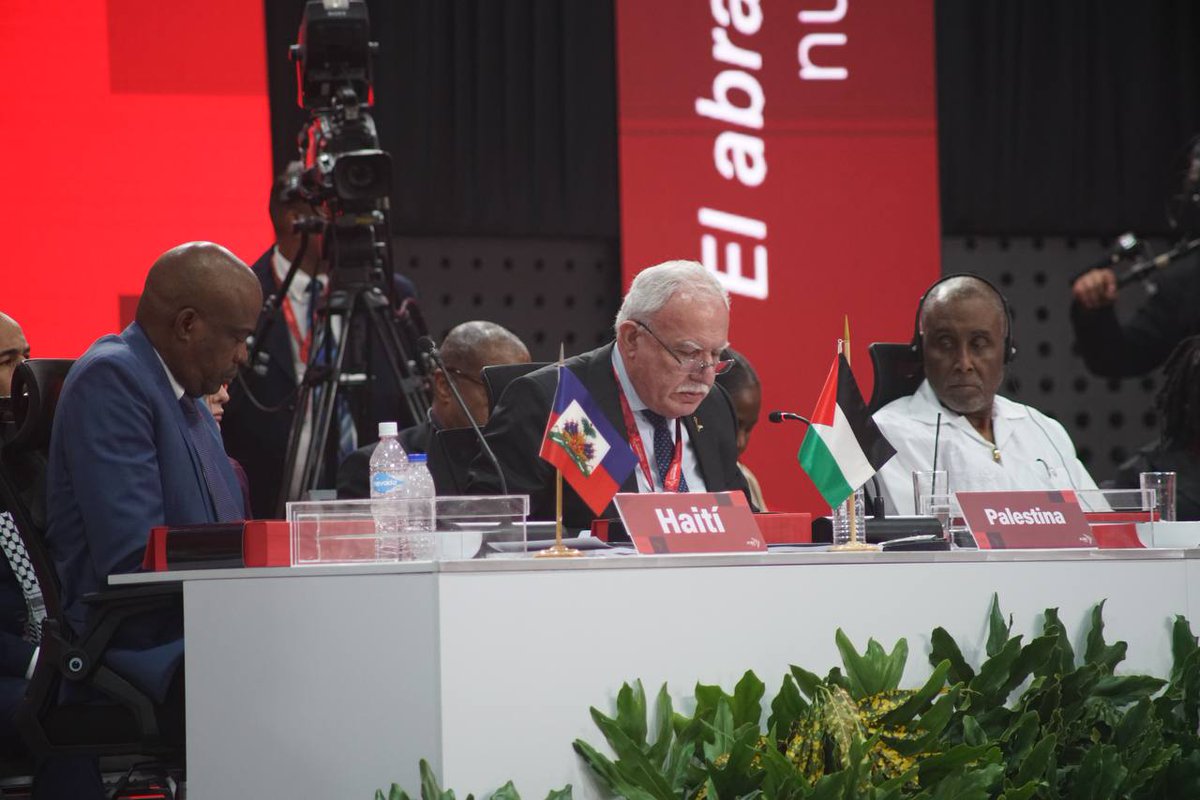
At the current summit, it was announced that Palestine had been included as a “brotherly country” and was included as a “permanent guest”. According to the resolution of the Heads of State, ALBA-TCP condemns the attacks against the Palestinian population and the “illegally occupied territories” and rejects “the merciless and inhuman genocide committed by the State of Israel, the occupying power, as well as its plan of spoliation, invasion, and domination.” Likewise, they denounced the support of several governments currently collaborating with the actions of the Israeli army and called for an “immediate ceasefire…From the heart of the peoples and governments of this alliance, we declare Palestine a brother country of the ALBA-TCP, and reaffirm our commitment to the defense of the Palestinian cause, which is the defense of humanity,” reads the resolution.
In this regard, Riyad al-Malki, advisor to the President of State for International Affairs of Palestine said “History will remember those who stood on the side of justice, ALBA’s lasting solidarity with Palestine is a testimony of freedom and collective resistance.” Furthermore, Malki added “This Alliance is a living testimony of collective integration to challenge imperialism and ensure a just world. These values resonate with the Palestinian struggle, an end to the illegal occupation.”
A call for counter-hegemonic struggle
The joint document signed by all the countries highlights the historical importance of ALBA-TCP in the struggle for a more equitable world: “Twenty years after this giant step, we pay homage to the founding leaders, Hugo Chávez Frías and Fidel Castro Ruz, who adopted that December 14, 2004, in Havana, Cuba, the vision of the future embodied in the founding documents of ALBA, which have allowed us to walk united until the present, animated by the ancestral force that led our peoples to be free and that encourages us to continue integrated in this Alliance for Life.”
Similarly, it was stressed that the existence of this multilateral organization operates as a possibility to create a region that resists the impositions of the most developed countries: “Today, we want to ratify before our peoples, the counter-hegemonic, democratic, anti-imperialist and anti-fascist nature of our Alliance and renew our commitment to help and protect each other, to continue building together a future of shared goals under the founding principles of complementarity, cooperation, social justice, defense of our sovereignty and solidarity.”
In this sense, Luis Arce stressed that “In the face of the challenges of a world threatened by fascism and neo-fascism, ALBA is not an option, ALBA is a necessity that must continue with firm steps, reaffirming the founding principles of solidarity, justice, and cooperation…ALBA is not only an alliance, it is a promise for the future, a living resistance, an instrument for the most dispossessed, and a reminder that together, as peoples, we are invincible.”
Objectives and principles of ALBA-TCP
According to ALBA’s official website, the fundamental objective of the project is “to achieve integral development, ensure social equality and contribute to guaranteeing the quality of life, good living, independence, self-determination and identity of the peoples.” For this very reason, the principles of ALBA-TCP propose that political decisions be made horizontally and take into account the economic differences of its members without meaning that the importance of each of the members is underestimated.
The principles shared by the countries are “trade and investment should not be ends in themselves, but instruments to achieve sustainable development; special and differentiated treatment, according to the level of development of the various countries; economic complementarity and cooperation; cooperation and solidarity; the creation of the Social Emergency Fund; the integrative development of communications and transportation; the sustainability of development; energy integration; the promotion of investments of Latin American capital in the region; the defense of Latin American and Caribbean identity and culture; respect for intellectual property; and the agreement of multilateral positions and in negotiations with countries and blocs in other regions.”
Adrian Ramsay MP, Green Party Co-leader. Wikipedia CC.
Reacting to news that government and regulators have broken the law by being too lenient on water companies that spill sewage, and on the day Thames Water seeks a £3bn bailout, Green Party co-leader Adrian Ramsay MP said:
“For too long billions have been leaking out to shareholders instead of going into fixing our broken water system. But it will be water customers who are expected to bail out this failed model of privatisation through steep hikes to water bills.
“The way to end this fiasco and ensure government and regulators keep within the law is to put failing water companies into special administration and ultimately to bring water back into public ownership.”