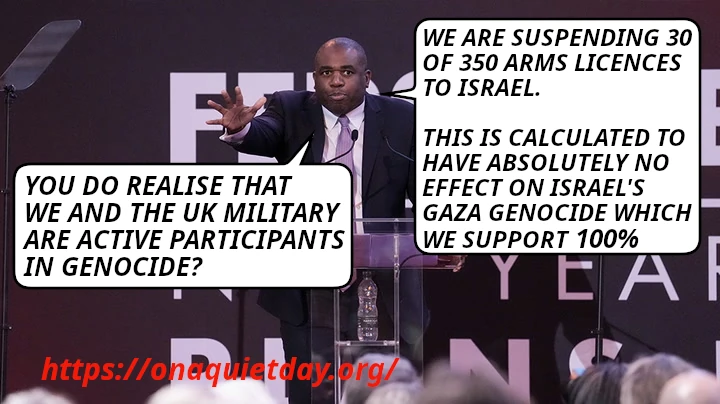
Genocide denying UK Foreign Secretary David Lammy says that UK is suspending 30 of 350 arms licences to Israel. He also confirms the UK government’s support for Israel’s Gaza genocide and the UK government and military’s active participation in genocide.
Journalists around the world condemn the British foreign secretary for erasing the work and suffering of Palestinian journalists
British Foreign Secretary David Lammy has been blasted for saying “there are no journalists in Gaza” at a meeting in parliament on Wednesday.
Lammy was asked by fellow Labour MP Matthew Patrick at a House of Commons foreign affairs committee meeting about his assessment “of the nature of the conflict” in Gaza and “how that impinges on getting aid in”.
“As I said, there is now widespread looting,” Lammy said in his reply.
“There are no journalists in Gaza and there are no politicians such as me who are able to go to Gaza, so I am unable to verify who is behind the looting,” he added.
Journalists from around the world condemned the British foreign secretary for appearing to erase the work and suffering of Palestinian journalists – at least 127 of whom have been killed during the course of Israel’s war on Gaza, according to the Committee to Protect Journalists.
…
Despite Lammy’s suggestion that the British government does not know who is looting aid because “there are no journalists” in Gaza, both reporters and the United Nations have established that gangs are looting aid with “protection” from Israel’s military.
There have even been numerous reports that Israel has actively armed gangs in Gaza. Israel has also blocked aid from reaching the besieged enclave throughout much of the war.
…
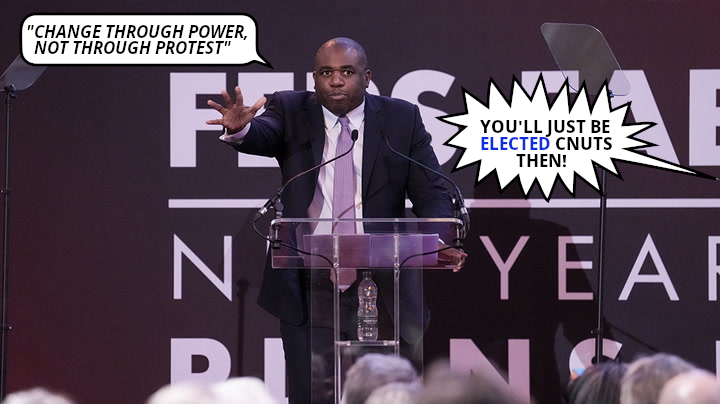
UK Labour Party Shadow Foreign Secretary repeatedly heckled at a speech to the Fabian Society over his and the Labour Party’s support for and complicity in Israel’s genocide of Gaza.Genocide denier and Current UK Prime Minister Keir Starmer is quoted that he supports Zionism without qualification. He also confirms that UK air force support has been essential in Israel’s mass-murdering genocide. Includes URLs https://www.declassifieduk.org/keir-starmers-100-spy-flights-over-gaza-in-support-of-israel/ and https://youtu.be/O74hZCKKdpA
dizzy: Israel’s genocides should be regarded as a shared venture involving the United States, United Kingdom and Israel.
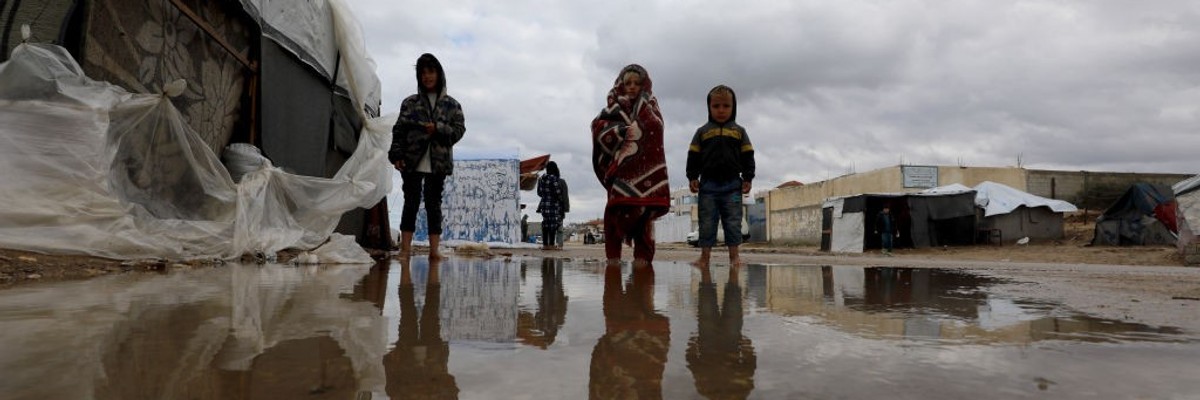
Displaced Palestinian children are pictured at a flooded makeshift camp in Nuseirat, Gaza on November 26, 2024. (Photo: Moiz Salhi/Anadolu via Getty Images)
“For many children, all they have is ruined bits of tent material swimming in swamp water in the camp they fled to for safety.”
Flooding induced by heavy rainstorms in recent days has compounded the humanitarian crisis facing Palestinians in the besieged Gaza Strip, intensifying the already-high threat of disease as nearly two million displaced people struggle to survive Israel’s U.S.-backed assault.
Save the Children, a humanitarian group working on the ground in Gaza, said Friday that torrential rainfall has transformed makeshift camps into swamps, impacting roughly 235,000 children who have been forced from their homes by Israeli attacks and displacement orders.
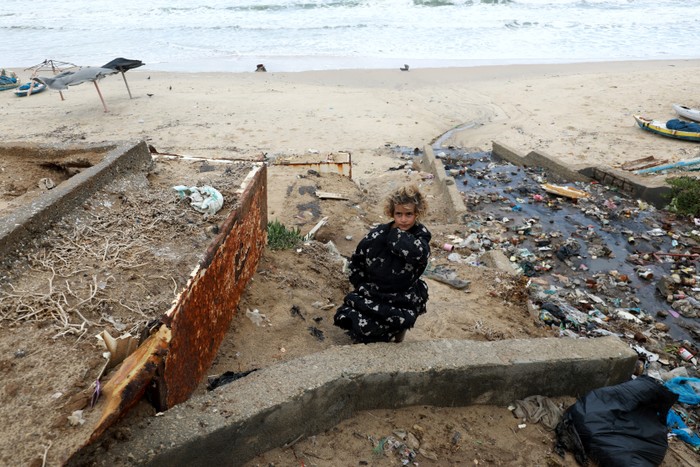
A Save the Children nutrition consultant who works in Gaza’s flood-affected camps said that most of the tents “are uninhabitable” and wholly inadequate to withstand harsh winter weather. Makeshift tents that now run for miles along Gaza’s coast have been badly damaged or completely destroyed in recent days by rising seawater.
“The tents are made of cloth and similar materials, and the ground is dust and mud, so tents get flooded within five minutes of rain,” said the Save the Children consultant, identified as Mariam. “People’s situation is miserable. A dire situation in terms of health, mental health, and immunity.”
“A mother came in today and apologized for being late. Why? Because it was raining through the night and their tent was flooded,” said Mariam. “The family had to go outside, and she had to carry the children until the rain stopped. Then they swept the water out and went back inside. Some people had to flee because big ponds were formed due to rain. It’s a tragic situation.”
(Photo: Moiz Salhi/Anadolu via Getty Images)
Reuters reported earlier this week that downpours “inundated tents and in some places washed away the plastic and cloth shelters used by displaced Gazans.” The United Nations estimates that around 1.6 million people live in makeshift shelters across Gaza.
“Some placed water buckets on the ground to protect mats from leaks and dug trenches to drain water away from their tents,” according to Reuters. “Many tents used early in the war have now worn out and no longer offer protection, but the price of new tents and plastic sheeting has shot up beyond the means of displaced families.”
Aid workers have warned for months of the threat stagnant water poses to public health in Gaza, whose sanitation infrastructure has been decimated by Israel’s large-scale bombing campaign. One Oxfam campaigner recently described the bomb-ravaged enclave as “a nightmarish landscape of insect and disease-ridden swamps and poisoned wells.”
In a report issued in September, the U.N. Children’s Fund and other organizations noted that “flooding creates stagnant water pools which can become breeding sites for mosquitoes, increasing the risk of diseases such as West Nile Fever.”
Jeremy Stoner, regional director for Save the Children, said Friday that “children in Gaza are not only losing their lives, their limbs, and their loved ones—they are also fleeing their bombed-out homes for camps with conditions less and less fit for human life, as we see more and more restrictions on aid.”
“As this deadly war has shattered the lives and futures of children for over a year now, we have seen access to critical things like food, healthcare, and sanitation stripped away,” Stoner added. “Now for many children, all they have is ruined bits of tent material swimming in swamp water in the camp they fled to for safety.”
Gaza’s health ministry said Friday that the official death toll in the enclave has risen to 44,363 following a series of Israeli attacks across the territory over the past 24 hours.
Since Thursday morning, as Al Jazeera reported Friday, Israeli attacks in central Gaza have killed dozens of people.
“Israeli fighter jets have carried out an intense bombing campaign in the Nuseirat area over the past day, targeting residential buildings and homes, as well as mosques and other public facilities,” the outlet observed. “One Israeli attack on Thursday struck a home sheltering displaced Palestinians, resulting in nine members from one family being killed. Israeli fighter jets also bombed a house in the camp belonging to the Dahdouh family on Friday, killing at least five people.”
Al Jazeera‘s Hani Mahmoud said Friday that as Israeli tanks and armored vehicles withdrew from areas of central Gaza that they attacked in the preceding 24 hours, “many displaced people made their way back to Nuseirat refugee camp to check on family members still inside.”
“Many were shocked to find out that their family members were not able to leave due to quadcopters constantly shooting at them,” Mahmoud said. “Many people have been killed either inside their homes or as they were making their way out of their residential buildings into the streets, they said. They are literally collecting bodies right now from the streets.”
On March 2 2022, delegates to the UN environment assembly adopted an ambitious resolution to develop the text of a new treaty by the end of 2024 to end plastic pollution. With 24 days of formal negotiation between almost 200 countries completed, spread over meetings in Peru, France, Kenya and Canada, the fifth and final negotiation meeting is about to take place in Busan, South Korea. This is crunch time. Agreement must be found or the opportunity to take global action to tackle plastic pollution might be lost.
I have studied international action to tackle plastic pollution for the past decade. During this time, I have witnessed remarkable growth in plastic waste – an estimated 400 million tonnes is thrown away every year. Plastic pollution is now ubiquitous.
The issue of plastic pollution has moved up the public and political agenda in a way few could have predicted. Global action has always been the missing piece of the picture, as the plastics economy transcends national boundaries, and actions in one jurisdiction, while locally beneficial, tend not to address global pollution patterns.
To tackle plastic pollution, a shift in the entire plastics economy is needed. This should focus on reuse and refill schemes, which reduce the need for new plastic products and the substitution of plastics with other materials that are less polluting or harmful.
With my team of policy researchers, I have attended the last three plastics treaty negotiation meetings as an observer to gauge progress towards a global treaty. For the most part, progress has been slow, largely because of delaying and blocking tactics by a few countries that depend on fossil fuel industries. Lobbying from the petrochemical industry frustrates progress further. Given the tight timescale to agree the treaty, I worry that no agreement will be reached.
Three priorities
Final negotiations must include three things.
An immediate priority is to agree on the rules governing how decisions are taken in the negotiations between member states, known as the “rules of procedure”. At present, decisions are taken by consensus, meaning all delegations must agree before a decision is reached.
Given the entrenched positions of some countries, consensus-based decision-making is unlikely to yield rapid agreement because the positions of some nations are so far apart. The rules of procedure needs to include a voting mechanism so that when there is decisive agreement between most nations a decisions can be taken and progress can be made, when consensus cannot be reached.
The second critical issue is finance. Plastic pollution is a challenge most acutely faced by low- and middle-income countries. The plastics treaty is only likely to be effective if there’s adequate funding for countries most affected by plastic pollution to take action.
As witnessed in the climate debate, finance is incredibly contentious and raises critical questions. That includes who will pay for the problems plastic pollution has already caused and the new measures to tackle plastic pollution, plus how supporting countries can best provide necessary technology and training.
The role of the private sector is also significant in the plastics economy, and discussions are underway about innovative options for private finance to support treaty implementation. For the treaty to be credible, agreement on the broad terms of a finance mechanism for treaty implementation is essential.
The treaty must also focus on actions most likely to reduce plastic pollution. There is clear evidence that reducing the production of primary plastic polymers reduces plastic pollution most efficiently and effectively.
Plastic is made at such a rate that it is impossible for waste management systems to keep up. So a treaty that focuses on waste management will not reduce plastic pollution significantly enough. Only putting the brake on plastic production will stop the inundation of plastic waste.
There are, of course, many other important elements to agree on during negotiations. Criteria must be set to identify problematic, unnecessary and avoidable plastics that companies should stop making. Problematic plastics have harmful effects on human health or the environment, so any chemicals of concern must be removed from plastic materials and products. Unnecessary plastics are those with a function that is deemed non-essential, while avoidable plastics have an essential function but could be replaced by a non-plastic alternative.
Genocide denier and Current UK Prime Minister Keir Starmer is quoted that he supports Zionism without qualification. He also confirms that UK air force support has been essential in Israel’s mass-murdering genocide. Includes URLs https://www.declassifieduk.org/keir-starmers-100-spy-flights-over-gaza-in-support-of-israel/ and https://youtu.be/O74hZCKKdpAGenocide denying UK Foreign Secretary David Lammy says that UK is suspending 30 of 350 arms licences to Israel. He also confirms the UK government’s support for Israel’s Gaza genocide and the UK government and military’s active participation in genocide.
Original article republished from MEMO under a Creative Commons Attribution-NonCommercial-ShareAlike 4.0 International License.
Palestinians and UN workers examine the destroyed makeshift tents and shelters after Israeli attack hits a United Nations Relief and Works Agency for Palestine Refugees in the Near East (UNRWA) school, killing and injuring many in Nuseirat Refugee Camp of Deir al-Balah, Gaza on July 15, 2024 [Abed Rahim Khatib/Anadolu Agency]
The Basque Government has awarded UNRWA the 2024 Ignacio Ellacuria Prize for Cooperation and Solidarity as a result of its “dedication to the Palestinian people over 75 years in a context of continuous conflict”.
The jury highlighted “the more human side of the direct work that it carries out in favour of justice and human rights with the Palestinian population” and concluded that it deserves this award “because of the real risk of disappearing,” since “it would imply taking away the Palestinian population’s right to refuge and the right of return to their lands and homes.”
UNRWA works in the Occupied Palestinian Territories, Israel, Jordan, Lebanon, and Syria and supports around 5.9 million Palestinians, providing them with education, medical care, camp infrastructure, microfinancing and other essentials.
Over the past few years, however, funding for the agency has been cut by donor states, while Israel has worked to defame and defund it.
Israel has lobbied hard to have UNRWA closed as it is the only UN agency to have a specific mandate to look after the basic needs of Palestinian refugees. If the agency no longer exists, argues Israel, then the refugee issue must no longer exist, and the legitimate right for Palestinian refugees to return to their land will be unnecessary. Israel has denied that right of return since the late 1940s, even though its own membership of the UN was made conditional upon Palestinian refugees being allowed to return to their homes and land.