Category: politics

  • Climate Movement Says ‘Hurricane Helene Must Be a Wake-Up Call’

    Spread the love

    Original article by Jessica Corbett republished from Common Dreams under Creative Commons (CC BY-NC-ND 3.0). 
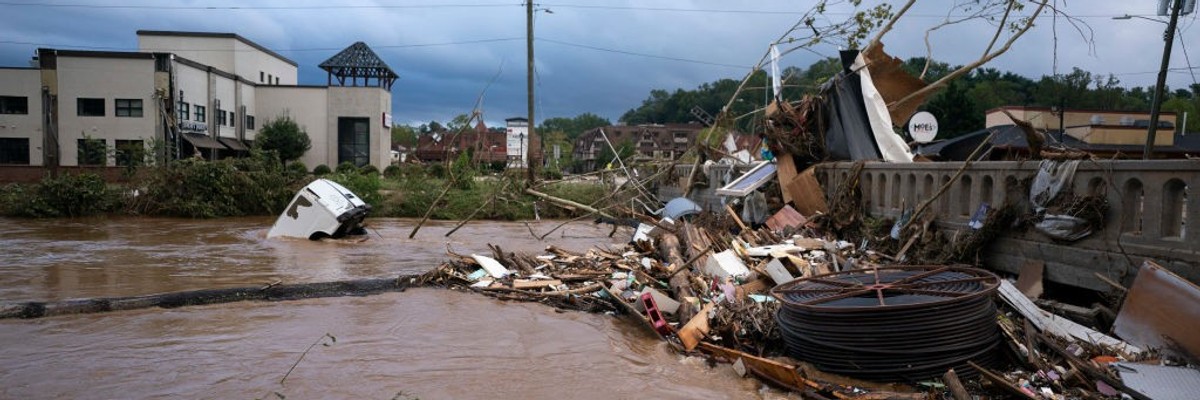
    A van flows in floodwaters near the Biltmore Village in the aftermath of Hurricane Helene on September 28, 2024 in Asheville, North Carolina. (Photo: Sean Rayford/Getty Images)

    “To those insisting that, ‘This is not the time!’ to have those other conversations, I say: This is *exactly* when we need to be having them,” said one climate scientist.

    As emergency crews have worked through the weekend to rescue people and restore essential services across several southeastern U.S. states, green groups in recent days have pointed to the death and damage from Hurricane Helene as just the latest evidence of the need for sweeping action on the climate emergency.

    Helene made landfall as a Category 4 hurricane with 140 mph winds in Florida’s Big Bend region late Thursday, then left a path of destruction across hundreds of miles of Georgia, the Carolinas, and Tennessee. As of early Sunday, at least 64 people are confirmed dead—including at least two people in Virginia—though that figure is expected to rise.

    “Moody’s Analytics said it expects $15 billion to $26 billion in property damage,” The Associated Press reported Sunday on what is now a post-tropical cyclone. “AccuWeather‘s preliminary estimate of the total damage and economic loss from Helene in the U.S. is between $95 billion and $110 billion.”

    The youth-led Sunrise Movement said Sunday that “any reporting about Hurricane Helene needs to be clear—this is not normal. This is not just a tragedy. This is a crime. Fossil fuel companies have known this would happen for the last 50 years. They lied to the public and bought out our government just to make a profit. Make them pay.”

    Greenpeace USA similarly declared on social media Saturday that “#HURRICANE HELENE MUST BE A WAKE-UP CALL FOR CLIMATE JUSTICE!”

    “We are heartbroken,” the group said, noting the dozens of people killed. “Communities have been devastated. The corporations heating the climate must be held accountable.”

    Dozens of communities across the United States have already launched climate liability lawsuits against Big Oil, which knew for decades that fossil fuels would heat the planet but promoted disinformation and raked in huge profits. Recently there have been calls for legal action by the U.S. Department of Justice and potential homicide cases brought by state and local prosecutors.

    “Our hearts and solidarity go out to everyone facing the devastation. Please support mutual aid relief efforts and demand oil companies #StartDrillingStartPaying!” Greenpeace said Saturday.

    Sunrise executive director Aru Shiney-Aja on Sunday offered a “friendly reminder that fossil fuel companies get 20 BILLION dollars in [government] subsidies every year,” while the Federal Emergency Management Agency (FEMA) “runs out of money to respond to disasters like Helene.”

    Both Shiney-Aja and Greenpeace shared footage from Asheville, North Carolina, which endured what Ryan Cole, the assistant director of Buncombe County Emergency Services, described as “biblical flooding.”

    Just two years ago, The New Lede reported that “from wildfires racing through the drought-stricken West, to heavy flooding in the central and eastern regions of the United States, extreme weather events are spurring many Americans to seek refuge in more environmentally stable cities, so-called ‘climate havens,’” including Asheville.

    This weekend, Asheville—which is over 2,000 feet above sea level and more than 250 miles from the coast—and surrounding communities are contending with disrupted water, power, and communications services due to what officials are reportedly calling “Buncombe County’s own Hurricane Katrina.”

    Noting Asheville’s elevation and distance from the coast, Lucky Tran, director of science communications and media relations at Columbia University in New York City, said Sunday that “no place is safe from climate change. We all suffer the consequences. We must all take action. We are all in this together.”

    https://twitter.com/alixabeth/status/1840218797942140960?ref_src=twsrc%5Etfw%7Ctwcamp%5Etweetembed%7Ctwterm%5E1840218797942140960%7Ctwgr%5E7dbf1c26106a7e3716bda71eeb630f7eafe840b0%7Ctwcon%5Es1_c10&ref_url=https%3A%2F%2Fwww.commondreams.org%2Fnews%2Fhurricane-helene

    As The New York Times reported Sunday:

    People across western North Carolina chainsawed their way to loved ones and drove for hours Saturday on dwindling gas tanks in search of food and power, in what one resident described as a “mini-apocalypse” after Hurricane Helene.

    Authorities said the region was facing a historic disaster a day after the powerful storm swept through the Southeast, downing power lines and washing out highways. Landslides, spotty cellphone service, and a gas shortage complicated rescue and recovery efforts. Some stranded people were being airlifted to safety.

    Antonia Juhasz, a leading climate and energy journalist and author, said Saturday that “Asheville, North Carolina is being wiped off the map by the worst storm to hit the region in a generation. This is what the climate crisis looks like: the production and use of fossil fuels changes the climate, intensifying extreme weather events and making them more frequent.”

    As hurricane scientist Jeff Masters detailed Friday, fossil fuel-driven climate change “makes the strongest hurricanes stronger,” boosts rainfall from such storms, leads to more rapid intensification, and causes sea-level rise that increases storm surge damage.

    In an effort to emphasize the climate change connection to extreme weather, from heatwaves to hurricanes, some climate campaigners have suggested naming such events after oil and gas companies.

    “What did a Helene ever do to deserve getting this horrific hurricane named after her? We should be naming hurricanes after fossil fuel CEOs instead. How about Hurricane Darren?” said Fossil Free Media director Jamie Henn, taking aim at ExxonMobil’s Darren Woods.

    Daniel Swain, a climate scientist focused on extreme weather, said on social media Saturday, “The images and stories just beginning to emerge from eastern TN and western NC in the aftermath of widespread catastrophic flooding wrought by Helene are genuinely horrifying, and the full scale of the disaster is likely as yet untold.”

    “This was, by far, the most extreme rain event in observed record across much/most of the region, where reliable records date back over 100 [years]. Unsurprisingly, the flooding which resulted has also been widespread, historic, and generally catastrophic across a broad region,” he explained. “These floods, which were concentrated in valleys containing rivers and typically modest creeks and streams, involved extremely large volumes of water moving downhill at high velocity. This was not a gradual or ‘gentle’ inundation by any means.”

    Swain stressed that “sometimes ‘worst-case’ scenarios really do come to pass, and I think we often lack the collective imagination to fully envision what that looks like. That’s a problem, because being honest about risks that exist is [the] first step toward mitigating them and preventing harm!”

    “Ultimately, there many folks in FL, GA, NC, and TN who are in need of urgent assistance—and that is/should be foremost priority,” he added. “But to those insisting that, ‘This is not the time!’ to have those other conversations, I say: This is *exactly* when we need to be having them.”

    The AP reported that “in Atlanta, 11.12 inches (28.24 centimeters) of rain fell over 48 hours, the most the city has seen over two days since record-keeping began in 1878,” while “in Florida’s Big Bend, some lost nearly everything they own, emerging from the storm without even a pair of shoes.”

    Along Florida’s Gulf Coast, “Helene shoved a wall of water estimated at least 10 feet high into the lowest-lying areas of Steinhatchee,” according to USA Today.

    South of there, in Pinellas County, officials have identified over 18,000 homes damaged by Helene—and at least 11,000 are “uninhabitable,” as the Tampa Bay Times put it.

    Highlighting the connection between climate change and more intense hurricanes, Congressman Maxwell Frost (D-Fla.) said Thursday that “the climate crisis is here. We must act to save lives.”

    Original article by Jessica Corbett republished from Common Dreams under Creative Commons (CC BY-NC-ND 3.0). 
  • Labour used water industry analysis to argue against nationalisation

    Spread the love

    https://www.theguardian.com/business/2024/sep/29/labour-water-industry-analysis-argue-against-nationalisation

    Thames Water is seeking to raise the funds it needs to avoid short-term nationalisation. Photograph: Maureen McLean/Rex/Shutterstock

    ‘Economically illiterate’ Defra letter sent to anti-sewage groups cites 2018 report commissioned by water companies

    Labour used “economically illiterate” analysis paid for by water companies in order to argue against the nationalisation of the sector, the Guardian can reveal.

    In an official letter recently sent to anti-sewage groups, civil servants cited a paper by the Social Market Foundation as a reason to avoid nationalisation as part of its review of the sector. The report from 2018 was commissioned by United Utilities, Anglian Water, Severn Trent and South West Water.

    The letter, sent by the Department for Environment, Food and Rural Affairs (Defra) to the Rivers Trust, Surfers Against Sewage, River Action UK and Greenpeace states: “The Social Market Foundation calculated the likely cost of renationalisation to be £90bn, drawing on publicly available data from Ofwat, the London Stock Exchange and the annual accounts of the water companies. Renationalisation would impose a huge burden on the public purse at a time when public finances are already stretched.”

    Sir Dieter Helm, a leading economist, called the analysis “economically illiterate”.

    Moody’s rating agency has disputed this figure and estimated that nationalisation could actually cost £14.5bn – a fraction of the analysis amount.

    Earlier this month, Steve Reed, the environment secretary, announced a review into the water companies and the regulators, but said nationalisation was firmly off the table. He said it would cost “billions of pounds” and would not solve the sewage crisis.

    …

    https://www.theguardian.com/business/2024/sep/29/labour-water-industry-analysis-argue-against-nationalisation

    Six water firms in England ‘overcharged customers by up to £1.5bn’

  • ‘This Maniac Must Be Stopped’: Netanyahu Condemned Over Massive Beirut Bombing

    Spread the love

    Original article by Jessica Corbett republished from Common Dreams under Creative Commons (CC BY-NC-ND 3.0). 
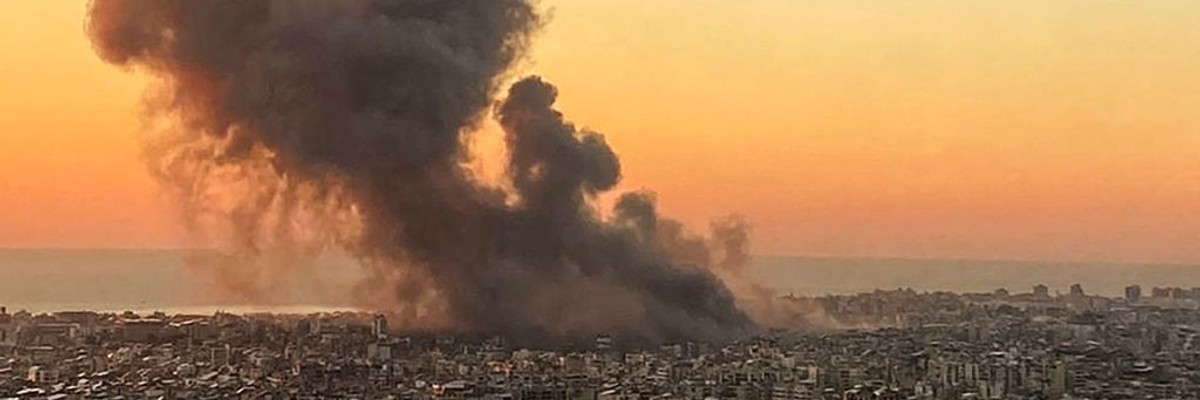
    Smoke rises above Beirut’s southern suburbs during an Israeli strike on Lebanese residential buildings on September 27, 2024. (Photo: AFP via Getty Images)

    While Hezbollah’s leader Hassan Nasrallah reportedly survived the attack on the densely populated area of Lebanon’s capitol, one observer warned that Israel may still “get the regional war it has sought.”

    Israel’s dropping of massive bombs in Beirut on Friday sparked a fresh wave of global condemnation against Israeli Prime Minister Benjamin Netanyahu, with critics accusing him of trying to drag the Middle East into an even bloodier conflict that could engulf the entire region.

    The Israeli attack supposedly targeted Hassan Nasrallah, head of the political and paramilitary group Hezbollah. Multiple media outlets reported that the leader survived, though hundreds of others are feared dead in the “complete carnage” from the bombing that leveled several buildings. While the death toll from Friday is not yet clear, over 700 people have been killed in Israel’s strikes in Lebanon since Monday.

    As The New York Times reported:

    Lebanon’s health minister, Firass Abiad, said that there had been a “complete decimation” of four to six residential buildings as a result of the Israeli strikes. He said that the number of casualties in hospitals was low so far because people were still trapped under the rubble. “They are residential buildings. They were filled with people,” Mr. Abiad said. “Whoever is in those buildings is now under the rubble.”

    Social media and news sites quickly filled with photos and videos of massive plumes of smoke and smoldering rubble.

    Jeanine Hennis-Plasschaert, the United Nations special coordinator for Lebanon, said Friday that she was “deeply alarmed and profoundly worried about the potential civilian impact of tonight’s massive strikes on Beirut’s densely populated southern suburbs. The city is still shaking with fear and panic widespread. All must urgently cease fire.”

    However, the bombing is widely expected to worsen this week’s escalation, which came after nearly a year of the Israel Defense Forces (IDF) trading strikes with Hezbollah over the Israeli assault on the Gaza Strip, which has killed over 41,000 Palestinians.

    “For Israel, it may not matter if Nasrallah was killed. Either way, it believes it’ll get the regional war it has sought,” Trita Parsi, executive vice president of the Quincy Institute for Responsible Statecraft, said of the Friday attack.

    Citing an unnamed Israeli official, NBC News reported that “Israel expects Hezbollah will attempt to mount a major retaliatory attack” in response to Friday’s bombing of the group’s command center.

    As Reuters detailed:

    Israel has struck the Hezbollah-controlled southern suburbs of Beirut, known as Dahiyeh, four times over the last week, killing at least three senior Hezbollah military commanders.

    But Friday’s attack was far more powerful, with multiple blasts shaking windows across the city, recalling Israeli airstrikes during the war it fought with Hezbollah in 2006.

    In a video posted on social media, IDF Spokesperson Rear Adm. Daniel Hagari described the Friday attack as “a precise strike” on what “served as the epicenter of Hezbollah’s terror,” adding that the group’s headquarters “was intentionally built under residential buildings.”

    During Netanyahu’s United Nations General Assembly speech on Friday—which was met with a walkout from several diplomats and other officials—the prime minister said that Hezbollah has stored rockets “in schools, in hospitals, in apartment buildings, and in the private homes of the citizens of Lebanon. They endanger their own people. They put a missile in every kitchen, a rocket in every garage.”

    In response, Middle East expert Assal Rad said, “So he’s claiming there’s no civilian spaces in Lebanon and Israel has a right to destroy all of it.”

    Jason Hickel, who has positions at multiple European universities, also sounded the alarm over those lines from the Israeli leader’s speech.

    Netanyahu is “effectively arguing all homes are a military target,” he said. “This is 100% genocidal and this maniac must be stopped.”

    Hours before the attack in suburban Beirut, the Democracy in Europe Movement 2025 (DiEM25) strongly condemned “Israel’s brutal bombardment of Lebanon, another reckless escalation in the Middle East on behalf of the Benjamin Netanyahu regime that risks further destabilization in an already fragile region.”

    “The Israeli bombardment of Lebanon is the latest dark chapter in a series of disproportionate displays of force. Its ongoing genocide in Palestine over the last year has proven beyond any doubt that its willingness to commit horrific acts knows no bounds,” DiEM25 said. “Rather than seeking a peaceful and just resolution, Israel’s government has consistently chosen the path of militarism, often with international support from the European Union and the United States.”

    “The international community, including the E.U., has a critical role to play in promoting peace rather than enabling violence,” the group added. “Peace and security in the Middle East will not come through bombs and military strength. It will come through diplomacy. We remain committed to working towards that aim and stand in solidarity with the Lebanese people, as well as all others suffering from this violent escalation.”

    Original article by Jessica Corbett republished from Common Dreams under Creative Commons (CC BY-NC-ND 3.0). 

  • Netanyahu accused of trying to drag wider world into Israel’s murderous wars

    Spread the love

    https://morningstaronline.co.uk/article/netanyahu-accused-of-trying-to-drag-wider-world-into-israels-murderous-wars

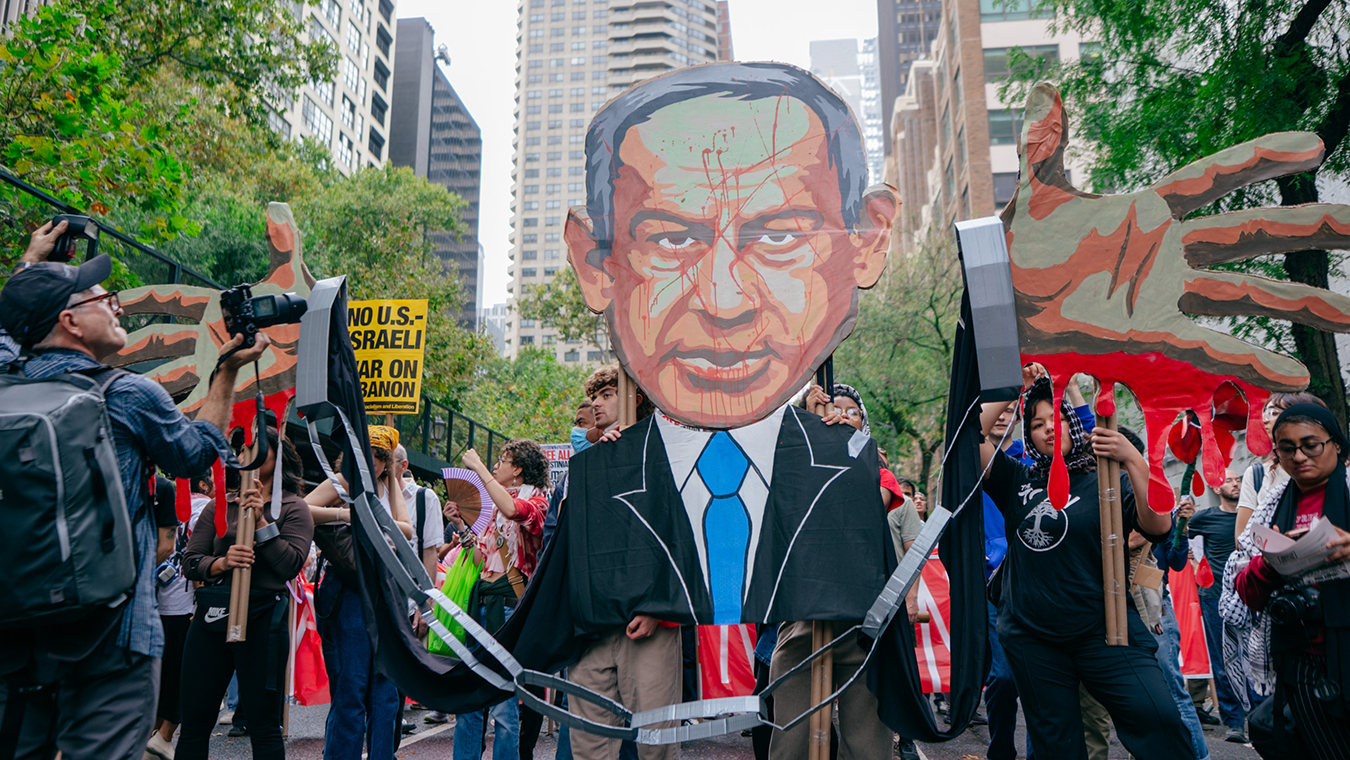
    Palestinian supporters protest Israeli Prime Minister Benjamin Netanyahu in Times Square during the 79th session of the United Nations General Assembly, September 26, 2024, in New York

    BENJAMIN NETANYAHU was accused today of trying to drag Britain and the wider world into Israel’s murderous wars in Lebanon and Gaza.

    Large numbers of diplomats from multiple nations walked out as Israel’s prime minister headed to the podium for his speech at the United Nations general assembly meeting in New York.

    Mr Netanyahu opened his speech by saying he wanted to “set the record straight” against the “lies” that other nations were telling the meeting of the bloc.

    He said that Israel has the right to defend itself from “savage murderers” and claimed that supporting Israel was in the “interest of all of us.”

    …

    A Stop the War spokesperson said: “Netanyahu is trying to drag the wider world, including Britain, into the murderous wars he is waging in Lebanon and Gaza.

    “The British government must use all possible pressure to force Israel to stop the killing and agree a ceasefire in both wars.”

    …

    In response to Mr Netanyahu’s speech, Green Party co-leader and Bristol Central MP Carla Denyer said: “No-one is winning while Israel turns down ceasefire proposals, more die in Gaza and Lebanon, and hostages are not released.

    “The UK government must revoke all arms licences and use all diplomatic power to bring an end to the killing.”

    …

    https://morningstaronline.co.uk/article/netanyahu-accused-of-trying-to-drag-wider-world-into-israels-murderous-wars

  • Israeli Prime Minister Benjamin Netanyahu defends his genocide in UN speech

    Spread the love

    Original article by Natalia Marques republished from peoples dispatch under a Creative Commons Attribution-ShareAlike 4.0 (CC BY-SA) license.

    Protesters demand arrest of Netanyahu ahead of UN visit (Photo: Wyatt Souers)

    Hounded across the world for war crimes, Netanyahu attempts to defend Israel’s genocidal campaign across the region

    Israeli Prime Minister Benjamin Netanyahu remained on the defensive throughout his speech to the United Nations today. Taking the stage amid jeers from the assembled delegates, who stormed out in protest, Netanyahu claimed that he had originally decided to skip the General Assembly but after hearing “lies and slander” against Israel, decided to “set the record straight.” 

    Israel’s genocide against Palestinians in Gaza has resulted in a death toll of over 41,000 people. Israel’s expansion of this genocidal onslaught into Lebanon has resulted in a major escalation, with the Zionist state’s bombs killing more than 700 in Lebanon since Monday. On the same day as Netanyahu’s speech, Israel launched a series of airstrikes in Beirut, and bombed a compound of Al Aqsa Hospital in Gaza, killing at least one person.

    “The UN is watching with great alarm,” the airstrikes in Beirut, said UN spokesman Stephane Dujarric.

    “Israel seeks peace, Israel yearns for peace,” Netanyahu proclaimed to the UNGA. 

    “We face savage enemies who seek our annihilation, and we must defend ourselves against these savage murderers, [who] seek not only to destroy us but also destroy our common civilization and return all of us to a dark age of tyranny and terror,” Netanyahu stated in the familiar war-mongering tone that Israeli officials have become known for since October 7. 

    Netanyahu is a wanted war criminal. In August, International Criminal Court (ICC) Chief Prosecutor Karim Khan urged ICC judges to rule on his request for arrest warrants for Netanyahu and Israeli Defense Minister Yoav Gallant. Khan had applied for arrest warrants back in May for the two top Israeli leaders for war crimes and crimes against humanity. But these warrants, if issued, would not apply in Israel’s biggest ally, the United States, which is not a party to the Rome Statute of the ICC.

    As Israel’s aggression continues to isolate it on the world stage, people of conscience in the United States, Israel’s largest military and financial backer, attempt to isolate it in the belly of the beast. 

    Thousands of people also marched to the United Nations on September 26 to protest Netanyahu’s visit to the UNGA. The protest was organized by the Shut It Down for Palestine Coalition which includes organizations such as the Palestinian Youth Movement, the People’s Forum, the ANSWER Coalition, and Al-Awda: The Palestine Right to Return Coalition. “When a war criminal comes to our city, we don’t stay home, we don’t stay silent. We go out to the streets, every single day that he is in this city, and we make it known, Netanyahu, the people are coming for you,” said Miriam Osman of the Palestinian Youth Movement to an assembled crowd of thousands in Midtown Manhattan.

    Later that day, a crowd of thousands protested outside the Loews Regency New York Hotel where Netanyahu was staying ahead of his UN speech. Demonstrators were met with brutality and arrests from New York police. 

    Original article by Natalia Marques republished from peoples dispatch under a Creative Commons Attribution-ShareAlike 4.0 (CC BY-SA) license.