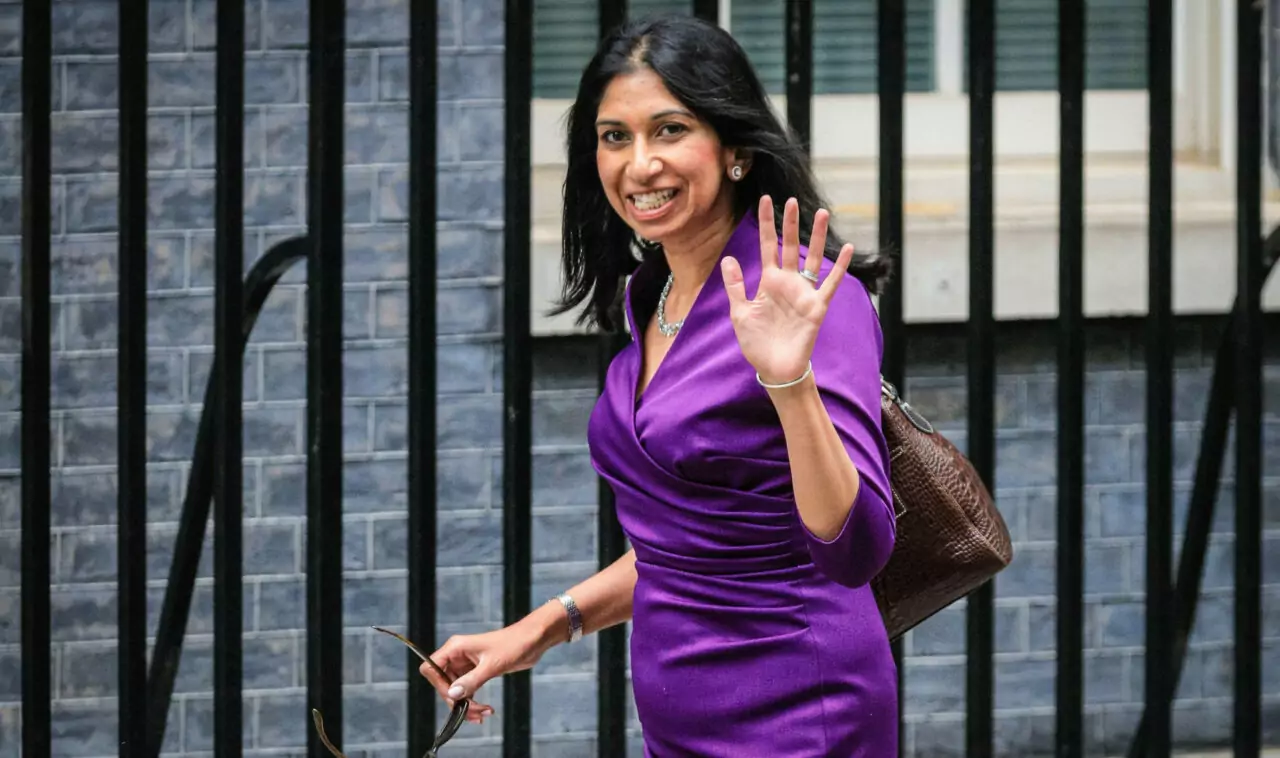
Lobby groups funded trips to Israel for Sue-Ellen ‘Suella’ Braverman. (Photo: Imageplotter / Alamy)
Exclusive: Tory politicians have accepted over £430,000 from Israel lobby groups and made 187 trips to the country.
Suella Braverman received largest contribution for her visit to Israel this year
Some 126 of the Tory party’s 344 MPs have accepted funding from pro-Israel lobby groups, Declassified has found.
The revelation comes as Rishi Sunak calls a general election in which his unequivocal backing of Israel could cost the party votes.
The value of the donations or hospitality amounts to over £430,000, with the organisations paying for sitting Conservative MPs to visit Israel on 187 occasions.
Some of those trips also involved visits to the Occupied Palestinian Territories, and a small number were co-sponsored by groups which do not form part of the Israel lobby.
The main funder is Conservative Friends of Israel, a parliamentary group which does not disclose its own sources of funding.
Other notable donors include the American Israel Public Affairs Committee (AIPAC), Australia-Israel Cultural Exchange, and the European Leadership Network.
Thirteen Tory politicians have accepted over £50,000 in total to travel to Israel since 7 October, including for “solidarity” missions.
Friends of Israel
Conservative Friends of Israel (CFI) is a pro-Israel lobby group set up in 1974 by Michael Fidler, a Tory politician described in one biography as having political views “reminiscent of the philosophy of Enoch Powell”.
The organisation has long standing links with the Israeli state, and is “beginning to resemble the Westminster outpost for Benjamin Netanyahu’s right-wing Likud coalition”, according to veteran journalist Peter Oborne.
Around 80 percent of Tory MPs are members of CFI. Over the past decade, it has taken more MPs on overseas trips than any other political donor in Britain.
Publicly available data reviewed by Declassified shows that CFI has funded 118 sitting Tory MPs to travel to Israel on 160 occasions, providing over £330,000 towards the visits.
Those MPs include deputy prime minister Oliver Dowden, home secretary James Cleverly, and justice secretary Alex Chalk, prior to their appointment to the cabinet.
Some 22 of those CFI-led visits have been subsidised by the Israeli foreign ministry to the tune of over £8,000 in total.
EHRC ‘extremely worried’ about the treatment of disabled benefits claimants by the government department
An investigation has been launched into whether the Department for Work and Pensions (DWP) broke equality law over its treatment of disabled benefits claimants.
The Equalities and Human Rights Commission (EHRC) is investigating a suspicion that the department failed to make reasonable adjustments for people with learning disabilities or long-term mental health conditions when carrying out benefit health assessments.
A further probe will be carried out into whether the Secretary of State for Work and Pensions’ was compliant with equality commitments when developing, implementing and monitoring policy guidance into health assessments.
The regulator first started looking into the department after a group of MPs recommended in 2021 an investigation into the deaths of vulnerable claimants, including by suicide, between 2008 and 2020.
Following this, the EHRC found further action was required and has now decided to pursue a formal investigation, the first of its kind into a government department.
Landscape of the North Pole where climate change has caused melting ice caps. Photo: Mongkolchon Akesin/Shutterstock.
A paper by the National Bureau of Economic Research suggests that each degree of global heating could reduce global GDP by 12%.
A new paper written for the National Bureau of Economic Research (NBER) suggests that the global economic cost of climate change could be around six times higher than previous estimations.
The paper, written by Northwestern economics professor Diego Känzig and Harvard economics professor Adrien Bilal, suggests that every one degree of atmospheric warming reduces global GDP by 12%.
It uses global heating data cross-referenced against aggregated national GDPs to come to a higher figure. The authors believe that this model provides a more complete picture, as many of the shocks, including extreme wind and precipitation, are affected by global conditions rather than localised heating.
It also places the social cost of carbon (SCC) at over $1,000/tCO2. This global measure estimates the economic damage caused by every tonne of carbon emitted and has historically been set far lower. According to the authors, their own calculations would only place the SCC at $151/tCO2 if evaluating local rather than global temperature shocks.
What does this mean for global economies?
The findings of this paper are clearly worrying as they suggest the threat to markets posed by climate change is significantly higher than previously quantifiable. The authors of the paper describe the impacts of a 1°C as “of the same magnitude as the growth impacts that typically occur after severe banking or financial crises,” and the long-term impacts of climate change as “comparable to the economic damage caused by fighting a war domestically and permanently [italics theirs].”
Kemi Badenoch and Nir Barkat. (Photo: Department for Business / Flickr)
Britain’s business secretary wants to strike a new trade deal with Israel amid its brutal onslaught on Gaza.
Badenoch is negotiating with an Israeli minister who threatens to “wipe out” its enemies
UK-Israel trade talks took place a week after the IDF killed three British aid workers
She decided to continue arms exports to Israel at the same time
The UK government, led by business secretary Kemi Badenoch, has been trying to finalise a new trade agreement with Israel throughout its invasion of Gaza.
The latest – and fifth – round of negotiations between officials of the two countries began on 8 April.
That was just seven days after three British aid workers were killed by the Israel Defense Forces (IDF) in Gaza.
The talks on a free trade agreement (FTA) continued even as UN agencies reported over 33,000 Palestinians had been killed by Israel and the Israeli government announced a date had been set for invading Rafah.
These negotiations were hosted by the UK, with a delegation of Israeli officials travelling to London for in-person discussions.
“An upgraded trade deal will play to British strengths and unlock trade for our world-leading services and digital sectors”, the UK’s Department for Business and Trade noted.
The negotiations are another aspect of Britain’s complicity in genocide, adding to its military and diplomatic support for Israel as it engages in mass attacks on civilians and civilian infrastructure in Gaza.
On the same day the trade talks began in April, Badenoch also authorised continued British arms exports to Israel.
Keir Starmer last week controversially welcomed Tory defector Natalie Elphicke into the Labour fold | Carl Court/Getty Images
The party may have a 30-point lead in the polls, but its lack of real offering to voters will soon cause problems
It’s widely agreed that England and Wales’ local election results were terrible for the Conservative Party, which lost 474 councillors, and not particularly good for the Labour Party, which gained only 186.
But many commentators still miss the current mood among Labour supporters. The party’s 30-point lead in a new YouGov poll has been extensively covered, but not the fact that its should-be supporters are hardly rejoicing at the news.
Because while many voters have distaste verging on outright anger at Rishi Sunak’s Conservatives, and would certainly take pleasure in seeing them ousted from government, they have little enthusiasm for the Labour alternative.
Analysis of the local elections’ voting figures suggests Labour is headed for a much smaller lead at the general election than polls suggest; likely one sufficient to ensure it ends up in government but not anything like a landslide. In these circumstances, the tensions within the party, and how they are reflected in the attitudes of its voters, become significant – and may cause Keir Starmer serious problems in office.
Much of the discontent stems from suspicions that under Starmer, Labour is now on the centre-right and will not deliver the major reforms needed to help the millions of ordinary people struggling to make ends meet. Even in one of the few areas where Starmer previously seemed to offer hope, workers’ rights, there are suggestions that his policy will soon be watered down.
This sense that the party will continue the current government’s status quo has only been strengthened by Labour welcoming two Tory defectors into its fold in recent weeks. One of them, Natalie Elphicke, is a determinedly right-wing politician, whom many would have said was on the far right of her previous party. Some very angry Labour MPs have contrasted her official reception with the ongoing exclusion of Diane Abbott and Jeremy Corbyn from the parliamentary party.
Starmer is also keen to play tough on defence matters, presenting Labour as strong on military spending, and determined to maintain a vastly expensive nuclear programme and Britain’s vain attempt to be a world power.
This will likely be met with opposition from many of the party’s supporters, who have objected to the UK’s involvement in numerous failed wars in the past 25 years – including Afghanistan, Syria, Iraq, Libya and now Gaza.
Whatever happens in Gaza, Labour will also be left with a legacy of deep mistrust over its failure to speak up for Palestinians. The ‘Gaza rebellions’ at the local elections earlier this month, which contributed significantly to the party failing to pick up the Tories’ lost votes, were hurried affairs organised late in the day. If organisers plan earlier for the general election, they may well have a much greater impact.
Then there is the issue of the climate crisis, which looms increasingly large, especially among younger voters. Labour’s U-turn on its £28bn pledge to invest in a rapid period of decarbonisation has struck a discordant note, and many find it difficult to accept claims by shadow climate change and net zero secretary Ed Miliband that the party is still on track to make Britain a “clean energy superpower”.
Labour may also soon have a problem among its own ranks. Many of the party’s 30 or so socialist-leaning MPs are keeping their heads down in the run-up to the general election for fear of suspension and deselection. This will change once the election is called. Some incoming new radicals may also be elected – who knows, even the odd socialist or two might slip through. It is certainly reasonable to think that Starmer, whether heading for a majority or minority Labour government, will have up to 40 MPs with a radical bent.
Where they will become significant will be when Labour runs into serious trouble a year or so into the new Parliament, when the multitude of toxic legacies left by 14 years of Conservative government emerge. At that point, if all Labour can offer on most policy areas is little more than modest change, British politics will become far more intens
Much of the discontent stems from suspicions that under Starmer, Labour is now on the centre-right and will not deliver the major reforms needed to help the millions of ordinary people struggling to make ends meet. Even in one of the few areas where Starmer previously seemed to offer hope, workers’ rights, there are suggestions that his policy will soon be watered down.
This sense that the party will continue the current government’s status quo has only been strengthened by Labour welcoming two Tory defectors into its fold in recent weeks. One of them, Natalie Elphicke, is a determinedly right-wing politician, whom many would have said was on the far right of her previous party. Some very angry Labour MPs have contrasted her official reception with the ongoing exclusion of Diane Abbott and Jeremy Corbyn from the parliamentary party.
And while Labour may claim to be the party of fiscal fairness, there is little faith in it getting truly serious about controlling tax avoidance and evasion, and even less about wholesale tax reform. Shadow chancellor Rachel Reeves has also already ruled out a wealth tax, despite the richest 1% of Britons holding more wealth than 70% of people in the UK.
Starmer is also keen to play tough on defence matters, presenting Labour as strong on military spending, and determined to maintain a vastly expensive nuclear programme and Britain’s vain attempt to be a world power.
This will likely be met with opposition from many of the party’s supporters, who have objected to the UK’s involvement in numerous failed wars in the past 25 years – including Afghanistan, Syria, Iraq, Libya and now Gaza.
Whatever happens in Gaza, Labour will also be left with a legacy of deep mistrust over its failure to speak up for Palestinians. The ‘Gaza rebellions’ at the local elections earlier this month, which contributed significantly to the party failing to pick up the Tories’ lost votes, were hurried affairs organised late in the day. If organisers plan earlier for the general election, they may well have a much greater impact.
Then there is the issue of the climate crisis, which looms increasingly large, especially among younger voters. Labour’s U-turn on its £28bn pledge to invest in a rapid period of decarbonisation has struck a discordant note, and many find it difficult to accept claims by shadow climate change and net zero secretary Ed Miliband that the party is still on track to make Britain a “clean energy superpower”.
Labour may also soon have a problem among its own ranks. Many of the party’s 30 or so socialist-leaning MPs are keeping their heads down in the run-up to the general election for fear of suspension and deselection. This will change once the election is called. Some incoming new radicals may also be elected – who knows, even the odd socialist or two might slip through. It is certainly reasonable to think that Starmer, whether heading for a majority or minority Labour government, will have up to 40 MPs with a radical bent.
Where they will become significant will be when Labour runs into serious trouble a year or so into the new Parliament, when the multitude of toxic legacies left by 14 years of Conservative government emerge. At that point, if all Labour can offer on most policy areas is little more than modest change, British politics will become far more intense – with a chance of some truly progressive thinking at last coming to the fore.