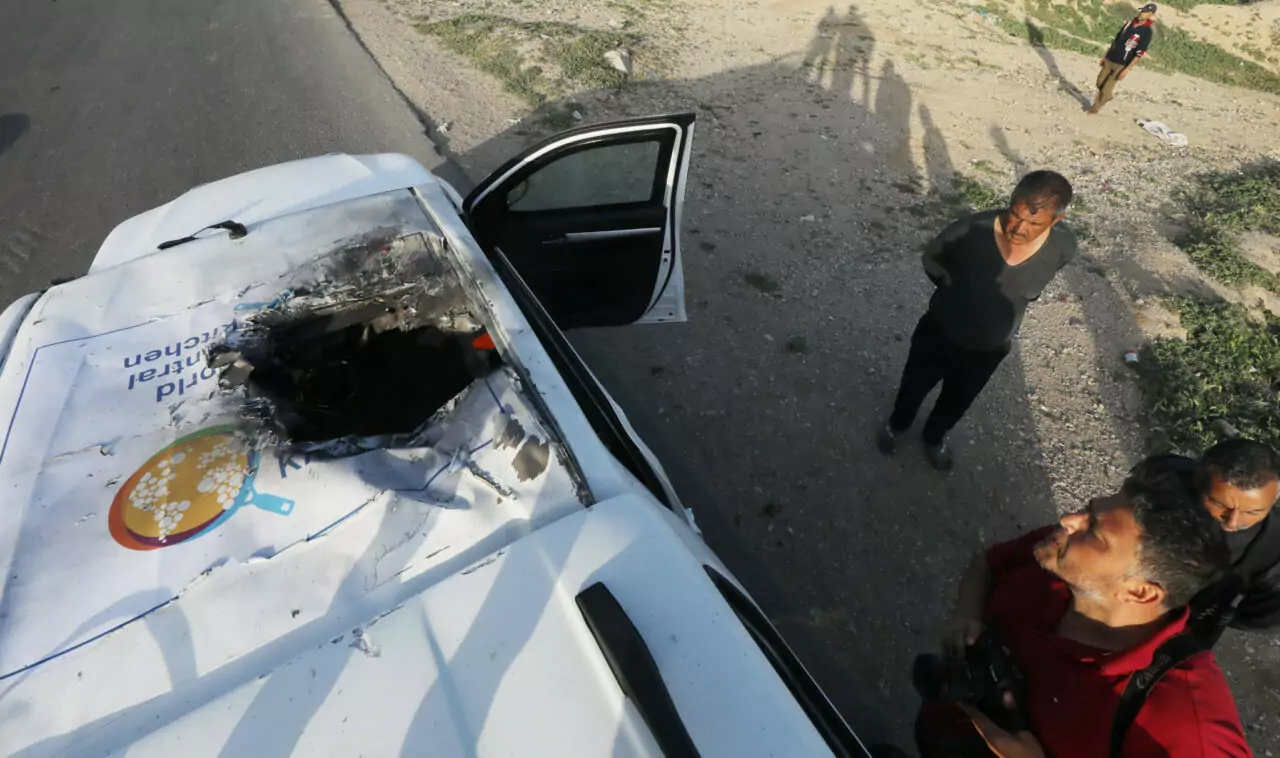
A World Central Kitchen vehicle hit by an Israeli drone in Gaza. (Photo: Omar Ashtawy via Alamy)
New court documents reveal that ministers David Cameron and Kemi Badenoch authorised UK arms sales to Israel right after an airstrike killed three British charity workers in Gaza.
On 1 April, Israeli forces launched a series of airstrikes on a convoy of aid workers in Gaza, killing three Britons, a Polish national, a Palestinian, an American-Canadian dual citizen, and an Australian.
The Israeli Air Force carried out the bombing with a Hermes 450 drone. According to Campaign Against the Arms Trade, this drone may be powered by a R902(W) Wankel engine produced in Britain by UAV Engines Limited (UEL).
New court documents show that the UK government decided to continue arms exports to Israel on 8 April, one week after the strike on the aid workers who were employed by the charity World Central Kitchen (WCK).
The revelation will put additional pressure on the Foreign Office to justify its decision not to suspend arms sales to Israel.
‘Killed with British weapons’
Global Legal Action Network (GLAN) and Palestinian human rights group Al-Haq challenged the UK government today in court over arms sales to Israel.
Documents provided to the court show that the UK government has conducted five legal assessments of the situation in Gaza since 18 December.
One of those assessments, which covered the period 18 December to 29 February, was delivered to UK foreign secretary David Cameron on 28 March.
On 3 April, two days after the Israeli airstrike on the aid workers, Cameron used this assessment to recommend that the UK continue arms sales to Israel.
Five days later, UK trade secretary Kemi Badenoch authorised the continuation of extant licences and new licences to Israel, according to GLAN’s press statement.
Ofcom warns breaches could result in ‘statutory sanctions’.
Media regulator Ofcom has issued a warning to broadcasters about using politicians as presenters, ahead of the general election.
The media regulator issued a statement in which it said it was putting ‘broadcasters on notice that they must maintain the highest editorial standards ahead of a General Election’ and that breaches could result in ‘statutory sanctions’.
It comes after Ofcom found GB News in breach of broadcasting rules when three Conservative MPs acted as newsreaders across five different episodes of its programmes.
Ofcom found that two episodes of Jacob Rees-Mogg’s State of the Nation, two episodes of Friday Morning with Esther and Phil, and one episode of Saturday Morning with Esther and Phil, broadcast during May and June 2023 had broken impartiality rules. These episodes broke the part of the Ofcom code that says, “News, in whatever form, must be… presented with due impartiality” and “No politician may be used as a newsreader, interviewer or reporter in any news programmes unless, exceptionally, it is editorially justified.”
PEN America CEO Suzanne Nossel speaks onstage during the 2023 PEN America Literary Gala on May 18, 2023 in New York City. (Photo: Bryan Bedder/Getty Images for PEN America)
“We cannot, in good faith, align with an organization that has shown such blatant disregard of our collective values,” a group of authors and translators wrote in an open letter.
The prominent free expression group PEN America announced Monday that it has canceled its 2024 literary awards ceremony amid growing backlash over the organization’s response to Israel’s assault on Gaza and alleged attempts to suppress dissent among its employees.
The decision came after nearly half of the authors nominated for PEN America awards withdrew their names from consideration, accusing PEN America of not sufficiently speaking out against Israel’s war on Gaza and the dire consequences for free expression.
The awards ceremony was scheduled to take place on April 29 in Manhattan.
In an open letter released last week, dozens of authors and translators who refused to accept any honors from the organization wrote that “PEN America has remained shamefully unwilling to speak out against the systematic nature” of Israel’s “often-targeted killings of Palestinian writers, professors, and journalists and their families.”
“We stand in solidarity with one another and with the people of Palestine in our refusal to lend our names and tacit approval to PEN America’s disgraceful inaction,” reads the open letter, which demands the resignation of PEN America CEO Suzanne Nossel, president Jennifer Finney Boylan, and the group’s entire executive committee.
“We cannot, in good faith, align with an organization that has shown such blatant disregard of our collective values,” the letter adds. “We stand in solidarity with a free Palestine. We refuse to be honored by an organization that acts as a cultural front for American imperialism. We refuse to gild the reputation of an organization that runs interference for an administration aiding and abetting genocide with our tax dollars. And we refuse to take part in anything that will serve to overshadow PEN’s complicity in normalizing genocide.”
“We have been disgusted, for months, by the sight of these leaders clinging to a disingenuous façade of neutrality.”
Clarisse Rosaz Shariyf, PEN America’s literary programming chief officer, said in a statement Monday that “we greatly respect that writers have followed their consciences, whether they chose to remain as nominees in their respective categories or not.”
“We regret that this unprecedented situation has taken away the spotlight from the extraordinary work selected by esteemed, insightful, and hard-working judges across all categories,” Rosaz Shariyf added. “As an organization dedicated to freedom of expression and writers, our commitment to recognizing and honoring outstanding authors and the literary community is steadfast.”
Outrage over PEN America’s approach to Israel’s war on the Gaza Strip has been intensifying for months.
In March, as Common Dreams reported at the time, Naomi Klein, Michelle Alexander, and other high-profile writers pulled out of the PEN World Voices Festival, accusing PEN America of betraying “the organization’s professed commitment to peace and equality for all, and to freedom and security for writers everywhere.”
After initially refusing to do so, PEN America late last month joined its global parent PEN International in calling for an immediate cease-fire in Gaza. But the organization’s critics—including current and former employees—argue it has failed to clearly and forcefully condemn Israel’s assault, which has killed more than 34,000 people in Gaza and fueled a catastrophic humanitarian emergency.
“We have been disgusted, for months, by the sight of these leaders clinging to a disingenuous façade of neutrality while parroting hasbara talking points,” the open letter from PEN America award nominees states. “We have also been appalled to learn that management has sought to suppress the off-hours political speech and activity of its own workers, in part by suggesting language by which staffers could be punished for participating in any political activity that undermines PEN America’s mission.”
The Intercept reported late last month that PEN America staffers also raised concerns in December over Nossel’s decision to visit Israel amid the country’s devastating attack on Gaza.
“We are concerned that Suzanne Nossel’s trip as planned will be perceived as a dismissal of the urgent and worsening humanitarian crisis in Gaza and free expression and human rights violations in the West Bank and in Israel,” the staffers wrote.
Original article by JAKE JOHNSON republished from Common Dreams under Creative Commons (CC BY-NC-ND 3.0).
United Nations High Commissioner for Human Rights Volker Türk speaks during a press conference in Cairo, Egypt on November 8, 2023. (Photo: Khaled Desouki/AFP via Getty Images)
“Hospitals are entitled to very special protection under international humanitarian law,” said Volker Türk, the United Nations high commissioner for human rights.
The United Nations’ human rights chief on Tuesday called for an international investigation into mass graves discovered at two Gaza hospitals that Israeli forces recently assailed and destroyed, further imperiling the enclave’s barely functioning healthcare system.
Volker Türk, the U.N. high commissioner for human rights, said in a statement that he was “horrified” by the discovery of mass graves at the Nasser and al-Shifa medical complexes, which the Israel Defense Forces (IDF) reduced to ruins.
More than 300 bodies were reportedly discovered in the mass grave near the Nasser facility in Khan Younis, Gaza, and eyewitnesses said Israeli soldiers executed civilians during their two-week-long raid of al-Shifa last month.
Türk demanded an “independent, effective, and transparent” probe into the killings and mass graves, adding that “given the prevailing climate of impunity, this should include international investigators.”
“Hospitals are entitled to very special protection under international humanitarian law,” he added. “And the intentional killing of civilians, detainees, and others who are hors de combat is a war crime.”
“Every 10 minutes a child is killed or wounded. They are protected under the laws of war, and yet they are ones who are disproportionately paying the ultimate price.”
The IDF’s destructive attacks on Nasser and al-Shifa were part of a broader Israeli assault on Gaza’s healthcare system. An analysis released Monday by Save the Children found that the rate of monthly Israeli attacks on healthcare in Gaza since October has exceeded that of any other conflict around the world since 2018.
The group estimated that Israel has launched an average of 73 attacks per month on healthcare in Gaza—and at least 435 attacks total since October.
“After six months of unimaginable horror, the healthcare system in Gaza has been brought to its knees,” said Xavier Joubert, Save the Children’s country director in the occupied Palestinian territory. “Healthcare workers are risking their lives daily to give Palestinian children a chance at survival. The constant attacks on healthcare are simply unjustifiable and must stop. Palestinian children must have unimpeded access to services, including healthcare and education.”
Türk also used his statement Tuesday to condemn Israeli forces’ killing of women and children in airstrikes on the southern Gaza city of Rafah in recent days. The human rights official noted that Gaza doctors rescued a baby from the womb of her mother as the latter succumbed to head injuries from an Israeli strike.
“The latest images of a premature child taken from the womb of her dying mother, of the adjacent two houses where 15 children and five women were killed—this is beyond warfare,” said Türk. “Every 10 minutes a child is killed or wounded. They are protected under the laws of war, and yet they are ones who are disproportionately paying the ultimate price in this war.”
Original article by JAKE JOHNSON republished from Common Dreams under Creative Commons (CC BY-NC-ND 3.0).
One year ago, Germany took its last three nuclear power stations offline. When it comes to energy, few events have baffled outsiders more.
In the face of climate change, calls to expedite the transition away from fossil fuels, and an energy crisis precipitated by Russia’s 2022 invasion of Ukraine, Berlin’s move to quit nuclear before carbon-intensive energy sources like coal has attracted significant criticism. (Greta Thunberg prominently labelled it “a mistake”.)
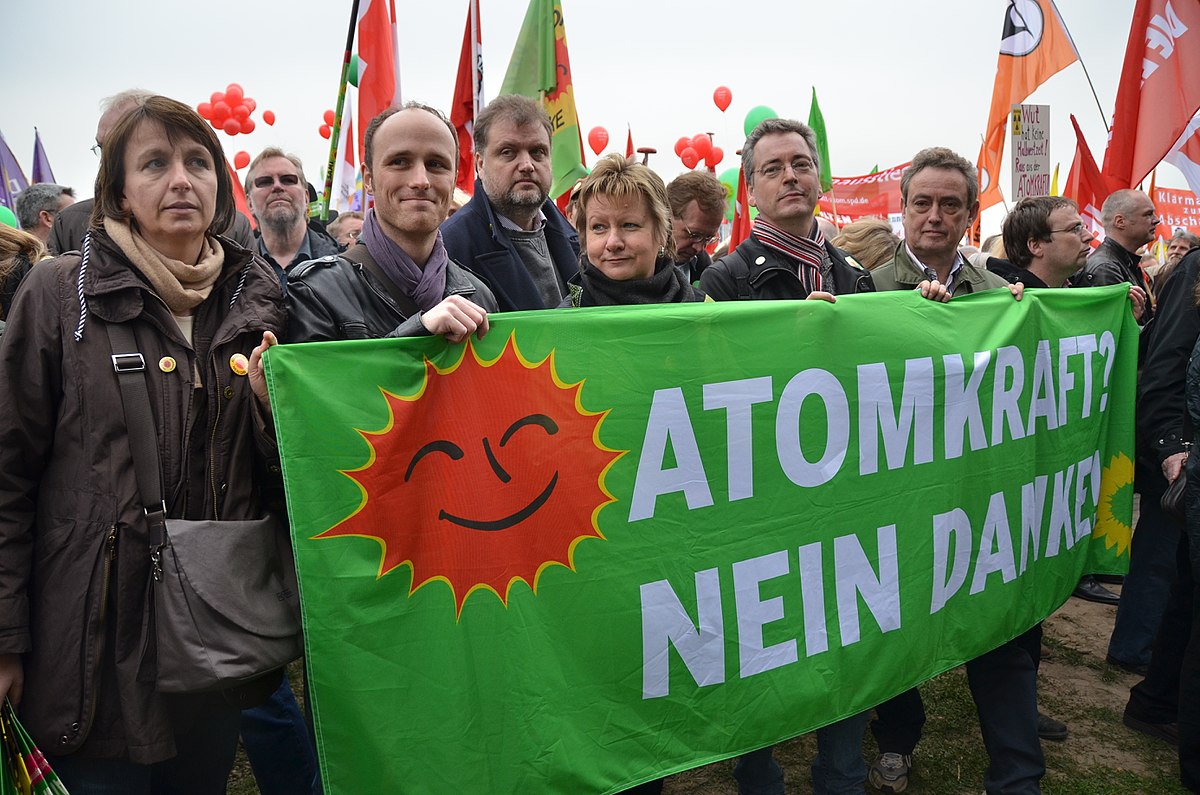
This decision can only be understood in the context of post-war socio-political developments in Germany, where anti-nuclearism predated the public climate discourse.
From a 1971 West German bestseller evocatively titled Peaceably into Catastrophe: A Documentation of Nuclear Power Plants, to huge protests of hundreds of thousands – including the largest-ever demonstration seen in the West German capital Bonn – the anti-nuclear movement attracted national attention and widespread sympathy. It became a major political force well before even the Chernobyl disaster of 1986.
Its motivations included: a distrust of technocracy; ecological, environmental and safety fears; suspicions that nuclear energy could engender nuclear proliferation; and general opposition to concentrated power (especially after its extreme consolidation under the Nazi dictatorship).
Instead, activists championed what they regarded as safer, greener, and more accessible renewable alternatives like solar and wind, embracing their promise of greater self-sufficiency, community participation, and citizen empowerment (“energy democracy”).
This support for renewables was less about CO₂ and more aimed at resetting power relations (through decentralised, bottom-up generation rather than top-down production and distribution), protecting local ecosystems, and promoting peace in the context of the cold war.
Germany’s Energiewende
The contrast here with Thunberg’s latter-day Fridays for Future movement and its “listen to the experts” slogan is striking. The older activist generation deliberately rejected the mainstream expertise of the time, which then regarded centralised nuclear power as the future and mass deployment of distributed renewables as a pipe dream.
This earlier movement was instrumental in creating Germany’s Green Party – today the world’s most influential – which emerged in 1980 and first entered national government from 1998 to 2005 as junior partner to the Social Democrats. This “red-green” coalition banned new reactors, announced a shutdown of existing ones by 2022, and passed a raft of legislation supporting renewable energy.
That, in turn, turbocharged the national deployment of renewables, which ballooned from 6.3% of gross domestic electricity consumption in 2000 to 51.8% in 2023.
These figures are all the more remarkable given the contributions of ordinary citizens. In 2019, they owned fully 40.4% (and over 50% in the early 2010s) of Germany’s total installed renewable power generation capacity, whether through community wind energy cooperatives, farm-based biogas installations, or household rooftop solar.
Most other countries’ more recent energy transitions have been attempts to achieve net-zero targets using whatever low-carbon technologies are available. Germany’s now-famous “Energiewende” (translated as “energy transition” or even “energy revolution”), however, has from its earlier inception sought to shift away from both carbon-intensive as well as nuclear energy to predominantly renewable alternatives.
Consecutive German governments have, over the past two and a half decades, more or less hewed to this line. Angela Merkel’s pro-nuclear second cabinet (2009-13) was an initial exception.
That lasted until the 2011 Fukushima disaster, after which mass protests of 250,000 and a shock state election loss to the Greens forced that administration, too, to revert to the 2022 phaseout plan. Small wonder that so many politicians today are reluctant to reopen that particular Pandora’s box.
Another ongoing political headache is where to store the country’s nuclear waste, an issue Germany has never managed to solve. No community has consented to host such a facility, and those designated for this purpose have seen large-scaleprotests.
Instead, radioactive waste has been stored in temporary facilities close to existing reactors – no long-term solution.
Nuclear remains unpopular
National polls underscore the Teutonic aversion to nuclear. Even in 2022, at the height of the recent energy crisis, a survey found that 52% opposed constructing new reactors, though 78% supported a temporary extension of existing plants until summer 2023. The three-way Social Democratic-Green-Liberal coalition government ultimately compromised on mid-April 2023.
Today, 51.6% of Germans believe this was premature. However, a further deferral was deemed politically unfeasible given the trenchant anti-nuclearism of the Greens and sizeable cross sections of the population.
Despite some public protestations to the contrary (the main opposition CDU party declared in January that Germany “cannot do without the nuclear power option at present”), in private few political leaders think the country will, or even realistically can, reverse course.
As an industry insider told me, talk of reintroducing nuclear to Germany is “delusional” because investors were “burnt … too many times” in the past and now “would rather put their money into safer investments”. Moreover, “it would take decades to build new [nuclear] power stations” and electricity is no longer the sector of concern, given the rapid buildout of renewables, with attention having shifted to heating and transport.
German nuclear power (purple) has largely been replaced by renewables (yellow), not coal (black and brown). Clean Energy Wire, CC BY-SA
Predictions that the nuclear exit would leave Germany forced to use more coal and facing rising prices and supply problems, meanwhile, have not transpired. In March 2023 – the month before the phaseout – the distribution of German electricity generation was 53% renewable, 25% coal, 17% gas, and 5% nuclear. In March 2024, it was 60% renewable, 24% coal, and 16% gas.
Overall, the past year has seen record renewable power production nationwide, a 60-year low in coal use, sizeable emissions cuts, and decreasing energy prices.
The country’s energy sector, it seems, has already moved on. In the words of one industry observer: “Once you switch off these nuclear power stations, they’re out.” And there’s no easy way back.
For better or worse, this technology – in its present form at least – is dead in the water here. For many Germans, it will not be missed.
Trevelyan Wing, Fellow of the Cambridge Centre for Geopolitics and Centre Researcher at the Cambridge Centre for Environment, Energy and Natural Resource Governance (CEENRG), University of Cambridge