There is huge aversion to the Conservative (Tory) Party in UK meaning that Keith Starmer’s Labour Party is likely to be elected at the next general election. This aversion to the Tories is partly due to successive worse than useless Tory Prime Ministers, Boris’s criminality, lying and cronyism, Brexit which has been catastrophic, trashing of the UK economy (partly due to Liz Truss’s catastrophic bonkers short term as Prime Minister and ill-judged budget), huge inflation and crippling fuel poverty caused by hugely increased energy prices. It is a growing recognition and acknowledgement that the Tories are shits destroying public services including the Health Service.
Looking at Keir Starmer’s performance as Director of Public Prosecutions and as Leader of the Opposition can inform us how he’s likely to perform as Prime Minister. It looks as though it should be avoided.
later edit: To Labour Party members: There is an historic opportunity now to move away from Neo-Liberal politics. Why would you want to elect the Tory Keir Starmer as Prime Minister and does that achieve anything?
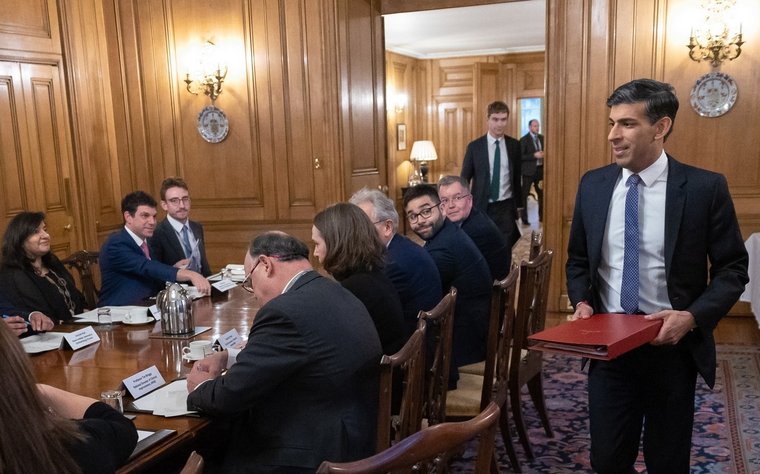
Sunak met with the CEOs of several UK private health corporations in Number 10 in December. | No 10 Downing Street
Rishi Sunak hosted a meeting with seven bosses from the UK’s biggest private health companies to discuss how to tackle the NHS backlog, openDemocracy can reveal.
Campaigners have raised concerns that the close involvement of private healthcare corporations in the government’s response to the NHS crisis will benefit shareholders at the expense of public investment.
The government announced the creation of the Elective Recovery Taskforce in December to provide advice on how to “turbocharge NHS recovery from the pandemic, reduce waiting times for patients and eliminate waits for routine care of over a year by 2025”.
At the time, the Department of Health and Social Care (DHSC) refused to give openDemocracy details of the group’s members, or say who had attended its launch at Number 10 led by the PM and health secretary Steve Barclay in December.
A guestlist for the event, obtained by openDemocracy through a Freedom of Information request, reveals that half a dozen CEOs from private health firms were in attendance.
Guests included the chief execs of the UK’s two largest private hospital operators: Paolo Pieri, the chief exec of Circle Health Group, and Justin Ash, who heads up Spire Healthcare. Also present was Jim Easton, the chief executive of Practice Plus Group, the NHS’s top private healthcare provider.
They were joined by David Hare, the chief executive of Independent Healthcare Provider Network, a lobby group that represents for-profit and not-for-profit private health organisations including Bupa and HCA, one of the biggest healthcare facility companies in the US.
Private health tycoons have wined and dined senior ministers while cashing in on NHS contracts
The private healthcare executives, which also included CEOs from Horder Healthcare, Newmedica, InHealth and Medefer, outnumbered the five NHS England directors invited to the event.
DHSC said it could not provide openDemocracy with minutes from the meeting because none were taken, and refused to share any papers handed out to attendees.
Separately, the government quietly published a list of members of the Elective Recovery Taskforce on Monday. The 16-person group includes DHSC ministers, six NHS bosses, and Hare.
Other members include Bill Morgan, a private healthcare lobbyist whose past clients included Virgin Care, who was appointed a Number 10 adviser in November, and Paul Manning, an NHS consultant surgeon who is also chief medical officer for Circle Healthcare.
The government said the role of the task force would be to “shape proposals for how the healthcare system can make use of all resources at its disposal, further tackling the backlog caused by the Covid-19 pandemic”. It will conclude its work in March.
Last week, the prime minister said he had signed up to an NHS GP after the Guardian reported that he had registered with a private clinic in west London that charges £250 for a consultation.
Tony O’Sullivan, a retired consultant paediatrician and co-chair of Keep Our NHS Public, told openDemocracy: “The head parasites are at the table to maximise future extraction of NHS funds.”
He added: “This is an important disclosure extracted from the government proving the direction of travel – to continue disinvesting in the NHS and increase its enforced dependence on private health care.
“The private sector was bailed out during Covid, has a lucrative four-year £10bn deal ongoing and is also in a position to earn massive profits from patients forced to go privately to avoid NHS queues of 7.2 million.”
openDemocracy has no paywall and relies on the backing of thousands of our readers to make stories like this freely available to everyone. You cansupport our work by making a donation here.
MORE than 25,000 ambulance workers walked out on strike today as Prime Minister Rishi Sunak said that it would be “lovely to wave a magic wand” and give them the pay rise they want and deserve.
His pathetic response to the mounting NHS crisis was in stark contrast to the determination and courage displayed by tens of thousands of health workers intent on winning pay justice and on defending the NHS from destruction at Tory hands.
On freezing picket lines across England and Wales, ambulance workers told their own stories of the life-saving jobs they do and the tragic, unnecessary deaths caused by the deliberate run-down of ambulance and health services in what is increasingly believed to be preparation for the Tories’ ultimate privatisation — the NHS.
Members of three unions — Unison, GMB and Unite — took strike action together.
Private health firms have donated more than £800,000 to the Conservative Party over the past ten years, openDemocracy can reveal.
This includes companies run by wealthy tycoons who have wined and dined former prime ministers Boris Johnson and Theresa May and other senior ministers.
Rishi Sunak’s party has accepted huge donations from private health firms.
The finding comes as the government hands out more NHS contracts to the private sector in a bid to tackle the backlog in the health service.
The British Medical Association has warned that relying on the private sector threatens the “sustainability of the NHS”, which has suffered from “a decade of underinvestment”.
Now, an investigation by openDemocracy reveals how Rishi Sunak’s party has received at least £800,000 from more than 35 private health and social care businesses. The true figure could be even higher because donors do not have to declare their field of work, meaning some may have flown under the radar.
And this is on top of huge personal donations from some of the business moguls behind these private healthcare companies.
Health profits
The Conservative Friends of the NHS is a group of Tory-voting doctors and health professionals who claim to support the NHS. The group’s president is health minister Maria Caufield and it has hosted stalls at the Conservative Party’s annual conference.
Chohan is a private health tycoon who set up a portfolio of medical and nursing businesses in London. One of his firms, West End Medical Practice Limited, has donated more than £198,000 to the Tories since 2019 – making it one of the sector’s biggest political donors.
As chair of the Conservative Friends of the NHS, Chohan has met with senior politicians, including Boris Johnson, Liz Truss and Nadhim Zahawi. Before Christmas, in the midst of the ongoing NHS crisis, he also attended a “meaningful” meeting at Number 10.
Despite the group’s claim to support the NHS, it has repeatedly championed a two-tier health system on Twitter, saying the private sector “should be applauded for reducing demand for the NHS”. In other tweets it has advocated health insurance and argued that “all high taxpayers must have [private health] insurance by 2025”.
Experts say reliance on private health firms is creating a system in which poorer people who cannot afford to go private are “left to put up or shut up”.
NHS outsourcing to the private sector has also been linked to higher mortality rates. And hospitals that use private cleaning companies have been linked with higher rates of the MRSA superbug.
NHS outsourcing to the private sector has been linked to higher mortality rates.
During the pandemic, Chohan – who previously donated to Labour before switching – came under scrutiny over two private firms he ran with his son that sold Covid tests. Reports said customers were charged between £80-£200 for the PCR tests, but many complained about lost samples and refused refunds.
Another Conservative Party donor is Genix Healthcare Ltd, which is part of a group of private dental clinics that makes the “majority” of its £6.6m income from NHS contracts.
The company was set up in response to the “severe shortage of NHS dentists” and says it aims to become the “dental corporate of choice for the NHS”.
Genix Healthcare has bankrolled the Tories with donations worth more than £158,000 since 2015, including cash and sponsorships.
Its owner, Mustafa Mohammed, who has posed for photos with Johnson and May and boasted about owning a Rolls-Royce and a Mercedes S-Class, has also given almost £225,000 of his own money to the party.
This includes a £20,000 donation to Jeremy Hunt in 2019, the year after he resigned as health secretary.
As one of the party’s top donors, Mohammed has been part of an elite Tory dining club called the Leader’s Group, which enjoys regular access to the prime minister and senior government figures.
Care homes and GPs
The majority of Tory donations from the private health sector have come since the pandemic began in 2020.
One such donor, Doctor Care Anywhere Group PLC, has given the party more than £37,000 in the past two years – and reportedly spent £1,000 on a ticket for government minister Paul Scully to watch a cricket match at Lord’s.
The company, which charges up to £60 for a single telephone call with a GP, raked in £25m revenue in the 2021 financial year.
Yet its records from last year say that a “severe shortage of GPs in the UK” has meant the firm’s “clinician capacity is currently insufficient to meet patient demand”. Bosses said they would not try to incentivise staff with additional pay rises because this would impact on Doctor Care Anywhere’s “cash generation”.
The Conservatives also accepted £28,000 worth of donations from Advinia Health Care Limited, which operates a network of 36 care homes across the UK.
The company has earned huge amounts of public money and boasted almost £96m in turnover in its latest financial accounts. From this, Advinia took more than £1.8m of pre-tax profits.
“Approximately 80% of group revenues came from state-funded Local Authorities and CCGs [clinical commissioning groups],” the company’s 2021 report says, adding that the taxpayer money “provide[s] the group steady, secure and timely cash inflows”.
But despite its healthy finances, Advinia’s founder and chairman, Dr Sanjeev Kanoria, recently called on Sunak to increase the government’s financial support to private care homes.
The Tories continued to accept donations from Advinia Health Care even after questions were raised about its finances. In 2019, the Guardian reported that the company had been placed under investigation by regulators over concerns about its cash flow and financial management. It was also claimed that bosses had refused to agree to an independent audit of its finances.
The true owners of Advinia Health Care remain unknown, thanks to the company’s financial structure. Records say the ultimate controlling party is the ‘Paraman Trust Settlement’, but there is no explanation of what this is, where it is located, or who is behind it. There is no trace of the Paraman Trust Settlement on the UK’s official company registry and little mention of it anywhere online.
Money donated by companies like Advinia Health Care comes on top extra cash that has been personally given by wealthy business tycoons in the health sector.
They include Dolar Popat, who has donated more than £188,000 in the past decade. Popat used to run a care home business and was appointed to the House of Lords in 2010.
John Nash is another former private healthcare tycoon who has donated to the Conservatives and been made a peer. Nash is the former chairman of Care UK, which operates 150 residential homes for elderly people.
Another firm, Babylon Healthcare, which provides GP consultations over the phone, also came under the spotlight recently amid reports that shareholders had donated to the former health secretary, Matt Hancock.
When the coalition government first introduced its landmark Health and Social Care Act in 2010, health secretary Andrew Lansley claimed the NHS would never again need to undergo such huge organisational change.
But even at the time, one widely respected commentator warned that – far from being the final fix that Lansley had advertised – the act “could become this government’s ‘poll tax’”.
In the event, it has been a slow-burn poll tax. Only now, ten years after it came into law, are we seeing its full effects, with publications from The Times to the Morning Star reporting that “A&E delays are ‘killing up to 500 people a week’”.
This figure – 5% above the normal number of people who die each week, though that baseline is also rising – can surely be traced back to the act, which ushered in a greater wave of privatisation than ever before. It compelled NHS management to behave as if they were in the private sector, competing to win business, and led to an increase in the proportion of contracts won and the use of contracts overall.
At the time, the damage caused was little noticed because government cuts in the first round of austerity targeted local authorities and adult social care. The first group of people to see their life expectancy fall were elderly women who most often lived on their own. It was in 2014 that this connection became apparent.
Back then, the government was still confident, with the Department for Health and Social Care rebutting any suggestion that austerity and privatisation might be linked to mortality. The privatisation figures were also opaque. In 2015, halfway through Jeremy Hunt’s tenure as health secretary, it was reported that ministers were misleading the public. By that point, private firms were winning 40% of new contracts – far higher than the 6% spend share claimed by the government and almost identical to the 41% won by NHS bodies.
The first great increase in mortality was recorded in that same year, a 5% rise that the government tried to attribute to influenza. The problem with that explanation was that the stalling and falls in life expectancy were not seen to the same extent anywhere else in Europe.
Last year it was claimed that austerity since 2010 had led to a third of a million excess deaths
By 2019, life expectancy for women had fallen in almost a fifth of all neighbourhoods and in over a tenth for men. Poorer people, both old and young, in poorer areas suffered most, with infant mortality among babies born to the poorest parents rising. Later there was a rise in deaths of women who were pregnant.
As NHS waiting lists spiralled, a tenth of all adults, most of those who could, were resorting to accessing private health care in 2021. But, in doing so, they lengthened the lists further by jumping the queues and thus diverting resources.
By April 2022, the number of vacant beds in hospitals was at an all-time low. Estimates of the damage done kept rising. Less than six months later, it was claimed that austerity since 2010 had led to a third of a million excess deaths, twice as many as from the pandemic.
Now, A&E departments are stretched to capacity, unable to clear patients to other beds in our hospitals as they could in the past. Those other beds cannot be cleared as they were before because adult social care has been repeatedly decimated, with what is left being tendered out to private companies.
All of this was foretold. In the four years after 2015, the value of one group of private sector contracts in the NHS rose by 89%. These figures were released just before the 2019 general election, partly in response to Matt Hancock, then the health secretary, claiming that “there is no privatisation of the NHS on my watch.”
Again, the damage was not so much through the extent of covert privatisation, but through the wider ethos that had been promoted. Take the USA: most of the enormous amount of money spent on healthcare there has little impact on improving health, because the ethos is wrong.
OPINION: Sunak wants yet another round of cuts to public spending. And just like in 2010, we didn’t vote for it
It is sometimes said – wrongly, that is – that the NHS has not been further privatised because the share of its spending that went to the private sector remained roughly the same between 2012 and 2020. By 2020 that share was about 7%, or just under £10bn a year. It rose to over £12bn during the pandemic when the government paid private hospitals to treat patients, but because overall health spending rose, the proportion remained roughly the same, still around 7%.
But the number of private companies involved did increase greatly, particularly in areas where there was already more private healthcare. By last year, private firms were delivering a quarter of all planned NHS hospital treatment in the least deprived areas of England, and 11% in the most deprived areas. Those shares – which have risen since 2020 – are higher than the overall 7% because it is in planned hospital treatment where the private sector has most infiltrated the NHS.
Last year, the Health and Care Act of 2022 put paid to Lansley’s claim that he had fixed the NHS ‘once and for all’. The act reduces the compulsion of the NHS from having to tender so many services to private sector bidding in future, but it was not designed to stop the rot. It will not solve the service’s problems, though there is hope that it could be the beginning of an actual change in ethos.
The pandemic made the effects of privatisation clear: Britons now have the worst access to healthcare in Europe and some of the worst post-pandemic outcomes. But the successive health secretaries who inflicted this tragedy are unrepentant.
The pandemic made the effects of privatisation clear: Britons now have the worst access to healthcare in Europe and some of the worst post-pandemic outcomes. But the successive health secretaries who inflicted this tragedy are unrepentant.
In 2018, Lansley criticised Hunt’s cuts in screening services, blaming them for delaying the detection of his bowel cancer. Hunt, meanwhile, went on to become foreign secretary and then chancellor of the exchequer. His legacy, as openDemocracy’s Caroline Molloy wrote last year, is “one of missed targets, lengthening waits, crumbling hospitals, missed opportunities, false solutions, funding boosts that vanished under scrutiny, and blaming everyone but himself.” Hancock is now most remembered for eating a camel penis and cow anus on live TV for money.
Belligerence, bravado and buffoonery. We got here because too many of us believed the words of fools.