dizzy: It’s difficult to argue that they are not Fascists when they commit the very crimes created immediately after WWII to address Fascism, to ensure “never again” and quote Fascist Adolf Hitler. It’s difficult to see that supporting countries are not aiding and abetting and complicit in genocide and war crimes when such blatant calls for such crimes are and have been made.
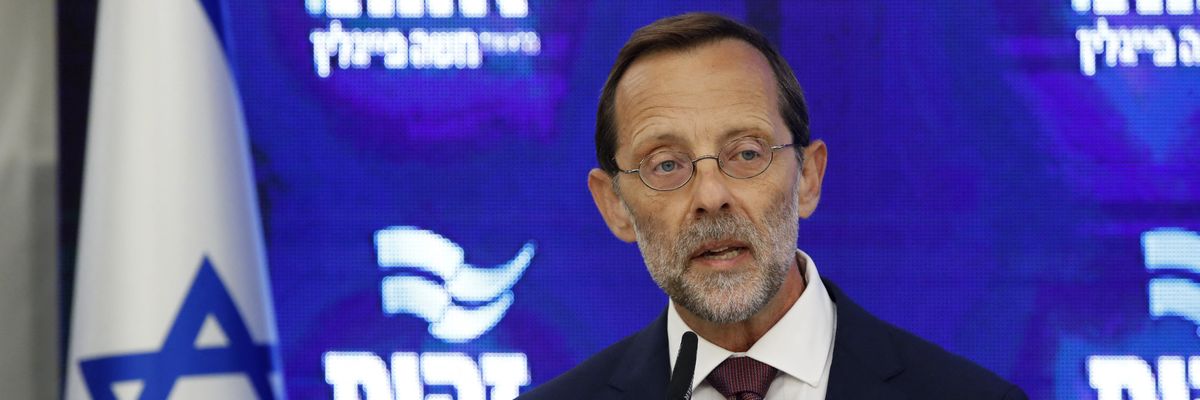
Israeli far-right Zehout (identity) political party chairman Moshe Feiglin gives a joint press statement with Prime Minister and Likud Chairman Benjamin Netanyahu (unseen) in Ramat Gan, near the Israeli coastal city of Tel Aviv on August 29, 2019. (Photo: Jack Guez/AFP via Getty Images)
“In what kind of society can one openly advocate policies modeled on Hitler’s conduct? In a society that feels complete impunity due to America’s protection,” one foreign policy expert said.
Former Israeli Knesset member Moshe Feiglin quoted Adolf Hitler as he called for Israel to resettle the Gaza Strip and create a “Hebrew Gaza.”
Feiglin, who quit Prime Minister Benjamin Netanyahu’s Likud Party to found the right-wing Zehut Party and plans to challenge Likud in Israel’s next elections, made the comments during a panel discussion on Israel’s Channel 12 that was shared on social media on Sunday, as Middle East Eye reported.
“We are not guests in our country, this is our country, all of it…” Feiglin said, adding, “As Hitler said, ‘I cannot live if one Jew is left.’ We can’t live here if one ‘Islamo-Nazi’ remains in Gaza.”
On @N12News Israel's most watched news show, former Likud MP Moshe Feiglin invokes ***Hitler*** to justify Gaza resettlement:
"As Hitler said, 'I cannot live if one Jew is left,' we can't live here if one 'Islamo-nazi' remains in Gaza."
Feiglin’s remarks earned widespread condemnation on social media.
“In what kind of society can one openly advocate policies modeled on Hitler’s conduct?” asked Trita Parsi, the executive vice president of the Quincy Institute for Responsible Statecraft. “In a society that feels complete impunity due to America’s protection.”
Former Greek Finance Minister and leader of the pan-European leftist political party DiEM25 Yanis Varoufakiswrote that “the evidence of genocidal intentions is mounting” and asked, “When will the ICC [International Criminal Court] act?”
Israel has killed at least 37,337 people and injured 85,299 in its war on Gaza since October 7, when Hamas carried out a lethal attack against southern Israel, killing around 1,100 people and taking more than 240 hostage. Prior to the attack, Israel had maintained a 16-year blockade of the narrow enclave.
South Africa brought a case before the International Court of Justice accusing Israel of genocide in Gaza, citing the vast destruction of its bombing campaign as well as statements made by high-level Israeli politicians, including Netanyahu, that portray all Gazans as complicit in the October 7 attacks. Several human rights experts and scholars have also concluded that Israel is committing genocide.
This is not the first time that Feiglin, who served in the Knesset from 2013 to 2015, has called for the expulsion of Palestinians from Gaza.
“We need a different prime minister who is willing to stick his neck out to win. Zehut will provide, whenever elections happen, such a candidate,” he told supporters in January, according to Middle East Eye. “For us, the war in Gaza is not merely a defensive war. It’s a war of liberation, the liberation of the land from its occupiers.”
In an October 2023 interview with Al Jazeera, he also advocated for the “complete destruction of Gaza, before invading it… Destruction like Dresden and Hiroshima, without a nuclear weapon.”
Zehut’s 2019 platform included the cancellation of the Oslo Accords with the Palestinians, according to Haaretz.
“Don’t talk to me about international law, because there is not such a thing. You know, the minute you use the word ‘Palestinian,’ you stop saying the truth. Because there is no Palestinian nation, and they know it,” Feiglin said that same year.
Other currently governing Israeli politicians have also called for the expulsion of Palestinians from Gaza.
Israeli National Security Minister Itamar Ben-Gvir said in January that the Israeli government should “encourage the migration” of Palestinians out of Gaza.
Later the same month, Ben-Gvir and Finance Minister Bezalel Smotrich attended a right-wing conference calling for the “resettlement” of Gaza.
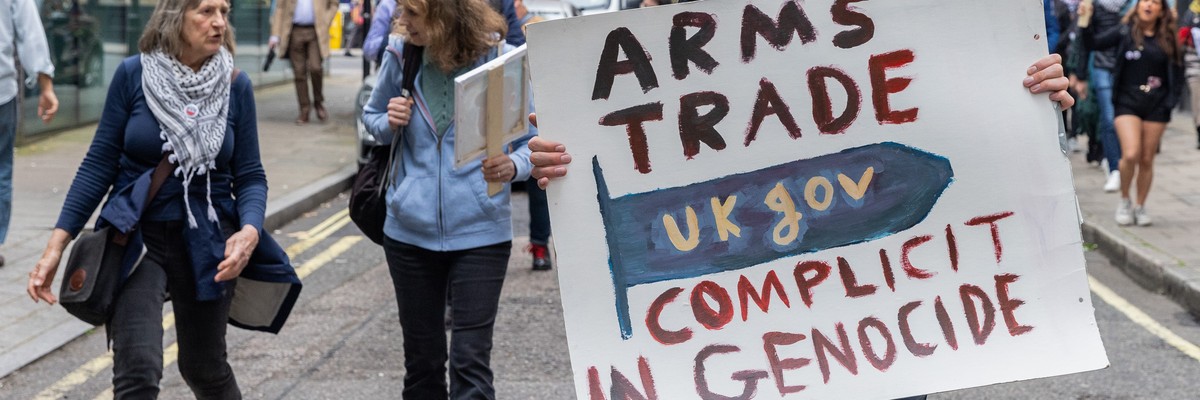
A pro-Palestinian protester holds a sign during a national demonstration to mark the 76th anniversary of the Nakba on May 18, 2024 in London. (Photo: Mark Kerrison/In Pictures via Getty Images)
“As long as Israel is killing Palestinian civilians in apparent contravention of international law, the U.K. government has a responsibility to stop selling it arms.”
As government data showed the British government has approved more than 100 arms licenses for Israel since it began bombarding Gaza in October, the humanitarian group Oxfam on Thursday joined a legal case demanding the U.K. High Court intervene in the country’s continued weapons sales in the interest of protecting Palestinian civilians.
Oxfam said the court “has been presented with evidence that Israel is not complying with the legal obligations that apply during armed conflict.” Human rights experts have said for months that Israel is blocking crucial humanitarian aid and failing to take steps to protect civilians, as in its recent attacks on encampments in Rafah and at Nuseirat refugee camp, where at least 274 Palestinians were killed in the Israel Defense Forces’ operation to rescue four Israeli hostages.
Oxfam joined Palestinian human rights group Al-Haq and U.K.-based Global Legal Action Network (GLAN) in calling on the High Court to order the Secretary of State for Business and Trade to suspend all licenses of weapons and military equipment for Israel, and to stop granting new licenses.
At a Royal Courts of Justice hearing on Thursday, Oxfam was granted permission to act as an intervener and provide a witness statement outlining the conditions the group has seen in Gaza since October.
“Gaza is fast becoming completely uninhabitable,” said Halima Begum, chief executive of Oxfam Great Britain. “More than 37,000 people have been killed and a further 84,000 have been wounded, the majority children. At least 500,000 Palestinians in Gaza are facing famine and children are dying of starvation. As long as Israel is killing Palestinian civilians in apparent contravention of international law, the U.K. government has a responsibility to stop selling it arms.”
Begum called on the U.K. to use “all the diplomatic leverage it has to push for an immediate and lasting cease-fire.”
Oxfam joined the legal case days after the United Nations Security Council adopted a resolution endorsing a U.S.-backed cease-fire proposal. U.S. Secretary of State Antony Blinken on Thursday accused Hamas of holding up the cease-fire deal by proposing more amendments to the agreement, while Hamas said it had only proposed counter-revisions to changes made by Israeli officials.
Meanwhile, Israeli attacks continued in Rafah, Gaza City, and other parts of the enclave.
“Morally, the U.K. should not be fueling this onslaught by selling Israel more weapons,” said Begum. “It is vital that the bombardment of Gaza ends, so that Oxfam and our fellow humanitarian agencies can safely deliver life-saving aid to civilians on the scale that is so urgently required.”
The U.K. has licensed at least £489 million ($624 million) of military exports to Israel since 2015, and the country provides about 15% of the components of the F-35 stealth bomber aircraft being used by Israel in Gaza.
On Tuesday, after the government released new figures regarding U.K. arms sales to Israel, Begum said the British government is engaging in “a remarkable feat of intellectual compromise” as it claims to support peace efforts in Gaza “while facilitating the supply of even greater flows of weapons to one of the belligerents.”
“It is a comprehensive failure in the U.K.’s moral leadership and the values of humanity for which this country is still known on the global stage that the government has granted more than 100 new licenses for arms sales to Israel,” said Begum. “This has occurred in the unequivocal knowledge that tens of thousands of innocent Palestinian children and their parents are being killed by Israel’s prosecution of the war in Gaza.”
Tim Bierley, campaigner for Global Justice Now, noted that “it’s clear to most people that the U.K. must cut off the supply of arms” to Israel as it faces an International Criminal Court investigation into its actions in Gaza. A YouGov poll last month found 55% of Britons supported suspending arms sales to Israel for the duration of the fighting in Gaza, including 40% of Conservative voters and 74% of Labour Party supporters.
“Despite the breathtaking scale and brutality of Israel’s war crimes in Gaza, the U.K. has given the green light to huge shipments of weapons to the country, including components for military aircraft and guns,” said Bierley. “The leaders of many countries, including Canada, the Netherlands, and Spain, have taken steps to [halt arms sales], but the British government has opted instead for complicity in war crimes. We must not accept this as normal.”
The High Court is scheduled to hold a judicial review hearing about a potential intervention in arms sales in October.
Regardless of who wins next month, fossil fuel interests have multiple levers for influencing policy.
The UK is heading to the polls on July 4. Although it doesn’t get enough attention, the two major parties — the Conservatives and Labour — have chosen climate change and, in particular, fossil fuel production in the North Sea as a clear political dividing line for the electorate.
As polling day draws closer, and election fervour takes hold, we will see the forces of British climate obstruction in full effect. Influential individuals, organisations and media outlets that seek to block, dilute, delay, or even reverse climate policies will attempt to widen that political dividing line with a mixture of claims to be defending individual freedoms, putting growth first, being ‘climate realists’, or by displacing concerns about the UK’s responsibility to act on climate change through ‘whataboutism’.
The Conservative government, under Prime Minister Rishi Sunak, has pushed ahead with issuing hundreds of new oil and gas licences in the North Sea. The government was due to further reform the licensing regime so permits are handed out on an annual basis, all under the auspices of ‘energy security’, but the election has halted the bill’s progress through Parliament. Future licences are expected to yield just three weeks’ worth of gas per year.
Sir Keir Starmer’s Labour Party, however, announced that it will end new licensing for oil and gas in the North Sea, with the very large caveat of honouring those already approved. But even this announcement ignited fierce resistance from the media, trade unions, Labour’s political opponents and some figures it deemed allies. The plan was labelled as “Thatcher on steroids”, “naive”, and risked “creating a cliff-edge” for industry and investment in and around the North Sea. In response to the vitriol, Starmer conceded that fossil fuels will continue to be used in the UK “for many, many years”.
This episode provides a useful insight into how climate obstructionism operates in the UK. In a new publication for the Climate Social Science Network (CSSN) based at Brown University, alongside Dr Ruth McKie and Dr James Painter, we identified three major channels through which obstructionism operates in Britain and the network of organisations that sustain it.
Financial Power
The first is the material. This speaks to the financial and structural power of the fossil fuel industry that allows it to use threats of capital flight and job losses to curry favourable policy conditions and fend off tax hikes that would dent profitability. It also speaks to party donations, where fossil fuel firms, or those that benefit from their expansion, provide funds to individual politicians or the wider party for access and a say over policy.
Since 2019, the Conservatives have received £8.4 million in donations from big polluters and those with direct links to fossil fuel production. The current Energy Security and Net Zero Secretary, Claire Coutinho, accepted a £2,000 donation in January 2024 from Lord Michael Hintze, a funder of the UK’s leading climate science denial group, the Global Warming Policy Foundation. Labour too have taken money from big polluters, most notably Drax, whose North Yorkshire power plant is the UK’s single largest source of emissions.
Alongside the material sits the institutional. The policy making process in the UK provides a multitude of opportunities for actors to shape policy, all within the bounds of proper procedure and due process. All Party Parliamentary Groups (APPGs), informal groups of politicians organised around key themes or policy issues, have provided an effective fora for obstructionist actors to garner access and shape policy. The rules governing APPGs often inhibit public scrutiny. Trade associations, and the companies they represent, can be omitted from official parliamentary transparency logs as only benefits in kind above £1,500 a year must be declared — a threshold many industry bodies claim not to meet.
Revolving doors between industry and government are another institutional means through which fossil fuel interests can determine policy. An investigation by The Ferret found that since 2011, 127 former oil and gas employees have gone into top government roles and been appointed to ministerial advisory boards. At least a dozen of these individuals were given roles in the North Sea Transition Authority, the organisation tasked with governing oil and gas production, as well as within departments responsible for writing energy and climate policy. Shutting this revolving door, or even just slowing it down through ‘cool-off’ periods, would go some way in curtailing obstructionism.
Climate Delay
The final, and perhaps most pronounced, thread of climate obstructionism in the UK is discursive, primarily promoted through the media. The right-leaning media in the UK, such as the Daily Telegraph and Daily Mail, have persistently opposed climate policy and action. This opposition used to be grounded in outright denial, where the integrity of climate science was disputed and denigrated. Now, though, a more pernicious form of discursive obstructionism is prevalent; that of climate delay.
Countless op-eds and articles have been published that acknowledge climate change but dispute the necessity of addressing it, the cost of implementing climate policy (both economically and in terms of national security), and the efficacy of green technologies such as wind turbines, electric vehicles (EVs) and heat pumps. These interventions, which are sometimes made by individuals with direct links to sceptic organisations or else use their framing, often push blatant untruths to the public, such as renewable energy pushing up household energy bills or solar panels jeopardising British farming. The media continues to both demonise climate activists and undermine public support for key climate policies.
In this election, watch out for climate obstructionism. While institutional channels may be curtailed due to purdah, others will pick up the slack. With all parties now firmly on an election footing, donations will become a crucial resource for knocking doors and getting out the vote in marginal seats. The sources of these donations, and the interests behind them, will bear the thumbprint of the fossil fuel industry. The media will increase its scrutiny of manifesto pledges and publish a litany of analyses. It is highly likely that Labour’s climate policy will be painted as a threat to national security, an insurmountable cost to the public purse, and reflecting the demands of both Vladimir Putin and Just Stop Oil simultaneously. The foundation of this framing has already been set.
What is less clear, though, is what comes after July 4. With a change of government comes a reconfiguration of interests and, for the winners, concessions will be made to those actors and constituencies that helped get them past the post. For the losing party, most likely to be the Conservatives, there may be an ideological reorientation that ends the cross-party consensus on tackling climate breakdown, making them the party of climate obstructionism that challenges the necessity of net zero and fights for more oil and gas.
This election might be the one that ends 14 years of Conservative rule, but it’s not likely to be the one to end climate obstructionism in the UK.
Freddie Daley is a Research Associate at the Centre for Global Political Economy at the University of Sussex.
Peter Newell is a Professor of International Relations at the University of Sussex.
They are the authors of a chapter in Climate Obstructionism across Europe, a new collection of essays analysing the organisations, politicians, think tanks and media outlets seeking to delay, derail and denigrate climate policy, produced by the Climate Social Science Network.
dizzy: I don’t agree that there is “cross-party consensus on tackling climate breakdown.” I suggest that instead the Conservative and Labour parties are indistinguishable in their support of plutocracy, sucking up to the rich and powerful. The Conservatives under Sunak have made no pretence of their intention to forge ahead with exploiting North Sea fossil fuels all they can and Labour do not intend to stop the Rosebank North Sea oil and gas field. Starmer has abandoned so many pledges that he should be recognised as as much a liar as Tony Blair or Boris Johnson.
The title of “… the party of climate obstructionism that challenges the necessity of net zero and fights for more oil and gas. ” is currently shared by the Conservatives and climate denier Nigel Farage’s Reform UK.
Rishi Sunak on stopping Rosebank says that any chancellor can stop his huge 91% subsidy to build Rosebank, that Keir Starmer is as bad as him for sucking up to Murdoch and other plutocrats and that we (the plebs) need to get organised to elect MPs that will stop Rosebank.
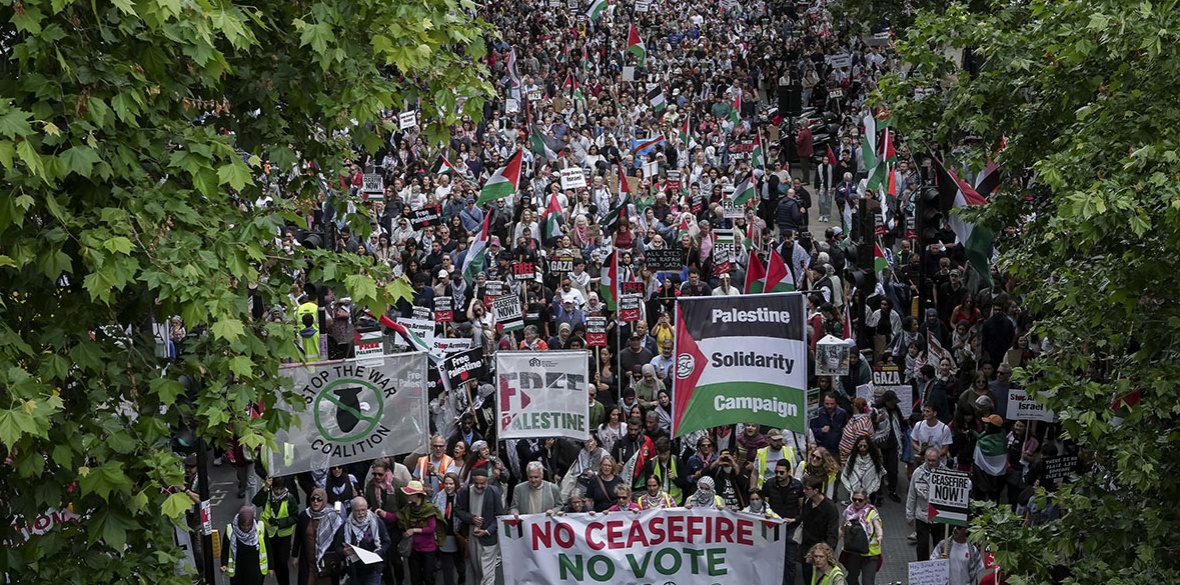
People take part in a national demonstration for Gaza from Russell Square to Whitehall in London, June 8, 2024
Hundreds of thousands protest across Britain demanding end to Gaza bloodshed
OVER the weekend, hundreds of thousands of people flooded Britain’s streets, calling for a permanent ceasefire in Gaza and warning political parties to stop arming Israel if they expect support in the upcoming election.
On Saturday, over 150,000 gathered in London for the 15th national march for Palestine.
The march took place as Israel carried out a murderous assault on Nuseirat refugee camp in Gaza.
Israeli forces killed at least 274 Palestinians and injured 698 more, according to Gaza’s Health Ministry.
Four Israeli captives were freed during the raid.
Prime Minister Rishi Sunak ignored the horrific death toll, instead describing the release of the captives as a “huge relief.”
Two days before, an Israeli air strike hit a UN school, murdering 33 people, including nine children.
Speaking at the rally, Palestine Solidarity Campaign director Ben Jamal accused political leaders of having “normalised massacres.”
He said: “Now our political leaders are coming before you asking for your vote. Your answer needs to be clear.
“We will not vote for those who normalise massacres.
“We will not vote for those who greenlight genocide.
“We will not vote for those who collaborate with systems of apartheid.”
He emphasised that justice for Palestinians needs to be forced onto the election agenda like never before.
Lindsey German from Stop the War said the massive demonstration, which stretched along Whitehall, sent “the loudest possible message to our politicians that the public support an immediate and unconditional ceasefire in Gaza.”