Category: Rosebank

  • How oil and gas company tax reliefs could lose the UK billions

    Spread the love
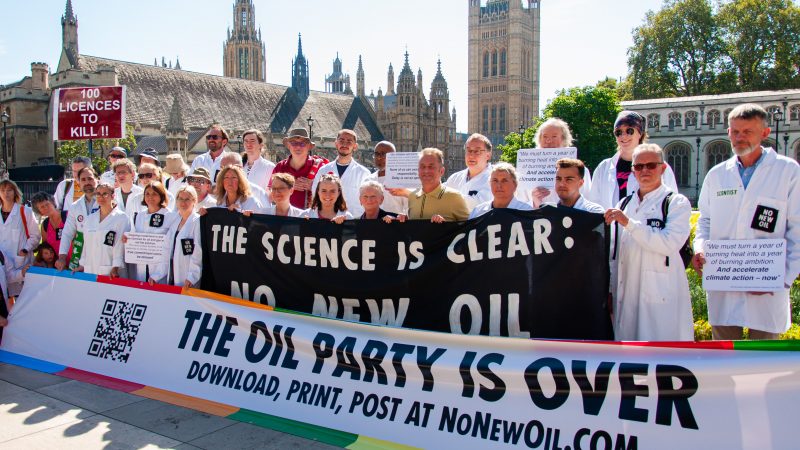
    Scientists protest at UK Parliament 5 September 2023.
    Scientists protest at UK Parliament 5 September 2023.

    Karl Matikonis, University College Dublin

    The recently-approved Rosebank oil field in the North Sea has been touted as a way to boost the UK economy and its energy security. But even with its windfall tax on energy company profits, the project is a good example of how the UK could miss out on billions in taxes over the life of an oilfield.

    Energy companies Equinor and Ithaca expect to invest £8.1 billion in Rosebank from development, during its operation and when they decommission the field once they’ve finished extracting its oil. Of this, 78% will be invested in UK-based businesses, and the project will support 1,600 jobs at the height of construction and around 450 UK-based jobs over its entire lifetime.

    The UK charges a headline 75% rate of tax on all UK energy production and so, at first glance, a major project like Rosebank would be expected to generate billions in tax payments for the UK Treasury over the years. But, according to my research, it could instead create billions in tax savings for the companies involved.

    Of the 75% tax that energy companies are currently charged, profits from oil and gas extraction in the UK are charged a corporate tax of 30%, supplemented by an extra 10% charge. The other 35% in taxes comes from the UK’s windfall tax.

    Such levies are typically used to redistribute profits when a company benefits from external circumstances. For example, energy companies have recently seen profits soar as prices rose due to concerns about satisfying global oil and gas demand during Russia’s invasion of Ukraine.

    The UK rolled out an additional 25% windfall tax in 2022 for oil and gas companies in response to this profit spike. On January 1 2023, the government increased it to 35% until at least the spring of 2028. The UK government raised £2.6 billion from the windfall tax alone last year.

    When the windfall tax is added to the 30% rate and the 10% extra, that makes for a whopping 75% tax on energy companies. This seems like a lot, but the reliefs and other tax breaks open to companies often help a lot of these charges disappear. When a business invests its profits, it can benefit from first-year capital allowances, subtract costs related to daily operations and gain additional investment allowances that can be saved up to reduce taxes on future profits.

    Crunching the numbers

    If an oil company makes £10 million, for example, current tax rules would claim £7.5 million from this. But if the company reinvests the earnings in oil and gas extraction, it wouldn’t just zero out its tax, it could also set aside an extra £1.6 million against future gains – or £3.4 million if it invests in decarbonisation.

    Project this on to Equinor and Ithaca’s multibillion-pound Rosebank investment and it could generate up to £8.4 billion in tax savings for the companies involved, based on my analysis of levies on energy producers,

    A spokesperson for Equinor told The Conversation: “These are numbers we don’t recognise.” Adding that estimates by energy consultancy Wood Mackenzie found Rosebank would bring £26.8 billion to the UK through tax payments and investments, he continued: “Over the years, oil and gas taxation in the UK has changed many times. It is impossible to estimate with any certainty exactly how large tax revenue and value creation this project will generate for the UK.” Ithaca did not respond to a request for comment.

    Many players in the UK’s oil and gas sector can take advantage of a range of capital and investment allowances, deductions and taxation reliefs. In fact, before the windfall tax, companies often got back more from the UK government than they paid in taxes.

    The windfall tax will expire in 2028 or if energy prices fall below a certain level for six months. And so while it has forced some companies pay tax on some recent bumper profits, it won’t always be around to make even that happen.
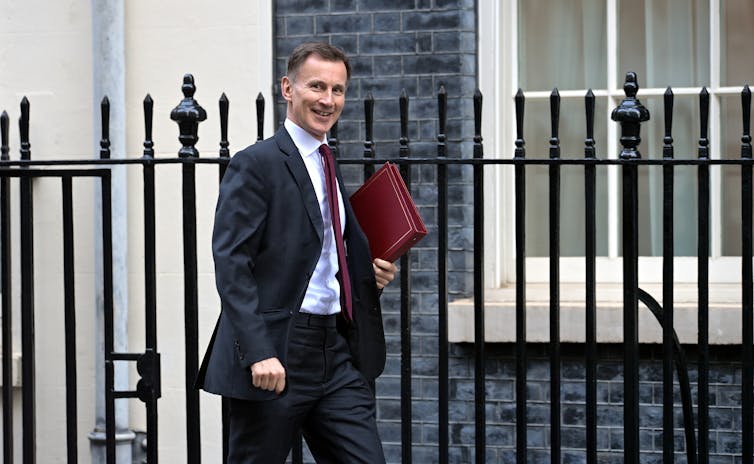
    Jeremy Hunt walking along Downing Street, London.
    UK chancellor Jeremy Hunt increased and extended a UK windfall tax on oil and gas companies last year.
    Sean Aidan Calderbank/Shutterstock

    Shortsighted or strategy?

    Compared to nations like Norway that offer more long-standing corporate tax regimes, the UK’s history is riddled with policies that have been swayed by short-term political urgencies. This sidelines long-term vision and provides a very weak signal to companies considering investment in the UK.

    A revolving door of UK prime ministers in recent times hasn’t helped and has also seen investors lose some confidence in the country’s economy. A slew of lucrative tax reliefs might seem like the perfect way to counterbalance recent policy oscillations.

    Central to the UK’s energy strategy is an intent to ramp up extraction, ostensibly to enhance national energy security. But will this happen with Rosebank?

    When asked about this, the Equinor spokesperson said: “Rosebank will strengthen our contributions to UK energy security. The field is estimated to start producing in 2026/2027 and produce for more than 20 years. The gas will go into the UK pipeline system. The oil will be offloaded offshore. It is a light, sweet crude oil that can be used in refineries in the UK. If the UK needs the oil, when the field starts producing, the UK will get it.”

    But Equinor, like other energy companies drilling in UK oilfields, doesn’t have to sell what it drills back to the UK.

    The UK continues to feed the oil and gas industry with reliefs, while renewable energy projects (but not gas-generation) face the electricity generator levy – a 45% charge on power generated above a £75 per megawatt hour (MWh) threshold. As much of the rest of the world moves towards more sustainable energy solutions, the UK should realign its tax priorities with the broader, greener global vision. The Conversation

    Karl Matikonis, Assistant Professor, University College Dublin

    This article is republished from The Conversation under a Creative Commons license. Read the original article.
  • Slow route to net zero will worsen global climate crisis, IPCC chief warns

    Spread the love

    https://www.theguardian.com/environment/2023/oct/02/slow-route-to-net-zero-will-worsen-global-climate-crisis-ipcc-chief-warns

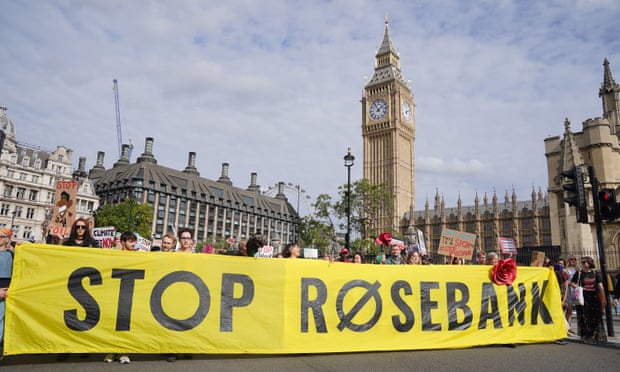
    Protesters demonstrate against the British government’s approval of the Rosebank oil field’s development. Photograph: Lucy North/PA

    Even if the 2050 goal is still met, postponing action – as the UK has done – will cause more heat and damage

    Postponing action and taking a slower route to net zero emissions by 2050 will worsen the climate crisis even if the goal is still reached by that date, the new chair of the Intergovernmental Panel on Climate Change (IPCC) has warned.

    Prof Jim Skea also said that approving new oil and gas fields only increased the already large amount of reserves that will have to be kept in the ground if global heating limits are to be reached.

    The IPCC is the world’s foremost authority on climate change, under which thousands of the world’s best experts give advice to the 195 nations that founded the body. It does not comment on the climate policies of individual nations, but Skea’s comments on Monday clearly indicate that the recent actions of the UK government has slowed climate action, despite IPCC scientists warning of “a rapidly closing window of opportunity to secure a livable and sustainable future for all”.

    Rishi Sunak weakened or abolished a number of green measures recently, including pushing back a ban on the sale of new petrol cars from 2030 to 2035. The UK also approved the exploitation of the large Rosebank oil field near Shetland on Wednesday.

    …

    https://www.theguardian.com/environment/2023/oct/02/slow-route-to-net-zero-will-worsen-global-climate-crisis-ipcc-chief-warns

  • Rosebank shows the UK’s offshore oil regulator no longer serves the public good

    Spread the love
    Igor Hotinsky / Shutterstock

    Gisa Weszkalnys, London School of Economics and Political Science and Gavin Bridge, Durham University

    In a four-line statement announcing the approval of the new Rosebank oil field 80 miles west of Shetland, the UK’s offshore oil and gas regulator showed its mission no longer serves the public good.

    The announcement by the North Sea Transition Authority (NSTA), which regulates oil and gas extraction in the waters off the British coast, asserted that net zero considerations had been taken into account – a technical definition that makes it appear long-term oil production is compatible with climate goals. This has outraged and dismayed climate scientists, campaigners, and the many other people concerned about the UK’s faltering climate leadership.

    The approval greenlights a process that is expected to produce first oil by 2026, and around 300 million barrels of oil (and a smaller amount of gas) over the next two decades. The project’s developers are Equinor, an oil company owned for the most part by the Norwegian state, and Ithaca Energy, owned by the Delek Group listed on the Tel Aviv stock exchange.

    The decision is out of step with demands for rapid action on climate change coming from a range of quarters. This includes shareholder activists demanding corporations accelerate decarbonisation, direct action groups such as Just Stop Oil, and financiers concerned about the risks of “asset stranding” as renewables become cheaper than fossil fuels.

    Public protests and legal challenges to the NSTA spotlight the irrationality and recklessness in the government’s expressed support for issuing new licenses. Activists are not alone in making this point.

    A welter of scientific studies and reports by international agencies confirm that new fossil fuel extraction is incompatible with keeping global temperature increases well below 2℃.

    Rosebank has been a major focus for climate activism in the past couple of years, as science, international policy and campaigners turn their attention to stopping new extraction, rather than solely focusing on reducing emissions. Calls to end new licensing for oil and gas are in line with climate science.

    But a climate politics focused on new licensing alone misses the point. The thing is, like other North Sea oil fields yet to be approved, Rosebank was licensed for oil and gas extraction years ago.

    The NSTA approval process follows licensing, sometimes after considerable time has passed. And it is this approval process that locks the UK into hydrocarbon production for years to come.

    End ‘maximising economic recovery’

    The core objective of the NSTA is to maximise the economic recovery of UK petroleum – a principle shorthanded as MER – as set out in the 1998 Petroleum Act. In practice, this means the regulator’s primary mission is to facilitate the extraction of oil and gas.

    A revised strategy in 2021 paired MER with an obligation to support the UK’s net zero commitments. And the former Oil and Gas Authority changed its name to include an explicit reference to the “transition” in 2022, underpinned by ambitions for emissions reduction and decarbonisation.

    NSTA sees its job as effecting the industry’s alignment with these goals. It is now also in charge of licensing for carbon capture and storage and offshore hydrogen storage.

    Rosebank’s approval therefore reveals a deeper truth: the regulator’s guiding objective fails the public good test. Regulation aims to avoid economic, environmental and social harms, and ensure the public good through delivering collective benefits and upholding socially-desirable ideals. The Rosebank decision arguably breaches this principle.

    Supporters of Rosebank argue it will contribute to the UK’s energy security and deploy decarbonisation technologies that reduce CO₂ emissions overall. These arguments do not stand scrutiny, however: oil from Rosebank, like around 80% of North Sea oil production, will be sold directly into international markets and will not materially affect the price of petrol or diesel for UK motorists.

    Much of the value of that oil will flow into the portfolios of Equinor and Ithaca. That value could be harnessed to speed up transition to renewables or ensure its benefits are widely distributed, but that’s largely down to Equinor and Ithaca – not the UK government.

    The NSTA asserts that its decision has “tak[en] net zero considerations into account”, yet the sector’s own decarbonisation ambitions count only those emissions associated with producing a barrel of oil, and exclude those from burning it (70%-90% of its total impact).

    Rewrite the Petroleum Act

    A decade ago, a decision by NSTA would not have raised much attention. Now it highlights a significant problem in need of reform. Piecemeal adaptation has left MER and other core regulatory principles untouched, which is at odds with the climate emergency.

    Existing licensed fields escape the weak scrutiny embodied in instruments such as the climate compatibility checkpoint, a series of tests to be applied in decisions about future licensing rounds. What’s more, as a litmus test for approval, Rosebank indicates other licensed projects may get the go-ahead, like Cambo.

    Removing NSTA’s central objective to maximise economic recovery requires nothing less than a rewrite of the Petroleum Act. This would be an opportunity to fundamentally revise what the North Sea is for, and whether or how to exploit its resources in the future. A start would be to consider a reversal of direction – a “minimising” of economic recovery, for example – which redefines the “economic” in terms of what is socially necessary.

    Such a move will inevitably entail reviewing licences already in place, and will likely generate challenges from the sector and other powerful incumbents. Rosebank exposes, however, how the new mission of the offshore regulator has to be about securing a new public good. This needs wider social debate, and should ultimately be decided through parliament.


    Imagine weekly climate newsletter

    Don’t have time to read about climate change as much as you’d like?

    Get a weekly roundup in your inbox instead. Every Wednesday, The Conversation’s environment editor writes Imagine, a short email that goes a little deeper into just one climate issue. Join the 20,000+ readers who’ve subscribed so far. The Conversation


    Gisa Weszkalnys, Associate Professor of Anthropology, London School of Economics and Political Science and Gavin Bridge, Professor of Geography and Fellow of the Durham Energy Institute, Durham University

    This article is republished from The Conversation under a Creative Commons license. Read the original article.

  • A day after IEA calls for no new oil & gas development, UK approves vast Rosebank oil field

    Spread the love
    https://priceofoil.org/2023/09/27/a-day-after-iea-calls-for-no-new-oil-gas-development-uk-approves-vast-rosebank-oil-field/

    Timing, they say, is everything. Yesterday, the world’s energy watchdog, the International Energy Agency (IEA), published its latest report, the 2023 Net Zero Roadmap.

    The IEA categorically stated that the time for no new oil and gas was over. If we are to keep temperatures to 1.5 degrees, then world leaders must not develop new oil, gas, or coal beyond existing fields.

    If we want a liveable planet, we must shift from fossil fuels to renewables.

    This is not the first time, either, that the IEA has confirmed that no new oil, gas, or coal fields are compatible with limiting global temperature rise to 1.5ºC.

    “Keeping alive the goal of limiting global warming to 1.5 °C requires the world to come together quickly. The good news is we know what we need to do – and how to do it,” said IEA Executive Director, Fatih Birol at the launch of the report. The IEA reiterated the way to do it is not to approve new oil and gas fields.

    …

  • ‘Morally Obscene’: UK Approves Massive Undeveloped Oil and Gas Field in North Sea

    Spread the love
    Campaigners take part in a Stop Rosebank emergency protest outside the U.K. Government building in Edinburgh, after the controversial Equinor Rosebank North Sea oil field was given the go-ahead Wednesday, September 27, 2023. (Photo: Jane Barlow/PA Images via Getty Images)
    Campaigners take part in a Stop Rosebank emergency protest outside the U.K. Government building in Edinburgh, after the controversial Equinor Rosebank North Sea oil field was given the go-ahead Wednesday, September 27, 2023. (Photo: Jane Barlow/PA Images via Getty Images)

    Original article by OLIVIA ROSANE republished from Common Dreams under Creative Commons (CC BY-NC-ND 3.0).

    “The disgraceful decision to give Rosebank the green light shows the extent of the U.K. government’s climate denial,” one activist said.

    Regulators in the United Kingdom on Wednesday greenlit the Rosebank oilfield in the North Sea, which campaigners warn contains enough oil and gas to match the yearly emissions of 28 low-income countries.

    The U.K. government said it welcomed the approval, in a statement that comes one week after Prime Minister Rishi Sunak announced he was delaying some elements of the country’s net-zero plan.

    “By approving Rosebank, Rishi Sunak has confirmed he couldn’t care less about climate change,” climate lawyer and executive director of the advocacy group Uplift Tessa Khan said in a statement. “As we’ve heard repeatedly, our world can no longer sustain new oil and gas drilling. And when we’re witnessing scorching temperatures, wildfires, devastating flooding, and heatwaves in our seas, it could not be clearer that this is a decision by the prime minister to add more fuel to the fire.”

    Rosebank, which is located off the northwest coast of the Shetland Islands, is the largest currently undeveloped oil field in the U.K., CNBCreported. Equinor, Norway’s state-owned oil company, has an 80% share in the project, with British company Ithaca Energy holding the remaining 20%.

    Equinor said it expected development to begin in 2026-2027 and for the field to produce more than 300 million barrels of oil overall, while Friends of the Earth Scotland said it contained 500 million barrels.

    The approval comes despite the fact that the International Energy Agency concluded in 2021 that no new fossil fuel projects should be launched if world leaders wanted to limit global heating to 1.5°C. It also comes on the heels of a government report finding that a record number of people in England died of heat-related causes in 2022.

    “This decision is nothing but carte blanche to fossil fuel companies to ruin the climate, punish bill payers, and siphon off obscene profits.”

    Green Member of Parliament Caroline Lucas called the approval “the greatest act of environmental vandalism in my lifetime” in a statement posted on X, formerly known as Twitter.

    “This is morally obscene,” she added in a second post. “It won’t improve energy security or lower bills—but it will shatter our climate commitments and demolish global leadership. Govt is complicit in this climate crime—as is Labour unless they pledge to do all possible to revoke it.”

    Sunak, a conservative, promised to approve hundreds of oil and gas drilling licenses in the North Sea in July, arguing it was necessary for energy security. The opposition Labour Party says it will prioritize renewable energy if it takes power, but will respect any licenses or approvals already in place, according to Reuters.

    “The disgraceful decision to give Rosebank the green light shows the extent of the U.K. government’s climate denial,” Friends of the Earth Scotland’s oil and gas campaigner Freya Aitchison said in a statement. “Fossil fuels are driving both climate breakdown and the cost of living crisis yet the U.K. Government is slamming its foot down on the accelerator.”

    Aitchison also called on the Scottish government specifically to oppose the project.

    “Delivering a fair and fast transition away from fossil fuels is one of the defining challenges of Humza Yousaf’s term as First Minister,” Aitchison said. “This must start with unequivocally condemning Rosebank and opposing the U.K. government’s decision to go ahead with a project that deliberately prioritizes the interests of Equinor while bringing little or no benefit to Scottish people.”

    Campaigners also questioned who would benefit from the project. While the government argued that it would inject cash into the economy and create almost 1,600 jobs, activists pointed out that Equinor made £62 billion in pre-tax profits last year and would get more than £3.75 billion in tax breaks for its work on Rosebank, meaning the U.K. would ultimately lose £750 million in tax money from the field’s development.

    “The ugly truth is that Sunak is pandering to vested interests, demonstrating the stranglehold the fossil fuel lobby has on government decision-making. And it’s bill payers and the climate that will suffer because of it,” Greenpeace U.K. climate campaigner Philip Evans said in a statement. “Why else would he make such a reckless decision?

    “This decision is nothing but carte blanche to fossil fuel companies to ruin the climate, punish bill payers, and siphon off obscene profits,” Evans added.

    Opponents of the project have promised to take legal action to stop it.

    “There are strong grounds to believe that the way this government has come to this decision is unlawful,” Khan said in a statement. “We shouldn’t have to fight this government for cheap, clean energy, and a liveable climate, but we will.”

    Original article by OLIVIA ROSANE republished from Common Dreams under Creative Commons (CC BY-NC-ND 3.0).