Osborne– who was chancellor under David Cameron’s government and was instrumental in bringing about austerity – said that the cuts announced by Reeves on Monday were “almost identical in structure and form” to those he made in 2010, when he announced £6.2bn worth of cuts.
…
“I don’t think there was anything she announced that I would have violently disagreed with or not done myself.
“In fact, it was almost identical in structure and form to what I did in the first couple of months that I was Chancellor of the Exchequer.
“So, you know, ‘Continuity Osborne.”
Sharing a clip from the podcast on social media, SNP Westminster leader Stephen Flynn said: “No comment.”
One of the defining features of contemporary electoral politics in Britain is the age divide. Young people are far more likely to support Labour, and older people to support the Conservatives. This divide is still apparent following the 2024 election – but it hides the complexity of how young people in particular choose to vote.
To the extent that there is a “youth vote” in Britain, it is characterised not by support for a single party, but by a particularly fierce rejection of the Conservatives – alongside greater enthusiasm than their elders for left-wing, socially liberal alternatives to Labour.
YouGov surveyed 2,182 adults of all ages between July 5 and 8 for my research team at the University of Exeter. The sample was selected to be representative of the British adult population.
The data from this survey – published here for the first time – gives a snapshot of how people of different ages say they cast their votes. Five per cent of our respondents under 30 didn’t tell us how they voted so we don’t know how their votes might have changed the overall picture. More research in the coming months may give a fuller account.
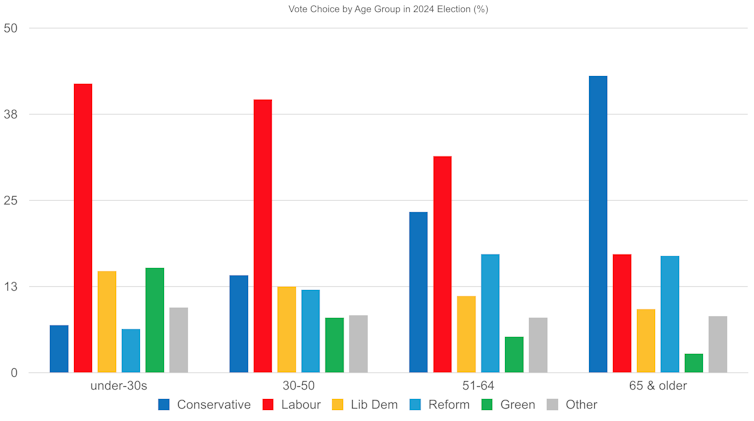
As the graph below shows, it’s only among the over-65s that the Conservatives won more support than Labour (by around 26 percentage points). They trailed Labour by around 8 points among the 51-64 age group, 26 points among 30- to 50-year-olds, and 35 points among the under-30s. Almost incredibly for Britain’s oldest and most successful political party, the Conservatives won barely 7% of the vote of under-30s in the survey.
Parties voted for by age group:
Bar chart showing vote choice by age group. Source: YouGov for University of Exeter, 5-7 July 2024., CC BY-NC-ND
Another key characteristic of the 2024 election is the record-low combined vote share for Labour and the Conservatives, and concurrent record-high vote share for smaller parties. This was not a blip. Voters have been steadily shifting away from the two major parties for years. But in 2024, the extent to which they did so was unprecedented: overall, the combined Labour/Tory vote share was just 57%.
The rejection of the major parties is most profound among young voters. Their support has become fragmented to such an extent that it is not really accurate to speak of a singular “youth vote”. Less than half (49%) of under-30s surveyed voted for Labour or the Conservatives. This compares to 54% of 30- to 50-year-olds, 55% of 51- to 64-year-olds, and 60% of over-65s.
The combined vote share for smaller parties among the under-30s was greater – at 46% – than the 42% who voted for the Labour party. The most successful challengers to the major parties for the youth vote were the Greens and Liberal Democrats, each of whom were backed by 15% of under-30s in the survey.
“Others” – including the Scottish National Party, Plaid Cymru and independents – won a combined 10% of votes from young respondents aged under 30. But the young people surveyed were not simply casting around for any alternative to the major parties. Just 6% of under-30s in the survey said they backed Reform UK (compared with 17% among the over-50s).
Want more politics coverage from academic experts? Every week, we bring you informed analysis of developments in government and fact check the claims being made.
Sign up for our weekly politics newsletter, delivered every Friday throughout the campaign and beyond.
No Reform youthquake
In the closing days of the campaign, there was some suspicion that Reform might achieve a “mini youthquake” in this election or the next. A JLPartners poll found that Reform appealed strongly to soon-to-be-enfranchised 16- and 17-year-old voters, and mock school elections apparently saw Reform winning a great deal of support among schoolchildren across the country.
Our data suggests this did not materialise in 2024. Reform has had some success in appealing to young voters: among under-30s from poorer households, for example, 13% said they supported Reform, compared with 4% for those from wealthier households.
However, similar proportions of under-30s from poorer households also said they voted for the Liberal Democrats (11%) and the Greens (14%). While voters in older age groups who were fed up of Labour and the Conservatives were more likely to switch to Reform and may do so again in future, among the under-30s such voters appeared more likely to switch to the Liberal Democrats, Greens and nationalist parties in Scotland and Wales.
Turnout
Turnout is a crucial issue when considering how young people vote. They have always been less likely to vote than their elders in any particular election. This owes primarily to lower levels of political interest, as well as circumstances associated with early adulthood such as being financially precarious and being less settled in one location. This was true in 2024 as well.
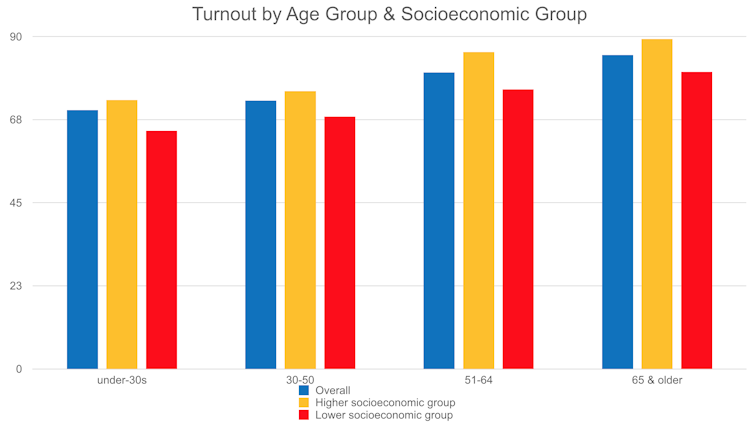
The graph below shows self-reported turnout by age group. The figures are substantially higher than the true turnout numbers, reflecting the long-established tendency of people to exaggerate their voting behaviour in surveys, but they clearly illustrate the age divide: under-30s were the group most likely to say they hadn’t voted.
Turnout by age group:
YouGov for University of Exeter, 5-7 July 2024., CC BY-NC-ND
The graph shows not only was the turnout of under-30s lower than that of older age groups, but that of under-30s from poorer households was particularly low. Young people from poorer backgrounds are less likely to vote than their predecessors were 30 years ago, and so are under-represented in elections to an even greater extent today.
People who vote during early adulthood establish habits that make them likely to vote for the rest of their lives. Those who don’t form such habits by their late 20s are likely to remain serial abstainers.
Younger generations are becoming increasingly unlikely to vote in their first election, leading a greater proportion of them to develop lasting habits of non-voting.
It is this tendency that lies behind one of the major democratic challenges facing the UK: rising levels of disengagement with politics and with voting, as younger people age but continue their youthful pattern of avoiding the ballot box.
Green and independent candidates inflicted a series of blows against the Labour Party
Keir Starmer’s election victory has given Labour a firm grip on power – but a closer look at the results shows a party facing stiff opposition from the left. Many candidates standing on anti-austerity and pro-Palestine platforms have achieved impressive results, which could spark a wider political movement.
Across most of Great Britain, support for the Labour Party did not actually increase. It is thanks only to the UK’s First Past the Post electoral system that such a big landslide was possible.
With two seats still left to declare, Labour has won 9.6 million votes – around 33.7% of all votes cast. This is far less than the 12.8 million votes (40%) the party secured in 2017, when Jeremy Corbyn was leader.
Since the last election in 2019, Labour has increased its overall share of the vote by less than two points. Polling expert John Curtice says this was “entirely as a result of a 17-point increase in support in Scotland”, following a collapse in SNP support.
Starmer’s victory, Curtis explains, was not so much due to a rise in support for the party, but “largely on the back of a dramatic 20-point decline in Conservative support”.
The Labour leader’s allies will, no doubt, use the result to show that the party can win elections only from the centre ground – and will continue to push out any opposition from the left. But yesterday’s vote also represents a major shift in support for left-wing candidates.
At the last election, no independent candidates won a seat. This time around, independents secured an impressive share of the vote and inflicted a series of major blows to Labour, winning in five constituencies in England. Many such candidates had stood on pro-Palestine platforms, highlighting Starmer’s support for Israeli atrocities in Gaza.
Independent Shockat Adam defeated Labour shadow cabinet minister Jon Ashworth in Leicester South, which was meant to be a safe seat; Ashworth had won by more than 22,000 votes in 2019. After the result was announced, Adam said: “This is for the people of Gaza.”
Elsewhere, IT consultant Iqbal Mohamed, pulled off a landslide victory against Labour in the constituency of Dewsbury and Batley in West Yorkshire, winning by almost 7,000 votes.
A solicitor called Adnan Hussein, who stood as an independent candidate in Blackburn, secured a narrow win over Labour, in what the BBC described as a “stunning victory”.
And another pro-Palestine independent candidate, Ayoub Khan, beat Labour in the constituency of Birmingham Perry Barr.
Meanwhile, Corbyn – who also stood as an independent after being forced out of the party – won his seat in Islington North by more than 7,200 votes. This was despite Labour pouring significant support into the constituency, including visits from party grandees like Tony Blair’s former chief adviser, Peter Mandelson, and former deputy leader Tom Watson.
Corbyn, of course, benefited from being so well-known and having served the constituency for more than 40 years. But the scale of his victory was certainly not guaranteed. Shortly before the election, the constituency was described in the media as “marginal”.
Other independents came a close second or third. They include 23-year-old Liane Mohamed, who was within touching distance of kicking Labour’s shadow health secretary, Wes Streeting, out of his seat in Ilford North. She lost by just 528 votes.
In Chingford and Woodford Green, the Labour Party scored a spectacular own-goal by ditching its popular local candidate, Faiza Shaheen, in a last-minute deselection that split the left-wing vote and allowed former Conservative leader Iain Duncan Smith to retain the seat with 17,000 votes. Shaheen – whom Starmer previously campaigned with and described as “a fantastic candidate” – stood as an independent and won almost 12,500 votes – only 79 less than Labour.
Even in Starmer’s ultra-safe central London seat of Holborn and St Pancras, an independent candidate emerged out of nowhere to land a considerable blow. The Labour leader lost nearly 18,000 votes (more than 17%) from the last election, falling from 36,641 to 18,884. His rival, the anti-apartheid campaigner Andrew Feinstein, came second with 7,312.
All of these wins should worry Labour. Although its victory is clear, the party faces a significant electoral and political threat from left-wing and pro-Palestine opponents. If it wants to secure another victory at the next election, it must think very carefully about its stance on issues like Gaza, the NHS and the cost of living crisis.
There are reasons independent candidates often struggle to win seats at a general election. They receive little airtime from the media and lack the big financial donations that larger parties rely on.
The First Past the Post system also greatly benefited Labour in this election, when compared to the Green Party and others. This will reignite calls for proportional representation.
But despite these systemic obstacles, this time around, many independent candidates succeeded. Their message resonated with the public. So what would have happened if they had worked together on a left-wing platform of fighting injustices, both in the UK and further afield? The results today could well be very different in many areas.
If there was ever a good time for them to consider a new party, it’s now. Nigel Farage’s Reform UK has shown that a new party can burst onto the stage and win seats in Parliament. Given the success of many left-wing independent candidates, and the purge of left-wingers from the Labour Party, could the left learn something from this in time for the next election?
Zionist Keir Starmer is quoted “I support Zionism without qualification.” He’s asked whether that means that he supports Zionism under all circumstances, whatever Zionists do.
Britain tested nuclear weapons in the Pacific in the 1950s. (Photo: Yui Mok / Alamy)
The lavish spending would continue under Labour.
Britain spends a larger portion of its military budget on nuclear weapons than any other state, a major report published today reveals.
Rishi Sunak’s government is putting 12 per cent of defence expenditure – equivalent to £12,000 every minute – towards the UK’s arsenal of at least 225 warheads.
Sunak increased spending on nuclear weapons last year by 17 per cent to £6.5 billion – a greater increase than any other nuclear power except the US.
Over the last five years UK expenditure rose by a staggering 43 per cent.
The startling figures appear in new research by the International Campaign to Abolish Nuclear Weapons (ICAN), a widely respected group that was awarded the Nobel Peace Prize in 2017.
ICAN calculates that Britain is the world’s fourth highest spender on nuclear weapons after the US, China and Russia.
Nuclear Starmer
The group’s report comes at a time when the Labour leadership is championing nuclear weapons. The party’s manifesto states: “Our commitment to the UK’s nuclear deterrent is absolute.”
This spending commitment is in stark contrast to Keir Starmer’s extreme caution when it comes to investing in public services.
The party describes the “independent nuclear deterrent” as “the bedrock of Labour’s plan to keep Britain safe”.
However, it is far from independent. Regular flights from the US carry material that are essential ingredients of Britain’s Trident nuclear missile system.
A Mutual Defence Agreement (MDA) between Britain and the US enshrines Whitehall’s reliance on the Pentagon for essential technology.
The agreement, which is due to be renewed this year, is incorporated in US law. Yet it has no legal status in Britain and has never been the subject of a substantial debate or vote in parliament.
The Liberal Democrats’ policy is identical to those of the Conservatives and Labour, saying they will “maintain the UK’s nuclear deterrent with four submarines providing continuous at-sea deterrence”.
The Scottish National Party has a long record of being opposed to nuclear weapons, which it says are “wrong strategically, morally and financially.”
It adds that it supports long-term investment in the Trident submarine base in Faslane as a conventional military base.
The Green party says it would “dismantle Britain’s entire Trident nuclear deterrent and remove all foreign nuclear weapons from UK soil.”
I’ve been expecting the SNP to abandon their green commitments and here it is … SNP’s Swinney describing fossil fuels as sustainable and calling for abandoning the transition to help the transition from fossil fuels. That pretty impressive twisted thinking Swinney.
URI removed
First Minister John Swinney is considering dropping Nicola Sturgeon’s opposition to new oil and gas licences (Image: PA)
7/9/24 This content removed following DMCA takedown notices initiated from the Scotsman claiming copyright infringement. I disagree with them – i.e. I don’t accept that I’m infringing the Scotsman’s copyright – and they look to be produced by a simple automated routine without human supervision or intervention i.e. a stupid bot. I’m disappointed that my website host accepts these notices without question, has redirected some articles as a result and threatened further restrictions.
I have successfully defended one article that the Scotsman was claiming copyright to. That copyright is clearly owned by the letter’s authors. That’s the standard of competence I’m up against.