Original article by Matthew Green and Merel de Buck republished from DeSmog.

Latest documents unearthed by Dutch climate activist seen as “valuable sources” for litigators.
Newly-discovered Shell documents dating back decades could help strengthen lawsuits aiming to hold the oil major to account for climate damages, climate attorneys say.
Among the files, reported for the first time today by DeSmog and Follow The Money, and published on Climate Files, there is a 1970 industry journal article where Shell appears to accept responsibility for harms caused by its products. A trove of Shell publications from the 1980s and 1990s foresee the “major adverse changes” the “greenhouse effect” is liable to cause to the climate.
And a 1998 report spells out Shell’s reasons for leaving the Global Climate Coalition, a now defunct lobby group that worked to undermine climate science. The document shows that Shell had acknowledged the need to adopt “prudent precautionary measures” to avoid the worst impacts of the climate crisis — even as it continued to push for more production of oil and gas.
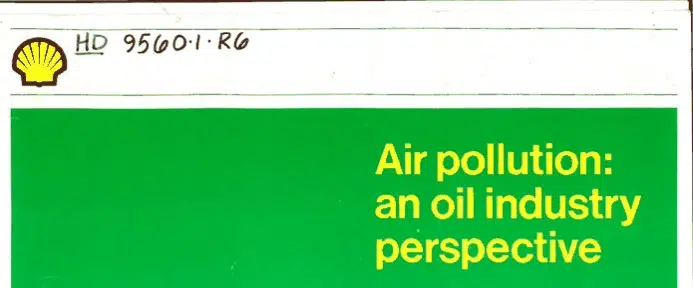
“It is feared that a further rise in carbon dioxide levels in the atmosphere could lead to a higher average surface temperature on Earth, which could have far-reaching environmental, social and economic consequences,” wrote the authors of a 1987 internal Shell publication entitled “Air Pollution: an Oil Industry Perspective.”
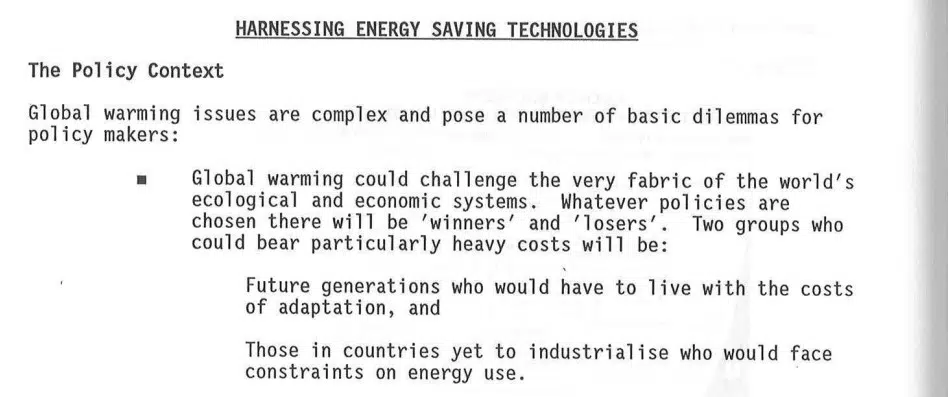
“Global warming could challenge the very fabric of the world’s ecological and economic systems,” Shell executive Ged Davis wrote in a contribution to a report by the Organisation for Economic Co-operation and Development (OECD) published two years later.
Vatan Hüzeir, a climate activist and doctoral candidate in sociology at Rotterdam’s Erasmus University, unearthed the documents over five years of research, gathering thousands of pages of Shell-related material from archives, former employees, and other sources.
The latest materials add to an initial tranche published in April last year which showed that even as Shell’s awareness of the potentially devastating consequences of climate change grew during the 1970s and 1980s, the company downplayed or omitted key risks in public communications; emphasised scientific uncertainties; and pushed for more fossil fuels.
Shell and other oil and gas companies have been named as defendants in dozens of U.S. climate lawsuits brought by the attorneys general of states such as New Jersey, Vermont, and California, as well as Washington, D.C. and other municipalities across the country. Some of these cases have been brought under consumer fraud or protection laws that penalise companies for misrepresenting their products to the public.
The Washington D.C.-based Center for Climate Integrity, which has filed briefs in support of many of the climate cases against Shell, said that the latest documents provide further evidence that the company has known for at least half a century that its products posed a threat to the climate, as well as the grave consequences of delaying action.
“These internal admissions are valuable sources for litigators around the world seeking to hold Shell accountable for its climate deception under a variety of legal theories,” Corey Riday-White, senior staff attorney at the Center for Climate Integrity, told DeSmog. “While Shell privately acknowledged the dangers of using its products as intended, the corporation publicly sowed doubt about the science and fought efforts to regulate its pollution.”
Hüzeir hopes the latest documents will support two additional and complementary legal strategies: showing that Shell has long accepted some liability for harms caused by its products — including, by implication, climate change — and demonstrating that even as Shell supported lobby groups that sought to block meaningful action to curb fossil fuel use, senior executives acknowledged the need for a “precautionary” approach to the growing climate crisis.
In response to a request for comment, Shell referred DeSmog to a previous statement it has made regarding the lawsuits.
“It is for government to determine the right trade-offs for society and put in place smart policy to enable fundamental change in the way society consumes energy,” a Shell spokesperson said.
More than a dozen of the newly released documents, as well as the previous tranche published in April, can be viewed on Climate Files, under the title Dirty Pearls: Exposing Shell’s hidden legacy of climate change accountability, 1970-1990.
Shell Knew
In July 2023, 20 Democratic members of Congress cited DeSmog’s initial coverage of the documents in a letter to U.S. Attorney General Merrick Garland, in which they requested a Department of Justice investigation into the evidence that Shell, ExxonMobil and other oil majors concealed their early knowledge of climate risks.
This spring, a Dutch court is due to hear Shell’s appeal of a 2021 order to slash the company’s carbon dioxide (CO2) emissions 45 percent by 2030, issued in response to a suit filed by environmental group Milieudefensie. Six other organisations also participated in the suit, including FossielvrijNL, a campaign group chaired by Hüzeir, as well as 17,000 Dutch citizens.
“Shell must do its part to contribute to combating dangerous climate change,” Hague district court judge Larissa Alwin said, reading out the ruling.
Hüzeir believes the latest tranche of documents will strengthen cases brought by climate litigators in Europe and North America, in part by providing clues to the possible existence of additional Shell documents that could be obtained through discovery — a pre-trial procedure in the U.S. legal system that parties involved in a lawsuit use to obtain evidence from each other.
“You have to ‘crack the shell,’” Hüzeir told DeSmog. “With the existing documents in hand, and perhaps many more yet to be discovered, prosecutors, litigators and campaign groups can ground their demands for Shell to be held accountable in even more detailed fact and documentation.”
‘Annoying Consequences’
Among the new documents is an October, 1970 article in Dutch trade publication Chemisch Weekblad (Chemical Weekly), in which two authors from the University of Leiden reported on their research into “chemistry and ethics” — including the results of interviews with petrochemical executives. Representatives from Shell had appeared to acknowledge that the company bore some responsibility for the problems that its products would cause.
“If a product is used, as indicated by Shell, and annoying consequences nevertheless arise, Shell feels partly responsible,” they told the researchers.
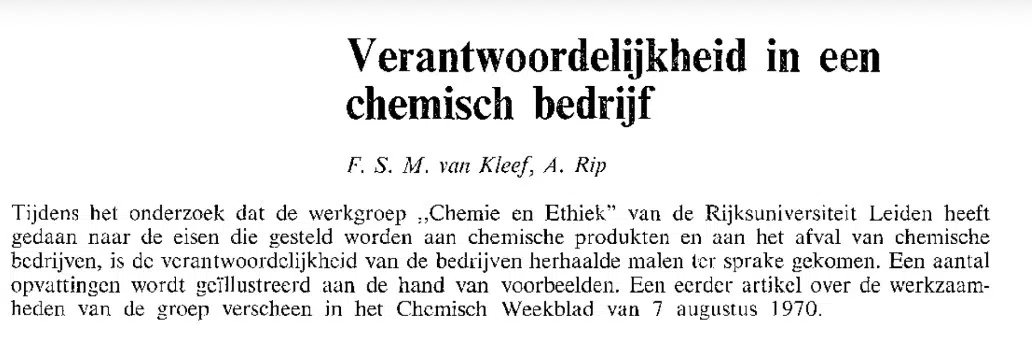
Hüzeir said the document, and others like it, could support litigators to argue that Shell’s apparent early admission of some liability for the side-effects caused by its products should, by extension, also include climate impacts from burning its oil and gas, now known as “Scope 3” emissions.
Later documents cast new light on Shell’s growing understanding of the risks posed by climate change. In a March 1985 article in the journal Conservation & Recycling, T.G. Wilkinson, who worked at the time in the Ecology Section of Shell UK’s Long Term Business Planning Unit, explored the risks posed by “energy-generated pollution.”
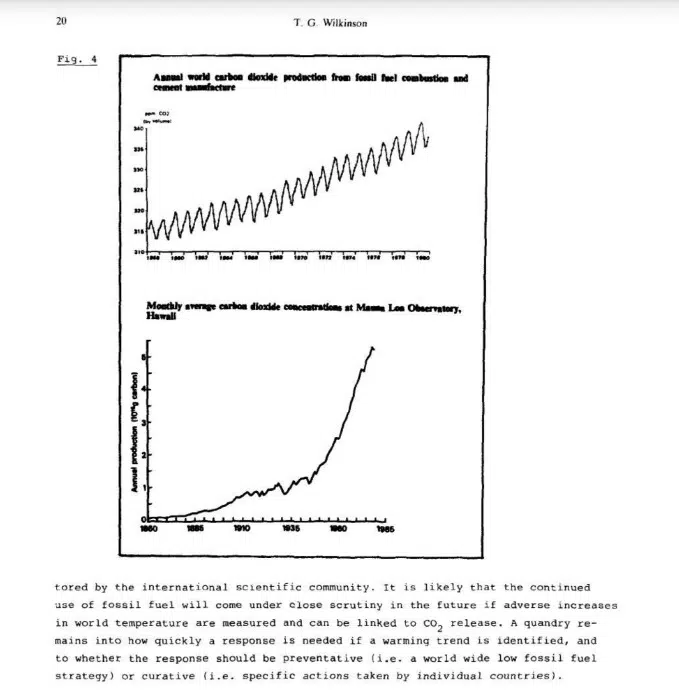
“Burning of fossil fuels which have taken millions of years to form has effectively upset the balance leading to an increase in CO2 in the atmosphere,” Wilkinson wrote. “The Greenhouse effect could lead to some melting of the ice-cap and a significant change in the climatic pattern throughout the world. Whilst this will cause major adverse changes to some areas, others will benefit.”
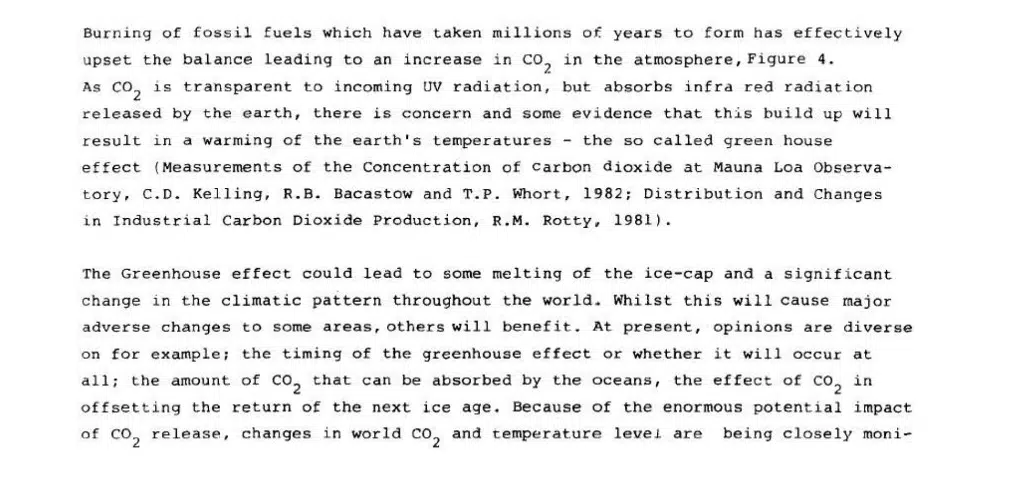
Wilkinson went on to explore whether a precautionary approach should be adopted to prevent the “potential enormous effects on the world’s climate.”
“It is likely that the continued use of fossil fuel will come under close scrutiny in the future if adverse increases in world temperature are measured and can be linked to CO2 release. A quandary remains into how quickly a response is needed if a warming trend is identified, and to whether the response should be preventative (i.e. a worldwide low fossil fuel strategy) or curative (i.e. specific actions taken by individual countries).
“The dilemma therefore remains as to whether to encourage the continued use of fossil fuels with the potential enormous effects on the world’s climate.”
Wilkinson returned to this dilemma in his conclusion, again noting the dangers posed by “emissions and discharges” caused by fossil fuels and nuclear power.
“As well as the benefits of these energy developments however, there are also consequences to the environment arising from the emissions and discharges which are part of the process operations or are implicit in the subsequent use of the fuel,” Wilkinson wrote. “There is concern that energy-generated pollution could well affect the quality of life that has at least in part been made possible by energy developments.”
Winners and Losers
Further evidence of Shell’s growing understanding of the risks posed by burning its products appears in the 1987 internal Shell publication “Air Pollution: an Oil Industry Perspective.”
“It is feared that a further rise in carbon dioxide levels in the atmosphere could lead to a higher average surface temperature on Earth, which could have far-reaching environmental, social and economic consequences,” the document said. “A lot of scientific research is being done to determine which climatic changes can occur and which measures should be taken.”
Shell’s understanding of the gravity of the dangers was also apparent in the 1989 OECD report, entitled “Energy Technologies for Reducing Emissions of Greenhouse Gases.” Davis, the Shell executive, who warned that “global warming could challenge the very fabric of the world’s ecological and economic systems,” also foresaw the possible cost to future generations of failing to curb emissions.
“Whatever policies are chosen there will be ‘winners’ and ‘losers,’” he wrote. “Two groups who could bear particularly heavy costs will be: Future generations who would have to live with the costs of adaptation, and…Those in countries yet to industrialise who would face constraints on energy use…How should we allocate resources between prevention and adaptation?”
Shell planners spelled out the risks even more starkly in an October 1989 confidential scenario exercise, previously reported by DeSmog. The authors warned that climate-fuelled migration could spark conflicts by swamping borders in the U.S., Soviet Union, Europe, and Australia, and that “civilisation could prove a fragile thing.”
‘Too Late’
In the 1990s, as the oil industry increasingly backed lobby groups and think tanks working to undermine climate science, the stark assessments of the risks of burning fossil fuels made by Shell staff in the previous decade gave way to a greater emphasis on scientific uncertainty.
In an October 1990 internal Dutch-language publication entitled “Climate Change,” Shell acknowledged that many leading scientists were convinced of the existence of the “greenhouse effect” — the term then used for climate change.
But the publication also echoed a message seen in other Shell documents that Hüzeir has turned up: emphasizing uncertainty about the magnitude and timing of climate impacts, “if they do come.”
“There is a considerable period of time (perhaps decades) between the increase in greenhouse gases and their ultimate effect on the climate,” the report stated. “As a result, by the time the enhanced greenhouse effect has been conclusively proven, it may be too late to do anything about it.”
Nevertheless, the report went on to acknowledge the importance of reducing greenhouse gas emissions, and referenced the possibility of using carbon taxes to promote a shift away from fossil fuels. “It is widely recognized that emissions of the main greenhouse gases must be limited if there is to be any chance of reducing the further strengthening of the greenhouse effect,” the document said.
The report also noted technologies that could reduce emissions, ranging from switching to fuels that produce less CO2 per unit of energy, to boosting nuclear and renewables such as solar and wind energy. Hüzeir hopes this explicit acknowledgement of the existence of alternatives could strengthen the hand of litigators who want to prove that Shell chose to continue boosting production of fossil fuels, even while knowing that cleaner options were available.

Shell’s emphasis on scientific uncertainty was evident again two years later, in September 1992, when the company’s Group Planning department published a “Business Environment Occasional Paper” on the “Potential Augmented Greenhouse Effect, & Depletion of the Ozone Layer.”
In contrast to Shell authors who had squarely recognised the primary role of fossil fuels in driving climate change in documents and graphs published during the 1980s, the authors emphasised that it was difficult to assess the extent to which fossil fuels were responsible.
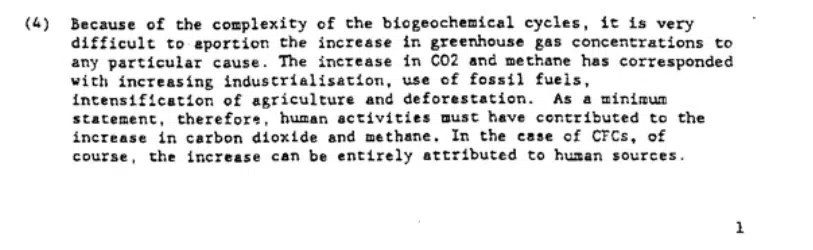
“Because of the complexity of the biogeochemical cycles, it is very difficult to aportion [sic] the increase in greenhouse gas concentrations to any particular cause,” the paper said. “The increase in CO2 and methane has corresponded with increasing industrialisation, use of fossil fuels, intensification of agriculture and deforestation. As a minimum statement, therefore, human activities must have contributed to the increase in carbon dioxide and methane.”
Meanwhile, in other documents, Shell recognised the need to adopt a “precautionary” approach to climate change. In a 1993 report by the World Energy Council, a think tank backed by government and industry, where Shell’s managing director at the time, John Jennings, served on the board, the word “precautionary” appears more than 20 times.
“Given the as yet unknown consequences of continued and increasing greenhouse gas emissions and impacts, the ability to ascertain the ‘economically optimal’ level of emissions and their mitigation, as required by a cost-benefit approach, is impossible,” the report said. “As a matter of simple prudence, therefore, action based on the precautionary principle is advocated.”

Hüzeir argues that such explicit acknowledgements of the need for precautionary measures will further bolster lawsuits alleging that Shell had developed a thorough understanding of the dangers posed by fossil fuels, even as it issued other publications that emphasised scientific uncertainties, and backed lobby groups working to undermine climate action.
‘Profits and Principles’
Shell was a founding member of the Global Climate Coalition (GCC), the outspoken oil industry lobby group, which was formed in 1989 to actively promote uncertainty and doubt about climate science in order to delay climate action.
Hüzeir believes Shell’s explanation of why it left the GCC in 1998 in an English-language sustainability report called “Profits and Principles – Does There Have to Be a Choice?” could provide a further hook for litigators.
DeSmog has previously documented that the GCC had attempted to limit the strength of statements regarding the human causes of climate change made by the Intergovernmental Panel on Climate Change, the UN’s scientific advisory body, in the run-up to the 1997 climate conference where nations agreed to the Kyoto Protocol.
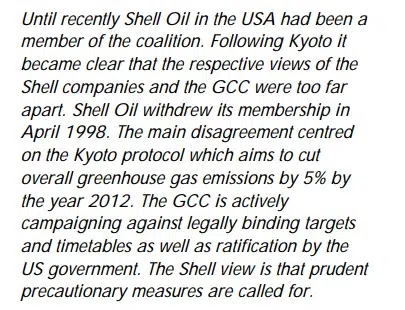
The “Profits and Principles” document said that the “main disagreement” between Shell and the GCC centred on the group’s opposition to the Kyoto agreement, which aimed to cut global greenhouse gas emissions by five percent by 2012.
“The GCC is actively campaigning against legally binding targets and timetables as well as ratification by the US government,” the report said. “The Shell view is that prudent precautionary measures are called for.”
Hüzeir said that Shell’s admission that it saw the need for these “precautionary measures” affirms that the company had long understood the risks posed by the climate crisis — knowledge apparent in many earlier files.
This document also raised the question of why Shell had continued to fund the GCC, as late as 1998 — the year it left the organisation — despite that understanding, Hüzeir said.
Shell’s acknowledgement that its position in GCC had become untenable could also help litigators demonstrate that oil and gas companies that remained in the group until it disbanded in 2002 had been acting in bad faith, Hüzeir added.
“We’ve heard many times from the fossil fuel industry that it was unsure whether or not to take early action on the climate crisis, because there were uncertainties in the science,” Hüzeir said. “But Shell’s deepening embrace of the precautionary principle, as revealed in this document, shows that Shell was well aware of the crisis ahead. What else did they know?”
Original article by Matthew Green and Merel de Buck republished from DeSmog.