What’s not to like about an all-female celebrity crew riding a rocket into space? Quite a lot, as it turns out.
Katy Perry and her companions were initially portrayed in the media as breaking down gender barriers. On their return to Earth, the team enthused about protecting the planet and blazing a trail for others. Perry even sang What a Wonderful World during the flight, and kissed the ground on exiting the spacecraft.
But the backlash was swift. Fellow celebrities piled in to highlight the “hypocrisy” of such an energy-intensive endeavour from a former Unicef climate champion. Evidence was quickly presented to dispute the pollution-free claims of the Blue Origin rocket, which is fuelled by oxygen and hydrogen. (In fact, the water vapour and nitrogen oxide emissions it creates add to global heating, on top of the emissions from the programme as a whole.)
But it’s the negative social effects of this kind of display from celebrities (of any gender) that our research sheds light on. I’m part of a team of social scientists researching the powerful effects of politicians, business leaders and celebrities who lead by example on climate change – or don’t.
Social kickback
Space tourism, and other energy-intensive activities by people in the public eye, such as using helicopters and private jets, have a much wider knock-on effect than the direct damage to the climate caused by the activity itself.
We carried out focus groups with members of the public to understand their reactions to the high-carbon behaviour of leaders in politics, culture and business. We also conducted experiments and surveys to test the effects of leaders “walking the talk” on climate change. We found that observing unnecessary high-carbon behaviour demotivates people and reduces the sense of collective effort that is essential for a successful societal response to climate change.
Solving climate change and other environmental crises requires fundamental changes to economies, societies and lifestyles according to climate science. Using much less energy, not just different kinds of energy, can play a big part in halting the damage. And it is the wealthiest people in the richest countries who use the most energy and set the standards and aspirations for the rest of society. That’s why the Blue Origin dream (of space exploration for the unfathomably wealthy) is a nightmare for the climate because it perpetuates an unsustainable culture.
Our findings reveal that when people see public figures behaving like this, they are less willing to make changes to their own lives. “Why should I do my bit for the climate when these celebrities are doing the opposite?” is the question people repeatedly asked in our research.
Many of the changes to behaviour necessary to tackle climate change will require people to accept trade-offs and embrace alternative ways of living. This includes using heat pumps instead of gas boilers, trading in large, fossil-fuelled vehicles (or even avoiding cars altogether) and forgoing flights – because there is no way to decarbonise long-distance flights in time.
When celebrities (or politicians and business leaders, for that matter) ignore the environmental damage of their choices, it sends a powerful signal that they are not really serious about addressing climate change.
Not only does this undermine people’s motivation to make changes, it reduces the credibility of leaders. That in turn makes coordinated climate action less likely, because shifting to a low-carbon society will require public trust in leadership and a sense of collective effort.
Individual choices matter
The widespread aversion to Perry’s space flight contradicts the popular argument that tackling the climate crisis “is not about individual behaviour”.
On the contrary, the response shows that these actions from celebrities and other leaders have much greater symbolic meaning than is captured by the idea of an “individual choice”. People are highly attuned to the behaviour of others because it signals and reinforces the values, morals and norms of our society. As such, few if any choices are truly “individual”.
This message of collective responsibility is one our current economic and political system works hard to suppress by championing unlimited freedom to consume, while ignoring the loss of freedom that such behaviour causes: freedom to live in a stable climate, freedom from pollution, freedom from extreme weather, freedom for future generations.
In fact, research reveals that most people understand the interconnectedness of society and the need for a coordinated response to the climate crisis. Climate assemblies, which convene ordinary citizens to discuss and deliberate a course of climate action, have revealed a willingness to curtail some activities in a fair way.
When it comes to preserving a liveable planet and a stable climate, most people know that space tourism and ultra-high-carbon living are off the agenda. Celebrities have a positive role to play in leading by example. It’s not rocket science.
US ports are now starting to see scheduled shipments from China decline as the result of Donald Trump’s 145% tariffs on Chinese goods. The port of Los Angeles, the biggest port for Chinese goods in the US, is predicting scheduled shipments in early May to be about a third lower than the same time last year.
Declining numbers of ships arriving stocked with Chinese imports are likely to affect US supermarket shelves soon, and after warnings from US supermarket bosses, Trump responded by saying trade talks between the US and China were under way in the past few days. But Chinese president Xi Jinping quickly denied talks were happening, suggesting he has no intention of backing away from a fight with the US.
As one of the most powerful leaders in the history of the People’s Republic of China, Xi has fashioned himself as a nationalistic icon. So if China perceives Trump’s tariffs as a bully tactic designed to undermine it, backing down from a confrontation with the US would seriously undermine Xi’s strongman image and rhetoric.
This is something that Trump probably hadn’t considered. At a rally marking his 100 days in office, the US president was still suggesting that China would just back down and “eat the tariffs”.
While tariffs appear to be the primary weapon in the trade war, China might have more tactics to hit back at Trump and the US economy. The question is what might they be?
A few weeks ago it seemed like Washington might punish China’s lack of willingness to negotiate with more tariffs, but now it’s clear that Trump is willing to make a deal and is trying to get China to come to the table. Trump is now implying that US tariffs on China could come down substantially. And US treasury secretary Scott Bessent has called the trade war with China “unsustainable”.
Leveraging agriculture and energy
China has reduced its reliance on US farm imports since the trade war began in Trump’s first presidency. This is bad news for Washington as agriculture is one few sectors in the US that actually has a large trade surplus with China. The 125% retaliatory tariffs will harm the sector’s profitability.
But China’s retaliatory tariffs aren’t the only issue American farmers have to contend with. As the trade war escalates, China has been using bureaucratic hurdles to restrict US agricultural products from entering China and as a potential negotiation tool. For instance, China has delayed the renewals of export license renewals of US pig farmers, and refused to renew licenses of poultry farmers for “health and safety” reasons.
Beijing’s actions might be designed to particularly hit the economy in core Trump supporting states. A major part of Trump and the Republican party’s base lies in “red states”, such as Nebraska, Iowa and Kansas, all have significant farming communities. Focusing on agricultural issues is a tactic that Beijing realises will hit home with Trump voters.
Out of the 444 US counties designated by the United States Department of Agriculture (USDA) as farming-dependent, 77.7% voted for Trump during the 2024 US presidential election. So, any hardship faced by the agriculture sector due to Trump’s own actions is likely to lose him support from a major political base. And with mid-term elections in 2026, Trump has to tread carefully when antagonising Beijing.
Another support base that Beijing might seek to undermine is those involved in the fossil fuel sector. In the past, the US has been a top supplier of natural gas to China.
China has not imported natural gas from the US since early February 2025, and has sought its natural gas from Australia, Indonesia, and Brunei. As the trade war continues, it is unlikely that the US would be able to sell its natural gas to China anytime soon, and this will have an impact on the energy industry – one of Trump’s major political support bases.
Restricting minerals
Another huge problem that the US faces stems from China’s restriction of the export of critical minerals. They include seven rare earth minerals namely samarium, gadolinium, terbium, dysprosium, lutetium, scandium and yttrium. While these are used in the clean energy and automobile sectors, the biggest concern would come from the US defence complex.
The White House probably anticipated export restrictions of critical minerals from China. After all, Beijing had banned the export of critical minerals to Japan in 2010 over a fishing trawler dispute, and stopped exporting “dual-use” metals that can be used to produce civilian and military technology, such as gallium, germanium and tungsten.
What’s next?
For the last few years, China has been trying to overcome an ailing economy that was primarily fuelled by a real-estate crisis. Trump probably expected China to buckle under pressure and come crawling to the negotiation table. After all, the Chinese Communist Party needs to fix its economy fast. The establishment has long relied on delivering economic prosperity to legitimise its rule over China.
Right now the tit-for-tat battle continues. By April 11, US tariffs on China peaked at 145%, while China’s retaliatory tariffs on US goods reached an unprecedented 125%.
Although it is clearly fighting back, China could go even further by selling off US treasuries and increasing US interest rates and thus borrowing cost. But unlike Trump, Xi often plays the long game. After all, Trump’s term as president will be over in less than four years, while Chinese president Xi has no term limits. All the latter has to do is exercise patience, and a friendlier US president might come around.
The Trump administration is a serious threat to democracy. They’re also laughably incompetent. But the result is no laughing matter.
…
Clown-show fascism describes a regime marked simultaneously by hubristic and defiant assaults on the democratic and constitutional order on the one hand and, on the other, a nearly laughable incompetence in just about every other area of the regime’s activity. The first characteristic certainly applies to the Trump administration, and it’s chilling and frightening and not at all funny. Just ask Mahmoud Khalil.
Yet at the same time, in other areas, the incompetence has been staggering. Trump’s constant about-faces and walk backs on tariffs have been an international embarrassment. Elon Musk’s DOGE has fired federal workers willy-nilly only to turn around and rehire many after the Musketeers realized they weren’t deep-state bloodsuckers and the work they did was kind of essential, after all—you know, like the people who tend the country’s nuclear weapons stockpile.
It can be hilarious to watch. But it carries two consequences that are no laughing matter.
First and more obviously, we have the prospect of the impact of Trump’s tariffs policy on real people. Will they cause inflation and a recession, as most experts now believe? As fate would have it, Trump will go to bed the night of his 100th day in office—Tuesday—and wake up the very next morning to the release of the first-quarter GDP number. Economists expect anemic results. The Atlanta Fed even predicts negative growth, around -2.5 percent. During Trump’s first week in office, its forecast nudged a gaudy 4 percent, but the president’s actions have liberated that figure ever downward.
Second and more insidiously: Even the gross incompetencies take us into treacherous territory because they contribute to making this all about one man, the man who must be in front of the cameras every day. He doesn’t have policies so much as he has urges, which he must announce to the world on a constant basis in a desperate plea that we keep him front of mind at all times. Some of those urges are cruel; some of them are a joke. What unites them is that they make the story entirely about him.
That is not how it’s supposed to work in democracies. Which we still are, for now, as we reach this 100-day mark. Only 1,361 to go.
Neo-Fascist Climate Science Denier Donald Trump says Burn, Baby, Burn.Elon Musk urges you to be a Fascist like him, says that you can ignore facts and reality then.
Original article by Roger Hallam republished from Roger Hallam. I have not asked to republish this article, expect that it will be ok.
Shymkent, Kazakhstan. Image by Raban Haaijk.
This month, the world’s elites will throw the first dice on how many millions they will have killed for their greatest of all crimes.
As of 28 April 2025, Asia is being battered by a brutal, life-threatening heatwave. Millions of people – right now – are facing unbearable temperatures. In many places it’s over 40°C. In some areas it’s approaching 46°C. In the Philippines, the heat index – the ‘feels like’ temperature – is hitting 53°C. That’s deadly.
People are collapsing in the streets. Children, the elderly, the poor – they’re the first to go. This isn’t just uncomfortable. It’s lethal. Heatstroke. Organ failure. Death in under six hours if you don’t have air conditioning – and most people don’t.
Crops are failing. Water supplies are drying up. Whole regions are becoming uninhabitable. In China, places like Zhejiang and Jiangsu have already hit record-breaking temperatures. In Bangladesh, Myanmar, Thailand – vast populations are at risk. In West Asia, where conflict and poverty already devastate lives, the heatwave is tipping people over the edge.
Let’s be absolutely clear: this is just the beginning. And it’s not a natural disaster – it’s a crime scene. A direct result of thirty years of lies, inaction, and wilful destruction by the people at the top – fossil fuel executives, politicians, and the liberal classes who let them get away with it.
This is the first phase of climate genocide. And it’s happening now.
So here we are. We’ve finally arrived.
2025 will be the second year in a row that global temperatures sit above 1.6°C. That’s not a statistic. That’s a death sentence – for millions. From this point on, every month is a roll of the dice. And if it lands on a six? The wet bulb threshold is breached – that deadly combination of heat and humidity where your body can’t cool down. People without air conditioning – the majority of humanity – die in six hours. That’s it. Game over.
Billions of people – in poor city slums, in rural villages, in places no one in power cares about – are now inside a roulette wheel of death. Waiting for their number to come up. That is what the ruling elites have created. That is what the liberal and professional classes have enabled – through cowardice, distraction, and silence. They could have stood up. They could have resisted. They chose not to. They are complicit.
The consequences? Beyond catastrophic. And if you sit back now, shrug your shoulders, and go back to your life – you are handing over the final keys. You are helping to lock in human extinction within the next ten years. If it hasn’t already been sealed.
Let’s stop pretending we don’t know what’s coming.
Do the numbers. We’re already at 1.6°C. Another 0.4°C rise is expected over the next decade. Add 0.5°C when air pollution clears and no longer cools the atmosphere. Add 0.3°C from the carbon lag – the delay between what we emit and when it shows up. Then add the collapse of forests, the melting permafrost, the methane, the wildfires.
We’re on track to blow through 3°C before 2050.
What does that mean? Ask the British insurance industry – they’ve already said it: 4 billion people dead. Half the human race. And that’s just the start. Because 3°C triggers feedbacks in the Earth system that take us past 5°C – the point where the human body, the human brain, life itself, no longer functions. That’s extinction. Everyone. Gone. Forever.
And even if there was just a 10% chance of this happening – which there isn’t, it’s now the central scenario – then to take that risk, to sit on your hands, is the greatest crime in history.
And if you still do nothing now, at this moment – then what are you?
Rev21 is hosting an online global convention this May, bringing together leading activists, writers, scientists, and changemakers to confront the realities of social and ecological collapse—and to begin designing the revolution we need. Held via Zoom with multiple talks, workshops, and breakout spaces, it’s a space to learn, connect, and collaborate on what 21st-century revolution can look like: holistic, nonviolent, and rooted in real relationships. For some, it’s a powerful networking moment; for others, it’s a first step into serious action. With solidarity pricing and an open invitation to those ready to shape the future, this isn’t just an event—it’s the beginning of a revolution.
Original article by Roger Hallam republished from Roger Hallam. I have not asked to republish this article, expect that it will be ok.
Neo-Fascist Climate Science Denier Donald Trump says Burn, Baby, Burn.Elon Musk urges you to be a Fascist like him, says that you can ignore facts and reality then.
Scientists have identified more than 25 parts of the Earth’s climate system that are likely to have “tipping points” – thresholds where a small additional change in global warming will cause them to irreversibly shift into a new state.
More recent research suggests that triggering one tipping element could cause subsequent changes in other tipping elements, potentially leading to a “tipping cascade”.
However, the interactions between individual tipping elements – and the ways they might trigger each other – remain largely underexplored.
In a review study, published last year in Earth System Dynamics, we unpack the current state of scientific understanding of the interactions between individual tipping elements.
We find that scientific literature suggests the majority of interactions between tipping elements will lead to further destabilisation of the climate system.
Existing research also indicates that “tipping cascades” could occur even under current global warming projections.
Scientific understanding of individual tipping elements is continuously improving, but more research on their interactions is needed.
An emerging field
The history of tipping elements as an object of investigation is relatively short. As a result, they are only partially accounted for in current climate models.
Since then, significant progress has been made on tipping element research.
For instance, the 2023 global tipping points report – co-authored by more than 200 researchers from 90 organisations in 26 countries – recognised that five “major” tipping elements – the Greenland and West Antarctic ice sheets, the warm-water coral reefs, the North Atlantic Subpolar Gyre and global permafrost regions – are already “at risk of being crossed due to warming”.
However, tipping elements have so far largely been studied in isolation. Most research has neglected the interactions between different tipping elements which could further destabilise the climate system – and eventually even lead to tipping cascades.
Tipping cascades
Interactions between tipping elements clearly exist.
For example, we find robust evidence that an influx of freshwater into the North Atlantic caused by the disintegration of the Greenland ice sheet would destabilise the AMOC and could trigger its slowdown. (This, in turn, could result in the ocean currents moving less heat from equatorial regions to higher latitudes, leading to significant cooling in Europe.)
In worst-case cascading scenarios, the tipping of one system directly leads to the tipping of another. In less dramatic cases, it only reinforces destabilisation of other systems.
So, what additional effects are to be expected from these interactions?
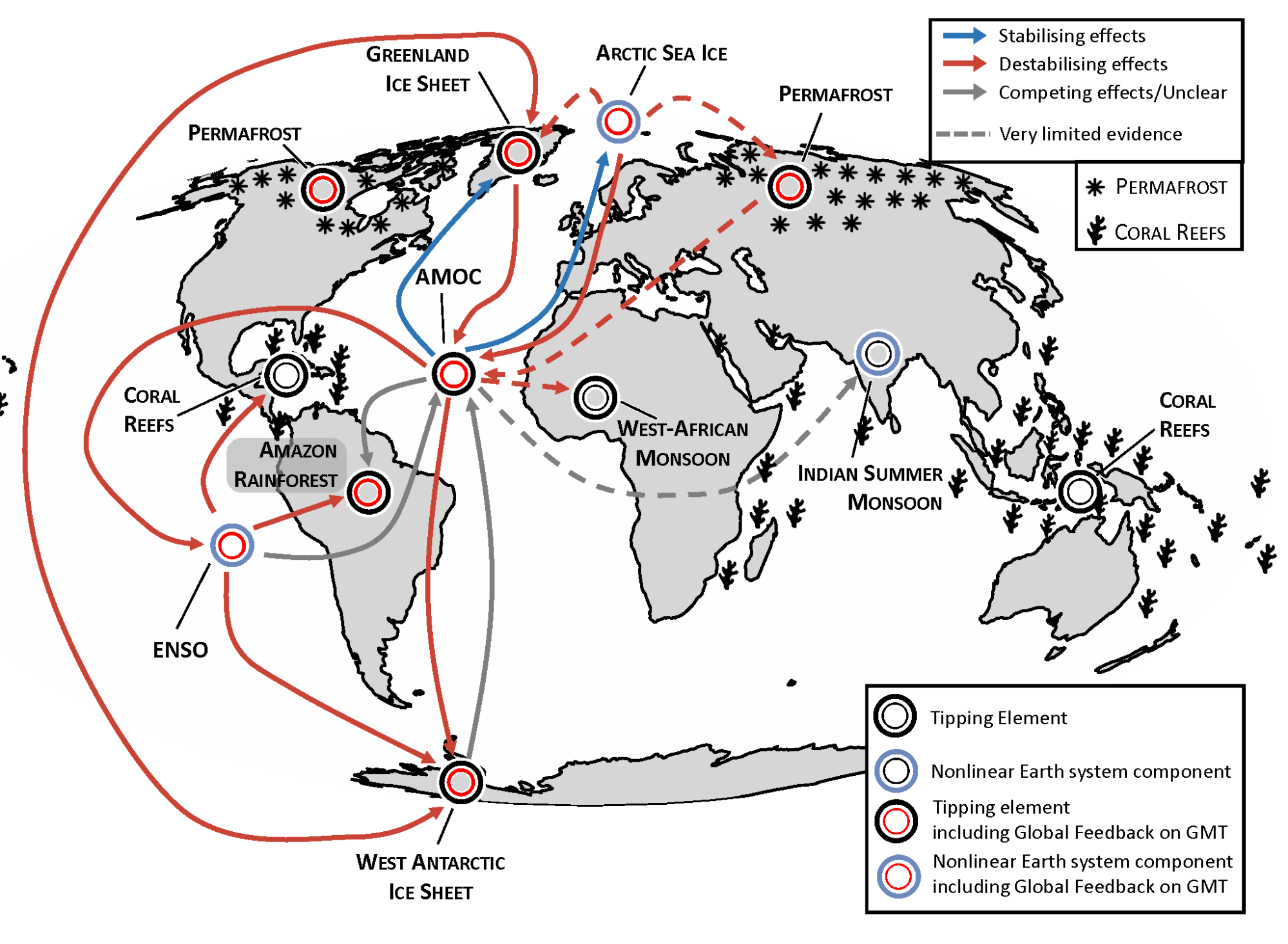
The map below shows how 13 out of 19 tipping element interactions analysed in our review study are expected to lead to further destabilisation. The arrows indicate destabilising (red), stabilising (blue) or competing (grey) effects, while the dashed lines show where there is only limited evidence for a connection.
A prominent example of a tipping point that leads to further destabilisation is the impact of changes to the AMOC. The weakening or collapse of the system of ocean currents may lead to accumulation of warm ocean water in the Southern Ocean, which could, in turn, contribute to a destabilisation of the West Antarctic ice sheet.
It has also been suggested that a weaker AMOC could promote El Niño events by increasing the temperature difference between the equator and the poles, which would strengthen trade winds. (While the El Niño-Southern Oscillation, or ENSO, is not a tipping element, it may play an important role as a propagator of disturbances.)
There are also a few examples – two out of 19 interactions – where a tipping point can help stabilise another system. For example, the weakening of AMOC could lead to an interrupted flow of warm water from equatorial to the polar Atlantic regions. This would drastically cool large parts of the polar region and could therefore stabilise the Greenland ice sheet.
Map of interactions between tipping elements. Stabilising effects are shown in blue, destabilising effects in red, and unclear effects in grey. Effects with very limited evidence are denoted by dashed lines. Credit: Wunderling et al. (2024)
A conceptual model
While scientists have gathered evidence for tipping points from observations, models and proxy data from the distant past, we still need more research to study interactions.
Our ongoing research aims to quantify the risk of tipping cascades using a conceptual computational model.
The model is “conceptual” in the sense that it is not grounded in physical or chemical processes, such as heat transfer or circulation patterns. Instead, a range of measurements – such as global average temperature, tipping temperature and temperature overshoot trajectory – serve as “modelling parameters” that can be varied to study a large range of possible scenarios.
To date, the model is limited to simulating the Amazon rainforest, the AMOC and the West Antarctic and Greenland ice sheets – tipping elements whose respective interactions are relatively well established.
However, using this model we can investigate – among other things – tipping risks under different so-called temperature “overshoot” scenarios.
This is where global warming peaks at a certain temperature level – for example, 2C – before declining to a lower long-term stabilisation temperature. (The subsequent decline is assumed to be the consequence of a global roll-out of negative-emission technologies, as assessed in several recentpublications.). The difference between the peak temperature and the long-term stabilisation temperature is the overshoot.
Evaluating millions of scenarios, our model calculates “tipping risks” for fixed combinations of a particular overshoot and stabilisation temperature.
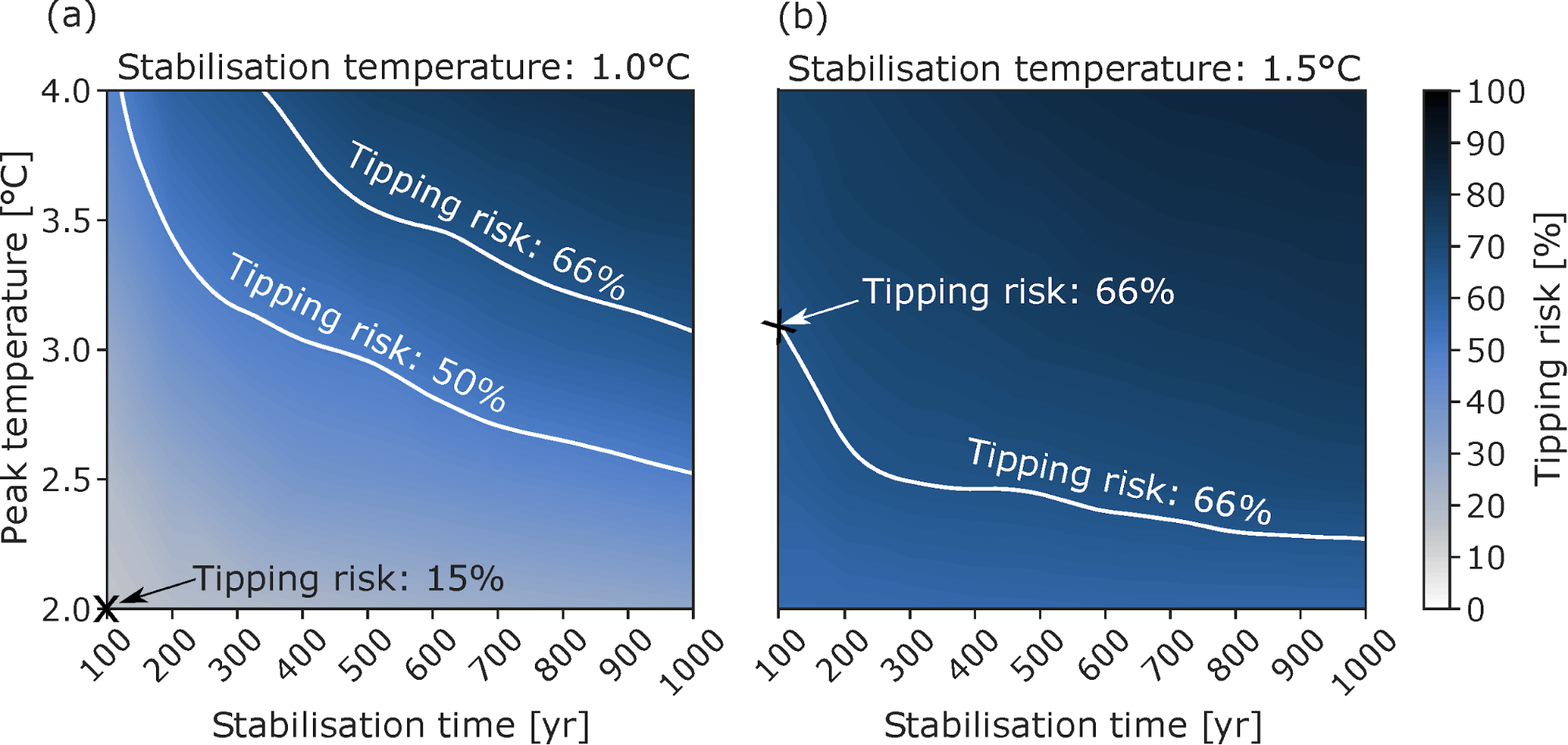
The main finding of the research is that long-term tipping risks are in the order of 15% if warming peaks at 2C and then stabilises at 1C.
In contrast, in a scenario where the peak warming reaches 3C and stabilises at 1.5C in the 22nd century, there is a 66% probability that at least one of the four modelled tipping elements would lose stability.
The figure below shows tipping risks where warming peaks at between 2C and 4C (“peak temperature” on y-axis) and takes 100-1,000 years to stabilise (“stabilisation time” on x-axis).
The figure on the left shows tipping probabilities where temperatures eventually stabilise at 1C and the figure on the right where temperatures settle at 1.5C. Darker colours represent higher tipping risks.
The figure shows how tipping risks increase with higher peak and stabilisation temperatures, as well as with longer stabilisation times.
Tipping risks under global warming overshoots for peak temperatures (between 2C and 4C) and overshoot durations (stabilisation time of 100 to 1,000 years) for stabilisation temperatures of 1C (left), and 1.5C (right). Credit: Adapted by the authors from figure 3 in Wunderling et al. (2023)
While solidly calculated and based on recent scientific literature, our results can not count as projections of future climate due to the conceptual nature of our underlying model.
Nevertheless, the findings are useful and complement findings from traditional climate models, known as General Circulation Models (GCMs).
GCMs have only started to fully address the dynamics of tipping elements and their interactions. For example, most do not yet feature fully interactive ice-sheet dynamics, nor their interactions with global oceans.
In a paper published last November, we used our conceptual model to show that neglecting interactions between the Greenland ice sheet and the AMOC can alter the expected number of tipped elements by more than a factor of two.
In addition, the high cost of running GCMs means researchers cannot run large “ensembles” of multiple model simulations to account for uncertainties in knowledge of key parameters. Our simplified conceptual model, on the other hand, can account for this uncertainty.
By drastically reducing physical complexity, we are able to compute several million – and up to a billion – ensemble members in large-scale Monte Carlo simulations.
Historical tipping events
While our results need to be confirmed by more complex Earth system models, such as GCMs, they hint at the need for scientists to examine interactions between tipping elements and potential tipping cascades more closely.
The study of abrupt climate changes of the distant and not-so-distant past is critical to convince researchers of the existence and significant impact of tipping cascades.
A potential candidate for investigation is the Eocene–Oligocene transition. This took place roughly 34m years ago and led to the formation of a continent-scale ice sheet on Antarctica which buried the region’s forests.
The transition likely involved the interaction of several tipping elements, including global deep-water formation, the Antarctic ice sheet, polar sea ice, monsoon systems and tropical forests. The monsoon-like climate of the Antarctic content at the end of the Eocene would have had to change drastically – or tip – to allow for glaciation during the transition to the Oligocene.
Since the events at that time were also linked to a major loss of mammal species, mostly in Europe, the Eocene–Oligocene transition might even have involved a climate-ecology tipping cascade.
Heinrich events, which took place in the last ice age – around 120,000 to 11,500 years ago – as well as the mid-Holocene, could also be especially revealing around what we can expect in the near future.
These events, which involved the release of icebergs into the North Atlantic, resulted in a fresh water inflow that substantially weakened the AMOC. This, in turn, led to the drying of northern Amazonia and the retreat of the rainforest. Today’s melting of the Greenland ice sheet could have similar consequences for the AMOC.
While these climate changes in the past happened through natural drivers, humans are potentially forcing these rapid changes now in the modern era through emissions of carbon dioxide, possibly on a much faster timescale.
Updated climate models
The science of interacting tipping elements and tipping cascades is in its early stages – and there is significant debate within the scientific community on the topic.
Some consider a global reorganisation of the climate system induced by tipping elements and cascades to be speculative, given that recent observations are not available and proxy data is scarce.
Additionally, there is scientific uncertainty of how tipping processes may play out across different spatial scales, as well as how to increase the resilience of tipping elements against perturbations.
Therefore, significant work is underway to investigate tipping processes in complex Earth system models. The Tipping Points Model Intercomparison Project (TIPMIP) and European Union-funded projects ClimTIP or TipESM are among a raft of such initiatives.
Although these initiatives are largely looking at tipping elements in isolation, they will also shed more light on the interactions between these important parameters of the Earth’s climate system stability.
Neo-Fascist Climate Science Denier Donald Trump says Burn, Baby, Burn.Elon Musk urges you to be a Fascist like him, says that you can ignore facts and reality then.