UK tops all league tables for highly polluting form of travel, with a flight taking off every six minutes last year
The UK is the private jet capital of Europe, with more flights than anywhere else on the continent, analysis has found.
Last year, a private jet set off from the UK once every six minutes, putting the country ahead of the rest of Europe when it comes to the extremely polluting form of travel. Many of these journeys have been called “polluting and pointless” by Greenpeace, as they are so short they could have easily been taken by train – and in one case, cycled in 30 minutes.
The analysis by the Dutch environmental consultancy CE Delft also found that the number of private jets taking off from the UK increased by 75% between 2021 and 2022 to 90,256 flights, emitting 500,000 tonnes of CO2 – more than in any other European country.
The UK tops all league tables for private jets, boasting the busiest route, the most polluting route and the most flights overall. Flights between London and Paris were the most popular route, accounting for 3,357 flights, and six of the top 10 routes overall also included London.
Environmental campaigners at Greenpeace are calling for a ban on private jet travel, highlighting that the research shows almost one-in-four (39%) private jet flights in Europe were considered “very short-haul” meaning they were less than 310 miles (500km) and could easily have been train trips.
There were also some staggeringly inefficient routes found in the analysis. A flight between Blackbushe and Farnborough in Hampshire – which is just 4.6 miles (7.4km) – topped the charts for the most carbon-intensive route in 2021 and 2022. This is because it takes less than 30 minutes to cycle between the two airports.
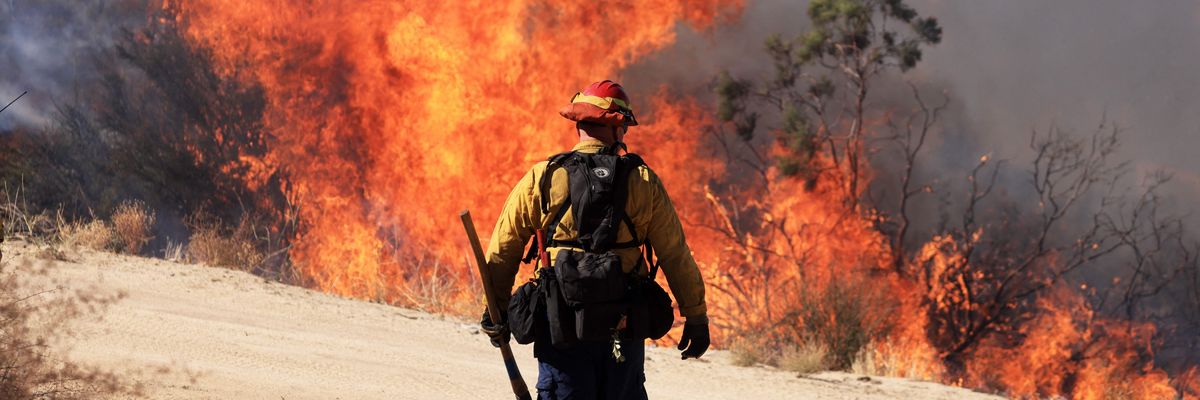
A firefighter walks toward flames as the Highland Fire burns in Aguana, California, on October 31, 2023. (Photo: David Swanson/AFP via Getty Images)
“Climate change is not something off in the future,” said one scientist. “It’s happening before our very eyes.”
New findings about the rising frequency of extreme wildfires have “the fingerprints of climate change” all over them, according to an Australian scientist who led a study published on Monday.
Calum Cunningham, a postdoctoral researcher at the University of Tasmania in Australia, told The Washington Post that he was driven to examine current trends in the frequency of wildfires after climate deniers suggested that because the global area being burned in blazes is declining, the idea of a growing wildfire crisis is being overblown by concerned scientists.
While the area destroyed by wildfires is indeed on the decline, analyses that include all fires—the majority of which are small and cause relatively little damage—obscured how the most extreme and destructive wildfires are rapidly growing more frequent.
Cunningham and his team analyzed data from National Aeronautics and Space Administration satellites, collecting four images of wildfires around the world per day over 21 years. They used the images to identify the 0.01% most extreme wildfires—those that release the most smoke and greenhouse gas emissions due to their size and uncontrollable nature.
Out of 30 million fires across the world over two decades, the researchers identified the 2,913 most extreme fire events and found that the frequency and intensity of such wildfires has more than doubled since 2003.
“Climate change is making fire weather more extreme and more frequent in a lot of the world.”
The problem is rapidly getting worse, the team found: The six years with the most extreme wildfires had all occurred since 2017.
Trends were particularly troubling in particular regions, like temperate conifer forests in the western United States and the Mediterranean, where the number of extreme fires rose by more than 10 times in 20 years.
In boreal forests in places like northern Europe and Canada, the frequency of the most intense and hard-to-control blazes increased by seven times.
“It’s absolutely in keeping with what climate change is doing to fire weather around the world,” Cunningham told the Post. “Climate change is making fire weather more extreme and more frequent in a lot of the world.”
The “fire weather” that’s driven the increase includes hotter and drier conditions, with temperatures staying high even overnight when they ordinarily would have have dropped in previous decades, giving firefighters a chance to make headway in putting out blazes.
“Rarely did we have 100,000-acre fires 20 years ago,” veteran firefighter Bobbie Scopa told the Post. “But now, it’s not uncommon.”
The researchers pointed to a “scary” feedback loop created as extreme wildfires create carbon emissions—leading to more planetary heating and even more fires.
“Climate change is not something off in the future,” Cunningham told the Post. “It’s happening before our very eyes. This is the manifestation of the reshaping of the climate we are doing.”
The study was published in Nature Ecology & Evolution days after wildfires scorched more than 14,000 acres in Southern California and more than 24,000 acres in New Mexico, where two people were killed. Last year, climate scientists were stunned by an unprecedented wildfire season in relatively damp Eastern Canada, where wildfires were made twice as likely by the climate emergency according to the World Weather Attribution.
Climate scientist and author Bill McGuire called the findings “terrifying, of course, but just not a surprise,” considering governments in the countries that produce the most fossil fuels are continuing to support and subsidize energy sources that heat the planet.
You know this don’t you? Temperature records continually getting broken, US Secretary General Antonio Guterres continually warning about climate hell, politicians and fossil fuel cnuts continuing to destroy the planet.
The solution is known and has been know since the 1960s and 70s – it is simply to stop burning fossil fuels. Fossil fuel companies have known, lied and deceived. Politicians in the pocket of the fossil fuel industry offer and do nothing.
Action was needed decades ago and shite politicians have failed us all. You can’t leave it to the profiteers or the politicians that they own if you want a planet you can live on – they quite clearly don’t give a feck about anything other than money and power.
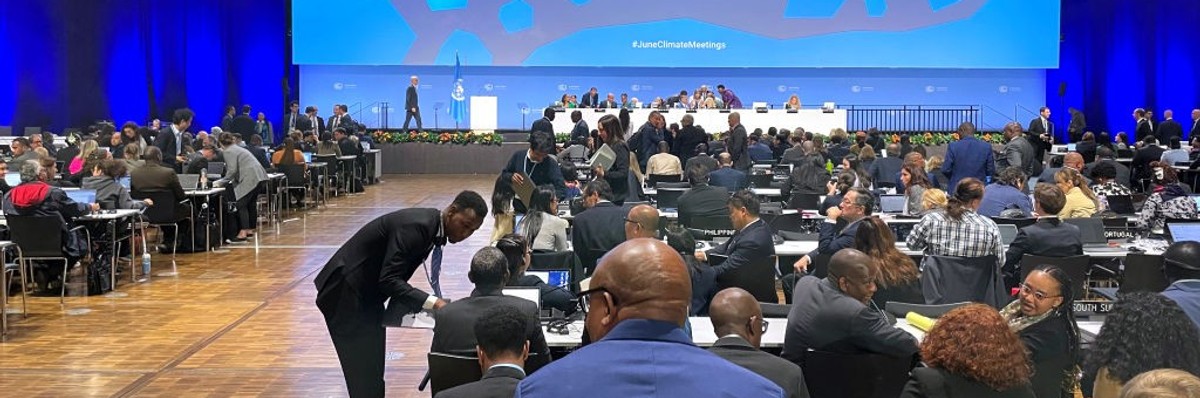
Delegates from around the world meet at an annual climate change conference in Bonn, Germany, on June 3, 2024, in preparation for the COP29 conference in November in Azerbaijan. (Photo: Christoph Driessen/Getty Images)
“We have to put the social justice element upfront,” an architect of the 2015 Paris agreement said as the world’s climate delegates gathered in Germany.
Advocates on Tuesday issued strong calls to action on climate finance for developing countries and an international agency released a report on the need to ramp up renewable energy production as the Bonn Climate Change Conference continued in Germany and G7 nations prepared to meet in Italy next week.
At the conference in Bonn, Friends of the Earth International pushed for more rich-country financing to pay for the rising costs of climate impacts in the Global South, while Laurence Tubiana, head of the European Climate Foundation and an architect of the 2015 Paris agreement, called for the global rich to pay their share through taxes and consumption levies.
Meanwhile, two organizations warned that countries aren’t on track to meet targets they set just last year. Oil Change International (OCI) published a briefing showing that G7 nations are expanding oil and gas commitments that undermine goals set at the United Nations Climate Change Conference (COP28) meeting in Dubai, and the International Energy Agency (IEA) issued a report showing that the world’s nations are not on track to meet their Dubai pledge to triple renewable energy production by 2030.
“The world is on fire because of decades of inaction by rich countries on reducing emissions, and their failure to pay the climate finance they owe to developing countries to transition to renewable energy systems for all, and to pay for rising costs for loss and damage and adaptation,” Sara Shaw, Friends of the Earth International program coordinator, said in a statement. “What is on the table to date is scales of magnitude away from what it needed. This year must be a year of breakthrough on climate finance.”
Climate representatives are meeting in Bonn this week and next to prepare for COP29 in November in Azerbaijan, where a key agenda item is expected to be financing for a green transition in the Global South. COP negotiations are conducted under the aegis of the United Nations Framework Convention on Climate Change (UNFCCC). At COP21 in 2015, nations signed the Paris agreement, a treaty that sought to limit global warming to less than 2°C above preindustrial levels.
Tubiana, an architect of that deal, said Tuesday that tackling climate change requires centering global justice in order to avoid conflict and gain public acceptance of climate measures.
“We have to put the social justice element upfront,” Tubiana, a French economist and diplomat, told The Guardian.
Tubiana said that raising the funds required for low-income nations will require holding both rich nations and people to account, via taxes and consumption levies, given that inequities exist not just between nations but also within them.
“This inequality is true not only between developed countries and developing ones, but within each country—the 1% of rich Chinese, or the 1% of very rich Indians, or the U.S. citizen—they have a lifestyle which is very, very similar, in terms of overconsumption,” she said.
The world’s richest and most powerful nations are not taking responsibility for climate action as they should, the new OCI briefing argues.
“Some G7 countries are massively expanding fossil fuel production at home, while others are investing in more fossil fuel infrastructure abroad,” the briefing states. “Both are catastrophic failures of leadership.”
OCI cites the United States, Italy, and Japan as particularly bad climate actors. The U.S. is the largest oil and gas producer in the world and has plans for massive expansions of the industry, despite President Joe Biden’s climate promises, the briefing notes. Italy has announced plans to double natural gas production. And both the U.S. and Japan have financed billions of dollars worth of oil and gas production in other countries just since the end of 2022, the document states, citing earlier OCI findings.
.@G7 countries 🇨🇦 🇺🇸 🇬🇧 could be responsible for nearly half of the CO2 pollution from new oil & gas projects planned between 2023 and 2050 – equivalent to the lifetime emissions of nearly 600 coal plants.
— Oil Change International (@PriceofOil) June 4, 2024
The IEA also spelled out unfulfilled commitments, while detailing progress that has been made on the energy transition. The agency looked at the domestic policies and targets of 150 countries to see how far along they were toward reaching the international target of tripling renewable power generation by 2030. It found that once added together, the nations’ domestic plans would get them about 70% of the way toward the 11,000 gigawatts of additional capacity required to meet the goal.
“There is a gap, but the gap is bridgeable,” Heymi Bahar, a senior energy analyst at the IEA and co-author of the report, toldThe Guardian.
Governments have not in most cases written these domestic plans into their Nationally Determined Contributions (NDCs) under the Paris agreement. The IEA report says that countries need to “bring their NDCs in line with their current domestic ambitions” and scale those ambitions up further still, to get from 70% to 100%. Moreover, they must follow through with their promises and achieve the targets they’ve set.
“This report makes clear that the tripling target is ambitious but achievable—though only if governments quickly turn promises into plans of action,” Fatih Birol, the IEA’s executive director, said in a statement.
The world added about 560 gigawatts of renewable capacity in 2023, a record increase, more than half of which came from China, according to the IEA. About half of planned capacity increases are in solar, with a quarter from wind power, the IEA report states.
Extinction Rebellion climate activists are blocking access to Farnborough Airport this morning (Sunday 2 June) to protest against the increasing use of highly polluting private jets by the super-rich and to call on the government to ban private jets, tax frequent flyers and make polluters pay.
Today’s blockade is part of a global week of action against private aviation under the banner Make Them Pay with actions in Denmark, Germany, Mexico, Norway, Sweden, Switzerland and the US, and follows Europe’s largest private jet convention EBACE in Geneva this week. In Farnborough, protesters have barricaded the airport’s Gulfstream Gate with the iconic XR pink boat with “LOVE IN ACTION” painted on the side, Ively Gate has four protesters locked on to oil drums, and the airport’s departure gate has an activist mounted on a tripod blockading the entrance. Police have seized a second tripod.
A fourth group of protesters are playing cat and mouse with the airport authorities, moving between the airport’s other gates to block them. At all three main gates, protesters are releasing colourful smoke flares, chanting slogans and engaging with members of the public, accompanied by the XR Rebel Rhythms band of drummers.
The activists are supported at all three main entrances to the airport by scores of demonstrators holding banners reading “FLYING TO EXTINCTION”, “PRIVATE FLIGHTS = PUBLIC DEATHS”, “STOP PRIVATE FLIGHTS”, “PRIVATE FLIGHTS COST THE EARTH” and “TAX FREQUENT FLYERS”.
Climate activists are targeting Farnborough Airport in an escalating campaign because it is the UK’s largest private jet airport. Last year 33,120 private flights landed and took off from its runways, carrying an average of just 2.5 passengers per flight, making them up to 40 times more carbon intensive than regular flights. Currently 40% of flights to and from the airport are empty. The airport is now seeking planning permission to increase the number of planes taking off or landing from a maximum of 50,000 a year to up to 70,000 a year.
Farnborough Airport claims to be a centre for business aviation yet around 50% of Farnborough flights headed to the Mediterranean during summer months, rather than business locations, with around 25% heading to Alpine destinations during the winter months. Last year a service was launched specifically to shuttle dogs and their owners to Dubai and back.
The demonstration includes campaigners from Extinction Rebellion, who have joined forces with local residents, Quakers, and campaign organisations Farnborough Noise Group, Blackwater Valley Friends of the Earth, and Bristol Aviation Action Network to voice their opposition to the airport’s expansion plans.
Dr Jessica Upton, 54, from Oxford, a Veterinary surgeon and foster carer said: “I’m here today because private airports are an abomination. Expanding Farnborough would be putting the indulgent wants of the rich minority over the needs of the majority. Local people need cleaner air and less noise pollution, and the world’s population urgently needs rapid reductions in greenhouse gas emissions to survive. Private airports disproportionately contribute to climate breakdown and closing them would boost our chances of sticking to the Paris Climate Accords, the supposedly legally binding international treaty agreed to and signed by our government.“
Daniela Voit, 37, from Surbiton, a Shiatsu Practitioner and Teacher, said: “Last year we hit a global average temperature rise of 1.5oC degrees celsius over an entire year. For decades we were told a 1.5oC rise needs to be avoided to avoid catastrophic changes to our lives due to the planetary warming caused by humanity’s CO2 emissions. We can see the consequences of this temperature rise all over the world – currently immense flooding in Brazil and Afghanistan and temperature of 52C in Pakistan. To carry on flying in private jets, one of the biggest causes for CO2 emissions per person, in a time of climate crisis is reckless. The rich 1% that are flying from Farnborough Private Jet Airport seem to think they are exempt from taking responsibility for what they are doing to our only home. Banning Private Jets is one of the first things we need to do to stop further temperature rises. This is vital to ensure the survival of all life – human, animal and plant – on this planet that we call our Mother Earth.” Make Them Pay demands:
1) Ban private jets. Flying in a private jet is the most inefficient and carbon-intensive mode of transport. Flights on private jets can be as much as 40 times more carbon-intensive than regular flights, and 50 times more polluting than trains. A four-hour private flight emits as much as the average person does in a year. Private jet use is entirely inappropriate during a climate emergency.There’s strong public support for banning private jets and banning this mode of travel was a key recommendation of the Climate Assembly.
2) Tax frequent flyers. Various citizens’ assemblies, for example in the UK, Scotland, and France, have recommended that frequent flyers and those who fly further should pay more.
They believe this would “address issues of tax fairness, as currently those who don’t fly are subsidising those who do” and that “this would deliver significant behaviour changes across society and have a positive impact on reducing overall carbon emissions caused by flying.”
Taxes on air travel would be a socially progressive way of raising climate funds and have been proposed by the group representing the most vulnerable countries at COP27 as an effective way to raise climate finance and pay for loss and damage, alongside debt cancellation.
3)Make polluters pay. It is only fair that the wealthiest in society and the highest-income, highest-emitters pay for their climate damage, and pay the most into climate Loss and Damage funds for the most affected peoples and areas to mitigate and adapt to the worst impacts of climate change.
The top 1% of the global population by income are responsible for more emissions than the bottom 50% combined. So not only is it a question of morality that the wealthiest in society pay the most, and commit to the most rapid emissions reductions – it’s also a mathematical necessity and a question of practicality and science.