Category: the filthy rich

  • Nigel Farage Dubbed ‘MP for Washington’ for Parroting Trump in Parliament

    Spread the love

    Article by Adam Barnett republished from DeSmog
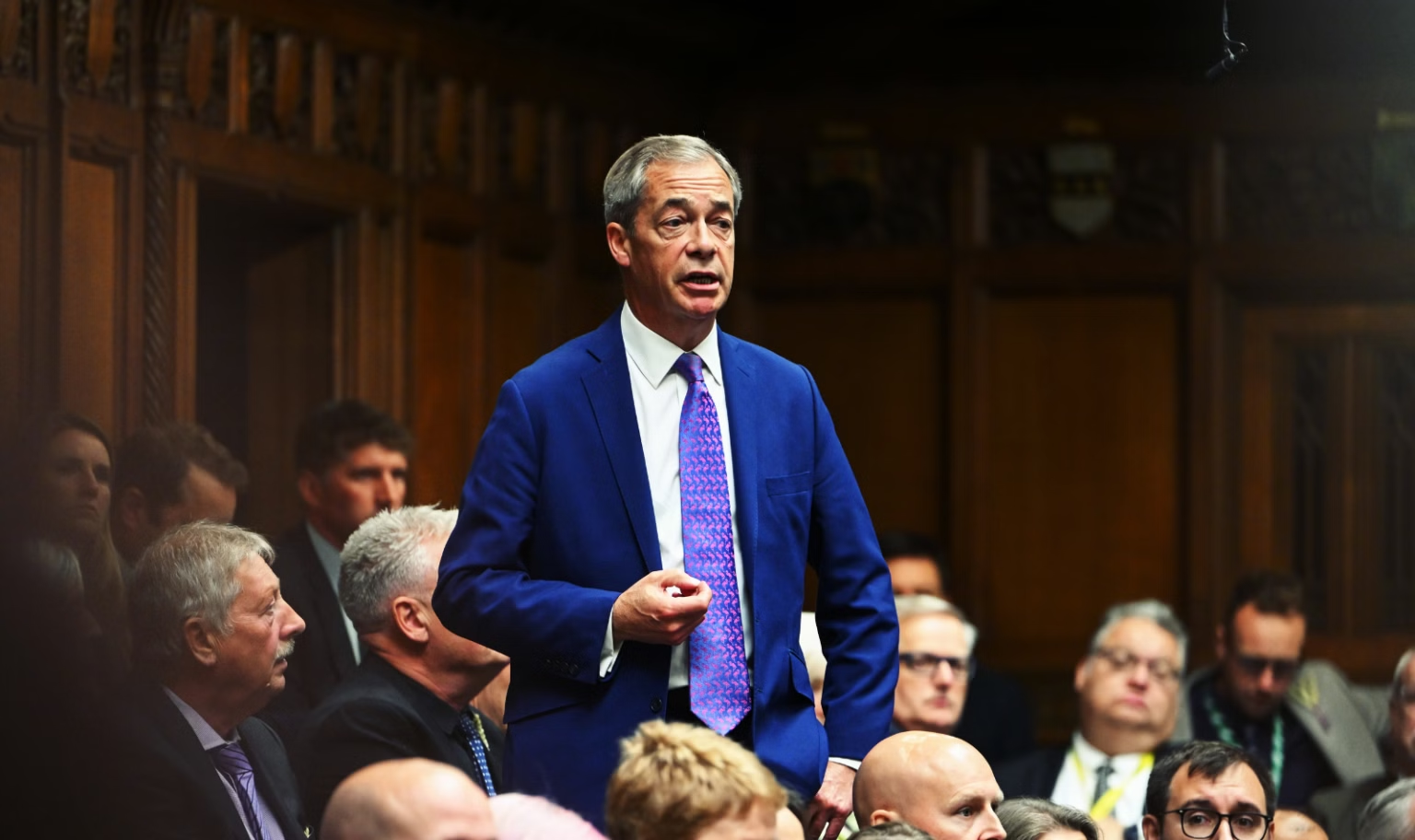
    Reform UK leader Nigel Farage. Credit: House of Commons (CC BY-3.0)

    Reform leader boosted the president’s attacks on UK Chagos Islands policy more often than raising the cost of living.

    Reform UK leader Nigel Farage used a quarter of his speeches in Parliament to boost U.S. President Donald Trump’s attacks on the UK’s Chagos Islands deal – three times more than he raised the cost of living.

    DeSmog’s analysis of parliamentary records finds that the former Clacton MP – who resigned last month in response to a series of financial scandals – raised the UK’s proposed deal with Mauritius in 10 of the 40 times he spoke in the House of Commons.

    Farage, who was first elected to Parliament in July 2024, mentioned Chagos more than any subject except immigration. This compares with only one speech about winter fuel payments, one on energy policy, and one about UK budget measures, all topics with a direct impact on the cost of living.

    “Seeing how often Farage has voiced views that line up perfectly with Trump’s interests, you might think he was the MP for Washington DC, not Clacton-on-Sea,” said Graeme McGregor, campaign manager at the Good Law Project.

    “He ought to spend more time focusing on issues that matter to people in Clacton, rather than his pastimes of grandstanding, jet-setting and schmoozing.”

    A version of this article was published by The Mirror.

    Most of Farage’s Chagos speeches also mentioned Trump, whose opposition to the deal saw it shelved in April. Negotiated by the previous Conservative government, it proposed giving Mauritius control of the islands, which are located in the Indian Ocean, with a 99-year lease for the UK to run the Diego Garcia military base, which is seen as a crucial asset by the U.S. government.

    In December 2024, Farage told the Commons he had “just returned, hotfoot, from a very full Mar-a-Lago”, Trump’s resort in Florida, and that “several members” of the incoming administration had expressed “deep disquiet” about plans to “surrender the sovereignty of the islands”.

    This was echoed in February 2025, when Farage claimed the agreement could destroy hopes of a UK-U.S. trade deal, claiming Britain’s chances of avoiding American tariffs would “evaporate”.

    “The special relationship will be dangerously fractured if the government carry on with this,” he added.

    The Reform leader also used the Commons to boast of his close relationship with Trump.  “I think I am in a fortunate position. It is not just that for 10 years I have stood up and defended President Trump – I was very much on my own in those days – but that I know half his Cabinet,” he said in February 2025.

    Farage has also campaigned against the Chagos deal in meetings with U.S. government officials, and tried to visit the Islands in February on a trip funded by Christopher Harborne, the donor at the centre of his resignation scandal.

    DeSmog has previously reported that Farage mentioned his constituency just twice in Parliament in the past 12 months, and only six times since his 2024 election. Over the same period, he has received £2.3 million in non-parliamentary income.

    He has also made a series of trips to the United States to speak at pro-Trump events, and has addressed Trump-aligned conferences in London, including the Alliance for Responsible Citizenship (ARC), and CPAC Great Britain.

    Reform, which has received more than £24 million from oil and gas interests, has vowed to emulate Trump’s policies – campaigning for the “mass deportations” of immigrants and dramatically increased fossil fuel extraction.

    https://infogram.com/farages-commons-speeches-1h0n25ojjqv7z4p


    Chagos Lobbying

    In an interview on his GB News show in January, Farage urged Mike Johnson, the Republican Speaker of the U.S. House of Representatives, to build opposition to the Chagos deal in the United States. Farage has also reportedly raised the issue directly with the White House on several occasions.

    In February, he attempted to visit the Chagos Islands via the nearby Maldives to support four Chagossians who are opposed to the deal. He has claimed he was blocked from entry by the UK government, which said it had no prior knowledge of Farage’s visit.

    The £25,000 trip was paid for by Harborne, the crypto billionaire whose £5 million undeclared “gift” to Farage before the 2024 election was being investigated by parliament’s standards commissioner when the Reform leader resigned last month.

    The investigation is expected to resume if he wins the by-election on 13 August, which all major parties have boycotted.

    Like Trump, Harborne — who has given Reform more than £25 million to date — also appears to oppose the Chagos deal. As well as bankrolling Farage’s visit to the region, Harborne has pledged to fund the small group of Chagossians trying to halt the UK government’s plan.

    Nick Dearden of the campaign group Global Justice Now, told DeSmog: “Farage made his name lecturing us about British sovereignty, but he clearly has no idea what this means, because whenever British interests are attacked by Donald Trump, Farage sides with the bully-boy in the White House.

    “Trump has repeatedly interfered in British politics, slamming our energy policy, forcing changes in our regulation of Big Tech companies and even fleecing the NHS,” Dearden added. “His poodle, Farage, has not stood up to him on one occasion. Instead, he has used his position to support a man who is so clearly trying to weaken us.”

    Nigel Farage and Reform UK have been contacted for comment.


    Farage’s Chagos Chatter in Parliament

    “…how confident is the foreign secretary that Donald Trump, if he becomes the 47th President of the USA, will approve of this deal, given the importance of our relationship with America?”
    7 October, 2024

    “I assure the House, having been in America last week and knowing the incoming U.S. defence secretary very well, that there is outright hostility towards this deal. […] Diego Garcia was described to me by a senior Trump adviser as the most important island on the planet for America, so the minister will find outright hostility.”
    13 November, 2024

    “I have just returned, hotfoot, from a very full Mar-a-Lago. I spoke to several members—senior administrators, especially—of the incoming administration, which will be in the White House in 32 days’ time. Let me assure you that there is very deep disquiet among them all as to what this deal may mean for the long-term future of Diego Garcia and whether such a deal will hold […] They also cannot understand why we would surrender the sovereignty of the islands on an advisory judgment from a pretty obscure court.”
    18 December, 2024

    “Diego Garcia is probably the single most important thing that we give America right now. Without it, America does not have access to the middle east, India and much else.

    […] I genuinely fear that if this continues and the American administration wakes up to it – I could quote three members of the Cabinet I have spoken to personally about it – our chances of not just avoiding tariffs but moving on to a sectoral free trade deal will all but evaporate. The special relationship will be dangerously fractured if the Government carry on with this…”
    4th February, 2025

    “The Americans, by the way, have been pretty busy with foreign policy just lately, so it is perhaps no wonder that Diego Garcia has not been high on their agenda, but when they wake up to the fact that this has been done – wholly unnecessarily – I would not be surprised if we find ourselves, together with the European Union, in their tariff regime.”
    5 February, 2025

    “[Urgent question:] To ask His Majesty’s Government to give us an update on the situation with regard to the Diego Garcia American military base and the British Indian Ocean Territory, especially in light of the recent comments of the American President.”
    25 February, 2026

    Article by Adam Barnett republished from DeSmog

    Nigel Farage is scathing at the £250,000 cost to the taxpayer of his unnecessary and ridiculous Clacton-on-Sea election campaign that he caused to avoid scrutiny and acccountability for the £5MILLION 'gift' that he didn't declare.
    Nigel Farage is scathing at the £250,000 cost to the taxpayer of his unnecessary and ridiculous Clacton-on-Sea election campaign that he caused to avoid scrutiny and acccountability for the £5MILLION ‘gift’ that he didn’t declare.
    Orcas discuss how Trump was re-elected and him being an obviously insane, xenophobic Fascist.
    Orcas discuss how Trump was re-elected and him being an obviously insane, xenophobic Fascist.
    Nigel Farage explains the politics of Reform UK: Racism, Fake anti-establishmentism, Deregulation, Corporatism, Climate Change Denial, Mysogyny and Transphobia.
    Nigel Farage explains the politics of Reform UK: Racism, Fake anti-establishmentism, Deregulation, Corporatism, Climate Change Denial, Mysogyny and Transphobia.

  • Communist Party delivers much needed medical aid to Cuba’s Ministry of Public Health in Havana

    Spread the love

    https://morningstaronline.co.uk/article/communist-party-delivers-much-needed-medical-aid-cubas-ministry-public-health-havana

     Comrades Gordon and Douglas with Cuban health officials

    Communist Party leaders Alex Gordon and Lorraine Douglas deliver vital medicines in trip to besieged socialist island

    ON THURSDAY a delegation from the Communist Party of Britain was received at Cuba’s Ministry of Public Health (Ministerio de Salud Publica) in Havana by Dr Henry Lopez Jimenez, Deputy Director of Public Health, a vetaran of Cuba’s Medical Brigades in Mozambique where he worked at the Central Hospital in Nampula.

    The CPB delegation was led by general secretary Alex Gordon and party chair Lorraine Douglas and included Ben Woodward who is in Havana as part of a brigade organised by the Instituto Cubano de Amistad con los Pueblos (ICAP), the Cuban Institute of Friendship with the Peoples.

    Dr Henry Lopez Jimenez outlined the extreme privations that have been created in Cuba’s world renowned health system as a result of the US blockade and sanctions regimes.

    Cuba’s infant mortality rate has increased as a direct consequence of the cruel and deliberate attack by the Trump administration on the Cuban people’s healthcare system. Cuban surgeons and nurses have been forced to complete medical operations using light from their own mobile phones during power cuts.

    The CPB delegation presented the Cuban health service with over £2,000 of medicines including analgesic painkillers, anti-inflamatory tablets and other medical aid, an advance donation from the Aid for Cuba appeal recently launched by the CPB, which raised £32,000.

    …

    Article continues at https://morningstaronline.co.uk/article/communist-party-delivers-much-needed-medical-aid-cubas-ministry-public-health-havana

  • More than 1 million children lost access to food benefits after Trump bill passed

    Spread the love

    https://www.theguardian.com/us-news/2026/jul/25/food-stamps-children-trump

    A person receives food aid bags at the Young Family YMCA in Atlanta, Georgia, 6 November 2025. Photograph: Erik S Lesser/EPA

    Analysis finds more than 4 million Americans lost Snap benefits, or food stamps, from July 2025 to March 2026

    More than a million children across the US have lost access to Supplemental Nutrition Assistance Program (Snap) food benefits since Congress approved the One Big Beautiful Bill Act in July 2025, according to a new report from the Center on Budget and Policy Priorities (CBPP).

    The analysis found that more than 4 millions Americans were removed from Snap from July 2025 to March 2026, marking a significant decline in participation in the federal food assistance program.

    …

    According to the CBPP analysis, children make up a significant portion of those losing benefits, with more than 1 million children across the 19 states studied no longer receiving Snap assistance.

    In Louisiana, nearly one in four children receiving Snap benefits lost assistance. Massachusetts and Texas each saw close to one-fifth of children enrolled in the program removed from Snap.

    The report comes as participation in the program continues to fall nationwide following major reductions to the federal food assistance program under the Trump administration.

    Snap, commonly referred to as food stamps, provides monthly benefits to low-income and no-income households to help pay for groceries and remains the country’s largest food assistance program.

    …

    https://www.theguardian.com/us-news/2026/jul/25/food-stamps-children-trump

    Donald Trump sings and dances, says that it's fun to kill everyone ... unless he gets distracted or falls asleep.
    Donald Trump sings and dances, says that it’s fun to kill everyone … unless he gets distracted or falls asleep.
    Orcas discuss how Trump was re-elected and him being an obviously insane, xenophobic Fascist.
    Orcas discuss how Trump was re-elected and him being an obviously insane, xenophobic Fascist.

  • ‘Mostly Made Up’? GAO Exposes Billions in Bullshit Elon Musk Claims About DOGE

    Spread the love

    Article by Brad Reed republished from Common Dreams under Creative Commons (CC BY-NC-ND 3.0).

    SpaceX CEO Elon Musk prepares to give $1,000,000 to a Wisconsin voter during a town hall meeting on March 30, 2025 in Green Bay, Wisconsin. (Photo by Scott Olson/Getty Images)

    DOGE was a “slapdash and deceptive effort” that only succeeded in “putting Americans’ sensitive data at risk and hollowing out critical agencies,” said US Sen. Gary Peters.

    A report from the Government Accountability Office released Thursday details how Elon Musk’s Department of Government Efficiency wildly exaggerated the savings it was able to deliver for the US federal government.

    The report, requested by Sens. Gary Peters (D-Mich.) and Richard Blumenthal (D-Conn.), finds that DOGE used a number of tricks to inflate the value of its purported savings, including taking credit for ending leases that were already in the process of being terminated and falsely claiming to have canceled contracts that were left intact.

    RECOMMENDED…

    Vice President Vance Discusses Administration's Fight Against Fraud In Milwaukee

    Trump Admin Argues Even Terminally Ill Patients Shouldn’t Be Exempt From Medicaid Work Requirements

    Russell Vought Director of OMB

    Impeachment Articles Filed Against ‘Unelected Shadow President’ Russell Vought

    The report also finds that DOGE “did not provide sufficient information to verify the method used to calculate 96%” of savings purportedly achieved through grant cancellations.

    And in cases where DOGE actually was responsible for terminating a contract or cancelling a lease, the report notes that it “did not consistently use its stated methodology for calculating savings or disclose limitations in a sufficient manner.”

    Even in instances where the department followed its stated methodology, the report adds, “it did not account for many complexities and nuances of federal contracting,” such as obligations or settlement costs that may have come from ending a contract.

    In touting the GAO report, Peters said it exposed DOGE as a “slapdash and deceptive effort” at streamlining government spending that only succeeded in “putting Americans’ sensitive data at risk and hollowing out critical agencies.”

    Blumenthal accused the Trump administration of using DOGE as cover to “recklessly slash government programs, ransacking critical services and resources and proudly displaying supposed ‘savings.’”

    Jessica Tillipman, associate dean for government procurement law at the George Washington University Law School, highlighted a number of DOGE flubs in a social media post breaking down the GAO report, including a “favorite example” of DOGE claiming $28 million in savings related to an Air Force contract that in reality only saved around $600,000.

    Eric Boehm, writer for libertarian magazine Reason, said that the GAO report revealed that the savings Musk and his minions claimed from their work was “mostly just made up.”

    In his assessment, Blumenthal said the report only “underscores the need for increased transparency and accountability from the Trump administration so the American public can better understand DOGE’s activities as the organization guts vital government programs.”

    Article by Brad Reed republished from Common Dreams under Creative Commons (CC BY-NC-ND 3.0).

    Orcas discuss Donald Trump and the killer apes' concept of democracy. Front Orca warns that Trump is crashing his country's economy and that everything he does he does for the fantastically wealthy.
    Orcas discuss Donald Trump and the killer apes’ concept of democracy. Front Orca warns that Trump is crashing his country’s economy and that everything he does he does for the fantastically wealthy.
    Elon Musk urges you to be a Fascist like him, says that you can ignore facts and reality then.
    Elon Musk urges you to be a Fascist like him, says that you can ignore facts and reality then.
  • The big Blair-era loophole behind Palantir’s tiny tax bill

    Spread the love

    Article by Jade-Ruyu Yan republished from OpenDemocracy under a Creative Commons Attribution-NonCommercial 4.0 International licence. 

    Illustration: James Battershill

    Palantir’s UK CEO Louis Mosley says the company uses “a standard tax incentive” to minimise corporate tax. But the UK is one of the few countries that allows for this.

    In May 2003, a standing committee of the House of Commons assembled to discuss and debate a mammoth Finance Bill. 

    “I am a tough chairman,” Nicholas Winterton, then a Conservative MP, declared at the first sitting, “and this will be an ordered, constructive and positive committee.” Mobile phones would be switched off, while members were permitted to remove their jackets at their discretion, provided they “are hung tidily on the rear of chairs.”

    Stuffed into MPs’ red boxes that day was a provision that, over the next two decades, would allow Big Tech to reap billions of pounds in corporate tax deductions in the UK. Tony Blair’s government wanted to allow a company issuing stock to its employees as part of a compensation package to claim a tax relief equivalent to the difference between the market value of the stock and the original price an employee paid for it. 

    The committee approved the provision, and it was passed by Parliament. This week, Louis Mosley, the CEO of Palantir’s UK and European operations, referenced this debate to defend the controversial US tech firm’s minimal corporate tax payments in the UK as “a standard tax incentive under UK law”. 

    Mosley’s comments came after a report by the Centre for International Corporate Tax Accountability and Research confirmed openDemocracy’s findings that Palantir has used its share-based compensation scheme for UK employees to minimise its corporate tax obligations by millions of pounds. As we uncovered, the company paid less than £1m in corporation cash taxes in the UK last year – less than it paid in Korea, Japan, France and Germany, despite the UK being its second-largest market after the US.

    The public conversation over Palantir’s tax minimisation cuts to the heart of the ongoing debate about capitalism in the UK: after a decade and a half of austerity, who should pay tax – and how much – to mend our unravelling social services and societal fabric? These questions are particularly acute in the case of Palantir, since much of the company’s profits in the UK are derived from government contracts paid for by ordinary taxpayers. 

    Palantir’s Mosley and former corporate tax lawyer Dan Neidle have argued that, while on paper, it could look like the corporation is avoiding tax, HMRC recoups the money via the income taxes paid by Palantir’s highly remunerated employees.

    “We run a generous share scheme for our UK employees. Those shares have risen sharply in value (because of our profitability). So then has the tax bill on those shares – paid at income tax rates, which are HIGHER than corporation tax rates. UK law then offsets some of that against corporation tax, exactly as Parliament intended,” wrote Mosley on LinkedIn, claiming that the company paid $148 million in UK taxes.

    “The net result of this sneaky wheeze? More tax paid by Palantir to the Treasury, not less.”

    Mosley’s claims cannot be independently verified as the company’s 2025 accounts have not been published on Companies House.

    “I don’t see this as tax avoidance, legally or morally,” Neidle, the founder of tax advisory nonprofit Tax Policy Associates, previously told openDemocracy. “[Palantir’s] employees in the UK will have been subject to income tax and employee/employer national insurance. So overall it likely resulted in additional tax being paid.”

    🔎

    We are continuing to investigate Palantir. If you have any information you feel might be relevant, please send it to info@opendemocracy.net. We protect our sources.

    A look at the 2003 tax amendments by the then Labour government, and interviews with tax experts based in other countries, reveal that the UK and the US are outliers in their generous approach to taxing corporations, despite the UK’s headline 25% corporation tax. 

    The decision to tax employees, while granting corporations deductions, is a clear political and regulatory choice, these experts said, based on the nature of economic activity a given tax regime incentivises — in this case finance capital and Big Tech. Or more bluntly, just because a particular tax provision exists, experts said, it doesn’t mean it is justified.

    “Even though this kind of huge deduction may be technically justifiable in a system of taxation, “it’s more the question of, ‘Is this fair?’” said Christoph Spengel, professor for international taxation at the University of Mannheim in Germany – a country that doesn’t allow this type of wide deduction.

    “What are the observable consequences if wealth is concentrated in the hands of only a few individuals? Because that’s what this means,” he said. 

    Spengel said he couldn’t see the justification for such a provision, “because actually there is no cost” to the corporation: no wealth has left the company and it has not given up any of its assets. An employee’s income tax and other personal tax obligations should have no bearing on whether a company gets a deduction, he added.

    “Corporations are really important players in the economy, and you want to have a tool to incentivise them to do things you like and stop them from doing things you don’t like,” said Reuven Avi-Yonah, Irwin I. Cohn professor of tax law at the University of Michigan whose work focuses on corporate and international taxation. “And the corporation tax is a very versatile instrument with which to do this.”

    “A lot of people are worried about two things: the concentration of wealth in very few hands and AI,” said Kimberly Clausing, Eric M. Zolt Chair in Tax Law and Policy at the UCLA School of Law. Clausing said that while economists and policymakers are considering a wide array of novel solutions to this problem, “the same objectives could be reached much more easily if we had the will to use our corporation tax properly.”

    Neidle, from Tax Policy Associates, disagreed.

    “Whilst it’s true that the UK and US are outliers in a formalistic sense, in reality people achieve the same thing in most of the world. That is both reasonable and hard to stop, given that a share scheme is economically equivalent to a bonus plus a share purchase,” he said.

    In Neidle’s opinion, a company giving its employees a cash bonus to buy shares was “economically identical” to just giving the employees the shares.

    “It’s generally a bad idea to create different tax results from identical economic cases, and if you do (as Germany has) then it’s trivial to get round it,” he said. “The result is the same – it’s just more complicated.”

    Blair-era break

    At the turn of the millennium, companies in the US – particularly in the then-nascent tech sector – were increasingly compensating employees with stock instead of higher salaries. For the firms, the benefits were threefold: they retained cash that could be invested in the business, held onto employees until their shares vested, and saved on tax.

    The UK government responded by taking a leaf out of the US’s playbook to amend its own corporation tax rules. When the change was passed in the early 2000s, the Treasury estimated that by 2007-08, it would lose around £95m in forgone taxes in that year, according to a reply to a Parliamentary question in 2003.

    Two decades later, as openDemocracy reported, Palantir alone was able to legally use this deduction to create a tax deduction worth around £230m in 2022 – a figure the company has not contested.

    “This is the main reason why US mega-corporations don’t pay any tax, because they all issue huge amounts of share-based compensation and deduct it,” Avi-Yonah told openDemocracy. “This has been true forever, it’s not a recent trend. What’s a recent trend is their incredible profitability because of AI.” 

    Blair-era MPs may have been unable to foresee the staggering shares-based wealth that Big Tech’s IPOs would create over the next two decades, but it is worth noting that not all countries treat corporate taxes the way the US and the UK do. 

    “The corporation tax deduction available in the UK is among the more generous. Stock-based compensation is supposed to reduce payroll pressure on cash flow, especially for start-ups,” Mike Lewis, the director of Tax Watch, told openDemocracy previously. “The fact that it is also available to established, profit-making companies means that it can effectively wipe out very profitable companies’ tax bills for years if share values significantly increase.”

    Neidle said he was concerned that the current debate around deductions for share-based compensation was being shaped by opinions about Palantir, rather than concerns about tax policy.

    “People here are starting with the conclusion they want: corporations are bad, Palantir is particularly bad. Then forcing a share scheme argument into it. It is not principled, and it’s not good policy,” he said.

    Tax and Regulation

    While tax laws are usually presented as a pragmatic set of rules and numbers, they are subjective and the result of policy debates, corporate lobbying and political compulsion.

    For instance, corporate income tax in the early 1900s in the US is the outcome of two struggles, writes Marjorie E. Kornhauser, professor of law emerita at Tulane University: “The attempt to enact an income tax and the struggle to regulate corporations.”

    As the nature of corporations has changed over the centuries, so have the arguments around how and why they should be taxed.

    Corporations today are structured very differently compared to previous eras. Research conducted in the US suggests companies are increasingly substituting wages with share-based payments.

    Further, tech firms (including Palantir) increasingly rely on dual-class stock, which allows vast amounts of stock to be issued to employees without their founders worrying about losing control of their companies. Founders are therefore rewarded with unprecedented control of their businesses and greater voting rights than ordinary shareholders. When Google debuted a dual-class structure in its IPO in 2004, only about 1% of US listed companies used such a structure. By 2018, that figure had risen to 30%.

    Another structural shift is the growing trend of tech companies earning a growing share of their revenue from public contracts, as governments around the world look to digitise and modernise. Palantir, for instance, earns a majority of its revenue in the US and UK from government contracts paid from public funds.

    “Ultimately it’s the taxpayers who fund the money that goes to Palantir,” said Avi-Yonah. The current arrangement is a “one-sided thing where they just grab the money and don’t pay any tax, and don’t give anything back,” except its services, he said.

    openDemocracy has reached out to Palantir for comment and will update the piece when they respond.

    This article was updated on 8 August 2026 to include comments from Dan Neidle.

    Article by Jade-Ruyu Yan republished from OpenDemocracy under a Creative Commons Attribution-NonCommercial 4.0 International licence. 

    Orcas discuss Donald Trump and the killer apes' concept of democracy. Front Orca warns that Trump is crashing his country's economy and that everything he does he does for the fantastically wealthy.
    Orcas discuss Donald Trump and the killer apes’ concept of democracy. Front Orca warns that Trump is crashing his country’s economy and that everything he does he does for the fantastically wealthy.
    Elon Musk urges you to be a Fascist like him, says that you can ignore facts and reality then.
    Elon Musk urges you to be a Fascist like him, says that you can ignore facts and reality then.

    Palantir