People dispense fuel at the pump at Costco Petrol Station in West Thurrock, Essex. The conflict in Iran has caused a surge in oil and gas prices, March 5, 2026
Campaigners warn soaring oil and gas prices are pushing households into another cost-of-living crisis
TEN straight days of high oil and gas prices are pushing households into another cost-of-living crisis, campaigners warned today, as costs suffered from the US-Israel attack on Iran.
The warning came as Chancellor Rachel Reeves said she had asked the competition watchdog to “crack down” on “rip-off” fuel prices ahead of a meeting with energy bosses to warn against war profiteering.
Ms Reeves insisted she “will not tolerate” firms exploiting uncertainty in the Middle East for excess financial gain.
The government has promised to intervene if companies engage in “unfair” practices that would hit customers facing a rise in the price of home heating oil, which is not covered by Ofgem’s energy price cap.
Rural communities which rely on oil to heat their homes are already being hit hard, according to charity Rural Action Derbyshire (RAD), which runs an oil-buying scheme.
The heating oil market is closely connected to the daily market for jet fuel, meaning price rises are typically passed directly to customers.
RAD said homes in Derbyshire saw the cost of 500 litres jump from around £300 to £700-800 in the week after the conflict.
For an average household, 500 litres lasts two to three months.
Campaigners from the Palestine Solidarity Campaign take part in a protest outside Downing Street, London, to oppose the visit of Israeli President Isaac Herzog, September 9, 2025
A REPORT examining Britain’s complicity in Israel’s genocide in Gaza is to be published on Monday following evidence from witnesses, journalists, survivors and experts.
MP Jeremy Corbyn, alongside co-authors Dr Shahd Hammouri and Prof Neve Gordon, will present the full findings of the Gaza Tribunal.
Ahead of its publication, Mr Corbyn said the report will “help cement the government’s legacy as a participant in one of the greatest crimes of our time.”
He added that he hopes “the Gaza Tribunal serves as a landmark contribution to the campaign for justice, and as a historical repository of evidence for generations to come.”
Whistleblower and former civil servant Mark Smith told the tribunal that it was “impossible to see how the UK government was acting legally.”
Genocide denier and Current UK Prime Minister Keir Starmer is quoted that he supports Zionism without qualification. He also confirms that UK air force support has been essential in Israel’s mass-murdering genocide. Includes URLs https://www.declassifieduk.org/keir-starmers-100-spy-flights-over-gaza-in-support-of-israel/ and https://youtu.be/O74hZCKKdpAKeir Starmer objects to criticism of the IDF. He asks how could anyone object to them starving people to death, forced marches like the Nazis did, bombing Gaza’s hospitals and universities, mass-murdering journalists, healthworkers and starving people queuing for food, killing and raping prisoners and murdering children. He calls for people to stop obstructing his genocide for Israel.UK Foreign Minister David Lammy confirms that UK government and military are active participants in Israel’s genocides and that the F-35 parts that they suspended from supplying to Israel are instead simply diverted via the United States. He says see https://youtu.be/QILgUHrdWRE
This work by Middle East Monitor is licensed under a Creative Commons Attribution-NonCommercial-ShareAlike 4.0 International License.
U.S. Navy warplane takes off from the aircraft carrier USS Abraham Lincoln during Operation Epic Fury targeting Iran in the Gulf of Oman, on March 01, 2026. [U.S. Navy / Handout – Anadolu Agency]
After the 12-day war in May last year, it was clear that both sides would be face-to-face soon. They restarted on 28th February 2026. Israel-US adopted the same pattern of targeting the top brass, including the Grand Leader, Ayatollah Ali Khamenei, on the very first day, thinking that in the absence of these officials, the Iranian administration would be like a rudderless ship. This would create confusion and provide an easy opportunity for regime change.
Thirteen days have passed, yet there are no visible signs of either the fall of the regime or a pause or ceasefire. Despite US-Israel’s anguish, Iran selected Mojtaba Khamenei as the new supreme leader – an act of defiance.
Both sides continue to bombard each other’s vital infrastructure, including civilian and military targets. Energy installations such as oil depots and refineries have become primary targets. Under a tit-for-tat policy, Iran has also declared that financial centers, banks, and offices of major technology companies such as Google, YouTube, and Microsoft could be the next targets. Already 26 US bases have been targeted. Following the assassination of Ayatollah Ali Khamenei, the conflict rapidly expanded from a limited confrontation into a regional war, and with the blockade of the Strait of Hormuz, its effects are now visible in the global economy and in the daily lives of ordinary people. Approximately 130 oil ships are anchored, stopping 20% oil which passes through the narrow strait of 33 km. Already four ships were targeted which tried to bypass the warning.
Among the GCC countries, the UAE faced the highest number of attacks.
Iran’s aggressive response and selection of Mojtaba, a hardliner, as Ayatollah, appear to indicate that Iran is prepared for a prolonged conflict, whereas the United States and Israel seem eager to conclude the war quickly. Meanwhile, President Trump’s plan to send Kurdish Peshmerga into Iran via Iraq seems like another disaster.
Tehran had been closely and patiently observing military buildups in the Indian Ocean, the Gulf of Oman, and the Mediterranean Sea for several weeks. The United States mobilized a substantial part of its defence capabilities, including naval armadas and two aircraft carriers, Abraham Lincoln and Gerald Ford. Hundreds of fifth-generation stealth fighter jets were deployed along with advanced air-defence systems such as THAAD and large stockpiles of interceptors.
In addition, the United States strengthened its military presence across several bases in the Gulf region, including Qatar, Bahrain, Oman, the United Arab Emirates, Kuwait, Saudi Arabia, Jordan, and Iraq.
Israel also appeared determined to launch what it described as a “fight-to-the-finish” war with the Islamic Republic. Prime Minister Benjamin Netanyahu repeatedly stated that he had been waiting for such a war for nearly forty years. Iran, on the other hand, has long maintained that it began preparing for such a scenario after the 2003 US-led invasion of Iraq and the fall of Saddam Hussein.
The earlier conflict in May had already revealed the strengths and weaknesses of both sides. However, the current course of the war suggests that the US–Israel alliance underestimated Iran’s military capabilities, particularly its missile and drone systems, careful planning, and effective use of its military resources.
Compared with the US–Israel alliance, Tehran appears to possess a clearer understanding of its adversaries’ strengths, limitations, and operational constraints.
Iran was also aware of its own limitations. Its air force cannot match the capabilities of US and Israeli fighter jets, and its airspace remains vulnerable to aerial attacks. As the conflict expanded, these vulnerabilities became evident. At the same time, the United States and Israel appeared to have an incomplete assessment of Iran’s capabilities. Although they possessed precise intelligence about the locations of Iranian leaders and senior officials—they killed several commanders and Ayatollah Ali Khamenei-they appeared to lack detailed knowledge of Iran’s missile infrastructure, drone networks, and underground silos developed over several decades.
It also appears that the US–Israel side underestimated the possibility of indirect assistance from Russia and China, relying heavily instead on air superiority and defensive shield systems.
Iran’s war strategy
A detailed military assessment would require expert analysis, but developments in the conflict suggest that Iran followed a three-stage strategy.
First, Iran responded to the US-Israel attacks by deploying large numbers of drones, many reportedly stored since 2011 and 2013. These drones forced US–Israel defence systems to respond with expensive interceptors. In financial terms, this created an asymmetric dynamic: Iranian drones costing between $20,000 and $50,000 were intercepted by missiles costing between $1 million and $2 million. As the wave of drone attacks continued, interceptor stocks began to decline, gradually exposing the airspace of US bases and Israel to greater risk.
Second, once defensive systems were strained, Iran launched more advanced missiles targeting radar installations, communication centres, satellites, and data facilities. Reports indicate damage to communication and data infrastructure at the Al Udeid Air Base in Qatar and at military installations in Bahrain. Such attacks disrupted surveillance and communication systems that coordinate missile defence networks such as THAAD, David’s Sling, Arrow, and Iron Dome. Command and monitoring centres that once gathered and transmitted military data across thousands of kilometres became severely limited in their operations.
Third,
Iran escalated its attacks using hypersonic missiles while adopting a tit-for-tat strategy. These strikes targeted refineries, military bases, and strategic infrastructure in Israel. Some reports suggest the use of the Khorramshahr-1 missile equipped with submunitions capable of dispersing dozens of warheads over a wide area, complicating interception efforts.
Meanwhile, attacks on naval assets reportedly forced aircraft carriers operating in the Gulf of Oman to reposition farther from the Iranian coastline.
After weakening regional defence systems, Iran announced a blockade of the Strait of Hormuz. This strait is one of the world’s most critical energy corridors, through which roughly 20 percent of global crude oil and a similar share of liquefied natural gas passes.
At present, around 130 oil tankers are reportedly anchored in the strait. Iran claims effective control over the Hormuz chokepoint.
It has targeted four vessels, including one linked to India, that attempted to pass through. Iran has reportedly deployed underwater tunnels and small, agile boats to intercept or attack ships that violate the blockade.
At the same time, attacks on energy facilities in Saudi Arabia and the temporary closure of Qatar’s Ras Laffan gas facilities disrupted global energy supplies. As a result, gas prices in Europe rose sharply while crude oil prices increased from about $62 per barrel to more than $100. Some analysts warn that if the conflict continues, oil prices could rise further, potentially reaching $200 per barrel. Such developments could trigger inflation, supply-chain disruptions, and rising unemployment worldwide.
Future of the War
Iran appears determined to pursue its objectives and may not halt operations even if a ceasefire is proposed by the United States or Israel. The selection of Mojtaba Khamenei as the new supreme authority signals continuity of leadership, consolidation of political control, and a claim of legitimacy within the existing system.
Large public gatherings during funeral processions and demonstrations suggest that, at least during wartime, sections of the population have rallied around the leadership.
Reports have also mentioned proposals to deploy Kurdish Peshmerga forces into Iran through Iraq. However, the region’s history suggests that such operations would face significant geographical and logistical difficulties. During the Iran–Iraq War, Saddam Hussein also attempted to advance through the mountainous terrain of the Zagros region but faced serious constraints.
Some Iranian sources have claimed the capture of US special forces personnel and the killing of several Israeli officials during the conflict, although many of these claims remain difficult to verify independently.
Chances of a Ceasefire
Iranian authorities have reportedly outlined three conditions for a ceasefire. First, all military attacks by the United States and Israel must stop immediately. Second, Tehran seeks assurances that such attacks will not be repeated in the future. Third, Iran demands recognition of its sovereignty and compensation for damages caused during the conflict. These conditions are not easy. Who will ensure that the U.S. and Israel would not attack in the future? Second, who will pay the reconstruction cost, etc.? It is true that regional problems can be resolved only when the issue of Palestine is resolved in a fair and just manner. Lebanon and Yemen, Syria also need attention.
Future Trajectory-Palestine solution is the only solution
Even if the present war stops, regional stability will remain uncertain. Long-standing political and security disputes remain unresolved. Israel is unlikely to abandon its strategic objectives, Greater Israel, while tensions involving Hezbollah and Hamas are likely to persist. The United States may also increase pressure on Gulf states to revise their security arrangements so that regional partners become more directly involved in future conflicts.
Implications for India
For India, energy security remains a major concern. Disruptions in the Strait of Hormuz could affect oil supplies and trade routes. Approximately 50% oil passes through the route, while Houthis are there to choke off the Red Sea navigation.
India must also prepare contingency plans for the evacuation of its 9 million workers from the region and strengthen logistical arrangements to safeguard trade and shipping routes in the event of prolonged instability. Chemical fertilizers are another major concern for India. The region provides the bulk of fertilizers and ensures food security. Disruption in supply line has significantly affected the supply of fresh vegetables, perishable items including agriproducts , poultry and meat products
In the long term, India is to sign a long term energy agreement with the US. At the same time, India needs a more coherent West Asia policy and must avoid being drawn into the region’s strategic conflicts. The region is sensitive as well as vital to India’s economy and geostrategy. India needs a careful policy.
The views expressed in this article belong to the author and do not necessarily reflect the editorial policy of Middle East Monitor.
This work by Middle East Monitor is licensed under a Creative Commons Attribution-NonCommercial-ShareAlike 4.0 International License.
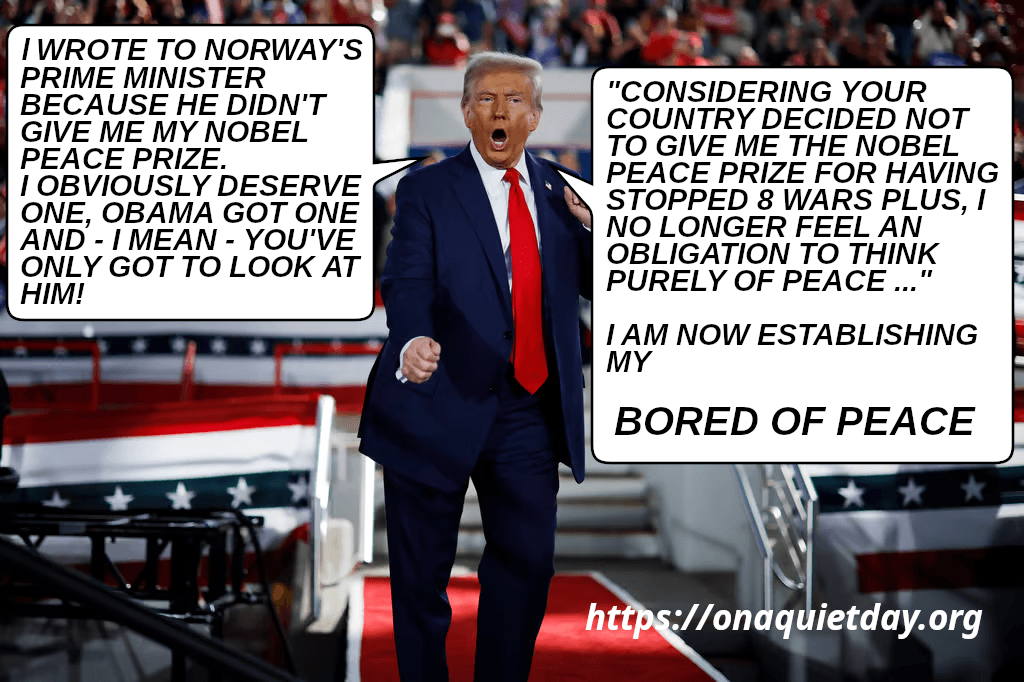
Climate science denier Donald Trump says that more liquid gold is being secured according to his policy of global privateeringDonald Trump explains why he established his Bored of PeaceDonald Trump warns against following the https://onaquietday.org blog, says that it’s easy atm, she only needs to report war crimes supporting Israel’s genocidal expansion.
This work by Middle East Monitor is licensed under a Creative Commons Attribution-NonCommercial-ShareAlike 4.0 International License.
A view of the United States Embassy compound in Baghdad, Iraq, where a missile attack was reported to have caused damage on March 14, 2026. [Murtadha Al-Sudani – Anadolu Agency]
The US Embassy in Iraq’s capital Baghdad came under a rocket attack early Saturday, local media reported, citing a security source, Anadolu reports.
The source told Shafaq News Agency that the attack resulted in the destruction of the embassy’s C-RAM air defense system “completely,” which is used to intercept incoming rockets and projectiles.
The news agency quoted another unnamed security source as saying that “a satellite communications system was destroyed as a result of the attack that targeted the US Embassy compound in Baghdad.”
The source explained that the damaged system was designated “to secure and exchange data via satellites for diplomatic staff and employees inside the compound.”
The source added that the US C-RAM air defense system was unable to intercept an “unidentified drone” that carried out the attack, despite its proximity to the targeted location, which led to the satellite communications system being directly hit.
No immediate reports were issued regarding casualties, and US officials have not yet commented on the incident.
Since Israel and the US launched joint attacks on Iran on Feb. 28, killing some 1,200 people, including then-Supreme Leader Ayatollah Ali Khamenei, hostilities have escalated.
Iran has retaliated with drone and missile strikes targeting Israel, Jordan, Iraq, and Gulf countries hosting US military assets.
This work by Middle East Monitor is licensed under a Creative Commons Attribution-NonCommercial-ShareAlike 4.0 International License.
Climate science denier Donald Trump says that more liquid gold is being secured according to his policy of global privateeringDonald Trump explains why he established his Bored of PeaceDonald Trump warns against following the https://onaquietday.org blog, says that it’s easy atm, she only needs to report war crimes supporting Israel’s genocidal expansion.
Nigel Farage wants you to think he’s leading a grassroots rebellion. A party of ordinary people finally rising up against the establishment. But when you follow the money, the truth is a lot less romantic: in many ways, Farage is the establishment.
Not three million supporters – just three millionaires
Since 2019, around 75% of all donations to Reform UK have reportedly come from just three men: Christopher Harborne, Jeremy Hosking, and Richard Tice.
Not three million ordinary contributors. Three millionaires.
It’s not unusual for wealthy people to back a party because they like its politics. But when a party is reliant on a flood of cash from a tiny number of donors, the obvious question arises: whose interests does that party end up serving?
When you look at what these men are known for, and you look at what Reform UK’s leadership has been saying and promising, the overlaps are hard to miss.
Nigel Farage reminds you that he’s the man that brought you Brexit and asks what could possibly go wrong.Nigel Farage explains the politics of Reform UK: Racism, Fake anti-establishmentism, Deregulation, Corporatism, Climate Change Denial, Mysogyny and Transphobia.Keir Starmer refuses to be outcnuted by Nigel Farage’s chasing the racist bigot vote.

 People dispense fuel at the pump at Costco Petrol Station in West Thurrock, Essex. The conflict in Iran has caused a surge in oil and gas prices, March 5, 2026